Need a word or phrase translated?

Hmm what do you guys think about

"女の世界も悪くねぇな。。。!"

The girl's of the this world aren't that bad!

Seems like a weird phrase. They say is alot in the manga I am currently reading. The usage of も here is interesting
 
我々にはあまり、興味も湧かないお話ですな

I'd like to confirm which of the following translations best corresponds with this sentence. My guess is 1

1. We aren't exactly interested or touched by your story.
2. We aren't exactly interested and your story was not moving

Thanks!
 
I don't think being moving has anything to do with it. Take that part out and either of the translations would work. Why do you think it has a sense of being moving?
 
My guess is that the OP divided 興味も湧かない into two parts.

@ the OP, も gives a nunce of "even" in that sentence.
 
I don't think being moving has anything to do with it. Take that part out and either of the translations would work. Why do you think it has a sense of being moving?

Isn't that what 湧かない describes in this context? That's what I thought. If i have the wrong idea, could you explain to me what it means?
 
My guess is that the OP divided 興味も湧かない into two parts.

@ the OP, も gives a nunce of "even" in that sentence.

Interesting...I though the reason for the creation of a new clause was so that あまり could be attributed to both 興味 and 湧かないお話, so I had believed 'も' to mean "also" in this instance. And sorry, could you spell out what OP stands for? Nothing is coming to mind. Maybe I could look that up to better understand how the nuance of "even" comes about. Is this nuance similar to the one "まで" would offer in this sentence?

どうもありがとう!
 
OP is the acronym of Original Poster, i.e., it refers to you.:)

も is more likely さえ.

興味が湧く is an idiom, meaning "to get into~ / to be interested in~" as a set.
 
OP is the acronym of Original Poster, i.e., it refers to you.:)

も is more likely さえ.

興味が湧く is an idiom, meaning "to get into~ / to be interested in~" as a set.

Oh 😌 I just thought about it a bit more, and yea, I have been noticing this trend in the acronyms. I get it now. I still can't see the need to use a comma here. Maybe I'm thinking too much from the english point-of-view. Thanks to Totoribe and Glenn!
 
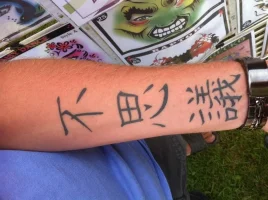
My friend has this tattoo on his arm and he won't tell me what it means. Can anyone translate it?
image.webp
 
Pronounced like 'fushigi (foo-she-ghee), in case you're curious.


Can someone please help me understand the bold part?

数学と物理の
成績は私より
良いな…

これは
残しとこう

英語はいいや

Context is that the girl who says this has somehow gained the ability to absorb other people's knowledge, whether she likes it or not.
Information about the guy whose knowledge she most recently absorbed (without wanting to) is floating in background.

I don't really get what the これ is referring to, probably because I don't get the とこう part.
 
注意された側は自分の人間性を否定さらたように思う人が多いと聞いた.

側 here means "while", right? Ive only heard it in contexts where it means like by the river.
What does ひてい do here?, it usually means to deny. but how do you deny human existence

" While scared My humanity is denied" what about 思う人 what is it doing here?
Is it

A lot of people that think and have heard THAT "While scared My humanity is denied". Or what?
 
It means, roughly speaking, 'party'.
'the cautioned side' -> 'the party being cautioned', 'the persons being cautioned'.

人間性 is 'humanity' not 'existence as a human being', and it's not unusual in English to talk about 'denying humanity'.

It comes together like, 'Among persons being cautioned, we heard that many of them feel that their humanity is being denied.'

(this is assuming that 否定さらた is a typo for 否定された)
 
Thanks. I thought about it a bit more and made a similar conclusion. However I have never heard about denying humanity in my life o.o. lol.
 
Pronounced like 'fushigi (foo-she-ghee), in case you're curious.


Can someone please help me understand the bold part?

数学と物理の
成績は私より
良いな…

これは
残しとこう

英語はいいや

Context is that the girl who says this has somehow gained the ability to absorb other people's knowledge, whether she likes it or not.
Information about the guy whose knowledge she most recently absorbed (without wanting to) is floating in background.

I don't really get what the これ is referring to, probably because I don't get the とこう part.
とこう is the contraction of ておこう.
 
Thank you very much, Toritoribe.

But I'm still confused about what exactly that sentence means.
Does it mean something like "That's what's left" with これ referring to all of the knowledge? Or is she analyzing the knowledge and これ only refers to the things he's better in? As in "He's better than me in math and physics. That's about it. He's pretty good in English too."
 
Thank you very much, Toritoribe.

But I'm still confused about what exactly that sentence means.
Does it mean something like "That's what's left" with これ referring to all of the knowledge? Or is she analyzing the knowledge and これ only refers to the things he's better in? As in "He's better than me in math and physics. That's about it. He's pretty good in English too."
The latter. これ refers to 数学と物理. She realized that "he is better than me in math and physics", so decides that she is going to hold these two.
いいや means 残さなくていいや, i.e., "no need (to be left)", not "good".
 
I'm having trouble identifying the person that actually performs the action in certain sentences.

Here's one such sentence. The scene is of a guy flirting with a girl. The guy says this.
おまえひとり囲っていけるだけのものはな。

I'm assuming おまえ makes the most sense in the above sentence, and translated it into this: "You're only holing yourself up(secluding yourself)." Would this be a correct translation? Or could it be something like "You're only going to be holed up alone."

I'd like to make sure I understand いける right. When joined with a verb(-te form), it indicates the verb is going on in a continuous state.
Ex: 食っていける -> to continue to eat(on a daily basis).
Thanks.
 
Your interpretation "the verb is going on in a continuous state" is for ~ていく. ~ていける is the potential form of it.

食っていく: to continue to eat(on a daily basis)
食っていける: to be able to continue to eat(on a daily basis)


囲う means "to keep a woman as a mistress" here, thus, the subject and the object of 囲っていける are the speaker/him and the addressee/her, respectively.

かこう【囲う】
II
1 〔めかけをもつ〕

めかけを囲う
keep a mistress
囲うを英語で訳す - goo辞書 英和和英


だけ is the same as くらい in this case, i.e., it's more close to "enough".


Also, you need to know why ~のものはな is put at the end of the sentence. This shows that it's not a sentence but the topic of the preceding sentence. (It's an inversion.)
 
だったらそんな上っつらの付き合いより思っとること全 部ぶちまけた方が、、、アイツと本音で話した方がなん とかなるかもしれんて思ったんや

上っつら=上っ面?In this case it means "surface" or "appearence"?

ぶちまけた方 = the actual verb is to get angry so "The method of getting angry?"

I don't understand the use of "yori" here. the person is thinking "more" about the surface of the relationship?
 
Back
Top Bottom