Need a word or phrase translated?

Thank you very much! I have another question, too...I checked jgram, etc. but haven't been able to find this phrase anywhere.

もしあるとすれば

Does it mean "If that's the case", or "If this (text in the sentence after the phrase) was the case?"
 
とする is sometimes used to mean something like "take as/treat as". With ~とすれば it's something like "If we assume that...".

If this was the start of the sentence, the ある should refer to something in the previous sentence. It could be something with ない previously (I don't have/there isn't X. If I did/if there was...). Or, if this is the middle of the sentence, the ある refers to something at the start of the sentence. Either way, what follows should be the outcome of that hypothetical.
 
もし is normally followed by a conditional like ば or たら, but it doesn't have to be とすれば . Similarly you can have とすれば without the もし.
 
I have a question about a verb and a question about a noun.

Here's the verb. This is how it's written, I double checked and don't think I mistranscribed it.

ほしがそらに みつるがごとく・・・・・・
おおくのたましいが うたかたのごとく
このよにうまれおち また きえてゆく・・・・・・
ひとは なんのために このようにうまれしんでいくのであろう・・・・・

Here's the expression/noun

くろきりゅうの まのてはせまる・・・・・・
このよが くろきりゅうのものと なるまえに
このよに めがみが よみがえるまえに
ひかりのりゅうは めざめるのだろうか・・・・・・

In kanji I would write the second text as:

黒き竜の まのては迫る
この世が 黒き竜のものと なる前に
この世に 女神が よみがえる前に
光の竜は 目覚めるのだろうか・・・・・・

Don't know if まのて would be 魔の手 or something?
 
1. is 満つる? (see here for example)

Actually by googling the sentence with your guesses at kanji you can get this which will give you the kanji/kana version.
 
1. is 満つる? (see here for example)

Actually by googling the sentence with your guesses at kanji you can get this which will give you the kanji/kana version.

Excellent help, thank you. I never thought about googling the sentence since it's from a 20 year old, half forgotten video game, but anything is on the internet these days I guess.

I will read みつる as if it was みちる then I guess. This is what I found as example and logically it fits.

So I was right about 魔の手, then I read it as "demon hand" which could be "evil sorcery" or something.
 
You might be amazed at the sort of stuff that turns up on fan sites and in 実況プレイ videos. Actually, the older game playthroughs are funnier (if you have a niconico account, this is one of the best, mostly for the commentary). Word for the day: 懐ゲー
 
Grammatically, 満つる is the adnominal/attributive form(連体形) of a classical verb 満つ, which is the classical form of 満ちる. Therefore みつるがごとく has an effect to sound classical/solemn/grave comparing to みちるがごとく. ほしそらにみつるがごとく is more accurate in classical grammar, though.
 
I would like to have these 6 tracks translated please.

1. 魔法少女?!
2. ノイズ
3. チューナー
4. 学園潜入
5. 同調
6. 真帆の思い
 
Anyone can translate what the character says in this video in 8:15 to 8:17?

Sounds to me like "ah, nano kotoa ne" or something like that. Thank you very much for your help!
 
Anyone can translate what the character says in this video in 8:15 to 8:17?

Sounds to me like "ah, nano kotoa ne" or something like that. Thank you very much for your help!

そうよ、なんのことはねえ
Sōyo, nan no koto wa nē.
Yeah (as you already know), there's nothing in it.
 
Translating a product label

What word or phrase would anyone like translated into Japanese or English?
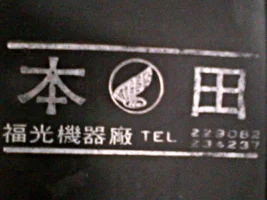
I am a collector of small Japanese motorcycles from the 1970s, specifically the Honda CT90. I have five of these bikes completely restored to original condition. I recently found a brush guard accessory unlike any I have seen before. I was told it is an original factory accessory but I have been unable to confirm that. On the guard is printed the Honda wing logo and the Kanji characters for han and da plus some other Kanji characters. I am hoping a translation of these characters will help me determine the origin of the part.
There are also two series of numbers preceded by the letters "TEL". My first thought would be that these are phone numbers but they have the wrong number of digits for modern phone numbers. Any thoughs in regard to these are also welcome. Here is a picture of the printing:

IMG-20130102-00438.webp

Much thanks for any help you can provide.
Phil
 
福光機器廠
Fukumitsu Kiki Shō
Fukumitsu Instruments Factory

1. Google search suggests there is no such company.
2. The last character "shō" means "factory" in CHINESE. It was also used in old Japanese, e.g. pre-WWⅡ, but it's no longer used in recent Japan.
3. I believe Honda didn't use (or at least quite rarely used) the kanji name 本田 on their products in '70s.

I think it's "Made in China".
 
Last edited:
Hello,

I would like someone to help me out. I am trying to add a tittle to an upcoming manga and would like to know the correct translation of this:

Will you be my servant?

This is a shoujo-ai manga and a master has to pick a servant for herself. It is almost like asking the other girl if she would like to be her servant. The servant can choose to say yes or no. It is kind of like asking the hand of the servant.

I would like to know the translation in Japanese characters.
Also, what is the difference between vertical writing and horizontal writing.


Thank you in advance!👍
 
My attempt (The latter one sounds more polite.)

しもべになってくれない?
Shimobe ni natte kurenai?

しもべになってくれますか?
Shimobe ni natte kuremasuka?


Horizontal writing is far more common recently, but vertical one is also used in books, newspapers or manga.
 
Thank you so very much!!!🙂:


My attempt (The latter one sounds more polite.)
しもべになってくれない?
Shimobe ni natte kurenai?
しもべになってくれますか?
Shimobe ni natte kuremasuka?
Horizontal writing is far more common recently, but vertical one is also used in books, newspapers or manga.
 
Thank you very much for your help. I was afraid it might be "Made in China" and I appreciate the confirmation.

Phil
 
A few things I like to ask about this text.

真宗本願寺派札幌別院♥除夜の鐘(西本願寺・西門徒)2012~2013

雪降りしきる中、老若男女 幸せで良い年を迎えるため 多くの参拝者には驚かされる。中でも若いカップルも多いのにはびっくり、明日の日本も希望が持てそうだ。

First, the 西 in 西本願寺. Is it せい or にし and what does it do here? I know 本願寺 this is the name of a buddhist movement at least.

Also, in 雪降りしきる中 what is the meaning and function of しきる? Is it "repeatedly" or is it to "divide/cut off" as if the sight is divided by falling snow?

I also found the way the sentence which followed was worded a bit weird but I take it that it means the writer is surprised by so many happy pilgrims, men and women of of all ages, coming to greet the new year.
 
Back
Top Bottom