Need a word or phrase translated?

Hello everyone! Im in desperate need of assistance. I'm a graphic designer and make t shirt and logos for heavy metal bands. A shirt im working on at the moment is suppose to say "worldwide unholy terror". Can you all help me translate that as fluent as possible in Japanese or.. well at-least translate back to that in English lol. thankyou all so much. I've been trying to get this translated everywhere with no luck.
 
Sorry to bother you with this, must say no matter how many times I reread this dialogue, I can't make sense of it. Could you please lend me a hand ?

A - "仲良くなればなるほど異性対してきつくなるのを本当にどうにかしたいです。"
B - "これは仲良くならない方がいいという暗示か…"
A - "..."
B - "ごめんよごめんよw 仲良くなりたいけど仲良くなってボロ出して嫌われるの怖いよ"

Thank you in advance.
 
Hello, I'm a little lost with this sentence. It seems simple enough, but "cold hands" doesn't really make sense to me. Is it really just as simple as "cold hands" or is it implying something more like English phrase "to get cold feet"?

怖かったんだから手が冷たくて私どうしたらいいかわからない。
 
Sorry to bother you with this, must say no matter how many times I reread this dialogue, I can't make sense of it. Could you please lend me a hand ?

A - "仲良くなればなるほど異性対してきつくなるのを本当にどうにかしたいです。"
B - "これは仲良くならない方がいいという暗示か…"
A - "..."
B - "ごめんよごめんよw 仲良くなりたいけど仲良くなってボロ出して嫌われるの怖いよ"

Thank you in advance.
What part of the conversation can't you understand, for instance?


I wish to know about a word pronounced: bibidi-kun
The word "bibidi" doesn't much make sence. Isn't it bibiri-kun?


Hello, I'm a little lost with this sentence. It seems simple enough, but "cold hands" doesn't really make sense to me. Is it really just as simple as "cold hands" or is it implying something more like English phrase "to get cold feet"?

怖かったんだから手が冷たくて私どうしたらいいかわからない。
It seems like not a single sentence. I think it would be 怖かったんだから、手が冷たくて。(=手が冷たくて怖かったんだから。)私どうしたらいいかわからない。, or could be 怖かったんだから。手が冷たくて、私どうしたらいいかわからない。.
 
@Toritoribe : thanks for answering. Working on it, what I do not understand is essentially in the first sentence. I understand the words fine without having to check them up (except for 異性), the problems come up making sense of it as a whole, syntaxically if you see what I mean. For example, what the speaker wants to do (i.e. what したい refers to) remains unclear to me.
 
@toritoribe : thanks for answering. Working on it, what I do not understand is essentially in the first sentence. I understand the words fine without having to check them up (except for 異性), the problems come up making sense of it as a whole, syntaxically if you see what I mean. For example, what the speaker wants to do (i.e. what したい refers to) remains unclear to me.

仲良くなればなるほど異性対してきつくなるのを object of どうにかする
本当に adverb
どうにかしたいです。 =どうにかする+~たい want to do something

仲良くなればなるほど
~ば~ほど the more, the more
仲良くなる to become closer (as friends)

異性対してきつくなるのを
異性 a person of the opposite sex
きつくなる =きつい+なる to become harsh/tough on (someone)
 
It seems like not a single sentence. I think it would be 怖かったんだから、手が冷たくて。(=手が冷たくて怖かったんだから。)私どうしたらいいかわからない。, or could be 怖かったんだから。手が冷たくて、私どうしたらいいかわからない。.

I think I understand it a little bit better now. Thank you. :)
 
If I walk into a kitchen and I want to ask if the cooking is going alright, how do I ask it?
would that be something like "料理を元気ですか" ?
 
No, 元気 is only to describe the condition of health of a person.
If you want to ask how something is going, ~はどうですか?
If you want to ask if something is going well, ~は上手く(うまく)行っていますか? or ~は順調(じゅんちょう)ですか?
for example.
 
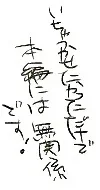
I'm trying to translate a doujinshi. The first page says something about it not being related to the original story, but I can't get the exact meaning of the sentence. I'm having a hard time understanding it because of the lack of kanji in the first half.

asd.webp
いちゃうかせたかっただけで本編には無関係です!

Any idea what this means?
Is かせた supposed to be 貸せた?
I'm not sure what いちゃう is supposed to mean in this context either.
 
いちゃかせたかった;-)
:bikkuri:
...That makes much more sense. I feel silly now. 😌
Thank you very much! 🙇

---------- Post added at 19:30 ---------- Previous post was at 17:31 ----------

Ran into another problem. I think I get the gist of it, but I'm feeling unsure.

呼んでおいて居ないとは
時間厳守以前の問題
では…

Each line was in a separate word bubble.
Is it basically just saying that if the person he's calling for doesn't come, then it must be a problem with punctuality?

I'm not sure about 以前の問題, I tried looking up some sentences that use it to get better idea of how to translate it in a way that makes sense with the context, but nothing was very helpful.
 
It's not "the person he's calling for doesn't come" but "the person who is calling for him doesn't come".

~以前の問題 means "more than a matter of ~" or like that.
 
I have a translation question. My niece's online nickname is "Ichigo Usagi", which she tells me is Japanese for "Strawberry Bunny", written in English. Is this correct, and how would you write this in Japanese? Thanks.
 
hiragana: いちごうさぎ
katakana: イチゴウサギ
kanji: 苺兎
 
Hey guys, I'm trying to say something Japanese and I need to know if I formed the sentence properly. Here it is:

私は友だちにかれのビデオゲームをうらせることをこいます。

It should say: "I asked my friend if he would let me sell his video game."

If it's terribly butchered Japanese, don't be afraid to tell me. I'm here to learn after all. Thank you so much!
 
I would say 友達のテレビゲームを売らせてくれるかどうか本人にたずねた。 or 友達のテレビゲームを売ってもいいかどうか本人にたずねた。

Note the difference in translation of "to ask" between the two forms.

asked my friend if~
~かどうかたずねた/聞いた。

asked my friend to let me do
~させてくれるよう頼んだ。(請う[こ]う is almost the same to 頼[たの]む in this case.)
 
"We have the keys to an apartment we share."
My best guess:
僕達は分け持つアパートの鍵が持っている。

Wasn't sure whether to use wakeau or wakemotsu, or to use ga or wo towards the end.
 
Back
Top Bottom