Need a word or phrase translated?

I swear one of these days I'll manage to stop having to ask so many questions, but hey, you gotta be curious to learn!
This was written underneath art of two characters passing each other silently, one of which was crying.
Am I completely wrong in thinking it at it's core resembles the whole "How the people we once loved become strangers again" or am I completely off?:
"あんなに通じ合ったのに
盲目になって今日も拗ねる
悪気も無くて遠くまた
すれ違ったまま"
(and yes it was formatted exactly like this, though it's most likely for poetics sake rather than separating the words) Any help would be greatly appreciated!
 
Oh my goodness, I wouldn't have known that in a million years. Thank you so much for your help!
I didn't know the song at all, either. It's written in a typical lyrics style, so I googled the phrases, and got the result.
 
わかんなくても、ナマ温かい目で見守ってやればいいのよ
I'm confused whether the subject is ''you'' or ''I''. Consider the later phrase, it seems to be an advice so is it ''you''?
ナマ温かい目で is ''with a lukewarm eye'' ?

Context: A ship captain is nervous. The speaker asks is it his first time to feel like that (I'm not sure about this). The vice captain said the ship captain said it is a man's romance.

Oh I forgot, the subject of わかんなくても is ''I'', according to context.
 
Last edited:
The subject is "you" or "we".
Incidentally, the subject of わかんない must be the same as the subject of 見守ってやる.
ナマ温かい目で is just a variation/word play of 温かい目で "with a warm eye". It might be less warm than 温かい目で, but doesn't have any negative nuance.
 
Here is the original lines:

艦長、少しは落ち着いてください。

これが落ち着いていられるか。ようやくおれの艦が、陛下の目通りにかなうんだぞ。

Speaker: 艦長って、この艦にやけに感情移入してない?

。。。男のロマンなんだってさ。

Speaker: あ~、そういう事。

わかるのか? ミオ。

Speaker: わかんなくても、ナマ温かい目で見守ってやればいいのよ

So you mean the subject of わかんなくても is ''you''?
 
Last edited:
珊瑚号 is not a strange name at all. It's more likely a traditional naming pattern. 珊瑚 is not archaic at all, either. Are those Japanese names really the translation of the Hawaiian names? What is the Japanese names of other dogs?
?

It is a very strange name in the context of the naming tradition of Japanese native dogs and totally out of the usual patterns. Names like 鈴王 or 鶴姫 or 紅貴 would be more typical. To give a Hawaiian reading over a Japanese name is wacky and causes trouble for researchers like myself. I have no idea if they are the correct translation from Hawaiian to Japanese. Anyway it doesn't matter as long as the name is recorded correctly in the archive.
Any help with this one?
honjou arakisou dog snippet2.webp

....ou Gou Honjou Arakisou
○王号 本庄荒木荘

This one helpfully has furigana scribbled but I can't make out the first one. Thanks in advance!
 
Last edited:
You don't have access to better scans, photos, or copies?
 
It is a very strange name in the context of the naming tradition of Japanese native dogs and totally out of the usual patterns. Names like 鈴王 or 鶴姫 or 紅貴 would be more typical. To give a Hawaiian reading over a Japanese name is wacky and causes trouble for researchers like myself. I have no idea if they are the correct translation from Hawaiian to Japanese. Anyway it doesn't matter as long as the name is recorded correctly in the archive.
Any help with this one?
View attachment 23537
....ou Gou Honjou Arakisou
○王号 本庄荒木荘

This one helpfully has furigana scribbled but I can't make out the first one. Thanks in advance!
Seems like 狼王号 Rōō-gō, meaning Wolf King.

Those are exactly traditional, not strange at all to my native eyes, including 狼王.
 
Seems like 狼王号 Rōō-gō, meaning Wolf King.

Those are exactly traditional, not strange at all to my native eyes, including 狼王.
Thanks for the help.

I think you're misunderstanding what I'm calling strange and why. Those names I have mentioned in my last message are indeed very traditional. I could show you the really strange names (like putting a Kanji gloss on "Kilmore" using some absolutely bizarre combinations) but it's not relevant here and nobody cares but me anyway. Thanks again.
 
It's also traditional in a sense; for instance 切藻亜 for Kilmore.
 
Hello! How are you?
I need help for a short sentence: I need to have it translated into Japanese, but I have 0 knowledge of this language and until now I have communicated with Japanese people just by copying and pasting stuff from grammar websites or books with the English translation (which is a very long process).
I'd like to send a postcard, so what I have to say (in Japanese) is: "Who wants this postcard? Contact me privately for your address. PS: Can we communicate with kanji only, or in English? Because I don't understand Japanese."
Thank you so much! If you want, you can also explain your translation, so this becomes useful for me too, since I'm interesting in languages :D
 
誰かこの絵葉書ほしい人いますか?住所を直接教えてください。
PS
英語で会話できませんか?日本語がわからないもので。

Can we communicate with kanji only
You seem to be confusing Japanese and Chinese language. Even Japanese people can't communicate with each other with kanji only. Kanji is just one of the components of the Japanese writing system.

Japanese writing system - Wikipedia, the free encyclopedia
 
Hello all!
After spending hours (no really, hours) on Google translate to no avail, I humbly ask your assistace.
I need a phrase translated for a script I'm writing for a class I am taking.
The phrase I'm trying to say is:
"No soul to save, no heart to break."
Or any variation of.
Such as, I have no soul to save, I have no soul for you to save, I have no soul that can be saved, etc.
Any help in this would be greatly appreciated.
Thank you!
 
How do you say "anime recommendations".
お薦め(の)アニメ

Hello all!
After spending hours (no really, hours) on Google translate to no avail, I humbly ask your assistace.
I need a phrase translated for a script I'm writing for a class I am taking.
The phrase I'm trying to say is:
"No soul to save, no heart to break."
Or any variation of.
Such as, I have no soul to save, I have no soul for you to save, I have no soul that can be saved, etc.
Any help in this would be greatly appreciated.
Thank you!
救う魂もなく、壊れる心もない
 
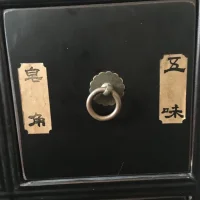
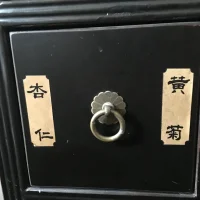
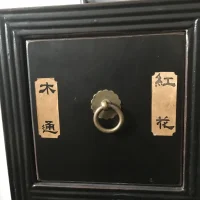
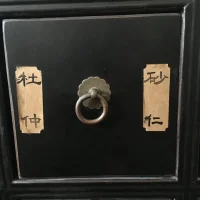
If anyone knowledgeable would be so kind...my aunt bought this chest at a thrift store and I was curious on the meaning of the language on the drawers. It looks to me like kanji. Thank you so much!
 

Attachments

  • image.webp
    image.webp
    685.6 KB · Views: 195
  • image.webp
    image.webp
    742.4 KB · Views: 191
  • image.webp
    image.webp
    824.5 KB · Views: 191
  • image.webp
    image.webp
    756.3 KB · Views: 157
Those are all the names of herbal medicines/traditional Chinese medicines.

紅花: Safflower 木通: Chocolate vine
砂仁(= 縮砂): Amomum villosum 杜仲: Eucommia ulmoides
五味(= 五味子): Schisandra chinensis 皂角: Gleditsia sinensis
黄菊(= 菊花): Yellow forists' daisy 杏仁: Apricot
 
Last edited:
今はまだ、亡くなってさほど経っておらん故に、はっきりと実体化しておるが、何十世代か経てば抽象化される。
This sentence is too hard for me to analyze.
Context: A girl trains herself in a temple. Her opponent is a thought make up by her friends' memory and they transform that thought into a real being.
My attempt: ''Now the thought haven't passed to the extent of its end therefore, it materializes clearly but, after some decade of generation it will abstract.''
 
Last edited:
Back
Top Bottom