Need a word or phrase translated?

「務まらん」では務まりまへんのよ makes sense? 務まらん is the quotation of what the addressee(or someone else) said previously.
 
Hi, i need help with this sentence...
きっと 私服は ズバ抜けたセンスの着こなしを してるんだろう

What does ズバ actually meant? I can't find its meaning in jisho.org although some japanese sfx translation said it meant "bluntly said".

As far as I can understand from each word's meaning, is that:
A is saying that B would certainly say something like "outdated dress sense" about A's clothes.
 
Oh, I see. Thus, it means that, it is not fit to be "not fit"?
I can't judge if that's correct or not since I don't know in what context 務まる is used.

Hi, i need help with this sentence...
きっと 私服は ズバ抜けたセンスの着こなしを してるんだろう

What does ズバ actually meant? I can't find its meaning in jisho.org although some japanese sfx translation said it meant "bluntly said".

As far as I can understand from each word's meaning, is that:
A is saying that B would certainly say something like "outdated dress sense" about A's clothes.
ずば抜ける is a single word.
ずばぬける【ずば抜ける】の英語・英訳 - 和英辞書 - 英語辞書 - goo辞書
 
I'm a bit confused about the actor for 仲間の影に紛れるよう does it kunai or the one who throws it? Maybe if the actor was kunai, then 紛らす would have been used? Could somebody please clarify it?
仲間の影に紛れるよう無拍子で放たれた苦無は、音速に迫る勢いで飛来した。
 
苦無 is the subject/agent. When the verb is 紛らす/紛らせる, the subject/agent is the thrower.

苦無影に紛れる。(紛れる is intransitive.)
苦無影に紛らす/紛らせる。(紛らす/紛らせる is transitive.)
 
The 紛れる in this case probably means:
まぎれる【紛れる】の意味 - 国語辞書 - goo辞書
入りまじって区別がつかなくなる。また、はっきりしなくなる。「人込みに―・れて見失う」「勝負の行方が―・れてくる」

"A kunai thrown off-beat, as if to blend in with the shadows of (his/her) comrades, came flying with an impetus approaching the speed of sound."

Somebody threw the kunai in a manner that it would blend in with the shadows. The kunai does the blending in and thus is the actor.

(Toritoribe beat me to it by 3 minutes!)
 
Last edited:
Hi!
Can somebody help me with a Japanese expression similar to "Honorable guests, welcome to ABC 123 event!"
Or how do you usually welcome the guest in a formal event in Japanese?
Thx in adv.
 
Hey there, I'd like to get some confirmation on my interpretation of the following phrase - especifically, that I've the right understanding of this use of ほど:

お前というチンピラを叩き潰すには惜しい程のな。

Am I correct in interpreting it as something akin to "I almost regret having to crush you"?

If context is needed, the speaker's someone who's already beaten said hoodlum several times now but, now, the guy has returned to attack the speaker after spending weeks training.
Problem is, their fight is still obviously going to be one-sided.

So, the speaker's showing regret that he needs to beat the guy after all his effort?

Many thanks.
 
Last edited:
The addressee/hoodlum was beaten by the speaker and he has come back, right? What is the sentence said right before it?
 
The addressee/hoodlum was beaten by the speaker and he has come back, right? What is the sentence said right before it?

Yes, this'll be the 3rd time he's they've fought.

As for the prior line, it's the end of the hoodlum's bombastic speech on how he's hoping to "settle everything" with this one: "盛り上がってきたぜ! 最高のステージになりそうだ!"
 
お前というチンピラを叩き潰すには惜しい程の(最高の)ステージにな makes sense?
 
お前というチンピラを叩き潰すには惜しい程の(最高の)ステージにな makes sense?

Hmm, so the speaker was referencing the hoodlum's line (I don't remember ever seeing の used like this)...then, he means that it's getting to the point/stage where he's starting to feel sorry?
 
惜しい means "too good / too precious / wasteful" here, not "regret/sorry".

おしい【惜しい】
2 〔もったいない〕
くだらない会議に時間を使うのは惜しい
Time is too precious to spend in fruitless meetings.
秘書にしておくには惜しい男だ
It's a waste for him to remain a secretary.
いま捨ててしまっては惜しい
It is still too good to be thrown away.
君にあげるのなら惜しくない
I'd be happy to give it to you.
おしい【惜しい】の英語・英訳 - 和英辞書 - 英語辞書 - goo辞書

I don't remember ever seeing の used like this
That's ordinary の for possession. The modified noun is just omitted.
−ほど【−程】
1 〔…くらい,…の程度〕
お銚子(ちょうし)1本ほどの酒ですっかり酔ってしまった
I got drunk on just one bottle of sake.
弟は父ほどの背丈はない
My brother is not as tall as my father.
信じられないほどの好条件だ
The offer is too good to be true./It's an unbelievably good offer.
小説と呼ぶほどのものではない
It does not deserve to be called a novel.
この1年間地震というほどの地震はなかった
There hasn't been an earthquake 「worth mentioning [worthy of the name] for the past year.
ほど【程】の英語・英訳 - 和英辞書 - 英語辞書 - goo辞書
 
Last edited:
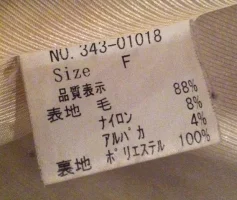
Hi,
I need help translating a laundry label.
Is there anyone who would be so nice as to help me out?
I think that it says alpaca and nylon but other than that I am at a loss...
Thank you for your patience!
 

Attachments

  • lapp.webp
    lapp.webp
    69.8 KB · Views: 171
Could someone please give me a hint about the actor for 散開して in the following sentence? Does it Ryo's squad or 敵さんの上陸部隊?

【亮】「そういえば、そんなことがあったな」
敵さんの上陸部隊と湾岸で衝突した後、散開して内陸に進撃を開始した敵部隊の掃討に入ったんだったか。
【亮】「確か、あのときは俺の部隊もかなり損害くらって……ああ、そうだ。部隊とはぐれて連絡も取れなかったもんだから、一人でしばらくさまよってた気がする」
 
The following sentence seems to be missing a verb. You can find it in the 3rd panel on this page.

なに, その間 = What, (verb?) in the meantime

I know it's usual for Japanese to drop pronouns and particles, but is it normal to drop things like verbs?
 
Last edited by a moderator:
The following sentence seems to be missing a verb. You can find it in the 3rd panel on <expurgated>

何, その間 = What, (verb?) in the meantime

I know it's usual for Japanese to drop pronouns and particles, but is it normal to drop things like verbs?

That introduces the action shown in the following panels.

Please don't link to hentai materials.
 
Back
Top Bottom