Need a Kanji Translated? Just ask!

Hi, could you help me?

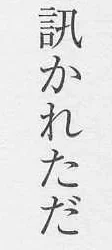
unknown kanji.webp
Sorry maybe there's someone already asked about this.
But could you tell me how to read this kanji and what's the meaning of it.
because I've already opened almost all of my kanji dictionaries and I just found nothing. I know it's cliche. :emoji_frowning2:

It's similar to kanji "dare" which is also can't be founded. except you knew the meaning/how to read it.

And is there any kanji which is rarely or even never could be found in any dictionary?
 
I guess I found it..
Meaning: consign, requesting, entrusting with, pretend, hint
Source: Kotoba! (Iphone App)
ON reading: taku
KUN reading: kakotsu.keru, kako.tsu, kako.tsu keru

Skip-Code: 1-7-3

:)
 
View attachment 8300
Sorry maybe there's someone already asked about this.
But could you tell me how to read this kanji and what's the meaning of it.
because I've already opened almost all of my kanji dictionaries and I just found nothing. I know it's cliche. :emoji_frowning2:

It's similar to kanji "dare" which is also can't be founded. except you knew the meaning/how to read it.

And is there any kanji which is rarely or even never could be found in any dictionary?

訊く (ki-ku) means "to ask".
It is not one of 常用漢字, yet is used quite often. 🙂:
 
vinacchi,

The kanji is "訊" and its readings are the following:

Onyomi: shun, jin, shin
Kunyomi: ki-ku, tazu-neru, to-u

It means to listen, hear, inquire, ask.
 
Thank you so much guys xD
that's exactly what I've been looking for!
and yeah after you guys told me about the kun-yomi i tried to look it up once again and i found it in one of my dictionaries.
except in 常用漢字辞書.
I was wondering why it's not included in it, is it because it's often used like "誰"?
haaaaa. Sorry for asking too much. lol.
but i appreciate it!
 
Yes, unfortunately 常用漢字 doesn't necessarily mean commonly used kanji in the sense that they're actually commonly used by people. It seems like that's all most non-Japanese dictionaries/kanji books focus on, though, which is terribly frustrating when you happen to come across not-so-uncommon words like 謙遜 (けんそん; "humble") or 虎 (とら; "tiger") or 箸 (はし; "chopsticks". This one still kills me), and I can't even imagine the frustrations one would face if coming across まとまる, まとめる, or まとう on Wikipedia written with their kanji: 纏まる, 纏める, 纏う (I mention Wikipedia because it seems to be one of the more heavy-kanji-use places out there).
 
Again it is some kanji with which I don't really know the difference between them.

先見
先見の明
智慮
予知
予見
遠謀
 
Again it is some kanji with which I don't really know the difference between them.
先見
先見の明
智慮
予知
予見
遠謀
*Disclaimer: I'm not a Japanese expert, just happened to pass jlpt1 with a low passing grade, so always best to check with a native.
Based on my e-dic, 先見=foresight, and 先見の明 is also =foresight, used in 先見の明の� る=farsighted/visionary. Noun, don't think it is commonly used in everyday life, more on newspapers to describe certain important people.
智慮 cannot be found.
予知 means prediction、予知する=predict.
予知能力=second sight
予見するmeans foresee. This word should be more commonly used with するto become a verb.
遠謀 means to think and plan about the far future. This seems to be old word inherited from Chinese, probably seldom used, but its meant to praise people like generals in ancient China going to war... (something like that)
 
I'm attempting to translate an interview.
I've got it finished, save for one response. . .
The question asks, "What would you do if Doraemon existed?"
The first part of the response reads, "I'd try to touch his head! What is it like? Is it smooth? Tufty?"
But then it goes to. . .
道具は困った時にでも泣きついてみる☆
It's mostly the first half of the sentence that makes no sense to me, I don't understand what he's saying about being troubled about tools, and I wasn't able to find a good translation for 時にでも. . . could someone help me try to figure this out?
 
I'm attempting to translate an interview.
I've got it finished, save for one response. . .
The question asks, "What would you do if Doraemon existed?"
The first part of the response reads, "I'd try to touch his head! What is it like? Is it smooth? Tufty?"
But then it goes to. . .
道具は困った時にでも泣きついてみる☆
It's mostly the first half of the sentence that makes no sense to me, I don't understand what he's saying about being troubled about tools, and I wasn't able to find a good translation for 時にでも. . . could someone help me try to figure this out?
I asked my translator friend and it seems to mean that:
(if doraemon exist) if I lack some tools, i will beg him for it (as in cry and beg for it like some kid)
 
I'm attempting to translate an interview.
I've got it finished, save for one response. . .
The question asks, "What would you do if Doraemon existed?"
The first part of the response reads, "I'd try to touch his head! What is it like? Is it smooth? Tufty?"
But then it goes to. . .
道具は困った時にでも泣きついてみる☆
It's mostly the first half of the sentence that makes no sense to me, I don't understand what he's saying about being troubled about tools, and I wasn't able to find a good translation for 時にでも. . . could someone help me try to figure this out?
The subject of 困った is not 道具 but the speaker or "I". でも implies that 困った時に is one of the example cases when the speaker begs Doraemon to help him (by using Draemon's tools). See the explanation of でも in a J-J dictionary.

3 物事をはっきりと言わず、一例として挙げる意を表す。「けが―したら大変だ」「兄に―相談するか」
http://dictionary.goo.ne.jp/leaf/jn2/152508/m0u/でも/

Thus, you can think 困った時にでも as "when I'm in trouble or something".


BTW, isn't this topic more appropriate for Need a word or phrase translated? than here "Need a Kanji Translated? Just ask!"?;-)
 
Is the person being interviewed Japanese?
Yes, he is. He's the vocal for a Japanese band, and I found the interview in a Japanese magazine.
But I think the posts answered what I was looking for. ^^ Thanks!
 
羅城門
Wikipedia says that it reffers to 'Main city gate', but I cant find 羅城 in the WWWJDIC, I know 城 means something like fortress, but then still I can't find 羅
 
It's got a few meanings.
「羅」の部首・画数・読み方・意味 - goo漢字辞典

Two of them have to do with thin silk (#s 1 and 3). #2 says it basically means to be in a line (並ぶ). And the last one says it's just a character used for transcribing foreign sounds. So it's possible that 羅城門 is "a gate lined up in the castle" or something to that effect.

Though you can read about what it actually is at Wikipedia -- 羅城門 or Wikipedia -- Rashomon (gotta say "Rashomon" is a shock as a reading for that one; normally it's 羅生門, I thought...).
 
Need help with translation

Picture0063.webp


The url above links to a photograph of document in what I think is Kanji, if it is in fact kanji, could someone please translate the document for me. A either exact word for word or just the general idea will work. Thank you so much.
 
Hello...I already have an answer to this question (its apparently UK, USA) but would like to know what the characters for these two words are? The sentences that give me the 'hints' are below.

英をあらわすアルファベット2文字
米をあらわすアルファベット3文字
 
i
The url above links to a photograph of document in what i think is Kanji, if it is in fact kanji, could someone please translate the document for me. A either exact word for word or just the general idea will work. Thank you so much.
That's a certificate of a calligraphy exhibition given for a person Steven/Stephen Bourdon/Bowdoin.

Hello...I already have an answer to this question (its apparently UK, USA) but would like to know what the characters for these two words are? The sentences that give me the 'hints' are below.
英をあらわすアルファベット2文字
米をあらわすアルファベット3文字
The hints say that the answers are written in "alphabets" and not "characters", thus, "UK" and "USA" are the only correct answers.

EDIT:
Or are you talking about the two characters for UK and USA, i.e., 英 and 米?
 
Last edited:
Hi! I am gonna get me a tattoo with the words, Dream, Fight, Conquer on my wrist. As it will be too long to write in latin, i am thinking about getting it in kanji.

Could anyone please translate these 3 words into kanji? If so, would it even make any sense in kanji?

Thanks in advance
 
Hi!
Could any1 please tell me how can I read the following kanji?

I just started learning the first 80 Kyōiku kanji🙂:

It would be nice if some1 could "convert" the Kanji on the picture to Japanese romaji.

Thank you!
 
Hi!

How do you read : 矛槍, 鉄球ヌンチャク and 鉄槍 and what does it mean?

I know its related to ninja .

Thank you ^^
 
Last edited:
Back
Top Bottom