


- 22 Feb 2008
- 18,266
- 4,926
It's not really something that needs to be translated, but two kanji from which I would like to the difference, because both mean 'love'
恋
愛
Need a Kanji Translated? Just ask! | Page 19 | Japan Forum
Follow along with the video below to see how to install our site as a web app on your home screen.
Note: This feature may not be available in some browsers.

It's not really something that needs to be translated, but two kanji from which I would like to the difference, because both mean 'love'
恋
愛
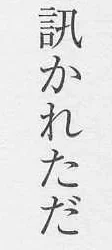

View attachment 8300
Sorry maybe there's someone already asked about this.
But could you tell me how to read this kanji and what's the meaning of it.
because I've already opened almost all of my kanji dictionaries and I just found nothing. I know it's cliche. :emoji_frowning2:
It's similar to kanji "dare" which is also can't be founded. except you knew the meaning/how to read it.
And is there any kanji which is rarely or even never could be found in any dictionary?
 :
:

*Disclaimer: I'm not a Japanese expert, just happened to pass jlpt1 with a low passing grade, so always best to check with a native.Again it is some kanji with which I don't really know the difference between them.
先見
先見の明
智慮
予知
予見
遠謀
I asked my translator friend and it seems to mean that:I'm attempting to translate an interview.
I've got it finished, save for one response. . .
The question asks, "What would you do if Doraemon existed?"
The first part of the response reads, "I'd try to touch his head! What is it like? Is it smooth? Tufty?"
But then it goes to. . .
道具は困った時にでも泣きついてみる☆
It's mostly the first half of the sentence that makes no sense to me, I don't understand what he's saying about being troubled about tools, and I wasn't able to find a good translation for 時にでも. . . could someone help me try to figure this out?
The subject of 困った is not 道具 but the speaker or "I". でも implies that 困った時に is one of the example cases when the speaker begs Doraemon to help him (by using Draemon's tools). See the explanation of でも in a J-J dictionary.I'm attempting to translate an interview.
I've got it finished, save for one response. . .
The question asks, "What would you do if Doraemon existed?"
The first part of the response reads, "I'd try to touch his head! What is it like? Is it smooth? Tufty?"
But then it goes to. . .
道具は困った時にでも泣きついてみる☆
It's mostly the first half of the sentence that makes no sense to me, I don't understand what he's saying about being troubled about tools, and I wasn't able to find a good translation for 時にでも. . . could someone help me try to figure this out?
http://dictionary.goo.ne.jp/leaf/jn2/152508/m0u/でも/3 物事をはっきりと言わず、一例として挙げる意を表す。「けが―したら大変だ」「兄に―相談するか」
Yes, he is. He's the vocal for a Japanese band, and I found the interview in a Japanese magazine.Is the person being interviewed Japanese?
That's a certificate of a calligraphy exhibition given for a person Steven/Stephen Bourdon/Bowdoin.i
The url above links to a photograph of document in what i think is Kanji, if it is in fact kanji, could someone please translate the document for me. A either exact word for word or just the general idea will work. Thank you so much.
The hints say that the answers are written in "alphabets" and not "characters", thus, "UK" and "USA" are the only correct answers.Hello...I already have an answer to this question (its apparently UK, USA) but would like to know what the characters for these two words are? The sentences that give me the 'hints' are below.
英をあらわすアルファベット2文字
米をあらわすアルファベット3文字
Arigatou gozaimasu.left one: chiryaku
right one: shun/jun


