Sure! If it's any comfort, I went to check for Genki on amazon this morning. I was a bit put off by the price which goes over 100$. I probably would've gotten it if it had been cheaper. Even the used copies on amazon.ca are about the same price. This is for all three books though (Correction key, workbook and textbook).
I appreciate that you're taking our words to heart. And yes, the price of Genki (as with many college textbooks, unfortunately) can be a bit prohibitive. For what it's worth, you may be able to find used copies for cheaper if you search around.
I will say that I, like mdchachi, never actually used Genki itself as an early learner. I used two textbooks called Yookoso (which I rarely see mentioned these days) and Japanese: The Spoken Language (which I wouldn't recommend for your case since you seem very reading-focused). I supplemented this with a lot of self-study, reading ahead in my textbooks and using dictionaries and grammar references like the Dictionaries of Basic/Intermediate Japanese Grammar to read native materials (mostly video games, actually, not unlike yourself). The structure provided by the textbooks, I think, was invaluable in giving me a solid basis on which to build a more thorough and complete understanding of the language.
What's weird here is that there seems to be two different kanjis for the same meaning. In my dictionary, 「貼る」is grayed out. Might be because it's the less frequently used version of 「張る」? So out of curiosity, I google translated with both kanji and the meanings differ. This means that by using 「貼る」you get one meaning while using 「張る」 you get another one. In this case, however, no kanji are used whatsoever.
First of all, this may seem "weird" to you because you're not used to it, but it's not, really. There are many homonyms with different meanings expressed with different kanji, and also places where there is some overlap and the nuances are more subtle. I can't speak to your dictionary, but 貼 of 貼る is a 常用漢字(じょうようかんじ - you can look it up) and is thus certainly not "rare" or "infrequently used" in any sense. Considering that this game doesn't exactly use standard Japanese orthography (with many common kanji replaced by hiragana and katakana, spaces between words, etc.) you probably don't want to read too much into why certain things are written with certain scripts. It's a stylistic choice as much as anything.
So here goes:
「かいだんを のぼった先にある
トビラの 近くに はられている 紙を
風使いの チカラを かりて はがすのです。」
"Use strong wind on the paper stuck on the wall near the door at the top of the stairs to rip it off."
First of all, note that you're missing かりて from your JP transcription, though you seem to be accounting for the word in your translation. That is, unless you're mistakenly translating the noun 風使い as "use strong wind", in which case you should see below.
You're pretty close regarding the meaning (which, again, is admirable). Though I'd point out a few things.
- Note that it's 風使い, not just 風. 風使い is not really a common word, but it suggests "user/wielder of the wind" (you'll also see similar compounds like 魔法使い - magic-user or mage - or with animal names like 象使い - elephant trainer - or 蛇使い - snake charmer). Is there a character like this in the game?
- Nitpicky point perhaps, but "stuck on" the wall has a nuance that 貼る doesn't necessarily have. It more likely just means "posted", "affixed", etc.
- It doesn't actually refer to a wall anywhere in the sentence, though it's kind of implied by 貼る and is probably a correct interpretation.
Regarding the explanation about にある, I read it 4 times to try to understand it. What I understand is that it's used to express that the noun phrase that precedes it is in a state of existence.
"In a state of existence" is a very vague explanation that makes me wonder how well you truly understand this point. (Yは)Xにある is one of the most common ways in Japanese to say "Y (where Y is an inanimate object) is (i.e. exists) in X". Switching it around, XにあるY is a noun phrase meaning "the Y (that exists) in X".
本は図書館にある The book is in the library.
図書館にある本 a book (or "books") in the library
Again, note that the former is a complete sentence and the latter is a noun phrase (a noun being modified by a relative clause) like my earlier example.
It might help you, for practice, to try to translate all of the broken-down (broken-up?) phrases in Toritoribe-san's post:
かいだんをのぼった先.
かいだんをのぼった先にあるトビラ.
かいだんをのぼった先にあるトビラの近くにはられている紙
Note that these are all noun phrases where the main idea is the final noun, and everything that comes before modifies it.
But yes, to reiterate Toritoribe-san's post, the main idea here is 紙をはがすのです, where everything preceding 紙 is modifying 紙 (i.e. telling you what kind of paper it is, while 風使いの力を借りて is an adverbial phrase modifying はがす (i.e. telling you how or in what manner to rip it off).
Would I be right to say that:
Is a noun phrase because even though there's a verb here, it's connected to 「かいだん」with the 「の」particle which is used to link 普通名詞(s) therefore implying that we're dealing with a noun phrase?
No, that's not correct. First of all, note none of the の's in this sentence are connected to 階段. You have 扉の近く, 風使いの力, and はがすのです (the last of which is a different の - see below). Second, noun phrases occur all the time in sentences with verbs (in English as well as Japanese). Take a sentence like "Give the book to the man wearing a red hat". "the man wearing a red hat" is a noun phrase. "(you) give" is the main verb hear, while "wear" is only being used as part of a phrase qualifying the man.
What I don't understand here is why のぼった is in the past. If you were to give instructions to someone, you wouldn't use the past, would you? I mean, it's not the passive form here so I guess it's something of an imperative like we would use when giving instructions.
First of all (and this is a
very important point, perhaps the most important point) you'll want to disabuse yourself of the notion that Japanese grammar is going to follow the rules you expect from English. "(As a native English speaker), you'd expect that..." is rarely, if ever, going to help you understand or form Japanese sentences, and will often just serve to confuse you.
Second, there is an imperative form in Japanese, which is not being used in this sentence. In this sentence, the "explanatory" sentence-final particle の in はがすのです (for future reference, you'll also see it as 「~んです」) is being used as an imperative. You can probably find an explanation of this in one of your reference guides.
Third, note that のぼった is not the imperative here. The sentence is not telling the listener to "climb the stairs" (at least, not directly). のぼった is part of the relative clause modifying 先, which in turn is part of another clause modifying 紙.
Now that that's all out of the way (phew!), I'm going to quote myself from a post on another forum, tweaking the explanation a bit to match the example here:
me from somewhere else said:
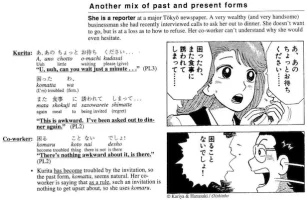
In Japanese, what many people refer to as the "past tense" is actually the perfect aspect. The focus is not when the action was performed relative to the present time, but whether or not the action was complete at the time under consideration.
This distinction often manifests itself in relative clauses. With 階段をのぼった先, by the time the hypothetical person reaches the destination at the top of the stairs, s/he has already climbed them (the action is complete). This is why the perfect (or "past tense") is being used here. 階段をのぼる先 would mean something like "the place/destination where one is about to climb the stairs". Given that 先 suggests "the other side" of something, perhaps you can see why this doesn't make as much sense.
This can be a bit confusing at first as it's different from English, but understanding the concept will go a long way towards helping you make sense of how tense is used in Japanese down the line.
Anyhow, hope this helps a bit. I must say, I'm heartened to see that you're asking some good questions.



 :.
:.
 .
. 


