Learning Japanese through Translation

Regarding the method you describe, I'm thinking you mean something like this.
The bilingual books work better because the translations are generally more faithful to each other. This example is not so great. "Costing me a fortune in free drinks" is not the best translation from a learning perspective. I don't even think it's a great translation in general.

I've been polite and civil in my attempts at understanding.
And that's why people are still helping you.

Regardless, suppose I were to go through Genki and ask a question about it here, what would people say? Check out the text book? Ok, I'll help you out because you're doing the textbook now? I mean, it started with exposure to authentic text not being effective to me having to use a specific textbook (not Tae Kim's book).
They would say oh this guy is seriously trying to learn Japanese. I want to help him. Otherwise the default reaction will be oh yet another one of these people trying to learn Japanese from song lyrics and Google.

I'd like if someone took the time to teach me things based on the material I bring without forcing to use the method they've used. I think it's a fair request considering it can certainly be ignored. In fact, I'd rather be ignored then coerced to use a method which I know doesn't work for me.
You seem pretty adept at learning concepts from reference material and parsing out things. It doesn't seem like a big stretch to learn from material that's actually designed for learning.

You're essentially asking for a bunch of free labor to teach you very basic stuff that's covered in beginning courses of Japanese. Like how to count glasses of alcohol. Or how to use の (this example is not an advanced usage of の, it's very typical). Lucky for you there are a few people here who will help you. But you will just have to listen to the constant refrain of get a text book. ;-)

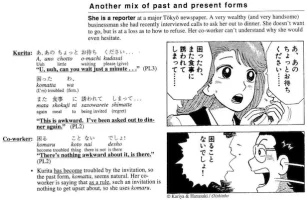
By the way since you like this parsing method I suggest buying the back catalog of Mangajin. It was a magazine that essentially did what you are trying to do -- took original Japanese source manga and explained the Japanese including detailed grammar notes. Of course it was meant to be a supplement for Japanese studies, not a primary method.

mangajin.webp
 
You're essentially asking for a bunch of free labor to teach you very basic stuff that's covered in beginning courses of Japanese.
If someone were to ask me money to help I would comply. I've paid people before through paypal for their criticism of my drawings without them asking. I already a couple of people in mind for this thread I'd like to reward for their help. Let's not make assumptions here please 🙂:.

I'm studying Toritoribe reply at the moment, I'll get back once I'm done and a longer reply to your post.
 
I've been translating Paper Mario on the side and I can honestly say I can understand most of what's written.
Do you understand the text or do you only think you understand it? In other words, has a proficient reader checked your translation or are you merely assuming it's correct?

I also have a story, though it doesn't end quite as nicely as Toritoribe's. A while ago I joined a fan translation group for a visual novel. Translation was already 70% complete at the time - tens of thousands of lines written by one translator over the course of two years. He was clearly confident in his skills. The only problem was that almost every single line was wrong.

When I pointed out that the project would essentially have to be redone from scratch, he was devastated and swore never to translate anything again.

While you probably won't end up in such an extreme situation, let it serve as a cautionary tale about estimating your own skills :). If you already have someone checking your work, you can ignore everything I said. If you don't, feel free to post some segments here on the forum.
 
@lanthas:
Do you understand the text or do you only think you understand it? In other words, has a proficient reader checked your translation or are you merely assuming it's correct?
Neither. I mean not exactly.
At my current level, I'm not aiming for a 100% translation accuracy. I'm trying to understand the gist of written messages. I understand enough to understand what's going even if my understanding is muddled by some inaccuracies. I'm not stuck because I don't understand what to do next, I can understand in-game tutorials and item descriptions and how they're used. Of course, context helps a lot as in I can determine a lot of what's going on just by the watching what's going on on-screen and using my judgment.

If you don't, feel free to post some segments here on the forum.
Don't worry, that's certainly my intention. I have a few translations/comments ready but I want to finish what I've already started before moving on.

@mdchachi
oh yet another one of these people trying to learn Japanese from song lyrics and Google.
Which is not what I'm doing. I've explained at length and more than once that the translation exercise I'm pursuing is part of what I'm doing to learn, not all of it. Anyone willing to look beyond appearances will realize this.

I think asking a grammatical question in the context of a textbook is as valid as asking the same question in the context from an excerpt from just about any written medium, be it a novel, comic book, website or video game.

I wanted to know what I'm talking about so I compared Genki with what I'm using right now:

Compare the following examples about 「の」:
Genki I p.16:
Quote: "No is a particle that connects two nouns. The phrase: Toozai [...] means a student at Tozai University.
vs
A Guide to Japanese Grammar, p.64:
Quote: "[...] it [「の」] can be used to connect one or more nouns.

I think we can in good faith that both definitions are basically the same. So to dismiss A Guide to Japanese Grammar as valuable reference to learn the language because it's not qualified as textbook is unfair. What does it matter if I learn this information from Genki or from AGJG?

One thing I've been told is that the internet can't suffice to learn the language and yet AGJG is available for free. Given that the information provided in the comparison above is nearly identical, I don't see what the issue with using the internet would be. It's be dishonest to limit the content of Genki and AGJG to the 「の」particle, but I think it warrants rethinking some Japanese learning related axioms Even then, I bought the books, I'm just saying that it's not so simple as saying: "Learning from the internet doesn't work, give it up."

But you will just have to listen to the constant refrain of get a text book. ;-)
Well hopefully people will realize that if I were to give in to Genki as the sole way to learn a language I would've done so the first 5 times I was told to do so :P.

Regarding Mangajin, I'm not into manga at all. I mean, it'd have no motivation to browse it, let alone buy it. I'd much rather buy the rest of the Genki books at that rate. Thanks for the suggestion though. If any other come to mind, I'd like to know for sure.

@Toritoribe :
I had written a long reply regarding the girl learning from lyrics but again, it'd lead the thread being derailed. I think I'll create a thread about language learning as it can be discussed there. I also realized I wanted to prove my ideas too much and becoming too verbose about it.

As for いっぱいの酒代, it's actually [いっぱいの酒]代, i.e, いっぱいの酒の代金, as same as 一食の食事代, 一冊の本代 or 一足の靴代
So that's why I couldn't figure it out, I wasn't parsing the text correctly.

Speaking strictly, いっぱいの酒代 is more grammatical, but those expressions are quite commonly used in conversations.
I don't know why that is but like you said, I should probably focus on covering more of the basics asap than investigate this one further.

Finally, just for confirmation, ルイネロさんもうやめにしないかい? is said by the barman right before these lines?
Yes, that's right.

Anyway, I would usually explain あんたの当たらない占いなんかいっぱいの酒代にもなりゃしないよ。 like this;
The core of the sentence is 占いなんか酒代にならない.
あんたの当たらない modifies 占い.
いっぱいの modifies 酒代.
も is for emphasis here, meaning "even".
なりゃしない is a colloquial contraction of なりはしない. "The -masu stem of verb + はしない" is an emphasized negative form, so なりはしない is almost the same as ならない in meaning.
Here's the definition of なる.
Well that pretty much clears it up. It confirms that it's too complex for me at this point in time.
 
Alright, so here's another one. This one from a fortune teller in Paper Mario:
空中 ふわふわ うかぶ
とうぎ ロビー えます かいだん おぼった先ある」
''Inside a city floating in the sky, I see that there are some stairs in the lobby of the competition arena.''
(there's more to it but I wanted to start small).

What I found a bit difficult was to include all of the information with all the locations brought up here, i.e. the sky, the inside the city, the competition arena and the lobby. It's a bit challenging to rephrase the sentence so that it keeps the same meaning without dropping part of the information from the excerpt. For instance, I know the text doesn't the stairs are in the lobby but I couldn't see a better way of putting it.

Important vocabulary:
浮かぶ:「五段」:to float, to be suspended.
I had to look up ロビー to realize it was a 外来語. Some of them are a lot easier to recognize than others.
階段/かいだん:「普通名詞」:stairs

Questions:
1) One thing I've noticed is that expressions like: はわふわ seem to happen quite often in Japanese. I found another one earlier one: まあまあ. Is there a word for those types of expressions?

2) The part I'm finding more difficult is (warning: potentially basic question asked by a beginner):
おぼったにある」
I'm fine with the にある construction which says that something exists there (inanimate object). It's the 「おぼった」 which is giving me trouble. Maybe the 先 is a typo on my part. The kanji doesn't look like would fit there considering its various definitions refer to something akin to ''previous''.
I'm thinking the 「お」might be honorific while ぼった is probably the inflected (past) form a verb but I don't know which one yet.
 
Alright, so here's another one. This one from a fortune teller in Paper Mario:
空中 ふわふわ うかぶ
とうぎ ロビー えます かいだん おぼった先ある」
''Inside a city floating in the sky, I see that there are some stairs in the lobby of the competition arena.''
(there's more to it but I wanted to start small).

You have all (or most of; see below) the words there, but are misinterpreting the connection between them.

1) One thing I've noticed is that expressions like: はわふわ seem to happen quite often in Japanese. I found another one earlier one: まあまあ. Is there a word for those types of expressions?

ふわふわ is a 擬態語(ぎたいご), a mimetic word, which often describe types of movement, shapes or feelings in terms through symbolic sounds.
They're often grouped together along with 擬音語(ぎおんご) or onomatopoeic words, which are similar in appearance and generally describe more concrete sounds (i.e. ガタガタ for a clatter/rattle)

まあまあ repeats two sounds, but it isn't typically considered one of the above.

2) The part I'm finding more difficult is (warning: potentially basic question asked by a beginner):
おぼったにある」
I'm fine with the にある construction which says that something exists there (inanimate object). It's the 「おぼった」 which is giving me trouble. Maybe the 先 is a typo on my part.
先 isn't likely to be a typo, but おぼった almost certainly is. Look again and see if it isn't のぼった.

And yes, it's a past tense verb (one you should be able to figure out now, as it goes perfectly with stairs) modifying the noun 先. Now see if you can figure out the spatial relationship between the stairs and the arena lobby.
 
Last edited:
Zizka said:
Well hopefully people will realize that if I were to give in to Genki as the sole way to learn a language I would've done so the first 5 times I was told to do so.

Since I've answered a few of your questions in my post above, maybe you'll indulge me here.

Look, none of us are getting royalties from the publishers of Genki, nor do we have some kind of agenda or vested interest in having everyone learn Japanese the One True Way(tm), which doesn't even exist. We are simply trying—desperately—to encourage you to study the language in an efficient, productive way that minimizes frustration on everyone's part (that includes both us as "tutors" and you as a learner).

Zizka said:
I think we can in good faith that both definitions are basically the same. So to dismiss A Guide to Japanese Grammar as valuable reference to learn the language because it's not qualified as textbook is unfair. What does it matter if I learn this information from Genki or from AGJG?

The difference between Genki (or any good textbook) and reference materials (be they free internet resources or physical books) is not about any one particular grammatical explanation. It's that the former has been produced by professional Japanese language teachers, tested in actual learning environments, and proven to teach things in an order (and with sufficient reinforcement) that it is effective in giving beginning learners a solid structure in the language.

Any reference material (including Makino's Dictionary of Basic/Intermediate/Advanced Japanese Grammar, which is an _excellent_ resource that goes way beyond Tae Kim's guide) is best used as a _supplement_, rather than a primary learning material, because it is not structured in such a way that it builds upon itself, nor does it provide exercises for reinforcement, meaning that a learner who just reads through it will be overwhelmed with a wealth of grammatical knowledge that they will be unable to put into context.

You seem to be under the impression that we are just Genki zealots who look down our noses at free internet materials. This is not the case. Neither is anyone here telling you to stop trying to play and understand video games. On the contrary, exposing yourself to native materials is great, and as long as your questions display some thought and effort on your part, I, for one, am more happy to answer them. We are simply pointing out that you could benefit from more structure in your studies, not based on our biases or preconceptions, but rather on our own experiences and actual observation of the areas you seem to be struggling with.

One of the most difficult things at first about learning Japanese (or anything) is getting a grasp on what you do and don't know. This is what a structured textbook can provide you that assorted reference guides can't.

Anyhow, that's my rant.

(P.S. I'd be happy to have this post moved to a meta-thread on study methods if you end up creating one.)
 
Alright, so here's another one. This one from a fortune teller in Paper Mario:
空中 ふわふわ うかぶ
とうぎ ロビー えます かいだん おぼった先ある」
''Inside a city floating in the sky, I see that there are some stairs in the lobby of the competition arena.''
(there's more to it but I wanted to start small).
The first sentence ends with 見えます, i.e., 空中に ふわふわ うかぶ 街の中 とうぎ場の ロビーが 見えます is a single sentence, and かいだんを のぼった先にある is the beginning of the next sentence, which continues to the next line. Try again.

This is a minor thing, but 空中 is not the same as 空. 空中 can be used even when it's floating just a bit from the ground, but 空 can't work for those cases. Indeed, it might be really "in the sky" in that game, but I would use "in the air" instead of "in the sky" for the accuracy of the translation.
 
Since there was the possibility of having a typo here, I went back to get some screenshots:
PUn2MaW.webp

Followed by:
Myy92jF.webp

So there was indeed a typo on my part as it's 「の」and not 「お」. You were right jt_.

ふわふわ is a 擬態語(ぎたいご), a mimetic word, which often describe types of movement, shapes or feelings in terms through symbolic sounds.
Ah great, thanks. I figured there was some kind of terminology for this.

This is a minor thing, but 空中 is not the same as 空.
I wasn't sure about this one. I looked up both in the dictionary. Good to know.

The first sentence ends with 見えます, i.e., 空中に ふわふわ うかぶ 街の中 とうぎ場の ロビーが 見えます is a single sentence, and かいだんを のぼった先にある
Question 1: Why not put a period if it's the end of the sentence? It is because it's more of an independent clause than a full sentence? Anyways, I'll try again.

Anyhow, the fixed transcription and me second attempt with a different parsing:
「空中に ふわふわ うかぶ 街の中
とうぎ場の ロビーが 見えます」
"I see a lobby inside the competition center in a town flying gently in the air."

「かいだんを のぼった先にある」
You climbed some stairs...
(this one is likely a lot less accurate).
「階段」:stairs.
登:のぼる:五段:"to climb" conjugated in the past. 階段 is the direct object of the verb 登る because of 「を」.
Question 2: I find the にある there a bit out of place. Why not simply write:
「かいだんを のぼった」?
It's the particle 「に」with the 「ある」used to express the existence of inanimate objects.

So something along the lines of "previously climbed the stairs".
Since I've answered a few of your questions in my post above, maybe you'll indulge me here.
That's fine, I sort of derailed a bit myself. As long as it doesn't completely change tangent.

I read your message twice. I did sort of get the Genki zealot vibe at first if I'm to be completely honest although "zealot" might be too strong a word. It'd say a rigid approach was the impression I got initially. As for the rest, your rationale is coherent and I understand where you're coming from. I think we could discuss further why A Guide to Japanese Grammar disqualifies as a textbook as well as the attributes of a textbook vs reference material but I feel like it'd be unnecessary at this point in time.

Finally, regarding the money, I was thinking of donating to the forum directly. I felt like this was the most fair approach as everyone sort of benefits that way instead of picking individual people.

EDIT: Come to think about it:
Question 3: トビラ is written in カタカナ here. It's not a 外来語 though. I've been told that writing a word in カタカナ instead of ひらがな is sometimes arbitrary.

Aren't there *some* reason though? It looks odd to have トビラ here. In Dragon Quest,
トビラ was always written 扉. This makes me think that トビラ isn't always written that way as some sort of linguistic convention.
 
Last edited:
1)
That's a complete sentence. The reason is probably because to save the space for letters. That game is for native Japanese speakers, and it's obvious for natives (or those who are fluent in Japanese, of course) where each sentence ends eve without any period.

The subject is not "I". It's a suggestion/an instruction said to the listener(s).

2)
The three lines in the second picture is a single sentence. What is the core of the sentence?
Hint: the core is "an object and the main verb".
Hint2: 先 is not used only for "temporal".

3)
Katakana is also used for emphasis, just like Italics in English. The same goes to チカラ.
 
EDIT: Oops, posted at the same time as @Toritoribe! Will reply to your message in another one.
I can't edit my message anymore so here goes:
EDIT2: I think I can manage some of the last part:
トビラの 近くに はられている」
"Near the door..."
「トビラの 近くに はられている
This is the ーている form we've discussed before in combination with the passive form of the verb.

In order to determine what verb is in the passive form here, I need to "reverse-engineer" it so to speak.

When you have a 「-る」verb, you'd replace the last 「る」and replace it with 「られる」. In this example, it means the original verb is はる. Since no kanji are being used here, I need to figure out which はる it is. It's not "spring" as that's not a verb. I think this leaves
「張る/貼る」through a process of elimination.

Question 4:
What's weird here is that there seems to be two different kanjis for the same meaning. In my dictionary, 「貼る」is grayed out. Might be because it's the less frequently used version of 「張る」? So out of curiosity, I google translated with both kanji and the meanings differ. This means that by using 「貼る」you get one meaning while using 「張る」 you get another one. In this case, however, no kanji are used whatsoever.
 
The three lines in the second picture is a single sentence. What is the core of the sentence?
Hint: the core is "an object and the main verb".
Hint2: 先 is not used only for "temporal".
Well, there are more than one verb here:
1. 「ある」
2. 「はられている」
3. 「はがす」I'm pretty sure that's a verb as well followed by 「のです」, to tear off.
How would I determine out of the three which one is the main verb? The one at the very end? In that case, I'd say the main verb is 「剝がす」.
As for the object, I'd say 「紙」.

So 「先」 isn't only used as a temporal. So if I look it up in the dictionary I get:
"Noun (futsuumeishi)
May take the particle 'no'
Noun, used as a suffix
Prefix"
So 「先」is used with 「にある」. So it has to be interpreted as something that exists. If I look at the definitions of 「先」it'd say "destination" and "front" are potential candidates.
"In front of the top of the stairs" maybe? But then I'd be a prepositional use so I'd probably need 「に」there.
 
First of all, I just want to thank you for genuinely going over my and Toritoribe-san's messages multiple times and making an honest effort to take them to heart. We just want to help, and I appreciate that you're trying to understand that.

Question 2: I find the にある there a bit out of place. Why not simply write:
「かいだんを のぼった」?
It's the particle 「に」with the 「ある」used to express the existence of inanimate objects.
This is one thing that I'm very certain you're not clear on, as it's more of an advanced point than the more simple areas you seem to be struggling with. With the caveat that it may be beyond your current level, here is my attempt to explain this.

In Japanese, any noun (or noun phrase) can be modified by a predicate (i.e. adjective, verb, or copula) in the plain form. These are called relative clauses, and it's a fundamental concept you'll need to grasp to reach a higher level of Japanese.

To put it in the simplest of terms...

階段をのぼった is a full sentence in Japanese (in English, it would require a grammatical subject, but in Japanese this isn't necessary and can be omitted).
Alone, it would mean "(I/he/she) climbed the stairs."

階段をのぼった先 is a noun phrase. The main noun is 先, and it is being modified by 階段をのぼった. 先 in this case does not mean "previously." It closer to the 目的地 (destination) of the word seen here:

先の意味 - 和英辞典 - コトバンク

Literally, it is "a destination/endpoint (that can be described as) after having climbed the stairs." Or in another words, "(a place) at the top of the stairs". Because it is a noun (phrase) describing a location, it can take にある. Note that this is (further) modifying トビラ, forming another noun phrase.

Note that these relative clauses have a loose binding (much like the いっぱい(一杯)の酒代 we discussed earlier, which actually is something of an abbreviation of 一杯分の酒代).

階段をのぼった人 would be "a person who climbed the stairs."
階段をのぼった時 would be "the time (I) climbed the stairs."
階段をのぼった経験 would be "the experience of climbing the stairs."

Maybe this will give you a better idea of what's going on here.
 
Last edited:
3')
You got it right. The original verb is 張る/貼る.

4)
Speaking strictly, those two kanji are different in meaning, but 張る is often used in the context where 貼る is appropriate. One of the reasons would be 貼る was not in jōyō kanji until 2010, and 張る had been used instead.

The one at the very end?
Exactly. That's why the first sentence ends with 見えます, too. If the main verb is (先に)ある, your translation should be "there is~/ it exists ~", not "I see". (This is just for your future reference, but your initial English translation "I see that there are some stairs in the lobby of the competition arena." is translated to とうぎ場のロビーにかいだんがあるのが見えます.)

Yes both for はがす and 紙.


EDIT:
Related to jt_-san's explanation, here's another hint;
かいだんをのぼった modifies 先.
かいだんをのぼった先にある modifies トビラ.
かいだんをのぼった先にあるトビラの近くにはられている modifies 紙.
風使いのチカラをかりて is an adverbial clause modifying はがす (describing "how/in what way/by what means").
 
We just want to help, and I appreciate that you're trying to understand that.
Sure! If it's any comfort, I went to check for Genki on amazon this morning. I was a bit put off by the price which goes over 100$. I probably would've gotten it if it had been cheaper. Even the used copies on amazon.ca are about the same price. This is for all three books though (Correction key, workbook and textbook).

So here goes:
「かいだんを のぼった先にある
トビラの 近くに はられている 紙を
風使いの チカラを はがすのです。」
"Use strong wind on the paper stuck on the wall near the door at the top of the stairs to rip it off."

Regarding the explanation about にある, I read it 4 times to try to understand it. What I understand is that it's used to express that the noun phrase that precedes it is in a state of existence.

Would I be right to say that:
階段をのぼった先 is a noun phrase. The main noun is 先, and it is being modified by 階段をのぼった.
Is a noun phrase because even though there's a verb here, it's connected to 「かいだん」with the 「の」particle which is used to link 普通名詞(s) therefore implying that we're dealing with a noun phrase?

What I don't understand here is why のぼった is in the past. If you were to give instructions to someone, you wouldn't use the past, would you? I mean, it's not the passive form here so I guess it's something of an imperative like we would use when giving instructions.
 
Last edited by a moderator:
I think we can in good faith that both definitions are basically the same. So to dismiss A Guide to Japanese Grammar as valuable reference to learn the language because it's not qualified as textbook is unfair. What does it matter if I learn this information from Genki or from AGJG?

One thing I've been told is that the internet can't suffice to learn the language and yet AGJG is available for free. Given that the information provided in the comparison above is nearly identical, I don't see what the issue with using the internet would be. It's be dishonest to limit the content of Genki and AGJG to the 「の」particle, but I think it warrants rethinking some Japanese learning related axioms Even then, I bought the books, I'm just saying that it's not so simple as saying: "Learning from the internet doesn't work, give it up."
The point is not the difference between using one reference material over another. The point is not taking time to learn specific lessons where specific topics are covered such as verb conjugation, transitive/intransitive verb handling, adjective tense, na-adjective vs. i-adjective, etc. You are haphazardly covering them as they come up in the material you are trying to read.
By the way I've never even seen a Genki textbook. In my day I started with Japanese for Busy People and then used the Learn Japanese series by Young & Nakjima-Okano. But Genki seems to be highly recommended which is why it's mentioned all the time. But you could try another one if you were so inclined. Or continue with this crowd-sourcing method you have going on here. For better or worse you will naturally be compared to people such as this guy: Issue understanding the の particle's usage in a book title | Japan Forum Your case however appears to not be hopeless.
 
You are haphazardly covering them as they come up in the material you are trying to read.
I'm taking some time to reply to this while waiting for some explanations about my last translation attempt.

You're assuming wrong, mdchachi. I've read A Guide to Japanese Grammar once and I'm about halfway through to reading it twice (cover to cover). So I don't check sporadically as things come up. That's your interpretation of reality but it's incorrect which is understandable as you don't know much about my daily studying schedule. This is why I could recognize the passive form previously for instance. As for the -ている form, I could understand it because Toritoribe explained it to me.

Anyways, results will speak by themselves in the end. I can already tell I'm progressing in the way I interpret sentences compared to a couple of days back anyway.

As for the link you referenced to, starting by literature was a mistake on his part in my opinion. It doesn't discredit the translation method, it only presupposes that starting with more basic texts would be advisable as opposed to going for the hardest written form first (literature).

I've been browsing Genki a bit more and some things turn me off a bit, like activities where you practice with your classmates. It's a bit of a waste in my case since I'm self-teaching. I'm also not interested in the audio exercises as it's beside my objective. Not crossing it out though. Just saying that maybe a different textbook would be more adapted to my needs/objectives.
 
So here goes:
「かいだんを のぼった先にある
トビラの 近くに はられている 紙を
風使いの チカラを はがすのです。」
"Use strong wind on the paper stuck on the wall near the door at the top of the stairs to rip it off."

Regarding the explanation about にある, I read it 4 times to try to understand it. What I understand is that it's used to express that the noun phrase that precedes it is in a state of existence.

Would I be right to say that:

Is a noun phrase because even though there's a verb here, it's connected to 「かいだん」with the 「の」particle which is used to link 普通名詞(s) therefore implying that we're dealing with a noun phrase?

What I don't understand here is why のぼった is in the past. If you were to give instructions to someone, you wouldn't use the past, would you? I mean, it's not the passive form here so I guess it's something of an imperative like we would use when giving instructions.

I think it would be helpful for you to try to parse things in a similar manner as that Mangajin example I showed you in addition to showing your translation. Then it's easier to see which things you've interpreted incorrectly.
かいだんを のぼった先にある
stairway (direct-obj) climbed ahead/other-side (at) exists
トビラの 近くに はられている 紙を
column (poss.) nearby (at) affixed(intrans.) paper (direct-obj)
風使いの チカラを はがすのです。
wind-strong (noun-modifier) force (direct-obj) tear-off (explanatory) (polite).

It's also easy to see that you missed かりて from the original text because two direct objects don't make sense in the above. You need two verbs.
 
Finally, regarding the money, I was thinking of donating to the forum directly.
A wise choice.

Your case however appears to not be hopeless.
One of the highest compliments a person will ever receive on this forum...

As for some words being written in katakana, you are probably already starting to get a feel for this, but it's all about readability. Japanese has a lot of flexibility in terms of which writing system can be used. With younger readers, for example, hiragana is often used in place of kanji that may not yet have been studied. Using katakana can help make a word stand out from surrounding hiragana. An author will first gauge the level of the intended audience, and then write the text in a way that provides optimal readability. And having spaces placed in the text, as has been done with Mario, is quite a luxury! Enjoy it while it lasts.
 
@joadbres :
Yes, I think I understand the usage of katakana. It's the 外来語 which can be a bit troublesome at time as I don't instantly recognize the loan word phonetically. Thankfully dictionaries usually solve that issue.

@mdchachi :
Regarding the parsing, I've checked the image you've provided. I think you mean transcribing the meaning of words underneath the Japanese. I'll do that next time assuredly, it's a good idea.

Regarding your parsing, there's something incorrect (I think).
トビラの 近くに はられている 紙を
column (poss.) nearby (at) affixed(intrans.) paper (direct-obj)
Regarding トビラ, I couldn't find "column" anywhere as a definition for it. I couldn't find it in both kana in a dictionary or on Google. In-game, the paper was near a door on top of the stairs which further reinforces that トビラ is essentially 扉 here.
風使いの チカラを はがすのです。
wind-strong (noun-modifier) force (direct-obj) tear-off (explanatory) (polite).
Regarding this excerpt, I don't understand how you got the "strong wind" which is why I left it out of my translation. 使う means to use. If I look up 使い on jinsho I get:
Noun - used as a suffix, Noun - used as a prefix
4. use; usage; user;
Also, in your first excerpt you defined 「の」as a "possessive" while in the second one you used it as a "noun-modifier". Are they mutually interchangeable in this context? This is probably more advanced stuff which doesn't need to be covered now but I'm just curious.

In Genki the authors bring up both aspects of 「の」:
B7rVkvI.webp

and
wEufwZu.webp

(by the way, I find the grammatical explanation superior to A Guide to Japanese Grammar).
 
Regarding トビラ, I couldn't find "column" anywhere as a definition for it. I couldn't find it in both kana in a dictionary or on Google. In-game, the paper was near a door on top of the stairs which further reinforces that トビラ is essentially 扉 here.
Yes, you're right. Sorry, it's door.

Regarding this excerpt, I don't understand how you got the "strong wind" which is why I left it out of my translation. 使う means to use. If I look up 使い on jinsho I get:
Again, my bad. Which is another reason why I often don't jump into these threads.
使い can be used as a suffix in the sense of "make use of."
e.g. Android使いの電話 (btw I just made this up, I don't know if this is something a native speaker would actually say).

Also, in your first excerpt you defined 「の」as a "possessive" while in the second one you used it as a "noun-modifier". Are they mutually interchangeable in this context? This is probably more advanced stuff which doesn't need to be covered now but I'm just curious.
I also mentioned earlier, I don't really get into the grammar any more. I don't really differentiate between them in my mind. I just thought that from an English-speaking perspective this usage doesn't seem like the possessive usage so I called it a noun-modifier.

(by the way, I find the grammatical explanation superior to A Guide to Japanese Grammar).
That's good to hear. It's a significantly different price.
 
Sure! If it's any comfort, I went to check for Genki on amazon this morning. I was a bit put off by the price which goes over 100$. I probably would've gotten it if it had been cheaper. Even the used copies on amazon.ca are about the same price. This is for all three books though (Correction key, workbook and textbook).

I appreciate that you're taking our words to heart. And yes, the price of Genki (as with many college textbooks, unfortunately) can be a bit prohibitive. For what it's worth, you may be able to find used copies for cheaper if you search around.

I will say that I, like mdchachi, never actually used Genki itself as an early learner. I used two textbooks called Yookoso (which I rarely see mentioned these days) and Japanese: The Spoken Language (which I wouldn't recommend for your case since you seem very reading-focused). I supplemented this with a lot of self-study, reading ahead in my textbooks and using dictionaries and grammar references like the Dictionaries of Basic/Intermediate Japanese Grammar to read native materials (mostly video games, actually, not unlike yourself). The structure provided by the textbooks, I think, was invaluable in giving me a solid basis on which to build a more thorough and complete understanding of the language.

What's weird here is that there seems to be two different kanjis for the same meaning. In my dictionary, 「貼る」is grayed out. Might be because it's the less frequently used version of 「張る」? So out of curiosity, I google translated with both kanji and the meanings differ. This means that by using 「貼る」you get one meaning while using 「張る」 you get another one. In this case, however, no kanji are used whatsoever.
First of all, this may seem "weird" to you because you're not used to it, but it's not, really. There are many homonyms with different meanings expressed with different kanji, and also places where there is some overlap and the nuances are more subtle. I can't speak to your dictionary, but 貼 of 貼る is a 常用漢字(じょうようかんじ - you can look it up) and is thus certainly not "rare" or "infrequently used" in any sense. Considering that this game doesn't exactly use standard Japanese orthography (with many common kanji replaced by hiragana and katakana, spaces between words, etc.) you probably don't want to read too much into why certain things are written with certain scripts. It's a stylistic choice as much as anything.

So here goes:
「かいだんを のぼった先にある
トビラの 近くに はられている 紙を
風使いの チカラを かりて はがすのです。」
"Use strong wind on the paper stuck on the wall near the door at the top of the stairs to rip it off."

First of all, note that you're missing かりて from your JP transcription, though you seem to be accounting for the word in your translation. That is, unless you're mistakenly translating the noun 風使い as "use strong wind", in which case you should see below.

You're pretty close regarding the meaning (which, again, is admirable). Though I'd point out a few things.
- Note that it's 風使い, not just 風. 風使い is not really a common word, but it suggests "user/wielder of the wind" (you'll also see similar compounds like 魔法使い - magic-user or mage - or with animal names like 象使い - elephant trainer - or 蛇使い - snake charmer). Is there a character like this in the game?
- Nitpicky point perhaps, but "stuck on" the wall has a nuance that 貼る doesn't necessarily have. It more likely just means "posted", "affixed", etc.
- It doesn't actually refer to a wall anywhere in the sentence, though it's kind of implied by 貼る and is probably a correct interpretation.

Regarding the explanation about にある, I read it 4 times to try to understand it. What I understand is that it's used to express that the noun phrase that precedes it is in a state of existence.
"In a state of existence" is a very vague explanation that makes me wonder how well you truly understand this point. (Yは)Xにある is one of the most common ways in Japanese to say "Y (where Y is an inanimate object) is (i.e. exists) in X". Switching it around, XにあるY is a noun phrase meaning "the Y (that exists) in X".

本は図書館にある The book is in the library.
図書館にある本 a book (or "books") in the library

Again, note that the former is a complete sentence and the latter is a noun phrase (a noun being modified by a relative clause) like my earlier example.

It might help you, for practice, to try to translate all of the broken-down (broken-up?) phrases in Toritoribe-san's post:

かいだんをのぼった先.
かいだんをのぼった先にあるトビラ.
かいだんをのぼった先にあるトビラの近くにはられている紙

Note that these are all noun phrases where the main idea is the final noun, and everything that comes before modifies it.

But yes, to reiterate Toritoribe-san's post, the main idea here is 紙をはがすのです, where everything preceding 紙 is modifying 紙 (i.e. telling you what kind of paper it is, while 風使いの力を借りて is an adverbial phrase modifying はがす (i.e. telling you how or in what manner to rip it off).

Would I be right to say that:

Is a noun phrase because even though there's a verb here, it's connected to 「かいだん」with the 「の」particle which is used to link 普通名詞(s) therefore implying that we're dealing with a noun phrase?

No, that's not correct. First of all, note none of the の's in this sentence are connected to 階段. You have 扉の近く, 風使いの力, and はがすのです (the last of which is a different の - see below). Second, noun phrases occur all the time in sentences with verbs (in English as well as Japanese). Take a sentence like "Give the book to the man wearing a red hat". "the man wearing a red hat" is a noun phrase. "(you) give" is the main verb hear, while "wear" is only being used as part of a phrase qualifying the man.

What I don't understand here is why のぼった is in the past. If you were to give instructions to someone, you wouldn't use the past, would you? I mean, it's not the passive form here so I guess it's something of an imperative like we would use when giving instructions.
First of all (and this is a very important point, perhaps the most important point) you'll want to disabuse yourself of the notion that Japanese grammar is going to follow the rules you expect from English. "(As a native English speaker), you'd expect that..." is rarely, if ever, going to help you understand or form Japanese sentences, and will often just serve to confuse you.

Second, there is an imperative form in Japanese, which is not being used in this sentence. In this sentence, the "explanatory" sentence-final particle の in はがすのです (for future reference, you'll also see it as 「~んです」) is being used as an imperative. You can probably find an explanation of this in one of your reference guides.

Third, note that のぼった is not the imperative here. The sentence is not telling the listener to "climb the stairs" (at least, not directly). のぼった is part of the relative clause modifying 先, which in turn is part of another clause modifying 紙.

Now that that's all out of the way (phew!), I'm going to quote myself from a post on another forum, tweaking the explanation a bit to match the example here:

me from somewhere else said:
In Japanese, what many people refer to as the "past tense" is actually the perfect aspect. The focus is not when the action was performed relative to the present time, but whether or not the action was complete at the time under consideration.

This distinction often manifests itself in relative clauses. With 階段をのぼった先, by the time the hypothetical person reaches the destination at the top of the stairs, s/he has already climbed them (the action is complete). This is why the perfect (or "past tense") is being used here. 階段をのぼる先 would mean something like "the place/destination where one is about to climb the stairs". Given that 先 suggests "the other side" of something, perhaps you can see why this doesn't make as much sense.

This can be a bit confusing at first as it's different from English, but understanding the concept will go a long way towards helping you make sense of how tense is used in Japanese down the line.

Anyhow, hope this helps a bit. I must say, I'm heartened to see that you're asking some good questions.
 
Last edited:
@mdchachi:
No problem at all.
I don't really differentiate between them in my mind.
That's sort of what I was getting to. I was under the impression that the reason why Genki brought up both functions informally was because they were just essentially noun connectors. That's why I was under the impression they were interchangeable.
@jt_:
Which game did you use? I picked Paper Mario because it's one of the few games which use furigana for kanji, which makes them faster to look up than using radicals. The downside is that I'm exposed to very few kanji in that game. The up side is that it allows me to focus on grammar.

Anyhow, about your message:
you probably don't want to read too much into why certain things are written with certain scripts.
I read the link Toritoribe put in his post about 常用漢字。I think I understand what it means. It's the most updated reference when it comes to Kanji in education.

-使い suffix explanation
Ah ok, it's very clearly explained. It's a useful suffix then to mean "user"/"trainer" of something. There's a character like that, yes. It can blow gusts of wind.

Nitpicky point perhaps, but "stuck on" the wall has a nuance that 貼る doesn't necessarily have. It more likely just means "posted"
In my dictionary, they give a list of definitions for both 「張る」and 「貼」which it difficult to figure out which one has which connotation. I understand that 「貼」was just recently added to 常用漢字 but I'll need to research the different in nuance between the two.

About the wall, I noticed there was no mention of it. It just felt weird to say something is posted without saying on what although it certainly could have been omitted.
本は図書館にある The book is in the library.
This one is totally clear.
図書館にある本
I didn't even know you could do a switch like this. I don't understand this one as much as I didn't see this explanation in my books before. For now I'll keep my eyes open for nouns which follow a 「にある」construction. It should allow me to understand what's going on.

Again, note that the former is a complete sentence and the latter is a noun phrase (a noun being modified by a relative clause) like my earlier example.
Nevermind, I understand now. The difference is essentially that the first one is an independent sentence while the second is a relative clause which'd be part of a sentence. In other words:
図書館にある」the part in green is the relative clause which describes the noun in blue.
かいだんをのぼった先.
The destination where the stairs were climbed.

かいだんをのぼった先にあるトビラ.
(This is the same example that you gave with the library: 図書館にある本 a book (or "books") in the library).
A door at the destination where you climbed the stairs. (that's a bad translation, I mean, it's not worded right but I think it captures the essence of the sentence).

かいだんをのぼった先にあるトビラの近くにはられている紙
(Wouldn't this be translated as more than one sentence in English?)
A paper has been affixed near the door at the destination where the stairs were climbed.

Anyway, I understand that you can have a sequence of clauses to describe a single noun.

Take a sentence like "Give the book to the man wearing a red hat". "the man wearing a red hat" is a noun phrase. "(you) give" is the main verb hear, while "wear" is only being used as part of a phrase qualifying the man.
Ok, yes, I understand that.

I don't know why I said that about 「かいだん」it didn't make any sense. My bad.
With 階段をのぼった先, by the time the hypothetical person reaches the destination at the top of the stairs, s/he has already climbed them (the action is complete).
Ok, it's more similar to the present perfect than it is related to the simple past then (or just the perfect in general). It does clear things up, i.e. The location where the stairs have been climbed.
 
かいだんをのぼった先にあるトビラ.
(This is the same example that you gave with the library: 図書館にある本 a book (or "books") in the library).
A door at the destination where you climbed the stairs. (that's a bad translation, I mean, it's not worded right but I think it captures the essence of the sentence).
The door at the top of the stairs or
The door up ahead after climbing the stairs
is how I would read it.

かいだんをのぼった先にあるトビラの近くにはられている紙
(Wouldn't this be translated as more than one sentence in English?)
A paper has been affixed near the door at the destination where the stairs were climbed.
It's not a complete sentence. All these phrases modify the paper. Something like:
The paper that is posted near the door which is up ahead after climbing the stairs
 
Regarding the explanation about にある, I read it 4 times to try to understand it. What I understand is that it's used to express that the noun phrase that precedes it is in a state of existence.
に indicates the location of existence, thus, "the noun phrase that precedes it(= に)" is a location. What is "in a state of existence" is the subject, not "the noun phrase that precedes it".
e.g.
パン屋が通りの向こうにある。
There is a bakery across the street (from the viewpoint of the speaker).

See, パン屋 is in a state of existence, and 通りの向こう is the location where the bakery exists. Incidentally, the meaning is completely the same even if the order of the phrases changes to 通りの向こうにパン屋がある。.

For now I'll keep my eyes open for nouns which follow a 「にある」construction. It should allow me to understand what's going on.
You should do that for all nouns which follow verbs/adjectives, not limiting to にある, just like 先 that follows のぼった, 紙 that follows はられている or 占い that follows 当たらない, or ロトゼタシアの美しい景色 that follows 見た, 茜色の海 that follows 染まった, 大樹の葉 that follows 満ちた in your initial post in this thread.

Ok, it's more similar to the present perfect than it is related to the simple past then (or just the perfect in general).
Exactly. のぼった is the past form, but not the past tense here. It's more likely the perfect tense, as you understand correctly.
Notice that the tense system in Japanese is different from the one in English. のぼった shows that the action is completed; "after climbing the stairs", thus, it can be future, too. (You might be tired of hearing this, but textbooks explain about this repeatedly across many chapters with using many expressions such like conditional clauses.)

Did you realize that my reply about the subject of the first sentence, by the way? It's clear who the subject is now, right?
The subject is not "I". It's a suggestion/an instruction said to the listener(s).
 
Back
Top Bottom