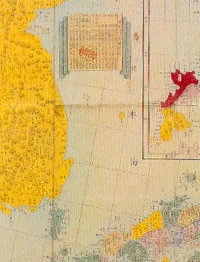
What I meantioned on last post is;
according to Korean source,
1 they were not sure whether Usando and Ullundo are the same island or not.
2 in Usando,there were 15 houses and 86 people.
thus Usando cannot be Dokdo
3 Before the Korean proclaimation of sovereignty(?) of Sokto,Korean officer went to check Ullungdo and mention there were 6 islets adjoining Ullungdo and Usando and chokto are significant.
Usando is adjoining Ullundo,whilst Dokdo is about 90km away from Ullungdo.
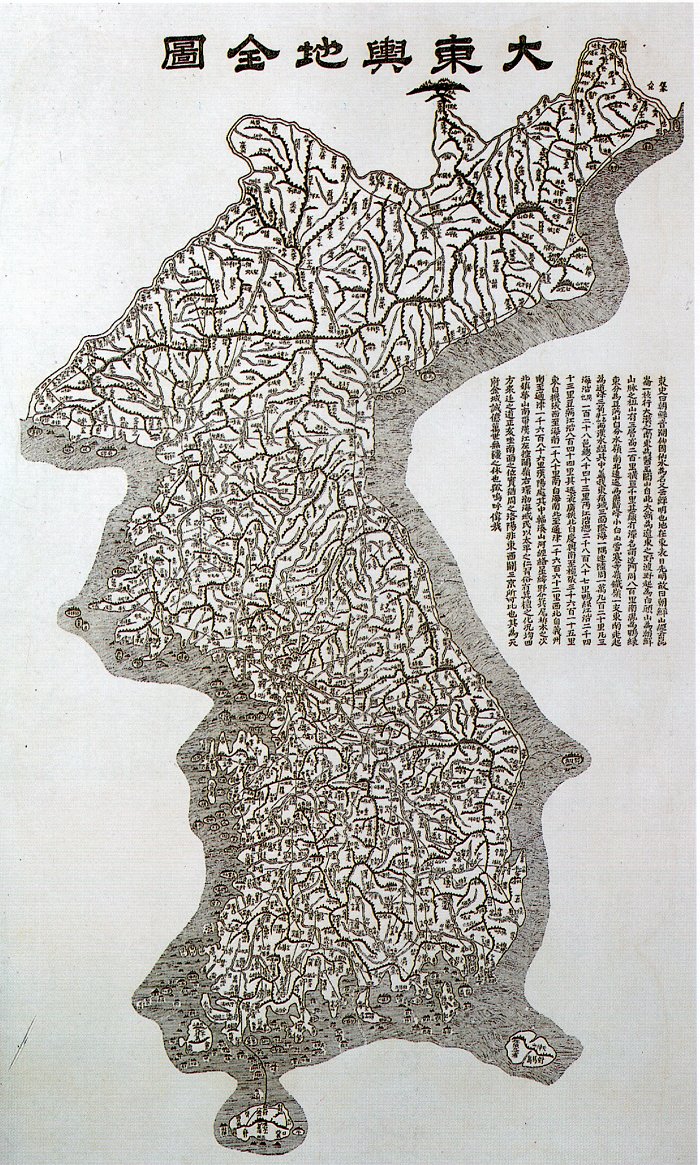
4 Krean map in 1899 inscribe an islet adjoining Ullungdo(north-east) as Usando.
Usando is not Dokdo.
There is no map which shows Dokdo.
There are no proof that shows Sokto is Dokdo.
Usando is not Dokdo... Sokto is not either, therefore Japan didn't really invade Korea and committed no attrocities anywhere in the world at any time. World War II is just a big misunderstanding in which Japan only killed guilty people, comfort women were well paid patriotic volunteers, and Japan was the only true victim (of US nuclear agression.) We need to sell this one hard to the other alleged victims of Japanese agression.
Thank you for clearing that up.
What is with your avatar? I think I know that guy, does he substitute teach in Colton, CA?
Which island is 竹島外一島? 1876-1877 Shimane, Ministry of Home Affairs, State Council
As Shibuyexpat pointed out, I would appreciate it if you could refrain from quoting 2ndary sources of shady nature as that passes on the burden of locating & verifying the original source to the reader when it is your job. It's not considered good practice in a serious discussion.
Here's a nice summary by one who's obviously put some effort into reading and summarizing the facts in clear, succinct language. I am quoting it in full because it's a long thread there and I don't know how to pinpoint that one in particular. (If it's a problem with Flying Yangban policy, I shall remove it. But I hope to reciprocate by contributing at some point. Thanks.)
On how the Lioncourt rocks came to be known as Takeshima.
(0)The Japanese government in 1905 chose to change the name of Matsushima to Takeshima because of the confusion of island names between Japan and the West.
(1) In 1787, a Frenchman, Calaup de la Perouse, discovers Ullungdo and names it Dagelet Island. (Note that ツ"discoverツ" is used to mean that it was discovered by the westerners.)
(2) In 1789, a British, James Colnett, discovers Ullungdo, and due to inaccurate coordinate measurement, thinks it a different island and names it Argonaut Island. Thus, for some time, there were actually two Ullungdo islands drawn on Western maps for some time.
(3) A German, Dr. Philipp Franz von Siebold reads in Japanese literature that there are two islands between the Oki Island and the Korean peninsula, the one closer to Japan named Matsushima, and the one closer to the Korean peninsula named Takeshima. Thus, according to the Western map, he concludes that the closer Dagelet Island must be Matsushima, and the farther Argonaut Island as Takeshima.
(4) However, in 1854, the Russian navy warships Pallada and Olivutsa remeasures the coordinates and finds that Argonaut Island and Dagelet Island are the same islands, the latter having been accurately mapped in the first place. Thus Argonaut Island eventually disappears from Western maps. (quoter's note: Pallada and Olivutsa also rediscover Liancourt Rocks and name the two conspicuous islets Manalai Rock and Olivutsa Rock.)
(5) An extremely complicated situation arose with the discovery of the Liancourt Rocks by a French whaling vessel in 1849 and the discovery of the Hornet Rocks by the British in 1855, prior to the disappearance of the Argonaut Island from the maps.
(6) Although the Liancourt Rocks and the Hornet rocks were both on the same island, in some Western maps, the Argonaut, Dagelet, Lioncourt, and Hornet were depicted as four separate entities on a single map.
(7) By 1870, most maps had dropped Argonaut Island (and the name Takeshima), and by 1900, only Dagelet Island (Matsushima) and Lioncourt (= Hornet) rocks remained. Due to the erroneous naming of Dagelet Island (Ullungdo) as Matsushima, the name Takeshima (the Japanese name for Ullungdo) was lost.
(8) In 1905, when the Japanese government decided to make a modern claim to the Lioncourt rocks, it revived the name by giving the island the name of Takeshima.
Posted by: passerby @ Flying Yangban| March 28, 2005, 08:48 AM
Title, formatting & numbering by Lexico
One more detail. In 1859 the British warship Actaeon also reported that Argonaut did not exist separate from Dagelet.
urecco said:
Yes, the ministry concluded "Takeshima" and "Matsushima" are Choson territory. But they are definitely Daglets and Argonaut checking their degrees and minutes in a Japanese map published in1870, as Tanaka mentions.
竹シマ Takeshima (Argonaut)
松シマ Matsushima (Daglet)
リエンコヲルトロック RienKoworuto Rokku (Liancourt Rocks)
You can see the three islands.
......
In 1858, Japan published a map which inscribes Mastushima as Ullungdo(Dagelet) and Takeshima as Ullungdo (Argonaut; wrong location) and Riankoruto Rock as Liancourt Rocks.
Therefore, the minister said 2 Ullungdos were Korea's.
And there are some maps which show two Ullungdoes.
But you can check if it shows 2 Ullungdoes or not by the location.
You're in the wrong again urecco.
As a passerby states, the so-called "error of Siebold" disappeared in Japan by 1870 with the exception of those in the Navy and the fishing industry. According to such scholars as Hori Kazuo and Choe Suh Myun, the confusion occurred at random. But according to Shin Yong Ha, maps produced and used outside the Navy & fishing industry were in general not affected by "Siebold's error" during the period from the 1870s to the 1880s. (I hope someone can verify this statistically.) Hence those in the State Council "Dashokan" 太政官, Ministry of Home Affairs 內務省, and Ministry of Foreign Affairs 外務省 were little affected if at all.
Furthermore, I shall proceed to prove on textual evidence that the Dashokan-Ministry of Home Affairs rulings do not concern "Siebold's error" at all; that "Takeshima and one other island 竹島外一島 have nothing to do with Japan." The confusion of two names on two places on the map for one physical island does not exist in our case as Mr. Tanaka and urecco would have us believe. Takeshima and Matsushima were two disctinct entities and treated as such in the rulings. Dajokan was not under the influence of "Siebold's error."
The answer comes rather too easy if you would just have a good look at one set of documents accessible at Japanese National Archives of Governmental Records in Tokyo the following.
國立公文書館 請求記號 2A-10-公2032 リ-ル 256 The document is dated the 4th year of 元和 1618 CE.
「日本海內竹島外一島地籍編纂方伺」 後端添記 Nihonkai nai Takeshima hokka itto chiseki hensan kata ukagai (An inquiry of Compilation of Land Register on Takeshima and Another Island in the Sea of Japan), Kobunroku (Official Documents), Dajokan (State Council), ed. Section on the the Home Ministry, Mar. 17, 1877, annex
(1) Isonotakeshima is also called Takeshima (=Ullungdo). It is 120 ri north-west of Oki.
(2) The island is about 90 ri around...
(13) Next there is another island called Matsushima (=Tokdo). The area of the island is approximately 30 chyou and shares the same [straight] sealane [as that leading to] (14) Takeshima. It is 80 ri from Oki. Trees and bamboo are scanty. Sea lions live there.
@ Urecco: The two islands mentioned in this supplement to the official State of Council decision are clearly two separte lslands as this document shows; they are Matsushima Takeshima (=Ullungdo) and (=Tokdo) of the classical period more than two hundred years before the influence of the "Sebolidan errors" from the Western maps.
The Meiji government from top down doubted the possibility of the two islands being part of Japan, and eventually ruled Japan out of any soverign claims to the two islands, Takeshima & Matsushima, aka Ullungdo & Tokdo as they are historically, linguistically, internationally, and effectively recognized/governed by the Republic of Korea.
Refereces in random order
Japanese
Hori Kazuo 1987, 堀和生「一九〇五年日本の竹島領土編入」『朝鮮史研究会論文集』 第24号, 1987
Urecco: The two islands mentioned in this supplement to the official State of Council decision are clearly two separte lslands as this document shows; they are Matsushima Takeshima (=Ullungdo) and (=Tokdo) of the classical period more than two hundred years before the influence of the "Sebolidan errors" from the Western maps.
Have you checked 大韓地誌 written by 玄菜 in 1899 and 大韓新地志 by 張志淵 in 1907?
I agree that Dojokan excluded Dokdo from her territory, yet unless Korea proclaimed her sovereignty over Dokdo by 1905, Japan peacefully got her sovereignty over Takeshima again.
If you insist Sokto is Dokdo, give me a map or document which shows the exact location.
So sorry to hear that. They really messed up with the 竹島 or Argonaut, didn't they? Which has nothing to do with Korea's case. We have our own inaccurate maps, so I won't blame you. But here's what really counts. Imagine one party who's repudiated its claim on numerous counts, and the other with a clean track record. Who has the better claim? Do you stand a chance? :evil::evil::evil:
Part A: Korean Soverignty Firmly Established over Ullungdo and Tokdo
urecco said:
Unless Korean proclaimed her sovereignty over Dokdo by 1905... And as I mentioned before, Usando cannot be Dokdo...
If... Sokto is Dokdo...
Then could you give me the evidence that Korea recongnized Dokdo as her own territory ?
Alright, urecco. Ready for some intensive reading ? I'll save the lecture coz you're a smart fella.
A-1. 512, Tokdo aka modern Takeshima is incorporated into Shilla 新羅 territory with the surrender of the State of Usan that controlled Ullungdo and its vicinity comprising an area covering modern Tokdo. State of Usan pays yearly tribute to the Shilla court. This has been already quoted earlier; so don't complain just yet. Evidence to follow.
A-2. 930, 11th year of King Taejo 太祖 of Koryo 高麗, spring, the second moon, the royal house incorporates Shilla's east coastal prefectures & clusters from Myongju 溟州 to Hungrye 興禮 with citadels numbering 100 and some. Fall, 8th moon, Urungdo 芋陵島 sends emissaries Pakkil 白吉 and Todu 土豆 to offer local goods; they are appointed Rectifier of the Directions 正位 and Rectifier of the Sun 正朝. Non-periodic collection of tribute begins. (this is new)
A-3. 1246, appoints two Pacification Commissioners of Ullungdo 鬱陵島按撫使. (new)
A-4. 1407, 宗貞茂 of Tsushima petitions Choson 朝鮮 Court for permission to take residence on Ullungdo en masse, but request is flatly denied. (new)
A-5. 1425, Kim, In Wu 金麟雨, appointed Pacification Commissioner of Ullungdo 鬱陵島按撫使. (new)
A-6. 1451, completes The History of Koryo 高麗史 in the geographical thesis of which comments that Usan 于山 and Murung 武陵 are two physically distinct yet geographically related islands meaning the knowledge of, and the soverignty of, the two islands goes back to at least the Koryo period (918-1392) even if we consider textual evidence only. (new)
A-7. 1432-1454, compiles The Veritable Records of King Sejong the Great 世宗壯憲大王實錄 the geographical thesis of which clearly restates the two islands Usan 于山 and Murung 武陵 as territory of the sovereign King Sejong the Great.
"The two islands of Usan 于山 and Mulung 武陵 are in the East Sea of Uljin District 蔚珍縣 [these two islands are not very far from each other; on a fine day when the wind is clear, are immediately visible from each other.]" (already introduced)
A-8. 1481/1531, compiles twice A Survey of the Geography of Korea (新增)東國輿地勝覽: 于山島 鬱陵島 [一云武陵一云羽陵二島在縣正東海中三峰岌嶪... 南峰稍卑風日淸明則峰頭樹木及山根沙渚歷歷可見.
"As for Usan Island and Ullung Island, one says it should be Mulung, another says it should be Urung. The two islands are in the sea straight to the east. Of the three peaks, the one in the north is high, whereas the one in the south is low. On a clear day, the pinnacle and trees, and even the foot of the hill and the sandy capes can be seen clearly."
A-9. 1693-1696, An, Yong Bok 安龍福 states before the Prefect 太守 of Houki Province 伯耆州: "松島則于山島此亦我國也... 傾年吾人來此處以鬱陵于山等島定以朝鮮界.
"Matsushima is Usando; this is belongs to my state...I was here last year and confirmed by these places Ullung and Usan Choson territory."
A-10. 1881, King Gojong 高宗 says, "I have heard that Songdo 松島, Jukdo 竹島, and Usando 芋山島 are collectively called Ullung 鬱陵."
A-11. 1898, E. Laporte writes, "蔚珍之東海에一島가有하니曰鬱陵島이라其附屬한小六島中에最著者는于山島竹島니大韓地誌에曰鬱陵島는古于山國이라."
"There is one Island in the Eastern Sea off Uljin called Ullungdo 鬱陵島. Of the six subordinate small islands, the most widely known are Usan Island 于山島 and Jukdo Island 竹島."
A-12. 1900, Oct. 25, Gojong 高宗 issues an imperial edict, "Ullung Prefecture 鬱陵郡 shall govern the whole of Ullung Island 鬱陵全島, Jukdo 竹島, and Sokdo 石島."
A-13. 1906, Mar. 25, Uldo Prefect 鬱島郡守 Shim, Hung Taek 沈興澤 reports, "本郡所屬獨島가在於本部外洋百餘里許이옵드니..."
"Tokdo which has been under this Prefecture of Ullung a hundred li's out in the great Eastern Sea..."
A-14. 1906, Apr. 29, Kangwon Cirtuit 江原道 Surveillence Commissioner 觀察使 reports, "本郡所屬獨島가在於外洋百餘里外에살더니..."
"Tokdo which has been under the Prefecture of Ullung a hundred li's out in the great Eastern Sea..."
A-15. 1906, Apr. 29, Deliberative Council Vice Commissioner 參政大臣 Bak, Jae Sun 朴齋純 issues Directive No. 3, "來報閱悉이고 獨島領地之說은全屬無根이나該島形便과日人如何行動을更爲査報할사"
"Having read your report thoroughly, your comment on Tokdo 獨島 as territory is absolutely groundless. Re-examine the current situation on the island in question and any movements of the Japanese, and report to me."
Part B: Further evidence proves the second island is modern Tokdo 獨島
The fact that Ullung Major designates the extended Ullung sphere of influence encompassing the two physically distinct islands and islet clusters of Ullung proper 鬱陵島 and Tokdo 獨島 is proven by the following.
B-1. 1656, 輿地誌: 鬱陵于山皆于山國地.于山則倭所爲松島也. Geographical Gazette, "Ullung Island and Usan Island are all in the territory of (the old) State of Usan. Usan is exactly what the Japanese call Matsushima "Pine Island." (note: This is Tokdo 獨島, aka modern Takeshima.)
B-2. 1694. 三陟僉使張漢相, 蔚陵島事蹟: "As I gazed towards the east, in the middle of the sea there is an island in the south-east direction. Its size is not quite one-third the size of Ullung, and the distance is not even 300 ri."
B-3. 1792, 增補東國文獻備考: 輿地志云鬱陵于山皆于山國地.于山則倭所謂松島也.
(quote of B-1.)
B-4. 1808, 萬器要覽: 輿地志云鬱陵于山皆于山國地.于山則倭所爲松島也.
(quote of B-1.)
B-5. before 1836, Jong, Yak Yong 丁若庸, 與猶堂全書: "Belonging to Uljin Prefecture 蔚珍縣 are Ullung Island 鬱陵, called Isotakeshima 磯竹島 by the Japanese, and Usan Island 于山 called Matsushima 松島 by the Japanese."
Part C. Conclusion: You'll never get it.
Unfortunately, Dajoukan concluded Takeshima and Matsushima were not Japanese territory in 1877. I agree with you. ...
I agree that Dojokan excluded Dokdo from her territory.
...
Japan peacefully got her sovereingty over Takeshima again.
Urecco, I'm glad you begin to see the significance of that Meiji governmental document. As for peaceful, um...........................................................................................................................................................................................................................................................................................................................................................................................................
日本太政官編 『公文錄』, 內務省之部, 1, 日本國立公文書館所藏, 1877年 3月 17日條, 「日本海內竹島外一島地籍編纂方伺」 後端添記 Nihonkai nai Takeshima hokka itto chiseki hensan kata ukagai (An inquiry of Compilation of Land Register on Takeshima and Another Island in the Sea of Japan), Kobunroku (Official Documents), Dajokan (State Council), Section on the Home Ministry, Mar. 17, 1877, annex. dated the 4th year of 元和 1618 CE, 國立公文書館 請求記號 2A-10-公2032 リ-ル 256.
I'm sure you are also aware that Japan is bound by this statement disclaiming all Japan's rights to Ullungdo and Tokdo aka modern Takeshima and Matsushima; by having said, "Japan has nothing to do with Takeshima and Matsushima." As a result, not only did your State Council exclude the two islands from the land registry for all of Japan, but also recognized Choson's long-held sovereignty over the two islands of Ullungdo and Tokdo.
C-1. Antiquity: Whereas ancestral Koreans had come into contact with Ullungdo 鬱陵島 and Tokdo 獨島 from an early period, quite probably in the neolithic period, and in the 6th century at the latest for sure, the Japanese became only aware of their existence in 1004 CE, and that came from a Korean drifting on a Japanese shore due to a disaster. Koreans have made a living on those islands and the immediate waters surrounding it, while the Japanese came as intruders more than a thousand years later since 512; as intruders into the economic, political, and ecological sphere belonging to Koreans.
C-2. Will: Whereas Korea has always stood fast to its sovereignty over Ullungdo 鬱陵島 and Tokdo 獨島, announcing internally and to any trespassers, Japan has slacked on its claim to either island on more than several counts. Whenever Korea objected to Japan's trespassing, Japan invariably retreated with an apology, often paying a price for the violation of the political boundary.
C-3. Legality, Morality, Humanity: From November 1869 to April 1870, Japan's government dispatched spies engaged in espionage within Korean territory for the sole purpose of annexing and exploiting Korean people, their land, and their sovereignty. In the process of this annexation, our Empress Myong Song 明星皇后 was assassinated August 20, 1895, by a group of men sent by your Emperor Hirohito. Although Korea announced itself neutral before the outbreak of the Russo-Japanese war, Japan mobilized its army in January 1904 and stationed them in Seoul near the Royal Palace.
It was under such military threat that the so-called Shimane ken 島根縣 illegally incorporated Tokdo 獨島 on February 22, 1905. You cannot hold our late Emperor Gojong responsible for not objecting to your Meiji government's vile act of robbing our land Tokdo; primarily because he was facing the gunbarrel. This is not some technicality that you can use to your advantage. Well, your Emperor poisoned ours anyway in 1907 after robbing his Empire in 1905.
You'd better stop asking for Tokdo. I assure you of the lives of my children. You'll never get it. :evil::evil::evil::evil::evil:
Eisuke, I know you have a busy life like everybody else, but please read the posts
#11, #16, #18, #21, #28, and #29.
Your link has been discredited a long time ago. Even urecco agreed in post 28. Let's not be repetitive here. How much more detail do you guys need to see reality? Is it that tough to face? Here are some really useful links. I'll repeat it just to thin out Mr. Tanaka's dishonest readings and falshoods he wants to spread. #Nos refer to post numbers.
Japan’s government approved a new public school textbook Tuesday, a book that China and South Korea immediately denounced for whitewashing Japan’s World War II atrocities.
www.nbcnews.com
#3: no title
Distorted Japanese History Textbooks Are Approved Related post
I didn't knowingly link any maps. They're only good for the international courts of justice that are on their way out. Common evolutionary sense tells us, "Change or die, you imperialist international courts of justice !"
A-8. 1481/1531, compiles twice A Survey of the Geography of Korea (新增)東國輿地勝覽: 于山島 鬱陵島 [一云武陵一云羽陵二島在縣正東海中三峰岌嶪... 南峰稍卑風日淸明則峰頭樹木及山根沙渚歷歷可見.
"As for Usan Island and Ullung Island, one says it should be Mulung, another says it should be Urung. The two islands are in the sea straight to the east. Of the three peaks, the one in the north is high, whereas the one on the south is low. On a clear day, the pinnacle and trees, and even the foot of the hill and the sandy capes can be seen clearly."
Do not omit the last part.
風便則二日可到 一説干山 鬱陵 本一島
You can reach (there) in 2 days in fine wind.
Some say Usan and Ullung are the same island.
A-11. 1898, E. Laporte writes, "蔚珍之東海에一島가有하니曰鬱陵島이라其附屬한小六六島中에最著者는于山島竹島니大韓地誌에曰鬱陵島는古于山國이라."
"There is one Island in the Eastern Sea off Uljin called Ullungdo 鬱陵島. Of the six subordinate small islands, the most widely known are Usan Island 于山島 and Jukdo Island 竹島."
1898 "Of the six subordinate small islands, the most widely known are Usan Island 于山島 and Jukdo Island 竹島."
1899 A map was published
Actually, there are 6 islands around Ullungdo. The Northeast one is inscribed as Usan.
How can Usando be Dokdo?
A-13. 1906, Mar. 25, Uldo Prefect 鬱島郡守 Shim, Hung Taek 沈興澤 reports, "本郡所屬獨島가在於本部外洋百餘里許이옵드니..."
"Tokdo which has been under this Prefecture of Ullung a hundred li's out in the great Eastern Sea..."
ICJ: What can it do for the victims of colonialism, Japanese & Other ?
Eisuke, what do you know about the International Court of Justice ? You wasted two post counts with no content worth noting. While you make empty claims, some people strive to convey genuine content. Try to absorb some because you seem to need the information.
The Asian Perspective on the International Court of Justice
Here are some serious criticisms that ICJ is facing due to its formation, function, and activities in the past.
1. What is the nature of ICJ ?
2. How is it viewed upon by former victims of colonialism ?
3. How was the sole Asian case ICJ handled, the Vrai Vuehell Temple Case between Thailand and Cambodia ?
4. Why is the Vrai Vuehell Temple Case considered a mistrial that should never have happened by many Asian countries ?
5. Why is an establishment of an Asian International Court of Justice (ICJA) needed for future arbitrations of international conflicts involving Asia ?
Kajimura Hideki, former Professor of Kanagawa University, states in "The Question of Takeshima/Tokdo,"
"In Japan, Korea's attitude of not responding to the 'arbitration by authoritative international organization' is generally regarded as incomprehensible and unreasonable. 'If you are so confident, wouldn't it be better to face a trial ?' the Japanese say, but is it really so ?"
"Korea counters that originally there is no dispute on the island, and there is no need to be troubled by a trial since it is Korea's inherent territory. It is not that they are not confident, but it ought to be seen from their deep-rooted distrust of the existing international judiciary organs."
"One may go so far as to say there is no 'firmly established and authoritative' practice or international law which is not influenced by the convenience of the Great Powers in today's world. It is the reality of today that the structure of the old international law formulated druing the days of imperialism dividing the world is sharply pitted against the opinions of newly developing countries that the old international law be reorganized."
"We must take note of the fact that Japanese emphasis on international arbitration means to use it as an absolute shield of the existing imperialistic international law, while Korea puts its basis on the logic of change and reform."
"In the domain of international law, there does not exist a body of written laws, such as a constitution. What is existing is a logical system worked out mainly by the scholars of the imperialist states since Grotius and the precedents decided by the international judiciary organizations. They are relatively simple. The documents concerning a new international order, now being prepared by the UNCTAD (U.N. Conference on Trade Development) are not directly binding on an international judiciary organization."
"The first international judiciary organization was PCIJ, Permanent Court of International Justice established after World War I, out of the need of the imperialist powers to make some rules on dividing foreign territories as it became difficult to resolve by war. After WWII the present ICJ, International Court of Justice, came into being."
"Both PCIJ and ICJ do not have great competence and authority on the sovereign nations, and bringing a lawsuit over a dispute or not is up to the sovereign nations concerned. A trial can occur only when both countries involved in a dispute agree."
"There are numerous instances in which one country wanted to sue but the other refused. Even if a judgement is passed, the argument arises that it is all right not to heed the judgement in spite of possible reproach or retaliation as ICJ does not have any legal force."
"In the past and at present, judges at the International Court of Justice are mostly the 'white men' belonging to the advanced countries. The judge is not bound directly by his nationalirty, but when looking at it empirically, he is not completely free from his sense of values. What PCIJ and ICJ handled was limited to cases between the same (kind of) imperialist countries and relatively insignificant cases."
"Only a few Asian cases have been brought before the court. The Indian takeover of Goa without filing a lawsuit cannot be justified and affirmed under any existing international law, but it received wide support from the newly developing countries as a direct anti-colonial action."
"If the problem of Takeshima/Tokdo were brought to ICJ, the evaluation of Japan's 1905 incorporation would become a big point of dispute. As today's ICJ attaches importance to the 'effective occupation' rather than historical background, it is uncertain whether it will acknowledge Japanese incorporation as imperialist aggression or the formalities of its effective occupation as defective, even if it accepts all the historical facts that Korea claims."
"The present-day ICJ is not well accustomed to the concept of imperialist aggression. The Minquiers and Ecrehos Case between Britain and France, ruled 1953, is cited as much resembling the Tokdo/Takeshima case. The Minquiers and Ecrehos Islands are a group of uninhabited reefs off the Normandy Peninsula and were under the control of a Normandy tribe. But when the British-French treaty in the 13th century stipulated that all the possessions of the Duke of Normandy would be turned over to France, the name of the islands was not specifically written down."
"While France did not take any administrative measure by assuming that the islands were naturally French territory, the British in the 19th century recognized its fishing value and started utilizing it taking various administrative steps. ICJ attached great importance to the detailed instances of effective occupation since the 19th century. Despite the French claim of historical legitimacy, ICJ ruled in favor of Britain by regarding the French failure to lodge any protest as an abandonment of its territorial rights."
"Of course the Takeshima/Tokdo issue is greatly different from this case from the standpoint of the length of the period of dispute and that it occured in the course of imperialist aggression. But if the judge has no sense of distinguishing this difference, he can possibly pass a judgment that Korea was negligent in keeping its territorial rights by following the precedent of the Minquiers and Ecrehos Case."
Vrai Vuehell Temple Case: Thailand vs. Cambodia
"The sole Asian case ICJ handled is the Vrai Vuehell Temple Case between Thailand and Cambodia, and its judgment is said to have been contemptuous of Asians. When the Thai King concluded a treaty of boundary demarcation with French Indochina, this temple was on the Thai side of the boundary, and therefore defined as Thai territory under the stipulations of the treaty."
"The dispute occurred afterwards as the French military office which made the map to be attached to the treaty, commissioned by the Thai King, placed it in the Cambodian territory, whether accidentally or intentionally. ICJ ruled in favor of Cambodia, by assuming that the Thai King gave a tacit consent to the map by distributing its copies afterward and by not requesting correction of the map."
"The Thai side thought there would be no problem since it was written down clearly in the treaty as Thai territory. It must have distributed the maps believing it was a convenient map, except for the 'insignificant error.' In other words, it was ICJ's view that the country which remained idly by and was incapable of correcting the mistake certainly deserved to receive punishment. It overruled an accumulation precedents by putting importance on the attached map before the text of the treaty."
"When viewed from the Asian perspective, it is difficult to assent to ICJ's decision. It may be a personal opinion, but it is noteworthy that Professor Lee Han -ki criticized the imperialist nature of ICJ and argued that Korea could safely entrust the Takeshima/Tokdo problem onlt if an Asian International Court of Justice (ICJA) were born."
(for details, please see Lee, Han-ki, Han'guk ui yongt'o (Korea's Territory), Seoul: Seoul National University Press, 1969)
"Korea is not trying to be blindly stubborn and obstinate. The Korean government is making an utmost effort to make 'effective occupation' that may easily be acceptable to the Euro-American logic while it respects assertions by the Third World Countries."
Kajimura, Hideki, "The Question of Takeshima/Tokdo," Korea Observer, Vol. 28 No. 3, Autumn 1997: 468-471
The original Japanese version of the article appeared in Chosen Kenkyu (Study of Korea), No.182, Sept. 1978
International Law and the Territorial Question
Sato Shojin, in "Japanese Expansionist Policy and the Question of Tokdo" states,
"In September 1954, the Japanese government proposed that the Korean government bring the question of Tokdo before the International Court of Justice, but this suggestion was rejected by Korea."
"Korea's rejection was considered just. According to Prof. Lee Han-key, 'International law is for imperialist countries even today, and it is impossible to depend on international law for clear-cut criteria for definition and demarcation of national boundaries.' It can be said that the International Court of Justice is still under the influence of imperialist countries."
Sato, Shojin, "Japanese Expansionist Policy and the Question of Tokdo," Korea Observer, Vol. 29 No.1 Spring 1998: 182
What are we seeing in Japan now ?
"Around the end of January 1905, the Japanese cabinet decided to incorporate Tokdo aka Takeshima into its territory. This came to the knowledge of the Korean government at the end of March 1906. In November 1905, four months prior to this, Japan had made Korea its protectorate, barring the latter from taking any counteractions against the actions the former took."
"In August 1945, Korea was freed from Japanese occupation, and Japan was placed under U.S. occupation and abandoned Tokdo. But in 1951, when its soverignty was restored by the conclusion of the San Francisco Peace Treaty with the U.S. and the Allied Powers, Japan began laying claims to Tokdo."
"The annexation of Tokdo during the Russo-Japanese War 1904-1905 should be examined in the vein of Japan's pursuit of an expansionist policy and analyzed in the overall process of the demarcation of territories by Korea, South and North, China, Russia, the Philippines and the U.S."
"Japan's post-war move to claim Tokdo as its territory is linked to its colonization of Ainu Moshiri and Okinawa . This move, along with its demand for the reversion of the Northern Islands, may be viewed as Japan's return to its imperialist expansionist policy of the past."
Sato Shojin, "Japanese Expansionist Policy and the Question of Tokdo," Korea Observer, Vol. 29 No.1 Spring 1998: 165-166
Reoccupation Attempted: What ought to be done ?
"While the Korean War was being fought, Japan, the U.S. and 48 other countries signed a Treaty of Peace in San Francisco in September 1951. The Japanese economy was revived by the mass production of materials for the U.S. troops in Korea."
Taking the Korean War as an opportunity 'Japanese imperialism' revived, and Japan is now laying cliam to Tokdo, the Northern Islands, and Chokyoto (Chogyodai). Today Tokdo is defended by Korean Police and is kept from Japan's seizure, but Japan has occupied Chogyoto since Okinawa was returned to Japan by the U.S. on May 15, 1972. It was on January 14, 1895, that the Japanese government decided to take possession of the island during the Sino-Japanese War."
"Japan refers to the four Northern Islands as Northern Territories and is demanding Russia to return them. The Russian government should return the islands not to Japan, but to their original inhabitants; Japan and Russia must return them to their original owners, the Ainu Moshiri including Sakhalin, the Kuriles, Hokkaido and the Maritime Province of Siberia."
Sato Shojin, "Japanese Expansionist Policy and the Question of Tokdo," Korea Observer, Vol. 29 No.1: 181 Spring 1998
What is Ainu Moshiri ?
"'Ainu Moshiri' means the 'Earth where the Ainu live' in the Ainu language. The Ainu people are an ethnic minority group in Japan, numbering several tens of thousands and mostly living in Hokkaido. They claim to have come to live in the Ainu Moshiri comprising Hokkaido, the Kuriles and Sakhalin during the Jomon age in Japan, 3,000 to 4,000 years ago. They have their own language, religion and culture, and maintain that they have been discriminated against, particularly since Japan's colonization of Hokkaido during the Meiji era , and that a new Ainu legislation should be enacted replacing the 'Hokkaido Former Aborigines Protection Act,' allowing them 'a higher degree of autonomy' for self-determination."
(Yamamoto Kazuaki, ed., Ainu Moshiri: ainu minzoku kara mita hokppo ryodo henkan kosho (Ainu Moshiri: Negotiations on the Reversion of the Northern Islands as viewed by the Ainu People) Tokyo: Ochanomizu shobo, 1992, pp. i-iii, 335-6;
Sato, Shojin, "Kokumin kokka nihon no ainu moshiri shokuminka to Chosen shokuminka" (Japan's Colonization of the Ainu Moshiri and Korea), Azia mondai kenkyu shoho (Journal of the Institute for Asian Studies), Dec. 1997, pp. 1-16;
also see the statements submitted by the Ainu Association of Hokkaido to the working Group on Indigenous Populations in Geneva, Switzerland in Aug. 1987, Aug. 1988, and July 1993;
the inauguration speech by Nomura Giichi representing the Ainu Association of Hokkaido at the opening ceremony of the International Year of the World's Indigenous Peoples at the UN General Assembly on Dec. 10, 1992)
Sato, Shojin, "Japanese Expansionist Policy and the Question of Tokdo," Korea Observer, Vol. 29 No.1 Spring 1998:165-166
Japanese Expansionist Policy and the Question of Tokdo: Conclusion
"The Japanese occupation of Tokdo was the initial step towrad the invasion of Korea . The Japanese fishermen had encroached upon Korean waters and islands such as Komundo, Ullungdo, and Narodo; sometimes they built settlements of Japanese 'emigrants' and infringed on Korean fishing grounds."
"At the beginning of 1910, Foreign Minister Komura Juntaro spoke before the Budget Committee of the House of Representatives of the Diet:
'...To concentrate emigrants in Manchuria and Korea is to concentrate the Yamato (Japanese) people. Prior to the Russo-Japanese War, Japan had been an insular country, but as the result of the war, it has become a sort of continental state.'
(The Proceedings of the First Sub-Committee of the Budget Committee, the House of Representatives, the 26th Imperial Diet, pp.5, 17)
"The Japanese government dispatched Japanese to Korea and Northeast China not only as combatants but also as emigrants to settle down there, turn the areas into Japanese territories, multiply the Yamato people, and to convert the island country of Japan into a continental state."
"Had Japan not suffered the defeat in the Asian War and the Pacific War, the multitude of Japanese would have settled down permanently in Northeast China, Korea, Taiwan, Saipan, and Palau, forced the emperor system and the Japanese language upon the natives, and dominated them under the slogans of 'Five Races in Harmony' or 'Korea and Manchuria are one body.'"
(Kim, Chong Mi, Suihe undoshi kenkyu (A Study of the History of the Social Equality Movement), (Tokyo: Gendai kikaku shitsu, 1994), pp. 263-301)
"Those Japanese 'emigrants' who had invaded many parts of Asia and the Pacific compelled the local peoples to use the Japanese language, built shinto shrines, and renamed places in Japanese style. As the war ended, these shrines were destroyed and the place names reverted to the original ones in Taiwan, Korea and Northeast China."
(Kim, Chong Mi, "Nihon kokumin kokkato nihonjin imin" (Japan and Japanese Immigration), Sabetsu to kyoseino shakaigaka (The Sociology of Discrimination and Symbiosis), Iwanamikoza Series, Modern Sociology, Vol. 15 Tokyo: Iwanamishoten, 1996, p. 129)
"As has already been observed, Sakhalin and Hokkaido were the lands of the aborigines who had first settled down there. The Japanese move to reoccupy Tokdo and reclaim the Northern Islands is but a link in the chain of its overall imperialistic design against other lands and peoples today to expand its territories including the economic water zone."
"The history of Japan's aggression still continues today. The Ainu Moshiri that includes the islands of Kunashiri, Etorofu, Habomai and Shikotan (these are Ainu words) and that is termed 'Northern Territories' by the Japanese government is, in fact, the homeland of the Ainu, Uilta, Nivx and other northern peoples. To free the Ainu Moshiri from the colonial control of Japan is a prerequsite to the task of checking Japan's reoccupation of Tokdo."
(Kim, Chong-mi, "Higashi azinai okeru inta nashonarizmu no rekishi" (History of Internationalism in East Asia);
Sato, Shojin, "Nihon kokkato ainumoshiri shokuminkato Chosen no shokuminka" (Japan's Colonization of Ainu Moshiri and Korea), Azia mondai kenkyu shoho (Journal of the Institue for Asian Studies), No. 12, 1997)
"In the midst of the imperialistic war between Japan and Russia, both trying to colonize Korea, the former took possession of Tokdo and proceeded to annex all of Korea. It was 36 years before its occupation of Tokdo that Japan named Ainu Moshiri 'Hokkaido' and incorporated it into its territory."
"Historically, Tokdo has been within the domain of Korea, and it will become a part of the territory of a unified Korea in the future. It is the territory of South Korea now."
"If the Japanese scholars of modern/contemporary Asian history wish to forestall Japan's designs of aggression on other lands and countries, they are advised to cope squarely with the Japanese move to reoccupy Tokto and to re-claim the title of the northern islands. This research activity involves an ideological implication to concur with or to negate aggression. It bears on the basic perception of history of the resercher."
"If a researcher wishes to check Japan's attempt at the reoccuopation of Tokdo, he should
1) clarify the facts and the historical meaning of the occupation of Tokdo in the course of Japan's aggression against Korea, and
2) critically examine the history of Japanese emigration, i.e. the history of Japan's colonization of foreign lands and peoples."
Sato, Shojin, "Japanese Expansionist Policy and the Question of Tokdo," Korea Observer, Vol. 29 No.1 Spring 1998: 182-185
Why do the maps show Usando Island as closer to land than Ullung Island? If the erroneous measurement of Argonaut explains the error of reversing Matushima and Takeshima on Western and Japanese maps (these began to appear after 1854 when the existence of Argonaut with its wrong position was denied), how can we explain Korean maps that reversed Ullungdo and Usando (Tokdo) 400 years earlier than these Western and Japanese maps?
New evidence to explain the oddly positioned (reversed) islands. In fact, they are not reversed but show a consistent mental map reflecting ocean currents and seafaring utilizing these sea currents.
quote:
崔書勉씨는 獨島를 연구하기 위해 朴正熙 대통령에게 軍艦(군함)을 빌려 포항에서 울릉도를 항해했다. 삼척, 강릉이 지리상으로 울릉도에 가까움에도 여객선이 포항에서 울릉도를 가는 것을 보고 이것은 필시 海流 때문일 것이라고 추측하고 이를 증명해 보이기 위한 것이었다.
>Choe Suh Myun petitioned for permission to board a navy vessel to study Tokdo. Observing the unusual phenomenon that despite Samchok and Kangnung being closer to Ullungdo, passenger boats shuttled from Pohang instead which is farther away. Hypothesizing that this must be due to the sea current, he set out to verify it.
>崔씨는 당시 출판된 「日本 沿岸 항해지」의 저자인 영국의 세인트존스 함장 지도에 獨島가 三峰(삼봉)으로 표시돼 있는데, 우리 역사 기록에 獨島가 三峰島(삼봉도)라고 기록돼 있어 文獻(문헌)이 일치함을 보고 놀라지 않을 수 없었다고 한다.
>Mr. Choe also took note of the fact that the British map by St. Jones also denotes TOkdo as Sambongdo 峰島; the age-old records of the Tripple-Peak Island had an outside corroboration.
>우리나라 古地圖에는 울릉도와 한반도 사이에 于山島(우산도)인 獨島가 실려 있는 것이 많다. 그런데 獨島는 실제로는 울릉도 밖에 있다. 그렇다면 울릉도 안에 있는 우산도라는 獨島를 어떻게 봐야 하는가.
>In fact many Korean maps of old places Usando which is Tokdo between Ullungdo and the peninsula. But physically Tokdo lies outside Ullung Island. How can this obvious discrepancy explained?
>窶コテ?鞘?倪?「テ?#50472;는 ツ『이 문제는 우리가 풀어야 할 중요한 문제ツ』라고 했다. 이를 위해 窶コテ?鞘?倪?「テ?#50472;는 ナ?C窶板ャ에 의해서 이러한 지도가 그려지지 않았는가 하는 ヒ愿ッ說(가설)을 세우고 해류답사를 거듭했다. 실제로 울릉도 テ?テ補?懌?。와 한국에서 가장 가까운 곳은 강원도 삼척 일대이다.
>"This was a major mystery to be solved," spoke Mr Choe. In order to solve the mystery, he studied in detail the currents that Tokdo Island intersects. Physically the closest place on the peninsular coast to Ullungdo and Tokdo is near Samchok, Kangwon Circuit.
>그럼에도 울릉도에 가는 배는 三陟(삼척)에서 가지 않고 그 밑에 있는 浦項(포항)에서 출발한다. 이것이 곧 海流의 지배를 받는 현상 때문이라고 판단하고 답사를 계속한 것이다.
>Nevertheless boats going to Ullung Island depart from Pohang. Assuming that this phenomenon is due to the influence of the ocean currents he conducted the study.
>그 결과, 비밀을 발견했다. 즉 포항에서 해류를 따라 엔진을 끈 채 항해하면 獨島가 먼저 보이고 나중에 울릉도가 나타난다. 그러다 보니까 옛날 사람들은 독도가 울릉도와 한반도 사이에 있는 것으로 생각했고 古地圖에도 그렇게 표시돼 있다는 것이 그의 설명이다.
>The result was indeed revealing. If the boat is left to drift without the engine running, he learned that Tokdo comes into sight first, and Ullungdo second. This must have caused medieval Koreans to picture a mental map of Tokdo closer to land than Ullung Island. Before the introduction of modern cartography, Koreans naturally transferred their mental map of Tokdo and Ullungdo onto paper.
>崔書勉씨는 이 답사를 기초로 서울 안국동에서 구입한 400여 장의 지도를 분석해 시대順으로 독도의 위치를 點(점)으로 표시한 결과, 현재 지도상의 「獨島 移動 軌蹟說(독도 이동 궤적설)」이라는 假說을 세울 수 있었다.
Armed with his newly founded theory, Mr Choe went further to examine around 400 maps collected from the antique book stores in Ankukdong, Seoul. Transcribing the time-series of the relative Tokdo positions to Ullungdo and the Eastern Coast, he was able to extend his theory to what he called "The Theory of the Shifting (Cartographic) Tokdo."
>덧붙여 그는 『일본 측이 옛날부터 우리가 獨島를 일관되게 獨島라고 부르는 것과는 달리 다케시마(竹島)와 마쓰시마(松島) 두 가지로 혼동해 불렀다』면서 『독도가 일본 고유의 영토라면 이런 혼동은 있을 수 없는 일』이라고 했다.
As an aside, he adds, "As opposed to Koreans who attached consistent names distinguishing Tokdo and Ullungdo in the course of time, the Japanese reversed the insular names without much consistency. If Tokdo were inherently Japanese, we wouldn't expect such confusion."
Preface to my next posts on the events leading to Japan's forceful taking of Tokdo...
lexico said:
C-3. Legality, Morality, Humanity : From November 1869 to April 1870, Japan's government dispatched spies engaged in espionage within Korean territory for the sole purpose of annexing and exploiting Korean people, their land, and their sovereignty. In the process of this annexation, our Empress Myong Song 窶督セツ青ッツ皇ツ后 was assassinated August 20, 1895, by a group of men sent by your Emperor Hirohito. Although Korea announced itself neutral before the outbreak of the Russo-Japanese war, Japan mobilized its army in January 1904 and stationed them in Seoul near the Royal Palace.
It was under such military threat that the so-called Shimane ken 窶懌?。ツ債ェテ」p illegaly incorporated Tokdo テ?テ補?懌?。 on February 22, 1905. You cannot hold our late Emperor Gojong responsible for not objecting to your Meiji government's vile act of robbing our land Tokdo; primarily because he was facing the gunbarrel. This is not some technicality that you can use to your advantage. Well, your Emperor poisoned ours anyway in 1907 after robbing his Empire in 1905.
As you seem to be overwhelmed by my statement, urecco et al., and I have only given you the cream off the top, it came to my attention that you might not have enough background knowledge to understand my rather terse information.
Therefore I shall continue without being asked to explain, only to shed some light on the Tokdo=Takeshima discussion. Mind you that the facts presented here are such that your history book authors have neglected out of choice, causing the huge outrage all over East Asia from those who know from first hand experience and genuine documents recording those historical events.
The highest form of learning we get from history is that of cause and effect. Every single decision made, every single word uttered, every single action taken by a government shall become known, analyzed, and passed judgement upon by both contemporaries and posterity, by Japanese and non-Japanese whether you like it or not.
Unless of course you excercise effective genocide or democide until there is left no one to claim anything. But then your conscientious citizens will ask you. You can incarcerate them. Then let the very stones cry out; what have you wrought, o, Great Empire of Japan !
Distortion of History as an Instrument of Invasion: late Tokugawa to early Meiji
Choson, Tsushima, and Meiji Relationship: Changes in the Late 1800's
"When studying Korean-Japanese relations or the distortion of Korean-Japanese history of the Meiji period, we should study the influence of the Choshu clan. Whereas Satsuma tried to gain a political initiative by using the issues of Ryukyu and Taiwan, Choshu strove to control political power in the new Meiji government over the Choson issue."
"As the Choshu failed to gain Shogunate support to win over Tsushima lying on the borderline of Choson and Japan, it aligned Tsushima into its anti-Shogunate campaign while giving it support. During this process the idea of occupying Choson surfaced by the end of the Shogunate period as Japan's view of Choson was being rewritten."
"According to Choshu clan documents, the so-called 'invasion of Choson by Jingu the Yamato Queen' and the historical invasion of Toyotomi Hideyoshi were praised as brilliant achievements. This chauvinistic position was intended to emphasize the difference between the bellicose Choshu and the Shogunate government which maintained friendly relationships with other neighboring countries."
"It also showed Choshu's determination to invade other countries... Tsushima, supported by Choshu, demonstrated its strong desire to achieve independence from Choson and expressed its contempt for Choson and consistently solicited the aid of the anti-Shogunate faction."
"Students such as Kido Takayoshi , of Yoshida Shoin (1830-1859) at his private school Shoka sonjuku, sought to distort Japan's history with its neighboring countries and ferment tensions with them for Japan's advantage. This effort was in cooperation with a Tsushima samurai by the name of Oshima Tomonojo."
"As the Tokugawa Shogunate was toppled, and the new Meiji government was established, and the Choshu, Satsuma, and Tosa clans occupied important positions in the new government and emerged as a dominant group, Tsushima began to be under the influence of this group."
"Accordingly when Tsushima drafted and sent an official note to the Korean government, notifying the latter of the establishment of a new government in Japan, the format and substance of the letter were in breach of the past practice by denying Tsushima's dependence on Choson, and consequently the very framework of the traditional Korean-Japanese relations."
"Tsushima had upto that time been the sole channel of intercourse with Korea, and represented the Korean government in the issuance of a visa or permit in the form of tallies (Kamhap, kango) with the copper seals (toso, tosho) provided by the Korean government for tally trade with (passage to) Korea."
"In addition an emissary that Tsushima sent to Korea ignored the customary intermediary of a Korean translator-interpreter and contacted the magistrate of Tongnae directly. Also the letter contained some provocative phrases claiming that previous Choson-Japan relations had been merely private intercourse and that only the new requests in the letter could be considered as constituting the official relationship."
"It was generally believed that the letter was designed to provoke Choson into refusing it and to stir up public opinion and create a climate favorable to an invasion of Choson. In this way Choshu tried to establish a firm political leadership in changing the clan-centered Japanese political system into a centralized government structure."
"There was an implicit agreement between Choshu and Tsushima that the newly formed Meiji government should provide aid to Tsushima if Choson stopped its economic support to Tsushima. Kido repeatedly stressed a crisis of war with Korea and proposed the creation of armed forces under the direct command of the emperor and the consolidation of local clans into a centralized government."
"He also called attention to the fact that unless strong measures were used to take care of the many warriors employed and trained by various clans around the end of the Shogunate period, there could be a risk of domestic conflict. These urgings demonstrated the internal state of Japan in which a war was needed regardless of its outcome, victory or loss."
"This situation was quite similar to the political environment existing in Japan just before the Hideyoshi invasion of Korea in the 15th century. It is worth noting that Tsushima was involved in Kido Takayoshi's strategy aimed at containing internal disarray in Japan by focusing on external threats."
"Tsushima and Choshu failed to inveigle Korea into rejecting receipt of the letter. As part of their efforts to create tensions between Japan and Choson, Choshu and Tsushima claimed to be experts on Korean affairs and tried to brainwash the central government leaders with distorted historical relations with Choson."
"Distortion by these clan members includes; embellishing Queen Jingu's legendary 'conquest of the Three Kingdoms of Korea' as a historical fact, and to extoll Hideyoshi's invasion of Korea (1592-1598) as a 'heroic event' rather than an 'unjustified war' as was generally believed previously."
"In addition Choson's emissaries to Japan were described as tribute-bearing missions. They argued that the rice and legumes annually provided to Tsushima by Choson were a tribute for Japan's role in stopping the Japanese marauders. They further said that Choson did not accept Japan's note, notifying the former of the Meiji Restoration , because it contained such characters as 'imperial' or 'royal' referring to the Japanese emperor."
"They regarded this as an expression of contempt toward the Japanese emperor and fanned public opinion against Korea and held Korea responsible for the rupture of the negotiations between the two countries. This was the beginning of a full-scale campaign of distortion of the facts."
"Through careful analysis of this distortion process we could contribute to overcoming the differences in historical perceptions. It is noteworthy that the issue of Ullungdo and Tokdo came to the fore during this period of historical distortion."
excerpted from Hyun, Myung Chul, The Japanese Perception of Tokdo During the Opening of Ports, Korea Observer, Vol 29, Spring 1998: 99-102
From November 1869 to April 1870, Japan's government dispatched spies (who) engaged in espionage within Korean territory for the sole purpose of annexing and exploiting Korean people, their land, and their sovereignty.
The dispatch of a diplomatic mission and the analysis of its report on Tokdo: Part 1
"In the midst of the confusion attendant of Choson's 'refusal to accept the letter,' the Japanese Foreign Ministry became suspicious of the Choshu-Tsushima contact with Korea, and decided to dispatch a mission to establish direct diplomatic channels between Choson and Japan going over the head of Tsushima."
"With this as the turning point, Japan actively began to develop a new diplomatic relationship with Choson. The first diplomatic mission to Korea included Moriyama Shigeru ツ森ナスR窶禿? Sada Hakubo ツ住窶彡窶昶?卩?ツ? and Saito Ei テ「V窶慊。ナセテ? However, Tsushima supported by Choshu, opposed the dispatch of the mission by the central government in denial of its vested rights as the sole channel of contact with Korea."
"The Foreign Ministry planned eventually to take over the channel of diplomatic contact with Korea from Tsushima, but tried to appease Tsushima temporarily by posing the three as 'observers' internally and as officials of Tsushima vis-a-vis the Korean government. Of course Choson knew that they were actually dispatched from the Meiji government and was irritated that the Japanese mission might exert pressure on Choson to accept the letter."
"Considering that previous attempts to dispatch diplomatic missions on several occasions from around the end of the Shogunate had been aborted, this mission was important in understanding the diplomatic history between Korea and Japan. The dispatch of naval officer Katsu Kaishu , Foreign Ministry Official Mukayama Eigoro and Foreign Ministry official Hirayama Seisai was planned in 1863, 1864, and 1867 respectively, but was never realized."
"Although the list of the items to be studied by the mission is rather lengthy, it illustrates the historical perceptions of the Japanese government of the time and can be seen as providing a historical framework for the Japanese colonial view. Therefore it is reviewed here in full:"
Nov. 1 said:
ツ−. ナ団窶卍キナ陳ウヒ彗ヒ??#63789;窶卍ゥ窶朗ナ。ツ?ニ塚?椎?ツ信ナスgツ債キ窶ーz窶敕銀?コツ「ニ知禮ニ停?卩スツキ來ナ津ウナ陳ウ窶燃.
1. What was the beginning of Choson's dispatch of emissaries for the rites of a feudal subordinate since the reign years of keichyou (1596-1614) and Genka (1615-1623) ?
ツ−. 窶コ窶敖州ニ塚?椎?窶卍ゥ窶朗窶堙鳴債キナ陳ュニ団ナ津ウナスgナステ槌知禮窶弋,窶卍ゥ窶朗ニ塚?椎?窶コ窶敖州ニ蜘ツ債キ窶從ニ団ナ津ウナスgナステ槌知禮窶弋.
2. What was the protocol regarding Tsushimashu emissaries to Choson and that of Choson emissaries to Tsushima ?
ツ−. 窶卍ゥ窶朗ナ。ツ?ニ塚?椎?ナ?ツィツ坂?。ヒ?ウニ停?卩ステウナ津ウ窶燃, 窶ーEニ地窶慊ッナ。ツ?ツ青ァ窶忸ニ男ナステヲ窶愿シツ貢ニ停?卩ステウナ津ウナステヲヒ?オニ段ニ停?ケツ催?
3. What was the reason for receiving tallies (Kamhap, kango) with the copper seals (toso, tosho) from Choson ? Is this considered as tributary reception by Choson according to Choson's institutions ?
ツ−. 窶卍ゥ窶朗ニ知ナ。ツ?テゥ窶慊臣禮ニ停?卩ステウニ停?ケナ。ツ?ニ男ナステヲニ椎?窶徒窶ケナセニ知ツ青ウツ催アニ停?吮?ケテと陳照暖窶ー]ニ暖ニ停? ナ。ツ?ツ青ュニ男ナスナ?ニ弾ニ地ナスツゥツ催凖?テ閉敕脆知ナセテ懌?氾哉但ニ停?ケツ催?
4. Regarding the status of Choson, does it have the independent power to excercise its decision over its tributary state (Tsushima), although it might observe the calendar of Beijing ?
ツ−. ツ皇ナスg窶敕ュツ債キナ陳ュナ津ウツ静淒津、ナ坦ナ?テ最ステア窶「{窶ケテ淒?Cニ蜘窶敕ュ窶佛?窶ーテエナ津ウニ男窶「t良ツ港窶猫窶督ウ.
5. At the time of the emperor's emissary's dispatch, is there an adequate harbor for a naval vessel in the ocean waters near the capital ?
ツ−. 窶卍ゥ窶朗ナ。ツ?ニ知窶ケV魯ツ青シヒ慊アニ知窶愿??「ツォニ男ツ心テァテ業団窶ーAニ男窶「テ崘津ャヒ?凝サツョニ談ニ停?ケ窶「窶版致ナ?ナス窶ケツォ略論.
6. What are the rumors of Choson, being intoxicated by the poisonous kisses of Russia, requesting its protection, or rumors of Annexation ?
ツ−. 窶卍ゥ窶朗ナ。ツ?ナ?C窶板、ナ坦窶「ツ絶?敕オニ知虛窶コ窶ーナ?テュナ?Bニ知ツ青ク窶賄.
7. How well are the Choson navy and army prepared for battle ? How sophisticated are the arms of Choson ?
ツ−. 內ツ青ュニ知ナスツ。窶敕帚?伉?#63866;窶ケL窶「ツキニ知窶戞ニ誰ニ段ニ停?ケツ催?
8. Are the details of Choson's administration as what we have detected from Choryang ?
ツ−. 窶吐ヒ?頁ステヲナ?Jニ男窶「tニ弾ニ地窶「ツィ窶「iニ知ナ津ーナ?ツキ窶「ツィ邃「Jニ知ニ智窶凖。テコテ絶?ケy窶ーテ昶?「ツシニ知窶榔ナ督ヲ.
9. As for the opening of trade, what are the conditions of barter, price range, and the value of their currency ?
ツ−. 歲ナ陳ュ窶魯ナ津シ來窶伉カナス~.
10. Are the yearly tribute-trade vessels in operation ?
ツ−. 窶コ窶敖州ニ地兩ナ。ツ?ナ?テ犯知ヒ愿≫?板ァニ湛ニ停?ケナ津??懌?。ニ男ニ弾ナ津ーツ催帚?愿シ窶敕ッ幷窶「Y窶督ッ窶敕樞?ーテ、ヒ?ク窶從窶「テサ窶懌┐ヒ?ェ窶敕仰尋ツ湘ュツ青ュ窶敕ッナ?Oニ知窶愿シ窶敕ッ.
11. Tsushimashu is a lone island lying between the two countries. What are the costs of intercourse, that of delivering castaways, and any additional costs beyond the fixed costs ?
ツ−. 窶卍ゥ窶朗ニ地窶伉?#63866;ツ坂ぎニ知ナ?O窶伉エ內窶冢ニ地窶愿コ窶怒ツ人ニ知旅ツ行窶愿ッ窶佛?ツ青ャツ催?
12. Is it difficult for a Japanese to travel once outside the (designated) Choryang area ?
ツ−. 窶處窶懌?。ツ渉シ窶懌?。窶卍ゥ窶朗窶「窶昶?コツ「ニ男窶佛?ツ青ャナ津ウナスn窶凪??
13. What are the details that Takeshima and Matsushima came to be attatched to Choson ?
What appears to an identical list is worded slightly different here:
1. Since the inception of the Shogunate, Choson sent its emissaries to Japan. After being defeated by Hideyoshi's strong military power, Choson paid homage to Japan as a vassal. Why has this relationship deteriorated after the lapse of time ? It should be examined whether this deterioration was caused by the fact that peace has prevailed for a long time in Japan and our military power has weakened, with the Shogunate becoming enervated and finally dismantled. In addition, you should examine whether Choson had paid homage to Japan because Japan was much larger and stronger than Choson although the Korean-Japanese war was interrupted prematurely by Toyotomi Hideyoshi's sudden death. To answer these questions, the etiquette and protocol in sending an emissary to Choson by Tsushima and in receiving a Korean emissary by Tsushima should be carefully studied.
2. Tsushima is said to be conducting trade with Korea with the tallies (Kamhap or kango) provided by Choson. In the Choson system, this can be considered a form of tribute that Tsushima pays to Choson. This practice has been accepted without reflection since the early uncivilized days. This malpractice should be rectified when the emperor's diplomatic mission is sent later. Here we want to confirm whether this situation is still prevailing. It is to be ascertained whether Tsushima already knew that this relation was wrong but has had to accept it because of its geographical proximity to Choson.
3. It is understood that Choson surrendered to Qing-China when it emerged in Manchuria and became its vassal, which differs from our position toward China. Does Choson do whatever China wants it to do as its vassal, including the use of China's era name ? Is the use of the era name limited to the diplomatic documents when dispatching a mission to China while its own era name is used at home ? Investigate whether Choson possesses the status of self-government. Can Choson sign important agreements with other countries without the consent of China ?
4. When the emperor dispatches his emissary to Choson, it would be in order to send a warship to the port of Choryang in Busan. However, this would cause a delay and travel between Busan and the capital is expected to take a long time. Sending the mission to a port near the capital city is considered advisable now. Please check which port near the capital would be siutable for sending a warship to.
5. There is a rumor that Choson has clandestinely sought help from Russia because Choson already has been influenced by shrewed Russian diplomats. Confirm the truth of this rumor. Choson borders on Russia and there might have been discussions about a border agreement. Check on this possibility.
6. Find out the strengths and weaknesses of weaponry the Choson army and navy are equipped with.
7. Verify the reliability of our information gathered at Choryang concerning the political situation and the King and members of the Choson Court.
8. In case we trade with Choson, which items from Japan will be profitable ? What should we import for our national interest ? Investigate commodity prices in Choson, the quality of the currency in circulation, and trade procedures.
9. Is it proper to continue to allow Lord So of Tsushima to send an annually fixed number of trading ships to Choson ? Tsushima being an isolated island lying between Japan and Choson, it incurs expenses in addition to the regular conduct of intercourse and the return of shipwreck survivors. It seems that the Shogunate covered these expenses through contributions of gold and rice. Also Choson seems to have provided Tsushima with opportunities for profit through private trade, thereby contributing to its economy. In 1836 thirty thousand goku of annual aid was granted to Tsushima by the Shogunate but was terminated shortly afterwards. Tsushima appealed for continuation of this grant-in-aid. As the conduct of intercourse with Choson is going to be taken over by the central government, Tsushima will no longer be able to collect customs duties for trade with Korea. This means Tsushima will lose all the income sources including those incurring from the return of castaways and will be placed in an economically difficult situation. This cannot be allowed to happen without taking some counter-measures. Study the budget that may be required to meet the situation.
10. Travel within Choson is not permitted except in the area of Choryang. Proceed to the capital if you can arrange it with the assistance of the lord of Tsushima. If you can go to the capital, thoroughly investigate the customs, the systems of Choson. After completing the investigations of these items, return to Tokyo. However if you can stay in Choson until the emperor's mission arrives and continue investigating the situation, it would be better. Do as you see fit.
November ............................................................. Ministry of Foreign Affairs
references:
Choson gaiko jumusho (On the Conduct of Diplomacy of Korea), ed. by Han'guk ilbon munhwa yon'guhoe (Society for Study of Korean-Japanese culture) (Seoul: Songjin munhwasa, 1971), pp.438-447;
Nihon gaiko bunsho (Japanese diplomatic documents), edited by Japan Foreign Ministry Research Div. See section on Korea
also Shin Yong-Ha, "Choson wangjo ui Tokdo yon'gu wa ilbon jegukchu'ui ui Tokdo Ch'imryak (The Ownership of Tokdo by the Choson Dynasty and Its Invasion by Japanese Imperialists)," Han'guk tongnipsa undong yon'gu (Study of the History of Korean Independence Movement), No.3, 1987.
Chosen gaiko jimusho was prepared by the staff of the Japanese Foreign Ministry who took over the Japan House in Busan, formerly staffed by the officials from Tsushima in 1873. The book records the diplomatic history of Korea from 1866 to the period of Opening of Ports.
"It is interesting that these instructions indicate the ambition and assertiveness of the Japanese politicians of the day. Their arguments are based on falsified reports and information supplied by Tsushima and Choshu. It can also be seen that this approach to Choson was made from an unfriendly point of view. More importantly, current Japanese historians would not rectify the skewed perceptions of that time and continue to conduct historical research on Korea from this viewpoint. Consequently they are not yet free from the historical perception of the colonial age."
"What did the study mission report to the Foreign ministry ? The officials stayed in Korea from February 22, 1870, through early March and made their report in April. There follows a review of this report found in the book Chosenkoku kosai shimatsu naitansho (Report on Confidential Inquiry into Korea's Foreign Relations)."
"First the report states that Choson does not maintain a tributary relationship with Japan. Choson did not receive Japanese missions in order to keep its domestic situation and geography secret."
"Second, concerning the question of Tsushima being governed by Choson and receiving its aid, Tsushima is apparently a vassal in the Korean system as it has received the copper seals (tosa, tosho) from Korea. Furthermore, Tsushima receives fifty sok (goku) of rice and beans every year, a most significant fact symbolizing the status of a vassal. The report asserts that this relationship be ended.
"...Korea... could argue that Tsushima was taken away by Japan after the establishment of the Meiji government and Korea could persist in demanding its return to Korea, stressing its independent status in the clan-centered Shogunate polity and Tsushima's status as a dependency on Choson government."
"Third, regarding the question of whether Choson was conducting its own diplomatic affairs independent of China, the Japanese mission reports that Choson is operating independently of China."
"It can be said that the report represents a slightly different picture of Korea compared to the irresponsible propaganda of the politicians, though I admit that it was made from an unfriendly position. This report also urges that ツ'now is the time to invade Choson,' echoing the stance of Choshu."
"At the end of this report there is a detailed history of the annexation of Ullungdo and Tokdo by Choson which the writer will now examine."
How Ullungdo and Tokdo became Korean Possessions said:
1. Tokdo is an island near Ullungdo and there is no document on file by the Shogunate concernig this island.
2. The island of Ullungdo was settled by Korean people after the 1690's, but it has now become uninhabited.
"What is the reason for there being a separate chapter on Ullungdo and Tokdo in addition to the regular report ? It is thought that this addition was made to comply with the request of the Choshu politicians after the instruction was first approved."
"A careful examination of the logic involved suggests that Japan intended to argue that Tokdo was uninhabited because there had been no record of it during the Shogunate period. Concerning Ullungdo, the report insinuates a possibility of occupying this island as a terra nullis under international law even though it was once settled by Korean people."
"One part of this report contained the idea that the Shogunate's decision to recognize these islands as Korea's in the 1690's was a mistake. Moreover, it is notable that this report mentions, under the headings 'the products of Cheju,' that 'Cheju island was once called T'amna, and was not a territory of Choson originally.' This implies Japan's intention to invade and occupy the island, should an opprotunity present itself in the future."
"The writer has already discussed the fact that the Japanese had their own perception of Tokdo, that there was no Koreo-Japanese agreement, nor a record by the Shogunate concerning the island. That position became part of the logic with which Japan continues to contend for sovereignty over Tokdo."
"However, contrary to Japan's intention, this very historical document can be used as counterproof that Japan recognized Tokdo as territory of Choson:
1) Japan used the expression 'how Ullungdo and Tokdo became Korean possessions' acknowledging that Ullungdo and Tokdo were territories of Choson;
2) Traditionally, Japan believed Tokdo to be associated with Ullungdo; and
3) Japan admitted that there was an agreement with Choson during the reign of King Sukjong, which affirmed the two islands as belonging to Choson."
"However attention should be drawn to the fact that Japan was intent on separating these two areas from Choson and colonizing them. Then wasn't there any agreement made between Choson and Japan regarding Tokdo ?"
"Around the end of the Shogunate, Japan accepted foreign publicists' advice that Hokkaido inhabited by the Ainu might not be interpreted under international law as Japan's territory and stationed Japanese troops there. Akida Domain vehemently opposed the policy since many of its soldiers stationed there died from hunger and cold. Japan also bribed the Ainu, dressed them in Japanese clothes and tried to impress foreigners that the area was inhabited by Japanese."
"Is Japan's argument justifiable that 'Tokdo is not associated with Ullungdo' and that 'Choson which previously vacated and gave up controlling Ullungdo could not have managed Tokdo further east of Ullungdo ?' Japan also asserts that Japanese vessels had to go to Tokdo first en route to Ullungdo and that if Ullungdo's territorial title was disputed in the 1690's, then Tokdo should belong to Japan. Is this assertion valid ?"
"Japan's claim may hold water only if and when the writer fails to produce historical documents that Japan abandoned its claim to the title to Tokdo, if there does not exist a Korean-Japanese accord on the ownership of Tokdo, and if it is proved that Tokdo is a terra nullis. In 1877, however, the Japanese government clearly stated that Tokdo was not a territory of Japan."
Hyun, Myung Chul, The Japanese Perception of Tokdo During the Opening of Ports, Korea Observer, Vol. 29, No.1, Spring 1998: 103-109
Announcement: My next post will deal with the reports of the three Meiji spies, Moriyama Shigeru ツ森ナスR窶禿? Sada Hakubo ツ住窶彡窶昶?卩?ツ? and Saito Ei テ「V窶慊。ナセテ? dated April 15, 1870 urging the Japanese government to invade Choson in The dispatch of a diplomatic mission and the analysis of its report on Tokdo: Part 2
June Cho Interviews Minnesota School Teacher Mark S. Lovmo
Mark Lovmo is a well-known figure for his research in Tokdo issues in the English language. It all started while Mark was teaching English in Korea that sparked his interest; it lead him to uncover unique points of history esp. involving some parts the US Air Force played in the unfolding events surrounding Tokdo, but he also studied the matter in its entirety. Here's the full story with up-to-date links; June Cho interviews Mark S. Lovmo, April 26, 2005.
Q: What made you get into the history of Dokdo?
A: ...particularly, about the June 8, 1948 bombing incident, which I had never heard of before. As this story interested me, I thought that there has got to be more information on this incident in U.S. military archives, and I decided to look into the bombing incident using the research resources available in the United States. That was the beginning of my research, and it grew from there.
I found out which U.S. Air Force unit conducted this bombing, which killed over 30 Korean fishermen. I also interviewed a former bombardier of the unit from that time. It was interesting, because the Air Force had said in 1948 that their pilots and bombardiers could not see the fishing boats at the target site (Dokdo) when they dropped their bombs. However, the bombardier I interviewed said that he did see boats over the target area through his bomb-sight.
He did not remember what the island's name was, but he did know that it was a smaller island off the coast of another island and that it happened in the summer of 1948. While researching this story, I also read several books on Korean history and came upon a great deal of information on the sovereignty issue, too.
This is when I started to understand what had happened when Japan "incorporporated" Dokdo into their Empire in 1905. I was astounded to learn that the Japanese first recognized Korea's title to Dokdo in the late 19th century, but then changed their position when they understood that Korea could do nothing Japanese aggression.
I thought that with this was a great issue to write about, as very little in-depth English-language information was available on the internet. My natural interest in the dispute and the injustice that was involved was the catalyst for publishing my site.
Q: As a scholar researching the island for years, which country do you believe that the island belongs to?
A: I believe that Korea has the history to back up its claim, hands down. I mean, when you can even use Japanese sources to back up the Korean argument for sovereignty (like the Dajokan's decision in 1877 and the many Japanese maps that recognize Korea's title to Dokdo), in addition to older historical references and geographical facts, the overwhelming preponderance of evidence points to Dokdo as a Korean island.
Q: The current situation tells us that neither of the countries would give up the island. What is your take on this conflict between two countries? Do you have any idea how the two countries could reconcile?
A: Look, the Koreans are there, and that is not going to change unless Japan is willing to kick the Koreans out by military force and totally destroy all relations with the Koreans and lose out in world-wide opinion from their actions. That is if they succeed. I'm not saying the Japanese government has to like it, but they have to weigh their options. But actually, I really think the Japanese government (or elements within) uses this issue to gain political support for their own needs.
I do not think this is something that Korea needs to "negotiate" with Japan. There is nothing to negotiate. The Koreans have to be firm in their resolve in order to maintain what is rightfully theirs and to hopefully discourage certain disturbing movements within Japan nowadays.
Reconcilliation begins and ends with the Japanese government making the brave move to end their claims to Dokdo and get on with bigger and better things. I think this will eventually happen. Maybe not for a long time. That's why I think the truth of the Dokdo issue needs to get out to the wider world in order to facilitate this change for the better. The weight of world opinion based on the historical record will hopefully affect change in the Japanese government.
Both parties should leave all to Hague, I suppose. Many don't want to see too emotional acts in both countries, for both countries are not local players any more.
FYI it might help to read the numerous posts before restating a meaningless claim that has long since been rejected, Pipokun-san. Please take your time to digest the material.
Takeshima is part of Okinoshima Town, Oki-gun, Shimane Prefecture, and is located approximately 157km northwest of the Oki Islands at N 37ツ≫?ケ9'30", E 131ツ≫?ケ55'. It has two main islands as well as several rocky atolls. It occupies a total land area of 230,967 square meters, which is approximately five times the size of Tokyo Dome, an entertainment arena. The islands are poor in fresh water resources and therefore not suitable for habitation. However, the warm Tsushima Current from the south meets the cold Liman Current from the north around the islands, making the area rich in fish and algae http://www.pref.shimane.jp/section/takesima/eng/take2.html
Site reference of Shimane
Hello, Hiroyuki Nagashima-san. Good to see you here.
As for Shimane ken's claim to the island called Tokdo which you call "Takeshima", may I ask what gounds you can provide to justify the claim ?
I mean officially.
----
The last insert of two Korean maps; what is it that you want to say ?
I see the text overlaid, but could you please show me your reasoning ?
For example, could you please phrase it like "A (statement) & B (statement) hence C (concluding statement)" ?
----
Thank you, I see it now.
Hiroyuki Nagashima said:
If Usando (ヒ慊ーナスR窶懌?。) is Takeshima (Tokdo), why is there it in the west of Ullungdo (ナクT窶氾銀?懌?。) ?
I can give you two types of answers depending on how detailed I wish my answer to be.
1. The long version: The answer to you question has been given in post no. 36, which was to supplement post no. 28. I found the information I relayed in post no. 36 after the so-called "Siebold's error" had been discussed in my post no. 28.
(title of post no. 36) said:
New finding: Korean Tokdo and Ullungdo show consistency.-- Regarding Korean Maps in Post #12 (and others)
Please read it to find the answer you are seeking. It can also be noted that the Korean maps reflecting this understanding of human geography became the source of the so-called "Siebold's error" which produced much confusion for posterity.
I shall trace the details of how this Korean human geographic understanding propagated to Europe via Japan when I have the time (I have some duties that I must fill soon). But once I do that, it will give further ground for the primacy of Korea's effective control over Tokdo (J. Takeshima) during Choson dynasty, as even Japan officially accepted numerous times including the transmission of a Korean map to Europe and trusting the result of European maps depitcing the island in a manner similar to Choson Korea's, and also as evidenced in the understanding by European geographers such as Siebold et al.
2. The short version: On top of the Korean geographic perception on Tokdo (J. Takeshima), the other flaw of island area inconsistency can be only due to the limited technique of wood block preparation. Firstly the map is not to scale as understood in modern physical geography being a product of old technology.
Secondly, the strokes in the hanjas (kanjis) of ヒ慊ーナスR being few and the strokes in ナクT窶氾 being numerous further limited a more accurate representation of island surface areas. You must understand that the level of scientific implementation was limited by practical limits of Choson's technology; we were backward in many respects, so it is not surprising to find maps that would appear inferior from the modern viewpoint.
Please take your time analysing the information I provided. Should you find any part of it illogical or difficult to interpret, please let me know. I shall be more than glad to offer further assistance.
If the map is wrong, Usando (ヒ慊ーナスR窶懌?。) is not the data which are Takeshima (Tokdo).
If a map is right, Usan-do (ヒ慊ーナスR窶懌?。) is the proof which is not Takeshima (Tokdo).
The opinion for which the publication of a map was mistaken under the influence of an ocean current is a wishful guess of South Koreans.
Takeshima (Tokdo) is 92km from Ullungdo (ナクT窶氾銀?懌?。)to southeast.
Although it is 200km or more away from the Korean Peninsula to the east, why does an old North Korean make a mistake in a direction?
The Ullungdo(ナクT窶氾銀?懌?。) is far closer to the Korean Peninsula.
Didn't voyage technology exist in Korea?
The idea, ICJA, might be a good idea, but is Japan eligible to join it? Japan is definitely an Asian country, but when it comes to the dispute here, Japan was the criminal who invaded and colonized Asia, wasn't it?
And what's the difference between two? If the ICJA is more minority friendly or right organization than the ICJ, why don't you invite other nations?
I know the international community is just hypocritical. No justice in the Hague? Then do you think your government should leave the community like what Japan used to or create another organization based upon Asian nationalist oriented justice, liberty or democracy? Your idea sounds similar to ツ"No justice at the Tokyo Trialツ". I don't like the trial itself, however, I don't forget 53 yr peace after the Treaty of San Francisco as well, even you may think she has enjoyed the peace under the US NUKE umbrella.
As you showed some documents here, Japanese have a variety of ideas onto the dispute, liberal to conservative, even the far right to left. Do Korean as well?
If the map is wrong, Usando (ヒ慊ーナスR窶懌?。) is not the data which are Takeshima (Tokdo).
If a map is right, Usan-do (ヒ慊ーナスR窶懌?。) is the proof which is not Takeshima (Tokdo).
The opinion for which the publication of a map was mistaken under the influence of an ocean current is a wishful guess of South Koreans.
Takeshima (Tokdo) is 92km from Ullungdo (ナクT窶氾銀?懌?。)to southeast.
Although it is 200km or more away from the Korean Peninsula to the east, why does an old North Korean make a mistake in a direction?
The Ullungdo(ナクT窶氾銀?懌?。) is far closer to the Korean Peninsula.
Didn't voyage technology exist in Korea ?
Thank you for responding, Hiroyuki Nagashima-san !
While I ponder upon your meaning, could you please respond to my question ?
lexico said:
As for Shimane ken's claim to the island called Tokdo which you call "Takeshima", may I ask what gounds you can provide to justify the claim ?
I mean officially.
This site uses cookies to help personalise content, tailor your experience and to keep you logged in if you register.
By continuing to use this site, you are consenting to our use of cookies.