Science Japan to test wooden satellites

thomas

Unswerving cyclist
Admin
Joined
14 Mar 2002
Messages
21,050
Reaction score
18,903
A research team at Kyoto University is considering deploying a wooden satellite into orbit. Kyoto University, in collaboration with Japanese logging giant Sumitomo Forestry tested highly-durable wood at the International Space Station to see whether the terrestrial materials could withstand the challenges of orbital life. Their experiments showed the wood samples underwent minimal deterioration and maintained good stability. The international research group has determined that the satellite LignoSat, slated to be jointly launched in 2024 by Nasa and Japan's space agency JAXA, will likely use Magnolia wood – "hōnoki" (朴の木) in Japanese.


"Despite the extreme environment of outer space involving significant temperature changes and exposure to intense cosmic rays and dangerous solar particles for ten months, tests confirmed no decomposition or deformations, such as cracking, warping, peeling, or surface damage," a recent Kyoto University press release said. The experiment served as a preliminary investigation for the Kyoto University-led international partnership LignoSat, which designed a wooden satellite scheduled to be jointly launched by the Japanese space agency (JAXA) and NASA sometime next year.


200.gif

Reentry.
 
JAXA and NASA are on track to launch the world's first wooden satellite into space to make spaceflight more sustainable. According to the space agencies, LignoSat, a coffee mug-size satellite made from magnolia wood, is set to launch into Earth's orbit by summer 2024. Wood doesn't burn or rot in the lifeless vacuum of space. Still, it will incinerate into fine ash upon reentry into Earth's atmosphere, making it a surprisingly helpful, biodegradable material for future satellites. After successfully testing their wood samples aboard the International Space Station (ISS) earlier this year, the scientists believe the test satellite is fit for launch.


AA1k3Fa2.img


"Three wood specimens were tested and showed no deformation after space exposure," the researchers said in a statement in May. "Despite the extreme environment of outer space involving significant temperature changes and exposure to intense cosmic rays and dangerous solar particles for 10 months, tests confirmed no decomposition or deformations, such as cracking, warping, peeling or surface damage." To decide which wood to use, the scientists sent three wood samples — magnolia, cherry or birch — to the ISS to be kept in a module that was exposed to space. The researchers settled upon magnolia because it is less likely to split or break during manufacture. More than 9,300 tons (8,440 metric tons) of space objects — including space junk such as inoperative satellites and chunks of spent rocket stages — currently orbit Earth. But the shiny metals they are made from, such as lightweight titanium and aluminum, increase the overall brightness of the night sky by more than 10% over large parts of the planet, creating ambient light pollution that makes distant space phenomena harder to detect.

 
And here it is! JAXA presents the first wooden satellite named LignoSat:

bbc52c9f099b928efe67d9d6fcd913b2.jpg

Photo credit: Sujino Kenta via Asahi


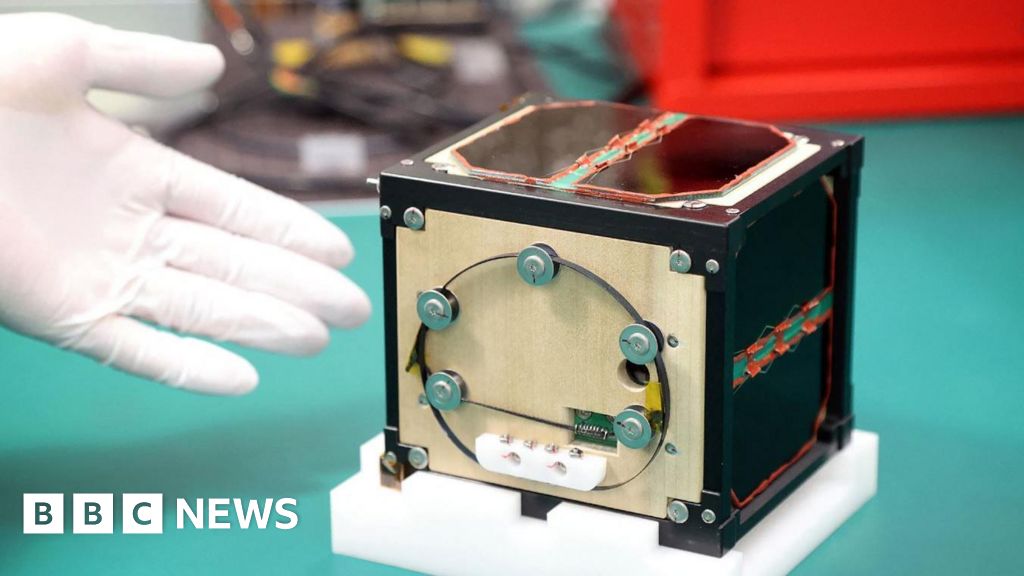
Kyoto University and Sumitomo Forestry Co have revealed a wooden satellite named LignoSat, shaped like a cube. It's the first time timber has been used for a satellite. The small wooden satellite measures 10 centimetres on each side and weighs approximately one kilogram. After being handed over to JAXA on 4 June, it is expected to be launched into space in autumn.

The LignoSat is made of Japanese bigleaf magnolia, and the wooden parts are directly joined using a traditional Japanese method instead of metallic or adhesive fasteners. Space is a harsh environment for satellites because the temperature fluctuates widely, and cosmic rays bombard them. However, the LignoSat passed stringent safety inspections by NASA and JAXA. The satellite will be sent to the International Space Station aboard a rocket of the private U.S. rocket manufacturer Space X in September.

 
The world's first wood-panelled satellite, LignoSat, has been launched into space. The tiny 900-gram satellite, crafted from magnolia wood using traditional Japanese techniques, is embarking on a mission to the International Space Station aboard a SpaceX rocket. Researchers at Kyoto University aim to assess the feasibility of using wood as a sustainable building material for future space exploration, particularly on celestial bodies like the Moon and Mars. By replacing some metal components with wood, they hope to reduce the environmental impact of space missions and open up new possibilities for sustainable space architecture.

LignoSat

Photo credit: Kyoto University

Dr. Simeon Barber, a space research scientist at the Open University, expressed enthusiasm for the innovative use of wood in space exploration. While acknowledging that LignoSat isn't entirely made of wood, he highlighted the potential of this renewable material for future missions. Barber noted that wood's sustainability and versatility make it a promising candidate for constructing shelters and other structures on extraterrestrial bodies. He also pointed out that wood has a history of space applications, such as its use in spacecraft re-entry shields and lunar lander components. However, he cautioned that wood's variable properties can pose challenges for precise engineering. The researchers at Kyoto University share this vision, believing that wood-based spacecraft could offer environmental benefits by reducing pollution during re-entry.

 
Back
Top Bottom