


- 17 Jul 2002
- 5,907
- 385
A study by Jean-Pascal Bassino (Ecole normale supérieure de Lyon) and Noriko Kato (Jumonji University) analysed the average height of Japanese 17 year-old students by prefecture and year of birth, ranging between 1947 and 1987.
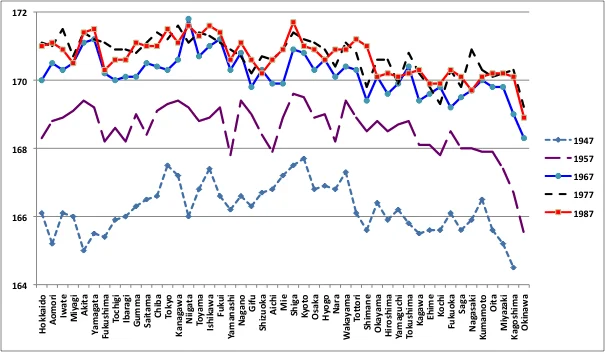
Prefecture-level average height at age 17 of male students (year of birth).
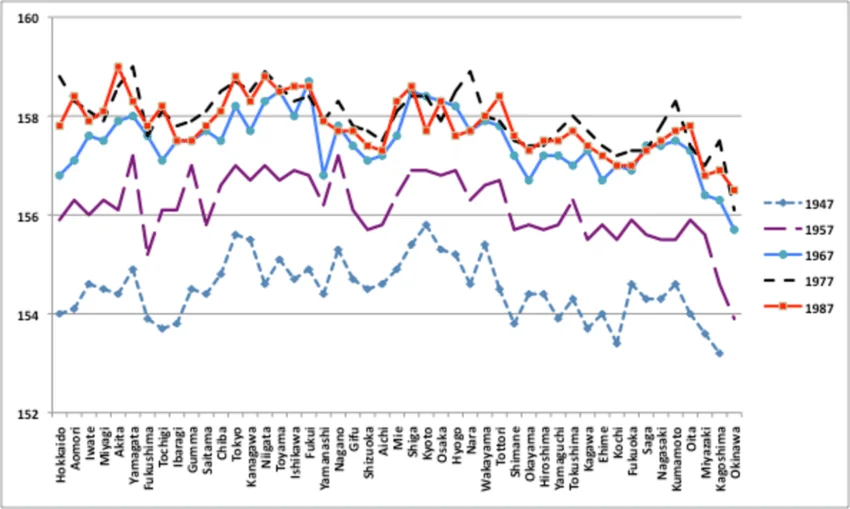
Prefecture-level average height at age 17 of female students (years of birth).
For both males and females, Okinawans have the shortest stature among the Japanese. For those born in 1987 (who are now 36 years old), the average is 1m69 for men and 1m57 for women.
The tallest Japanese men are found in Mie prefecture . Those born in 1987 measure nearly 1m72 in average. For women, the three tallest prefectures are Akita, Yamagata and Nara, closely followed by Niigata and Tokyo - all just shy of 1m59 for those born in 1987 or 1977.
The biggest gap in height in not geographic, but by age group. Japanese people born before the 1960s are considerably smaller than younger generations. There has been little change in stature since the late 1970s though, as the benefits of better nutrition (and compulsory milk at school) seem to have reached their full potential. In 40 years the average height increased by approximately 5 cm for men and 4 cm for women. In contrast, there is only a gap of 3 cm for men and 2 cm for women between the shortest and tallest prefectures for the same age group.
Prefecture-level average height at age 17 of male students (year of birth).
Prefecture-level average height at age 17 of female students (years of birth).
For both males and females, Okinawans have the shortest stature among the Japanese. For those born in 1987 (who are now 36 years old), the average is 1m69 for men and 1m57 for women.
The tallest Japanese men are found in Mie prefecture . Those born in 1987 measure nearly 1m72 in average. For women, the three tallest prefectures are Akita, Yamagata and Nara, closely followed by Niigata and Tokyo - all just shy of 1m59 for those born in 1987 or 1977.
The biggest gap in height in not geographic, but by age group. Japanese people born before the 1960s are considerably smaller than younger generations. There has been little change in stature since the late 1970s though, as the benefits of better nutrition (and compulsory milk at school) seem to have reached their full potential. In 40 years the average height increased by approximately 5 cm for men and 4 cm for women. In contrast, there is only a gap of 3 cm for men and 2 cm for women between the shortest and tallest prefectures for the same age group.


