


- 14 Mar 2002
- 21,056
- 18,911
Japanese manufacturers are developing new technologies to produce powerful motor magnets for electric and hybrid vehicles that do not rely on heavy rare earths. These materials are geopolitically sensitive and dominated mainly by China. Heavy rare earth elements—defined as those with atomic numbers 62 or higher—are essential for high-performance magnets, particularly in EV and hybrid motors: they enhance heat resistance but are mainly mined and processed in China, leaving global supply chains vulnerable.
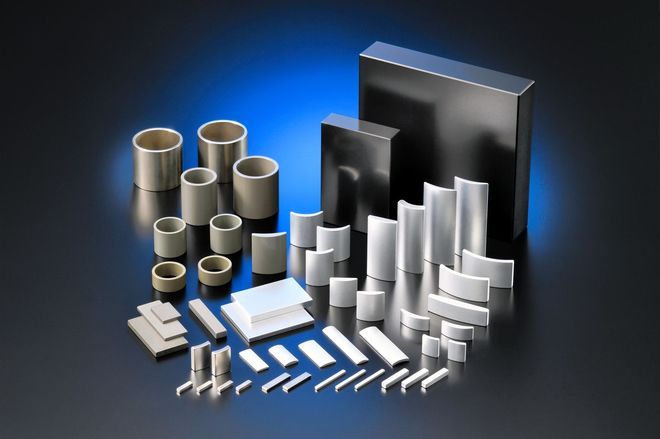
Neodymium magnets developed by Proterial Ltd., formerly Hitachi Metals Ltd. (via Asahi).
Japan's advanced materials companies are investing in magnets that do not require heavy rare earths, protecting auto production from potential disruptions. Currently, hybrid and EV motors depend on neodymium magnets, the strongest class of permanent magnets available. Since neodymium weakens at high temperatures, manufacturers have traditionally mixed in small amounts of dysprosium and terbium, two heavy rare earths, to maintain performance under heat.
Neodymium magnets developed by Proterial Ltd., formerly Hitachi Metals Ltd. (via Asahi).
Japan's advanced materials companies are investing in magnets that do not require heavy rare earths, protecting auto production from potential disruptions. Currently, hybrid and EV motors depend on neodymium magnets, the strongest class of permanent magnets available. Since neodymium weakens at high temperatures, manufacturers have traditionally mixed in small amounts of dysprosium and terbium, two heavy rare earths, to maintain performance under heat.
To curb that exposure, Japanese firms are developing heavy-rare-earth-free neodymium magnets and ramping up investment to bring them into mass production. Proterial Ltd., formerly Hitachi Metals Ltd., announced in late July that it has developed a heavy–rare-earth–free neodymium magnet for EV traction motors. By tightly controlling impurities, the company reports that it has achieved performance suitable for EV motors. The product can be used for hybrids as well. Proterial is eyeing mass production in Kumagaya, Saitama Prefecture, and Yabu, Hyogo Prefecture. Daido Steel Co. has already commercialized heavy–rare-earth–free neodymium magnets for hybrids. Its proprietary grain-refinement process produces much finer crystal grains, while reportedly markedly improving heat resistance and overall magnetic properties. Honda Motor Co. became the first to adopt the magnets for hybrids in 2016. Daido Steel reports that inquiries for hybrid and EV applications have recently increased from automakers in Japan and the United States.


