Need a word or phrase translated?

Hi. Could someone help me translating this? Thanks.

Anata ga tsuyoku natte iru baai wa, taimu sutanpu de watashi o miru
 
ouch, romaji.

What is the context? (Where did you find this, etc). It doesn't seem to make a huge lot of sense (timestamp? what?)
 
Hi
ouch, romaji.

What is the context? (Where did you find this, etc). It doesn't seem to make a huge lot of sense (timestamp? what?)

Hi! Thanks for replying. This is an enormous text a friend of mine sent me. I'm sorry to ask this, is there a way to contact you personally? The text my friend sent me is quite personal. If this is much asking, I understand.
 
You should ask your friend what it meant, in that case. Would you like me to delete the other thread, if the material may be personal?
 
What is the correct way to translate ライン in the following sentence? As far as I can guess it has the meaning 「衣服や人の体が形づくる輪郭の線。」. So the author tells that the joint of the collar is hidden with the skillful design.

素材は光沢からするとステンレスかアルミ系の何か。見た目からして非常に強固である事が分かる。取り付ける時の継ぎ目がある筈だったが、巧妙なデザインのラインに隠されてどこが継ぎ目なのかは分からない。
 
Yes, your interpretation is correct. (Judging from your translation "the joint of the collar", that's an explanation of a combat helmet or something, right?)
 
Thank you very much for your reply! It's literally a collar which will explode if the carrier will do something against the rules. The player is be able to take it off only if he passes the game.
It's from the survival game of some kind or maybe it is called 'battle royal'?
 
Ah, I see. I thought it's the joint of the collar and the helmet or something.:)
 
Hey there folks,

I'd like to get some clarification of two phrases that I translated; both are spoken at different moments of a fight scene, the speaker always referring to his opponent:

自分達の力の見極めも出来ず、子供のように感情のまま動くか! / He fights with a complete disregard for our capabilities…like a child!

Main thing I'd like to confirm here is my reading on the second part of this sentence: "子供のように感情のまま動く" implies that, to the speaker, the opponent's attitude in battle is childish, yes?


Second one:

相変わらず一途な男だよ…!こういう奴ってのは、ころっと騙されて突っ走っちまうんだよな! / As diligent as ever…but guys like that are very easily manipulated!

Issue here is "騙されて突っ走っちまう"; just to confirm, am I correct to read this as "manipulate into acting/running blindly"?

Thanks in advance for the insight.
 
1)
自分達 refers to the opponent(s).
子供のように: like children
感情のまま: in accordance with one's emotions

2)
Right.
 
1)
自分達 refers to the opponent(s).
子供のように: like children
感情のまま: in accordance with one's emotions

The 自分達 is really referring to the opponents and not to the speaker's own group? I forgot to mention but this is a fight between groups, with the speaker and opponent each on one side.

It seemed to me like the focus of this phrase was the speaker being aghast at his opponents child-like approach to battle, disregarding (or without even attempting to ascertain) his opponents might and doing whatever he felt like.

The speaker's group is known as military yes-men while the opponents are very free-spirited.
 
The 自分達 is really referring to the opponents and not to the speaker's own group?
Exactly. This is a quite common usage of 自分(達); "saying from the viewpoint of the addressee(s)". 自分達の力 refers to the opponent's power/ability/skill, thus, the speaker says that the opponent can't judge that their real power/ability/skill is less than the speaker's correctly.
 
Exactly. This is a quite common usage of 自分(達); "saying from the viewpoint of the addressee(s)". 自分達の力 refers to the opponent's power/ability/skill, thus, the speaker says that the opponent can't judge that their real power/ability/skill is less than the speaker's correctly.

Ah, I understand now.

Many thanks, Toritoribe-san!
 
I'm having some issues with a few sentences.

First, from http://language.tiu.ac.jp/materials/eng/yomu/yomu03.html:

先生に教えていただいた日本語を使って毎日何とか生活していますが、いろいろ面白いことがあります。

How I'm reading this, although I doubt either of these are correct:
I received lectures from my teacher, use Japanese everyday, and am somehow living/managing to have a life, but it is rather interesting.
or
I received lectures from my teacher on everyday Japanese usage and somehow live, etc.

Second, from a Wikipedia article:

『エスプガルーダ』(Espgaluda)は、ケイブが製作した業務用縦スクロールシューティングゲームのシリーズ、またはその第1作目のタイトルで、同社のエスプレイドの姉妹作に当たる。

1. What does 当たる mean here? Denshi Jisho is giving a lot of very different definitions for it.
2. How should I interpret 業務用? The article in question is about an arcade game, so I'm assuming 業務用 means for commercial use within the context of an arcade, in contrast to a copy of a home version of the game.

Thanks!
 
I'm having some issues with a few sentences.

First, from http://language.tiu.ac.jp/materials/eng/yomu/yomu03.html:

先生に教えていただいた日本語を使って毎日何とか生活していますが、いろいろ面白いことがあります。

How I'm reading this, although I doubt either of these are correct:
I received lectures from my teacher, use Japanese everyday, and am somehow living/managing to have a life, but it is rather interesting.
or
I received lectures from my teacher on everyday Japanese usage and somehow live, etc.


Thanks!

It would appear that you have not yet learned about nouns being modified by preceding verbs or phrases. Is this the case?

Can you tell the difference between:

先生に日本語を教えていただいた

先生に教えていただいた日本語
 
It would appear that you have not yet learned about nouns being modified by preceding verbs or phrases. Is this the case?

Can you tell the difference between:

先生に日本語を教えていただいた

先生に教えていただいた日本語

The first one would be something like "Japanese was kindly taught by the teacher", and the second one would be "The Japanese which was kindly taught by the teacher," so "先生に教えていただいた日本語を使って毎日何とか生活しています" would be "I am using the Japanese which was kindly taught [to me] by the teacher, and somehow living every day [getting by in everyday life?]." Is that correct?
 
The first one would be something like "Japanese was kindly taught by the teacher", and the second one would be "The Japanese which was kindly taught by the teacher," so "先生に教えていただいた日本語を使って毎日何とか生活しています" would be "I am using the Japanese which was kindly taught [to me] by the teacher, and somehow living every day [getting by in everyday life?]." Is that correct?

As a practical matter, yes. But as a nitpicking matter you have turned it into passive when the original is not passive.
 
先生 refers to the addressee, i.e. 田中先生, not his/her teacher in Japan.

『エスプガルーダ』(Espgaluda)は、ケイブが製作した業務用縦スクロールシューティングゲームのシリーズ、またはその第1作目のタイトルで、同社のエスプレイドの姉妹作に当たる。

1. What does 当たる mean here? Denshi Jisho is giving a lot of very different definitions for it.
2. How should I interpret 業務用? The article in question is about an arcade game, so I'm assuming 業務用 means for commercial use within the context of an arcade, in contrast to a copy of a home version of the game.
1)
あたる【当たる】
12 〔相当する〕
彼は私の曾(そう)祖父に当たる
He is my great grandfather.
彼女は私のいとこに当たる
She and I are cousins.
誕生日が祝日に当たった
My birthday fell on a national holiday.
1ドルは140円に当たった
One dollar was worth 140 yen.
「家」に当たるドイツ語は何か
What is the German (word) for ie?
その語句に当たる英語はない
There is no English equivalent for the phrase.
国務長官は日本の外務大臣に当たる
The Secretary of State isequivalent to [the counterpart of] our Foreign Minister.
この場合は第3条に当たる
Article 3 applies [is applicable] to this case.
http://dictionary.goo.ne.jp/leaf/je2/1148/m0u/当たる/

2)
業務用ゲーム means "arcade (video) game".
 
So

『エスプガルーダ』(Espgaluda)は、ケイブが製作した業務用縦スクロールシューティングゲームのシリーズ、またはその第1作目のタイトルで、同社のエスプレイドの姉妹作に当たる。

would be

"Espgaluda is a vertical-scrolling arcade game series produced by Cave, or otherwise the title of the first entry, and the sister-work to the same company's EspRaDe."

With 当たる being used here because it's expressing the same relatedness as outlined above? So in the case of "前作である『首領蜂』(どんぱち)の続編に当たる作品である。" (from a related article), I would assume 当たる is being used because of the prequel/sequel relatedness.

That helps a great deal. Thank you very much.
 
Hi everyone,
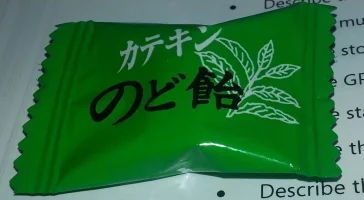
I was given a japanese candy, and got curious what it is, before eating :)
I translated the first word with help of character recognition and google translate. It's カテキン - Catechin, some kind of green tea extract.
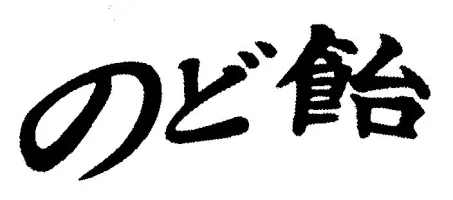
But i cannot translate the second word. I cannot find anywhere what those symbols looking like houses mean. They are nowhere to be found, i don't even know if its two symbols or one.
A little help would be very nice, thank you! :)
 

Attachments

  • phrase.webp
    phrase.webp
    13.7 KB · Views: 159
  • candy.webp
    candy.webp
    71.9 KB · Views: 139
Hi everyone,
I was given a japanese candy, and got curious what it is, before eating :)
I translated the first word with help of character recognition and google translate. It's カテキン - Catechin, some kind of green tea extract.
But i cannot translate the second word. I cannot find anywhere what those symbols looking like houses mean. They are nowhere to be found, i don't even know if its two symbols or one.
A little help would be very nice, thank you! :)

のど飴 "nodo ame"

A term for "throat candy" or a (soothing) throat lozenge.
 
Hi,
I'm try to translate the word 'engulf' into japanese. In the context of 'the fish came out of the water to "engulf" the fishing lure' A Transalators give me 飲む but is this correct in the context, or does this mean more to swallow rather then 'engulf/inhale'?. Thank you in advance if you can help.
 
Hi,
I'm try to translate the word 'engulf' into japanese. In the context of 'the fish came out of the water to "engulf" the fishing lure' A Transalators give me 飲む but is this correct in the context, or does this mean more to swallow rather then 'engulf/inhale'?. Thank you in advance if you can help.

Fish don't inhale and that's a figurative use of engulf anyway, as what the fish is really doing is biting, swallowing, or attacking the lure....which if they're jumping out to get it before it even hits the water has to be the greatest lure in the history of the world.

I would go with アタックする, as it conveys the same idea of eagerly and vigorously going after the lure.
 
Back
Top Bottom