Need a word or phrase translated?

Yeah, I, too, thought so initially, but what is written there is ひとつかみ, not ひとつみ. It could be a typo, of course.


The title of the attached image says the answer; "demi-glace (sauce)". ;-)

It was such a tiny blur on this iphone screen that I just assumed it was ひとつまみ, plus I have never heard of cooking directions (English, anyway) for a quantity like a "handful". That term makes me imagine a mountain of sugar piled up on a cupped palm.

Unfortunately, the title of the image doesn't display in Tapatalk, so I never saw it.
 
Hey there, folks.

could I ask someone to provide some info as to the difference in use between ~させる and ~やらせる?

Particularly, I'd like to see if, when compared to English, there'd be any significant difference between them because, from my understanding, both would be something akin to "allow X to happen / make X happen" in English.

Thanks.
 
やらせる can't be used for objectives/targets that やる can't be used with(of course:)) or as an auxiliary verb.
e.g.
○決心をさせる
×決心をやらせる(決心をやる is wrong since やる can't be used for abstract things such like 決心, 感動 or 落胆.)
○食べさせる(the causative form of 食べる)
×食べやらせる
 
やらせる can't be used for objectives/targets that やる can't be used with(of course:)) or as an auxiliary verb.
e.g.
○決心をさせる
テ?#27770;心をやらせる(決心をやる is wrong since やる can't be used for abstract things such like 決心, 感動 or 落胆.)
○食べさせる(the causative form of 食べる)
テ?#39135;べやらせる

Hmm. So the meaning's the same but the difference comes down to just grammatical correctness, then?

Alright, I see how it is now.

Many thanks, Toritoribe-san!
 
Hello everyone, new here. I was doing a project along with some friends and we needed a specific phrase in Japanese. I would like it to say something like "Dreamer's Code (Code of the Dreamer)". Looking around I found three possible words for 'dreamer' (夢想 , 夢想家 mousoka; 夢追人 yumeoibito; 空想家 kuusouka.) As for the word 'code', I was trying to look for something that would fit in the way "道" does for 武士道Bushido. Of course, any and all commentaries are taken into consideration, thank you ahead of time (^_^).
 
Hello everyone, new here. I was doing a project along with some friends and we needed a specific phrase in japanese. I would like it to say something like "Dreamer's Code (Code of the Dreamer)". Looking around I found three possible words for 'dreamer' (夢想 , 夢想家 mousoka; 夢追人 yumeoibito; 空想家 kuusouka.) As for the word 'code', I was trying to look for something that would fit in the way "道" does for 武士道Bushido. Of course, any and all commentaries are taken into consideration, thank you ahead of time (^_^).

ドリーマーズコード

No, I don't actually expect you'll like that one....
 
Hello everyone, new here. I was doing a project along with some friends and we needed a specific phrase in japanese. I would like it to say something like "Dreamer's Code (Code of the Dreamer)". Looking around I found three possible words for 'dreamer' (夢想 , 夢想家 mousoka; 夢追人 yumeoibito; 空想家 kuusouka.) As for the word 'code', I was trying to look for something that would fit in the way "道" does for 武士道Bushido. Of course, any and all commentaries are taken into consideration, thank you ahead of time (^_^).
So, you mean something like "rules/regulations" by "code", not "cryptography"?
(Actually, Mike-san's answer can solve this problem.:emoji_grinning:)
 
I get it, let's bully the new guy :frown:
But, I am not that misinformed, I just never expected a katakana answer... ヽ( ̄д ̄;)
 
I get it, let's bully the new guy :frown:
But, I am not that misinformed, I just never expected a katakana answer... ヽ( ̄д ̄;)

That was a perfectly sincere and valid answer. I wouldn't be the least surprised to see a group of Japanese guys come up with it.
 
Last edited by a moderator:
I get it, let's bully the new guy :frown:
But, I am not that misinformed, I just never expected a katakana answer... ヽ( ̄д ̄;)
What about my question? The Japanese translation of "code" differs depending on which meaning you want to convey.
 
What about my question? The Japanese translation of "code" differs depending on which meaning you want to convey.
Sorry bro! I think I understand the difficulty with the word, different meanings, even found koddo as a posible answer (so yes! Mike is right \(@д@)/ also).
Code plain and simple as "something to decipher" is what I would want, however I really enjoyed the other meaning 道 gave, as "the way of", "the path of", "the law by which one acts" perhaps, and if possible this latter meaning is the one I would like to work with, or something similar of course.
 
I can never understand why people act surprised that I'm right....

Where did you get "koddo"? I've never heard of that, and it certainly isn't what I said.

Do you really understand the difference between the meanings of "code" in English? You say you mean one, but want to use the Japanese for the entirely different one, apparently because you find the kanji kewl.

If this is just decoration, use whatever kanji you find most visually appealing and screw accuracy.
 
Hey, Can someone translate this to Japanese please, as a few words are unknown to me yet.

"I will do the same thing I did yesterday today. Which is nothing"

Also if possible

"I am skilled at everything I do"

Thanks
 
Thanks very much. Can I ask you (or another forum member) to render that phonetically in English, please?
"Sonzaishinai mono no tankyū" and "Fusonzai no tankyū" in romaji, respectively.


Hey, Can someone translate this to Japanese please, as a few words are unknown to me yet.

"I will do the same thing I did yesterday today. Which is nothing"

Also if possible

"I am skilled at everything I do"

Thanks
What is your translation so far, except that "a few words"?
 
"Sonzaishinai mono no tankyū" and "Fusonzai no tankyū" in romaji, respectively.


What is your translation so far, except that "a few words"?

These are my best translations of the two. I just can't grasp the rules of the language.

1.私は昨日何もない今日も同じことを行います(I will do the same thing I did yesterday today, which is nothing.

2.私がすべてを上手しています(I am skilled at everything I do)
 
I would say;

(私は)昨日と同じで今日も何もしないでしょう。

and

(私は)あらゆることをうまくこなせます。
 
Hello again!
I was listening to some Japanese and I heard this (paraphrasing a little):
子供たちみたいに、喧嘩することはないし
I'm not sure what the ないし means here. In this context, it is 乃至, the conjunction right? I'm not exactly sure how to use it, or even what it means in this context.
There's a chance I misheard it, but I don't think so... Thanks in advance for any help! :)
 
Probably just し for listing reasons. It is not uncommon to find it dangling at the end of sentences like that.
 
Hi, I'm wondering about the meaning of のる in this sentence, can't figure out what it means exactly.
(context: mecha pilot heading toward the enemy)「速度がのりすぎていて進路を変える事は出来な い。」Speed is...?
 
Hi, I'm wondering about the meaning of のる in this sentence, can't figure out what it means exactly.
(context: mecha pilot heading toward the enemy)「速度がのりすぎていて進路を変える事は出来ない。」Speed is...?

I would guess 速度がのる to be an idiomatic way of expressing 加速する, just going by the rest of the sentence. So the first bit is interchangeable with 速度が高すぎて or 加速しすぎて.
 
Thanks

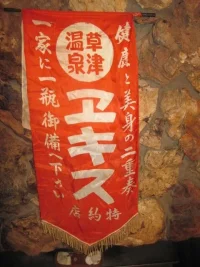
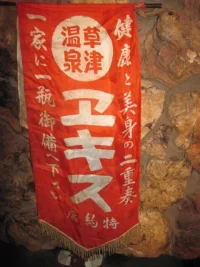
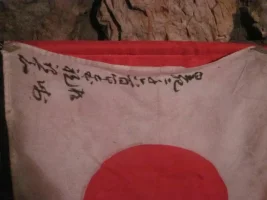
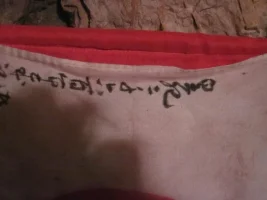
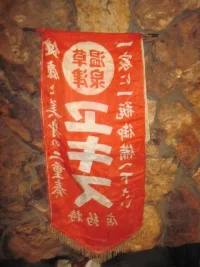
I found a flag and a banner it the trash of a WWII veteran who passed recently. I know he was a US Marine who landed on Iwo Jima, but do not know if these flag and banner are from there. Anyway, I would like to know what they have written on them.

Thank you,
Steve IMG_5715.webpIMG_5717.webpIMG_5718.webpIMG_5720.webp
 

Attachments

  • IMG_5714.webp
    IMG_5714.webp
    47.4 KB · Views: 177
I found a flag and a banner it the trash of a WWII veteran who passed recently. I know he was a US Marine who landed on Iwo Jima, but do not know if these flag and banner are from there. Anyway, I would like to know what they have written on them.

Thank you,
Steve

The banner is an advertising banner for "extract" from the waters of the Kusatsu hot springs, located in Gunma Prefecture, not Okinawa . The left side exhorts people to have one bottle per household. The right side says it is good for health and beauty.
 
Back
Top Bottom