Need a word or phrase translated?

にか・や(=ない)あらむ(平安時代) -->なくあらむ --> なからむ --> なからう(鎌倉時代?) --> なかろう-->「~~く・あろう」(江戸時代までに)-->「~~く・あるだろう」-->「~~いだろう」でしょう。。。From む to う ! :)

Sort of what I have so far from a few days interaction with Classical Japanese although it's not organized quite as well for reference I'm more interested in paying very close attention to differences between time periods.
 
No. なく is the -ku form of an adjective なし. に, か and や are all particles. They are not the etymology of なく.
 
No. なく is the -ku form of an adjective なし. に, か and や are all particles. They are not the etymology of なく.
Oh,.yes. That is it just off some random web site. I found a proper example of Infv + にかあらむ which should have a modern translation of the classic in ~であろうか
 
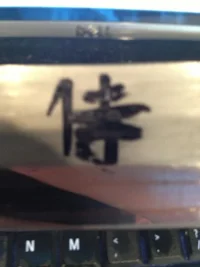
I have a decorative katana with some symbols on it (although im not sure it's even real, i bought the sword at a garage sale)

Photo Jul 23, 4 33 19 PM (HDR).webp
 
I'm having trouble translating this sentence (or partial sentence).

失理中なんだもん = Seiri-chuu nan da mon

I know that 'seiri-chuu' means 'during menstruation', but I'm not entirely sure what the rest means. I say it could be a partial sentence because the next bubble says 'don't stop (talking)'. The context is a girl is appologizing to someone. She says "I'm sorry" and then she says this sentence.
 
理中

~なんだもん is an expression to explain the reason or complaint. (The first ん is "the explanatry の/ん".) Thus, she said "Cuz I'm having my period."
 
Last edited:
I wanted to confirm if these two mean the same thing. If not, what does the いや in the second one do?

いや、それ以上
いやそれ以上

Thanks in advance.
 
I have trouble understanding this one:

助けることができなかったこと
自分の人生を悔やむだけ悔やみ(0.1秒)

In this story, a guy says this after dying while attempting to save a child and then quite literally ascending into paradise.

My guess would be something like: "I only regretted not being able to save my own life (for 0.1 seconds)."
Is that about right? I'm especially confused by the 悔やむだけ悔やみ part.

Thanks.
 
ちょっとこんなところに隠れてどうすんのよ?!
仕方ねーだろ見つかるウケにいかねーし!?

What are we doing in a place hidden like this anyways?!
It can't be helped do you wanna get found or something!?
This character says ウケ a lot, so what does this mean? also what is the ikane shi part?
 
I have trouble understanding this one:

助けることができなかったこと
自分の人生を悔やむだけ悔やみ(0.1秒)

In this story, a guy says this after dying while attempting to save a child and then quite literally ascending into paradise.

My guess would be something like: "I only regretted not being able to save my own life (for 0.1 seconds)."
Is that about right? I'm especially confused by the 悔やむだけ悔やみ part.
悔やむだけ emphasizes 悔やむ. It gives a nuance of "to one's limit".

The object of 助ける is the child. 助けることができなかったこと and 自分の人生 are both the objects of 悔やむ.


ちょっとこんなところに隠れてどうすんのよ?!
仕方ねーだろ見つかるウケにいかねーし!?

What are we doing in a place hidden like this anyways?!
It can't be helped do you wanna get found or something!?
This character says ウケalot, so what does thios mean? also what is the ikane shi part?
ケ, not ウケ
~わけにいかない is an idiom.

The subject of 隠れて is "we".

どうすんのよ means more likely "What are you going to do?" or "What can we do?(= we can't do anything)".
 
悔やむだけ emphasizes 悔やむ. It gives a nuance of "to one's limit".

The object of 助ける is the child. 助けることができなかったこと and 自分の人生 are both the objects of 悔やむ.

Ah, so he says that he really regrets both: not being able to save the kid and his life (how he's spent it)?
Thank you very much!
 
Thanks tori,

Some people are trying to carry out a plan to find information about something out, they want to approach the president somehow

そいうことだ会長は絶対何か知ってる。ただ俺たちにクチを割れねえだけなのさ!About something like that the president knows undoubtedly.
What does kuchi wo ware do? That katakana is same as "mouth" I believe right?
because that verb means to break

だとしたらどうやって割らせる?- Im confused by this too

決まってんだろう - Aint that obvious?
 
クチを割れねえ → 口を割れない → negative of 口を割る which is a set phrase meaning "to confess". The meaning of 割らせる in the following sentence then comes from that.
 
Just a tiny correction

negative potential of 口を割る;-)
 
So basically they're talking about how they'll make sure the president spills the beans about the information they're lookin for?
 
わたしの知っているお義兄さまとなかなか結びつかなかったのは事実だ. Coincidentally, the girl speaking is not blood-related. I can't figure out from the sentence whether she is implying their connection as friendship relation, or a blood relation. Is 義兄さま used here to emphasize the point of blood relation, or shift away from it since it was already mentioned?
 
お義兄さま[Oniisama] refers to "one's elder brother-IN-LAW (i.e., elder sister's husband or elder brother of her husband)".
 
Last edited:
Yea, I knew that. Well, I guess what I wanted to confirm was the meaning of the sentence. "It is a fact that I used to have no considerable relation with my brother(in-law)." That's my translation of the sentence. Correct me if I'm wrong.

What I'm wondering, is if this "relation/connection" that she speaks of it referring to a friendly relation like a brother and sister getting along, or referring to the connection of being part of the same family(Once their parents had married). It has a dual meaning, which I thought, might be clearer on the Japanese end.

Also, I'm under the general assumption that the Japanese usually refer to brother-in-laws as Ani-san, Ani-sama, etc. Does calling them Onii-sama reflect an increase in affection towards the brother-in-law? In other words, does the speaker now consider the brother-in-law as a true brother to be counted as part of the family?
 
結びつかなかった doesn't refer to the relation between the speaker and her brother-in-low. She said that the brother-in-law in front of her now (I don't know the context. This can be a rumor/an information about him.) can't be connected with his image in her memory(= わたしの知っているお義兄さま) well.

あにさん or あにさま is quite rarely used nowadays. I don't know where you got the information, but it's an old or a dialectal way of calling one's brother, whether brother or brother-in-law.
 
寒いと思ったら雪かいwww

My friend posted this on facebook. I don't get what hes trying to say is かい here か as well. It uses the "if" conjugation, so what is he saying

If I think its cold, will it snow? lol ( Just my guess, this seems weird to say though)

今年の夏を作ってくのは俺たち‼ つぅことで先取りしてやったんだよ

つっこと, what does this do?

Then theres a picture of my friend with someone else and this is the caption

ふえてんだよ - This from any verb?
 
Back
Top Bottom