Need a Kanji Translated? Just ask!

I can't type a proper reply for several hours. Would some other kind soul like to have a try at it in the meantime?

Maybe he won't feel quite as picked on if somebody else tells him about the existence of particles, verb/adjective conjugation, plain/polite form, active/passive voice, conditionals, and all the other stuff that goes into learning the Japanese language and not just the characters used to write it all down.
 
(May regret this, but) It's no different than English, really. You can have a base word which you change to show different things (tense, etc).

fast, faster, was fast
速い, もっと速く, 速かった
はやい、もっとはやく, はやかった

If all you knew was 速 you couldn't tell the difference between those. If you knew the kana versions, though, you could understand all of them if you heard them read aloud. 速 isn't a word by itself (e.g. you won't say "速" to mean speed). It is a kanji used to write various words, for example 速度 (speed, そくど).

It's not enough to just learn a bunch of characters with some English meaning, you have to learn the vocabulary that goes with them. Sometimes a kanji by itself is a word, but there are also compounds of more than one kanji, and words that are a mix of kanji and kana, and words for which there are no kanji, or words that have kanji but it isn't often used, because the kanji are not common. e.g. 胡椒 is the kanji for pepper, but they're not often used. コショウ or こしょう is written instead.

Taking a very simple sentence:
Go to school
学校に行く

学校 means 'school'. Don't worry about what the individual kanji mean here, the point is that there isn't a single kanji that means 'school', it's a compound word made of two kanji. に is a particle (similar here to 'to' in the English sentence), and 行く is the verb 'go'. Note, 行く, not 行. You need the kana there for it to be a verb. The kana is also the bit that changes if you wanted to change the sentence to something like 'went to school', or to make it an order 'Go to school!'.

Kanji - Wikipedia, the free encyclopedia - I think at minimum you should read this (particularly about the different readings). It might explain some things.
 
If he wants to learn kanji, let him be. Personally I think it is a great way to start Japanese, but don't forget the other parts.
 
I can't type a proper reply for several hours. Would some other kind soul like to have a try at it in the meantime?

Maybe he won't feel quite as picked on if somebody else tells him about the existence of particles, verb/adjective conjugation, plain/polite form, active/passive voice, conditionals, and all the other stuff that goes into learning the Japanese language and not just the characters used to write it all down.

Thank you Mike and I apologize for my previous replies to you but the thing is, I came from a computer language forum that after spending HARD work creating things for that community you can get bashed, attacked, laughed at etc if your creation doesn't meet their "standards" which is very hard to do. The situation like this is similar. What happened was a cycle like this: releasing a creation-bashing-fixing-people find a new problem and bashing-fixing and it repeats over and over. The computer language learning experience IS in it's own way just like other languages but when I was learning from these people that bashed me I always had a fear when releasing something new and another drama fest would happen again. Even if I did and made sure what people told me to do, they would just find other ways to bash me which was completely unneeded. I DID learn things but through "fear," which someone that is learning should NOT go through. When coming to a brand new forum and stuff like this is happening again it upsets you.

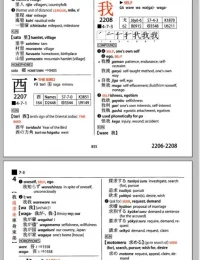
Anyway, I would still like to know the character 我 please, and how it is exactly used. Unless there is something I need to know first in order to understand it or else it won't make any sense to me. It does seem to be used in a strange way...
 
It is used to refer to one's self, or in the context of Buddhism to the concept of "self". When you say you see a character used in Japanese in a way that doesn't make sense to you it would be very helpful to us if you would post the actual sentence or context in which you saw it and just why you think it doesn't make sense.

You may wish to glance through the Wikipedia article on Japanese pronouns.

Imagine for a moment that I wandered into a forum of the type you mentioned and posted saying I want to program a game I had thought of....but that steadfastly said I didn't want to learn any code. That's sort of what you've been doing here. Code is the set of rules that tells how all the content portions relate to each other and how they are to be interpreted and acted upon in order to make any sense. Grammar/syntax serves the same function for human language. Knowing all the kanji in the world can not help you reliably and accurately work out what is being said in Japanese text unless you also know the "code" of the Japanese language.

Look at something as simple as "do":

Suru - do
Shinai - don't
Shita - did
Shinakatta - didn't
Shitai - want to do
Shitaku nai - don't want to do
Shitakatta - wanted to do
Shitaku nakatta - didnt want to do
Shiyou - try to do
Shite miru - try to do
Shite mitai - want to try to do
Shite mitakatta - wanted to try to do
Shite hoshii - want someone else to do
Shite hoshiku nai - don't want someone else to do
Etc etc etc

Then there are different forms of things, functionally equivalent but differing in politeness:

Aru
Arimasu
Gozaimasu

Nai
Arimasen
Gozaimasen

Suru
Nasaru
Itasu

Yaru
Ageru
Sashiageru

Morau
Itadaku

Kureru
Kudasu

Kuu
Taberu
Meshiagaru

Etc etc etc

Just the matter of pronoun choice can be a nightmare all its own. Sentences can be left grammatically "incomplete". Missing parts can be inferred from cultural cues in the speech. In dialogues in novels, for example, the speech between two people can be so clearly different that it isn't at all necessary to include "said Bill" or "Mary quipped" or any of that sort of marker we are used to relying on in English text to keep track of who is talking.

There is so much more to understanding Japanese than you could ever possibly hope to pick up just from recognizing kanji, and it isn't stuff that you're likely to just intuit from looking at it. That's why I constantly implore people to get a good quality proper pedagogically sound tried-and-true honest-to-gosh old-fashioned dead tree TEXTBOOK to learn from.

And English is my native language. Why do you ask?
 
In Japanese, this character, 我 makes no sense to me.

Various sources say it means "I" in Japanese, which is the same meaning in Chinese but how I see the Japanese using it confuses me.

Isn't 私 僕 俺 and I am pretty sure わたくし all mean "I" in English but I don't see 我 being used like one of those.

I have seen this before 我が which I know means "our" but it still doesn't make sense to me and I have also seen this as well 我々.
Japanese pronouns - Wikipedia, the free encyclopedia


I rarely ever see a person with thousands and thousands upon thousands of posts post normally on forums...
Then, many active members here in JREF, including me, must be all RARE cases. :sick:

Depending on readers, a post could sound as an insult, not only this one or maybe yours in another forum but also others' ones, of course including my ones.
 
Wow that really helped Mike and for my other posts just ignore them please.

So the 我 character does mean "self" but it's usually used when saying "our" or "we" I was wondering why it is not used all by itself like 私 can be.

Also one more thing about 我々 what IS this character? 々? It's not a hiragana or katakana character and I don't see it as a kanji in Kanji lists anywhere. What is that character and part of what group of writing?

For the things you listed for "do" I am going to try and spell them out for some practice:

suru- する
shinai- しない
shita- した
shinakatta- しなかった
shitai- したい
shitaku nai - したくない
shitakatta- したかった
Shitaku nakatta- したくなかった
shiyou- しょう
Shite miru- してみる
Shite mitai- してみたい
Shite Mitakatta- してみたかった
Shite Hoshii- してほしい
Shite Hoshiku nai- してほしくない

Is my hiragana spelling correct? I hope so... I didn't use google translate to "cheat" and only used it for the text font.
 
It is used by itself sometimes. Your exposure just isn't broad enough to have encountered it that way. It is somewhat formal so crops up more in formal speech as a collective (plural) pronoun, in which case it is doubled.

The mark you ask about indicates a repetition of the preceding kanji. Sort of like ditto marks.
 
I see so 々 is only for Kanji repetition. In a Hiragana book I read that there is a symbol used like that for hiragana repetition. However I have never seen that repetition mark used outside of the book.

Also since no correction have been made for my hiragana spelling, it's save to assume I spelled everything correctly? If so, YES!
 
At the risk of sounding condescending, you have to keep in mind that your exposure to Japanese simply isn't broad or extensive enough (yet) to venture into extrapolating very much from it in terms of what is common or uncommon.

On a side note, there is a five word phrase you can get ready to hear until it makes you want to throw up, as it figures into the answer to seemingly every question about Japanese, and that phrase is, "...it depends on the context..."
 
I see so 々 is only for Kanji repetition. In a Hiragana book I read that there is a symbol used like that for hiragana repetition. However I have never seen that repetition mark used outside of the book.
Those marks indeed exist, but are rarely used nowadays. You can see them in old documents.

Also since no correction have been made for my hiragana spelling, it's save to assume I spelled everything correctly? If so, YES!
Just one correction
shiyou- しょう --> しよう

shou/syou/shyou - しょう
shiyou - しよう
 
I just turned the page in the book I'm reading and found a chapter subheading: 我こそは菩薩という使命感

So there's your 我 in isolation.

(page 248 of 座標軸としての仏教学)
 
Capture.webp

there's your usage for 我
 
Hi guys, Hope you can help me.. I study japanese martial arts. I have an exam to be first dan.

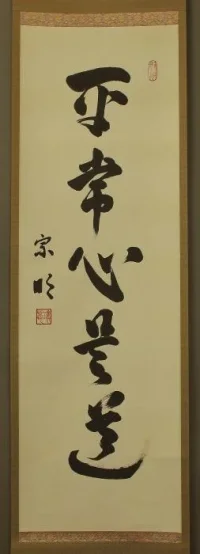
Can you help me to translate this calligraphy? Is very important for my thesis.


Till now, I understand the kanji "kokoro" the 3th... are u able to read the other kanji? what kanji are the other?


Thank u... let's spread love for japanese calligraphy ^^
 

Attachments

  • scroll.webp
    scroll.webp
    13.5 KB · Views: 176
平常心是道, perhaps?

How can you know this is important for your thesis if you can't even tell what it says?
 
平常心是道, perhaps?

How can you know this is important for your thesis if you can't even tell what it says?

Because I made a research of various ancient dojo, from Nara... and have some photos of this..

In Japanese how you will transliterate and translate as phrases? "Sense of balance is the Road"? Heijōshinzedō?
 
It is a phrase from Buddhism and in this case the 道 refers to 仏道, more specifically to 悟り...."Enlightenment" (or the achieving of Enlightenment).

平常心 refers to one's normal, ordinary mind (or perhaps state of mind).

是 just means "this".

I suspect the phrase is linguistically Chinese and taken directly from one of the Buddhist sutras, which often have come down to us only through Chinese translations, with original Sanskrit versions having failed to survive. (There is suspicion that some sutras were just originally Chinese to begin with).

I can imagine at least a couple interpretations or implications of it, neither of which I would feel responsible offering up as accurate or authentic. I hope one of our native speaking friends will help you out on this.

Did you read the page I linked to?
 
It is a phrase from Buddhism and in this case the 道 refers to 仏道, more specifically to 悟り...."Enlightenment" (or the achieving of Enlightenment).

平常心 refers to one's normal, ordinary mind (or perhaps state of mind).

是 just means "this".

I suspect the phrase is linguistically Chinese and taken directly from one of the Buddhist sutras, which often have come down to us only through Chinese translations, with original Sanskrit versions having failed to survive. (There is suspicion that some sutras were just originally Chinese to begin with).

I can imagine at least a couple interpretations or implications of it, neither of which I would feel responsible offering up as accurate or authentic. I hope one of our native speaking friends will help you out on this.

Did you read the page I linked to?

It's difficult... it's a koen right?

I just like to know the concept and the sense of the phrase.

By the way really thank you for reference and transliteration...really really helpful. It's very interesting by the way.
 
是 just means "this".
I feel strange correcting a North American's Chinese in a Japanese learning thread but it means "is/am/are", etc. In other words, it means "to be" or, using a math symbol, it means "=" .

Reading 是 used in old Chinese text as コレ is only a Japanese custom. We use that arbitrary reading because it helps us read and understand Chinese without changing the Chinese word order.

---------- Post added at 02:12 ---------- Previous post was at 01:59 ----------

It's difficult... it's a koen right?
What is a koen?

I just like to know the concept and the sense of the phrase.
The phrase means "Your presence of mind will lead you to Enlightenment", "Be your natural self and you will achieve Enlightenment.", etc.
 
Indeed 是 performs as a copula in a noun sentence(a sentence whose complement is a noun), but it's originally from the usage as a demonstrative pronoun "this".
e.g.
子曰、過而不改、謂過矣(子曰く、過ちて改めざる、これを過ちと謂う。)

What is a koen?
That's a typo of kōan.
Koan - Wikipedia
 
Last edited by a moderator:
What is the meaning of "矯正展"?

Is this a proper noun? I can't find it in my dictionary.

The context:

9月に東京拘置所で地域と親しみやすくするために、矯正展が開かれました。拘置所のレシピーを使った350円の「プリズン弁当」は、大人気でした。

Thanks.

(Source: Hiragana Blog | Hiragana Times
 
Back
Top Bottom