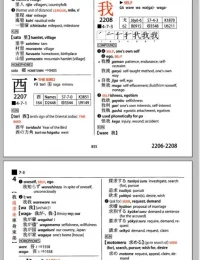
It is used to refer to one's self, or in the context of Buddhism to the concept of "self". When you say you see a character used in Japanese in a way that doesn't make sense to you it would be very helpful to us if you would post the actual sentence or context in which you saw it and just why you think it doesn't make sense.
You may wish to glance through
the Wikipedia article on Japanese pronouns.
Imagine for a moment that I wandered into a forum of the type you mentioned and posted saying I want to program a game I had thought of....but that steadfastly said I didn't want to learn any code. That's sort of what you've been doing here. Code is the set of rules that tells how all the content portions relate to each other and how they are to be interpreted and acted upon in order to make any sense. Grammar/syntax serves the same function for human language. Knowing all the kanji in the world can not help you reliably and accurately work out what is being said in Japanese text unless you also know the "code" of the Japanese language.
Look at something as simple as "do":
Suru - do
Shinai - don't
Shita - did
Shinakatta - didn't
Shitai - want to do
Shitaku nai - don't want to do
Shitakatta - wanted to do
Shitaku nakatta - didnt want to do
Shiyou - try to do
Shite miru - try to do
Shite mitai - want to try to do
Shite mitakatta - wanted to try to do
Shite hoshii - want someone else to do
Shite hoshiku nai - don't want someone else to do
Etc etc etc
Then there are different forms of things, functionally equivalent but differing in politeness:
Aru
Arimasu
Gozaimasu
Nai
Arimasen
Gozaimasen
Suru
Nasaru
Itasu
Yaru
Ageru
Sashiageru
Morau
Itadaku
Kureru
Kudasu
Kuu
Taberu
Meshiagaru
Etc etc etc
Just the matter of pronoun choice can be a nightmare all its own. Sentences can be left grammatically "incomplete". Missing parts can be inferred from cultural cues in the speech. In dialogues in novels, for example, the speech between two people can be so clearly different that it isn't at all necessary to include "said Bill" or "Mary quipped" or any of that sort of marker we are used to relying on in English text to keep track of who is talking.
There is so much more to understanding Japanese than you could ever possibly hope to pick up just from recognizing kanji, and it isn't stuff that you're likely to just intuit from looking at it. That's why I constantly implore people to get a good quality proper pedagogically sound tried-and-true honest-to-gosh old-fashioned dead tree TEXTBOOK to learn from.
And English is my native language. Why do you ask?