undrentide
Japa'n vagyok
- 18 Jan 2006
- 3,652
- 310
Ahaha thats funny
湯 Warm water
船 Boat

The word 湯船 came from the fact that during Edo period there were some public bath on the boat... so you can see a bit of history in this word.

Follow along with the video below to see how to install our site as a web app on your home screen.
Note: This feature may not be available in some browsers.

Ahaha thats funny
湯 Warm water
船 Boat

株価がもっと上がっていけばいいのに、What he was getting to, I guess, was that "iku" means to sound objective, analytical etc and "kuru" used with emotionality about the coming event, or to express increasing levels of anxiety and concern.

Yes, context matters in the case of ~て いく forecasting a big event to plan ahead for, or it could signal more of a distant observation. But くる、きた focuses on something already in process, more certain to arrive, or even closer to the subject temporally. I wonder if that is what tomii was talking about ?株価がもっと上がっていけばいいのに、
株価がもっと下がってくればいいのに、
株価がこの水準まで上昇していった場合、
株価がこの水準まで下落してきた場合、
心配事が増えていく
心配事が増えてくる
Whmm, it seems to me that that nuance is not from the words いく/くる themselves.

As for きた, except used in the conditional forms(e.g. きたら), right, it's used to express past. But くる can be used to express future.Yes, context matters in the case of ~て いく forecasting a big event to plan ahead for, or it could signal more of a distant observation. But くる、きた focuses on something already in process, more certain to arrive, or even closer to the subject temporally. I wonder if that is what tomii was talking about ?


Where did you get that connotation?

Yes, くる is like movement from past (already started) to present and いく from present (or immediate future) to more distant future.As for きた, except used in the conditional forms(e.g. きたら), right, it's used to express past. But くる can be used to express future.
開発が進めば野生動物の数が減ってくるから、近隣の環境にも影響が生じる。
The reason くる is used in this case is considered that the speaker focuses on the point the land development already expands, and looks back on that point. Thus, both いく and くる can be used for "forecasting." (The nuance would be different, though.)
そもそもの問題として、Tomiiさんは「いく/くる」に話者の主観(好き嫌い)が入ってると誤解してるのでは?:?

How does one say:
"I'm waiting for my friend to come to my house."
Is it something like:
うちに友達の来ることを持っています。
OR
ともだちがうちに来ていることを持っています。
Or something like that...?

Ahaha thats funny
湯 Warm water
船 Boat
The word 湯船 came from the fact that during Edo period there were some public bath on the boat... so you can see a bit of history in this word.

I believe boat carrying portable bathtubs were stationed off harbors for shipworkers, sailors etc. or anyone living along a riverway in Tokyo (maybe Osaka?)...I'd definately pay something to avoid bathing at a restaurant or outdoors at a blossom viewing event. :jama:Wow thats funny!
In just heard something that sounded like ちもいい? for is it okay to order?
Any ideas what this is?
Uh, as I wrote in my previous post, that "psychological involvement" wouldn't be from いく/くる themselves but from the context "いく for future," "くる for past."Yes, くる is like movement from past (already started) to present and いく from present (or immediate future) to more distant future.
But I think psychological involvement in the issue, depending on the other parts of the sentence, can also be a factor. For instance...
この町の人口はますます増えていくだろう。
The population of this town will probably continue increasing in the coming years. Seems like a relatively objective prediction about growth that is starting in the present or the near future.
この町の人の数がこれ以上増えてくる(いく)と大変だ。
If the number of people in this town grows any more, there will be problems.
With くる, the big, bad population increases are clearly on their way, and they are starting to feel threatening. The speaker already begins to sense the impact.
分かりました。とてもうれしいよ。本当にありがとうございます、とりとりべさん!!!uh, as i wrote in my previous post, that "psychological involvement" wouldn't be from いく/くる themselves but from the context "いく for future," "くる for past."
このまま人口が増えていったら大変ですよね|( 人口増加はすでに始まっており∥話者もそれを危惧している|)
この施策が成功すれば∥当市の人口も増加してくるでしょう|(客観妬予測|ただし恐らく「増加し始める」 に近いニュヂンベ|)
「~ていく」は未来の状態を表す構文だから∥客観妬な予測を表現する場合に使われることが多いのは∥ある意味当喪なのでは";-)
Hello!
Which of these two words is more common for discussing songs
歌or曲or歌曲
also, in this anime I watch the character says:
何で一人で掃除してるんだ。。。俺
and the subs say
Why am I cleaning... alone
I get that they switched the words around to get a more natural sounding English sentence. My question is, is this common? or only something someone would do when talking to themselves or only in anime?
thanks!
I dont know if i should post this question here, if its in the wrong area please let me know
Both 歌 and 曲 are commonly used. 曲 sometimes refers to music/tune/melody as the opposite to lyrics, though. 歌曲 is the term for a specific genre of classic music.Which of these two words is more common for discussing songs
歌or曲or歌曲
If you're talking about the order of the words, yes, it's often changed in conversation.also, in this anime i watch the character says:
何で一人で掃除してるんだ。。。俺
and the subs say
Why am I cleaning... alone
I get that they switched the words around to get a more natural sounding English sentence. My question is, is this common? or only something someone would do when talking to themselves or only in anime?
Both 歌 and 曲 are commonly used. 曲 sometimes refers to music/tune/melody as the opposite to lyrics, though. 歌曲 is the term for a specific genre of classic music.
If you're talking about the order of the words, yes, it's often changed in conversation.
誰、あそこにいるの。
なにやってんだ、おまえ。
Thanks Ashikaga-sensei注文(ちゅうもん)いい? = 注文してもいいですか?
What a funny piece of history...I believe boat carrying portable bathtubs were stationed off harbors for ship workers, sailors etc. or anyone living along a riverway in Tokyo (maybe Osaka?)...I'd definitely pay something to avoid bathing at a restaurant or outdoors at a blossom viewing event.
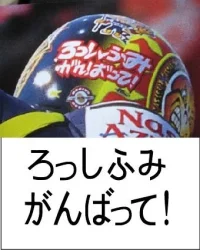
Strictly speaking, one dot of "dakuten" might be lacked, but it also seems that it's overlapping on "n." The shapes of "shi" "fu" "batte" look as weird as "ga" to me in the first place.Hello everybody. I need some help with a simple hiragana word namely "gambatte"
As you can see the image below is supposed to say:" Ross(h)ifumi gambatte", but there is something weird about the word "gambatte". According to me it is spelled wrong.
They used a katakana "ga" instead of a hiragana "ga". Can anyone, preferably a Japanese person, verify that for me? Did they really make a simple mistake here?
It's pretty strange because this sticker (the picture is a replica) is actually used by an Italian motogp rider, who rides for a Japanese brand! They should have told him by now that there is a spelling error, shouldn't they?
:32: I can't yet upload pictures so here is the URL: img187.imageshack.us/my.php?image=iobioo.jpg
Yeah, that's written in the correct way.Thank you for the very fast reply.
I also noticed that the "fu" was written in a very special way.
I added the original helmet sticker on the picture below, with a design of what I believe should be the right spelling.
Can you yet again double-check that for me, please?
Thank you in advance,
(It's OK as a parody, though.)
Hi i was having some trouble of this sentice could someone help me please? Its '' im sorry two o'clock is not alright - simiemasen nee je yok addy masen''. I know its wrong but could someone help correct what im missing in the japanese translation part please? I think im missing a ''wa'' somewhere. Thanks guys and girls
I was also hoping if you guys and girls could help me with this. Im learning negative replys towards questions at the moment and i was wondering if this was right, For example if someone asked if you could ask if you speak japanese i would anwser ''yes, but im not really good yet'' (to downplay my ability). So would this be right? (correct my spelling if its wrong please!) ''hi, demo joezo addy masen''.