Need a word or phrase translated?

Wow, I think I get it. Extremely polite Japanese seems very Convoluted compared to semi-polite or casual. ><

Hmm, I see. Does this sound natural? found it on the yahoo.jp dictionary
I would just leave out 湯 and go straight to the tub. :cool:

(熱い。。。。)風呂に浸る
 
tteotbstamp2-1.webp


Does it work and is it good?
 
Radness. If you and undrentide want a free CD when I release it, it shall be so.

Thanks for all the helps!

Peace,
b
 
I didn't think it was worth making a new thread so I'd like to ask...

What does it mean when one uses "~te iku" or "~te kuru"? I knwo some verbs that use it are like set words... But yeah. I just want to knwo when I should use them, or why someone might use them. thanks!
 
Yes, it's commonly used.
In addition to Elizabeth-san's, 湯船[ゆぶね] also can be used.
One dictionary listing also shows for にどっぶりとつかる ... huh ??

But even IF it's real, is that the に没頭、専心 soak up kind, or a hot tub ?? 😌
 
I didn't think it was worht making a new thread so I'd liek to ask...
What does it mean when one uses "~te iku" or "~te kuru"? I knwo some verbs that use it are like set words... But yeah. I just want to knwo when I should use them, or why someone might use them. thanks!
I think Tae Kims guide has a section on this,
I found it pretty useful.
guidetojapanese.org/enduring.html

(I probably could try to explain, but everything in that link is all I know about -ていく/てくる)
 
I didn't think it was worth making a new thread so I'd like to ask...
What does it mean when one uses "~te iku" or "~te kuru"? I knwo some verbs that use it are like set words... But yeah. I just want to knwo when I should use them, or why someone might use them. thanks!
You're talking about いく、くる as auxilliary verbs, not verbs of motion, I assume ?


~ていく, ~てくる | Japan Forum
Tackling て来る | Japan Forum
te form of verb+kimasu | Japan Forum
 
OK... So I read those three threads + tae kim + another thread. I'm not sure if I comprehend it completely... so let me give it a shot:

~ていく: when you do something then go away from here; when something continues to happen & it doesnt really suit you; something you do from now to the future...?

ex:

友達の家には走っていきます。 - I run to my friends house (which is away from here).
お母さんがタバコを吸っていきます。 - My mom continues to smoke (and I don't like it!)
日本語の勉強をがんばっていきます。 - I will try my best (from now on) with ym japanese studies.

~てくる: when you do something, then go away from there to here; when something continues to happen & it suits you; something up until the present

早く帰ってきました。 - I returned early (from somewhere else).
友達が僕にプレゼントをくれてきます。 - My friend cotinues to give me presents (and I liek it.)
マクドナルドの食べ物を食べてきました。もう太らないんですよ。 - I kept on eating mcdonalds food (up until now). thats why im not getting fat anymore.

---

Are these right? Honestly, I have no idea if they are, and I'm still kind of confused.
 
Hi

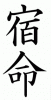
I am new to the forum and I was wondering if you could translate what these symbols mean. My friend is getting them as a tattoo and I dont think it means destiny like she said it does.

Thank You
 

Attachments

  • destiny.GIF
    destiny.GIF
    4.4 KB · Views: 173
Hi

I am new to the forum and I was wondering if you could translate what these symbols mean. My friend is getting them as a tattoo and I dont think it means destiny like she said it does.

Thank You

It is pronounced "shukumei", it means karma, fate, etc.
It has rather a negative connotation. I wonder if it really is what your friend is after...
😌
 
It is pronounced "shukumei", it means karma, fate, etc.
It has rather a negative connotation. I wonder if it really is what your friend is after...
😌
I wonder if it's similar to 境涯 as we would say "lot/station/condition" in life etc, or any circumstance that is moved only from overwhelming effort...
 
I have a sentance that I'm pretty sure I understand but I just want to make sure I understand. Itsuka Katy no ohaka ni Omaini ni ikitai desu.
I think it's saying. Someday I want to go to Katys grave.
I'm having a hard time finding what "Omaini" means though... I think it might mean pray or something like that.
 
I have a sentance that I'm pretty sure I understand but I just want to make sure I understand. Itsuka Katy no ohaka ni Omaini ni ikitai desu.
I think it's saying. Someday I want to go to Katys grave.
I'm having a hard time finding what "Omaini" means though... I think it might mean pray or something like that.

It's "omairi" not "omaini".

o-mairi is a noun derived from the verb "mairu", and "omairi ni iku" means to visit a temple/shrine/grave to pay respect and pray.

Elizabeth;622709 said:
I wonder if it's similar to 境涯 as we would say "lot/station/condition" in life etc, or any circumstance that is moved only from overwhelming effort...

Wow, Elizabeth san, I'd never seen the word 境涯 before and had to consult with a dictionary! 😌
すご~い!:cool:


The connotation seems to be similar but 宿命 is the fate itself while 境涯 is the situation one is put because of 宿命.
 
Last edited:
I have a sentance that I'm pretty sure I understand but I just want to make sure I understand. Itsuka Katy no ohaka ni Omaini ni ikitai desu.
I think it's saying. Someday I want to go to Katys grave.
I'm having a hard time finding what "Omaini" means though... I think it might mean pray or something like that.
It should be Omairi. And yes, to visit a grave (or go to a shrine, Buddhist alter, worship more broadly etc)

Ooops! Undrentide-san beat me again ! :)
 
Thanks for the replys the tattoo is suppost to say fate, detsiny is that what it means in this context otherwise I have some bad news for my friend.
 
~ていく: ...when something continues to happen & it doesnt really suit you...

~てくる: ...when something continues to happen & it suits you
Whmmm, for example

毎月どんどん給料が上がっていきます。
最近段々給料が下がってきました。

Where did you get that connotation?
 
Whmmm, for example
毎月どんどん給料が上がっていきます。
最近段々給料が下がってきました。
Where did you get that connotation?
Nice and very clear :cool:
I also like how you used "don don" and "dan dan" .
Do you know what is the difference in using どのようにしてand どうやって?
Thanks、
 
Long time no see, myawr-san!🙂:
Do you know what is the difference in using どのようにしてand どうやって?
どのようにして sounds formal/stiff. どうやって is more commonly used especially in conversation.
 
Whmmm, for example
毎月どんどん給料が上がっていきます。
最近段々給料が下がってきました。
Where did you get that connotation?
What he was getting to, I guess, was that "iku" means to sound objective, analytical etc and "kuru" used with emotionality about the coming event, or to express increasing levels of anxiety and concern.
 
Long time no see, myawr-san! 👋
どのようにして sounds formal/stiff. どうやって is more commonly used especially in conversation.
Toritoribeさん、thank you very much 👋;
I still drop by frequently but I have been in a long time of laziness in studying Japanese :(.
 
Back
Top Bottom