

Navigation
Install the app
How to install the app on iOS
Follow along with the video below to see how to install our site as a web app on your home screen.
Note: This feature may not be available in some browsers.
More options
Style variation
System
Light
Dark

You are using an out of date browser. It may not display this or other websites correctly.
You should upgrade or use an alternative browser.
You should upgrade or use an alternative browser.
Need a word or phrase translated?
- Thread starter Buntaro
- Start date

Ashikaga
もちもちした食感
- 19 Feb 2008
- 2,220
- 84
ArmandV, here is my attempt at translating the letter. Hope it helps.
I would like to congratulate Mr. Nakajima on his Mangled Skyscraper Award.
For many Godzilla fans around the world, there is no greater joy than seeing you looking great and healthy.
For 54 years since his birth back in 1954, Godzilla has been roaring in the hearts of the people around the world who love "Sense of Wonder".
Sadly, the creators of Godzilla, the producer Tomoyuki Tanaka, the director Ishiro Honda, the special effects director Eiji Tsuburaya and the composer Akira Ifukube are no longer with us, making you, Mister Nakajima, a living legend in the world of Godzilla.
How fantastic is it that the American Godzilla fans inviting that living legend to Chicago and showing him gratitude and respect?
I would like to thank all of you Godzilla lovers who gathered here today.
Mister Nakajima,
Please stop by at the Toho Studio with the trophy when you get back to Tokyo.
We would love to take a picture of you in front of the Godzilla statue at the main gate.
Congratulations!!!!
Shogo Tomiyama
Executive Producer
Toho Films
*I just want to point out that the name of the composer, Akira Ifukube is misspelled in the original letter. His first name is spelled 昭 instead of 明。
ASHIKAGA
I would like to congratulate Mr. Nakajima on his Mangled Skyscraper Award.
For many Godzilla fans around the world, there is no greater joy than seeing you looking great and healthy.
For 54 years since his birth back in 1954, Godzilla has been roaring in the hearts of the people around the world who love "Sense of Wonder".
Sadly, the creators of Godzilla, the producer Tomoyuki Tanaka, the director Ishiro Honda, the special effects director Eiji Tsuburaya and the composer Akira Ifukube are no longer with us, making you, Mister Nakajima, a living legend in the world of Godzilla.
How fantastic is it that the American Godzilla fans inviting that living legend to Chicago and showing him gratitude and respect?
I would like to thank all of you Godzilla lovers who gathered here today.
Mister Nakajima,
Please stop by at the Toho Studio with the trophy when you get back to Tokyo.
We would love to take a picture of you in front of the Godzilla statue at the main gate.
Congratulations!!!!
Shogo Tomiyama
Executive Producer
Toho Films
*I just want to point out that the name of the composer, Akira Ifukube is misspelled in the original letter. His first name is spelled 昭 instead of 明。
ASHIKAGA


Fuumei
眼鏡が要る
- 18 Sep 2005
- 242
- 1
到底死にそうには見えない。しかし女は静かな声で、もう死にますとはっきりいっ
た。自分も確にこれは死ぬなと思った。
I included the beginning of the sentence to help with the context here. I had a question on what "kore wa" here is referring to. Is he saying "this (woman)", and just saying "this" because what/who he is talking about is obvious? If anyone can help on this I'd greatly appreciate it. Thanks so much! :sorry:
た。自分も確にこれは死ぬなと思った。
I included the beginning of the sentence to help with the context here. I had a question on what "kore wa" here is referring to. Is he saying "this (woman)", and just saying "this" because what/who he is talking about is obvious? If anyone can help on this I'd greatly appreciate it. Thanks so much! :sorry:

- 17 Feb 2008
- 212
- 1
"くだけた日本語"
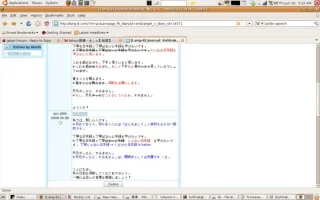
My one friend said that it means nothing, and I'm trying to find out the word for "friendly speech," so i thought I would get a second opinion (since he, despite living on a base in Japan, hasn't always been correct). The attached screenshot is of it used in a... natural... context. I thought that might help figure out what it means...
My one friend said that it means nothing, and I'm trying to find out the word for "friendly speech," so i thought I would get a second opinion (since he, despite living on a base in Japan, hasn't always been correct). The attached screenshot is of it used in a... natural... context. I thought that might help figure out what it means...
Attachments

AroundTheWorld
Devourer of Souls
- 25 Jun 2008
- 89
- 0
I play Final Fantasy XI, but I'm horrible with kanji and katakana. Will someone fluent in Japanese come over to my house and translate everything the Japanese players type to me and then translate my responses? ^^
... Nobody?
; ;
... Nobody?
; ;


Elizabeth
先輩
- 22 Apr 2003
- 9,839
- 135
These are "casual, friendly" speech:"くだけた日本語"
My one friend said that it means nothing, and i'm trying to find out the word for "friendly speech," so i thought i would get a second opinion (since he, despite living on a base in Japan, hasn't always been correct). The attatched screenshot is of it used in a... natural... context. I thought that might help figure out what it means...
くだけた言葉(/言い方/話し方
口語
Of course other expressions referring specifically to light talk, conversational language, etc. are also out there.


- 22 Feb 2008
- 18,266
- 4,926
In this context, "これ" would mean something like "状況; the situation", not "女". It might be similar to "これ" in "これは困った/これはめでたい".到底死にそうには見えない。しかし女は静かな声で、もう死にますとはっきりいっ
た。自分も確にこれは死ぬなと思った。
I included the beginning of the sentence to help with the context here. I had a question on what "kore wa" here is referring to. Is he saying "this (woman)", and just saying "this" because what/who he is talking about is obvious? If anyone can help on this I'd greatly appreciate it. Thanks so much! :sorry:
Hope this helps
(Is this from 夢十夜 by 夏目漱石?)
Fuumei
眼鏡が要る
- 18 Sep 2005
- 242
- 1
In this context, "これ" would mean something like "状況; the situation", not "女". It might be similar to "これ" in "これは困った/これはめでたい".
Hope this helps
That's interesting, and now that you mention it "kore wa komatta", I have heard that quite a bit and believe I somewhat understand it. Thanks for your explanation, I appreciate it.. Also, yes, you are right - It is from 夏目漱石. (First night). Very awesome that you caught that!
AroundTheWorld
Devourer of Souls
- 25 Jun 2008
- 89
- 0
Woo... I should go get my Japanese homework so you can do it for me! 
Just kidding! But maybe questions after I finish it!
Just kidding!
But maybe questions after I finish it!Toritobe is a genius, that's why. 僕を弟子にしてくださいっていうほど。。hehe nah, for real..That's interesting, and now that you mention it "kore wa komatta", I have heard that quite a bit and believe I somewhat understand it. Thanks for your explanation, I appreciate it.. Also, yes, you are right - It is from 夏目漱石. (First night). Very awesome that you caught that!
indigozeal
先輩
- 24 Mar 2005
- 29
- 0
1. ある売り子は残業するのをうんざりしている。同僚に仕事が嫌いならなぜ辞めない
かと聞かれると、彼女は「な、なんでやめないかって! エ、エェ!? そりゃあ
んた...」と返事する。
「そりゃあんた...」という部分は何の意味ですか。
2. I'm not even going to try this one in Japanese. It's an odd question about the insult 「無知」, used by itself as a stand-alone exclamation. What's the tone of it - can it be used in a gentle, kidding, among-friends sense, or is it more venal and purely mean? (I suppose many insults can be either depending on the circumstances, and I unfortunately don't have a useful example to illustrate. If there are any information anyone could volunteer, though, I'd appreciate it.)
Thank you in advance for any help.
かと聞かれると、彼女は「な、なんでやめないかって! エ、エェ!? そりゃあ
んた...」と返事する。
「そりゃあんた...」という部分は何の意味ですか。
2. I'm not even going to try this one in Japanese. It's an odd question about the insult 「無知」, used by itself as a stand-alone exclamation. What's the tone of it - can it be used in a gentle, kidding, among-friends sense, or is it more venal and purely mean? (I suppose many insults can be either depending on the circumstances, and I unfortunately don't have a useful example to illustrate. If there are any information anyone could volunteer, though, I'd appreciate it.)
Thank you in advance for any help.
Ashikaga
もちもちした食感
- 19 Feb 2008
- 2,220
- 84
1. ある売り子は残業するのをうんざりしている。同僚に仕事が嫌いならなぜ辞めない
かと聞かれると、彼女は「な、なんでやめないかって! エ、エェ!? そりゃあ
んた...」と返事する。
「そりゃあんた...」という部分は何の意味ですか。
Usually, そりゃ あんた (or それは あなた) is followed by the reason (in this case, the reason for not quitting the job). それ refers to 「なんで辞めないか」. あんた(あなた)here has an overtone of "Don't you know (the answer)!?".
So, if the sales clerk had completed the sentence, it would have been something like, 「そりゃ、あんた... 仕事を辞めちゃったら経済的に困るでしょう」or
「それは、あなた... 仕事を辞めたら生活していけないでしょう?」
In English, it would be something like, "Why don't I just quit the job?? WHAT!?
(Are you seriously asking me this?) OF COURSE I wouldn't quit because if I did, how would I pay the bills?"
Since I lack enough grammatical terms to explain this properly, I will give another example of this expression.
「へぇ~、Indigoってオートミールよりアイスクリームのほうが好きなんだぁ。」
「そりゃ、おまえ... アイスクリームのほうが好きに決まってるじゃん。」
"Wow...so you prefer ice cream over oatmeal..."
"Come ON! You KNOW I'd pick ice cream if I got to choose."
I wouldn't necessarily consider this to be insulting/rude. You just change the words "そりゃ あんた・おまえ" to "それは あなた" and you can make it a little less "frank". Perfectly fine to be used among friends and family members if you ask me.
父 「お前、もう彼女いるのか?」
息子 「そりゃ、親父... 俺だってもう18なんだから彼女くらいいるよ。」
The same effect can be achieved just with そりゃ・それは without the あんた・あなた・お前, etc.
Elizabeth
先輩
- 22 Apr 2003
- 9,839
- 135
そして、「何だそりゃ・・・?」なら、本当に荒っぽい言葉だと思われる場合がでしょう!!Usually, そりゃ あんた (or それは あなた) is followed by the reason (in this case, the reason for not quitting the job). それ refers to 「なんで辞めないか」. あんた(あなた)here has an overtone of "Don't you know (the answer)!?".
So, if the sales clerk had completed the sentence, it would have been something like, 「そりゃ、あんた... 仕事を辞めちゃったら経済的に困るでしょう」or
「それは、あなた... 仕事を辞めたら生活していけないでしょう?」
In English, it would be something like, "Why don't I just quit the job?? WHAT!?
(Are you seriously asking me this?) OF COURSE I wouldn't quit because if I did, how would I pay the bills?"
Since I lack enough grammatical terms to explain this properly, I will give another example of this expression.
「へぇ~、Indigoってオートミールよりアイスクリームのほうが好きなんだぁ。」
「そりゃ、おまえ... アイスクリームのほうが好きに決まってるじゃん。」
"Wow...so you prefer icecream over oatmeal..."
"Come ON! You KNOW I'd pick icecream if I got to choose."
I wouldn't necessarily consider this to be insulting/rude. You just change the words "そりゃ あんた・おまえ" to "それは あなた" and you can make it a little less "frank". Perfectly fine to be used among friends and family members if you ask me.
父 「お前、もう彼女いるのか?」
息子 「そりゃ、親父... 俺だってもう18なんだから彼女くらいいるよ。」
The same effect can be achieved just with そりゃ・それは without the あんた・あなた・お前, etc.

「そりゃいいね」など使ったほうが無難でしょうね。
日本語にも悪口があるかも知れませんね..:

でも、乱暴に聞こえるかどうかは文脈や使い方によるところが大きい大事だと思いますね。
Ashikaga
もちもちした食感
- 19 Feb 2008
- 2,220
- 84
そして、「何だそりゃ・・・?」なら、本当に荒っぽい言葉だと思われる場合がでしょう!!
「そりゃいいね」など使ったほうが無難でしょうね。
日本語にも悪口があるかも知れませんね..:
でも、乱暴に聞こえるかどうかは文脈や使い方によるところが大きい大事だと思いますね。
OPをもう一度よく読んでください。 ちょっと話がずれてしまっていますね。 「そりゃいいね」などを使ったほうが無難って.... 話の意味がわかりません。 あくまで「そりゃ、あんた」の、例文の中での意味を質問されてたのですし、「何だそりゃ」はもともと意味が違います。
私の説明のしかたが悪かったのでしょうか。 素人にしては上手いことまとめたなぁ~と自負してたのですが...www
Anyway, Indigozeal, I hope that helped.
sigmentofb
先輩
- 1 Oct 2007
- 75
- 0
Can someone tell my how you typ the follow names?
-Akimasa
-Akira
-Kevin
Domo arigatou already
Akimasa can be written dozens of ways, the most common is probably 昭正 or 明正.
Akira can be written in just one kanji, like 明, 昭, 彬, or 彰.
Since Kevin is a foreigner's name in Japan, it is written in katakana as ケヴィン.
sigmentofb
先輩
- 1 Oct 2007
- 75
- 0
Hello-
Can anybody here translate the image below into English for me? It was from a family history questionnaire I had sent to a relative in Japan, and received this response today. Any help is appreciated
Edit: By the way, the person mentioned in the first paragraph (Kamenoshin) is deceased, so don't worry about privacy issues...
Can anybody here translate the image below into English for me? It was from a family history questionnaire I had sent to a relative in Japan, and received this response today. Any help is appreciated
Edit: By the way, the person mentioned in the first paragraph (Kamenoshin) is deceased, so don't worry about privacy issues...
Ashikaga
もちもちした食感
- 19 Feb 2008
- 2,220
- 84
Re : Nishimoto family tradition
Kamenoshin Nishimoto was given a section of the Moriga-touge forest from the government for his achievement (in what, they don't know) in the early part of the Meiji priod (late 1860s to early 1870s)..
Re : the Nishimoto family address
The old residence (address) was located on a small hill in the same village about 450m from the current one. It was moved here in
the 10th year of the Taisho period (1922).
Kamenoshin Nishimoto was given a section of the Moriga-touge forest from the government for his achievement (in what, they don't know) in the early part of the Meiji priod (late 1860s to early 1870s)..
Re : the Nishimoto family address
The old residence (address) was located on a small hill in the same village about 450m from the current one. It was moved here in
the 10th year of the Taisho period (1922).
This to English:
saikin watashi wa yoku ryokou suru. NYC ni ittari, San Fran ni mo ittari, Minn ni mo ittari suru. Natsu ga dai suki desu.
----------------------------------------
Then can you help me translate this into Japanese.
I haven't really kept in touch with Tony. After high school we went our seperate ways. I am glad to see that you are keeping busy. And yes, I love summer as well. I am trying to plan a trip to Japan soon! It's a hard thing to plan!
Well, keep in touch!
----------------------------------------
Thanks! Kyle
saikin watashi wa yoku ryokou suru. NYC ni ittari, San Fran ni mo ittari, Minn ni mo ittari suru. Natsu ga dai suki desu.
----------------------------------------
Then can you help me translate this into Japanese.
I haven't really kept in touch with Tony. After high school we went our seperate ways. I am glad to see that you are keeping busy. And yes, I love summer as well. I am trying to plan a trip to Japan soon! It's a hard thing to plan!
Well, keep in touch!
----------------------------------------
Thanks! Kyle
Elizabeth
先輩
- 22 Apr 2003
- 9,839
- 135
Are you studying the language, Kyle ? As the name of this forum, "Learning Japanese," not "Translation Service," indicates, those are the members it is intended to assist in that process. If you are, that's fantastic. Please try these sentences first yourself. Thanks !This to English:
saikin watashi wa yoku ryokou suru. NYC ni ittari, San Fran ni mo ittari, Minn ni mo ittari suru. Natsu ga dai suki desu.
----------------------------------------
Then can you help me translate this into Japanese.
I haven't really kept in touch with Tony. After high school we went our seperate ways. I am glad to see that you are keeping busy. And yes, I love summer as well. I am trying to plan a trip to Japan soon! It's a hard thing to plan!
Well, keep in touch!
----------------------------------------
Thanks! Kyle

- 27 Dec 2003
- 2,853
- 2,102
- Thread starter
- #6,372
"saikin watashi wa yoku ryokou suru. NYC ni ittari, San Fran ni mo ittari, Minn ni mo ittari suru. Natsu ga dai suki desu."
--> I have been doing a lot of traveling recently. I go to places like New York City, San Francisco, etc. I go to all these places. I really like summer.
--> I have been doing a lot of traveling recently. I go to places like New York City, San Francisco, etc. I go to all these places. I really like summer.
Are you studying the language, Kyle ? As the name of this forum, "Learning Japanese," not "Translation Service," indicates, those are the members it is intended to assist in that process. If you are, that's fantastic. Please try these sentences first yourself. Thanks !
Yes, I am learning the language. I just get confused on how to put together some sentences. Like the composition throws me off, I have a hard time of knowing where to put what. But I will give the sentences a try.
私とトニは話せません。(As for me and Tony, we dont talk.)Would that be the equivalent of saying we haven't kept in touch?
高校にある(not sure if that means after high school)私とトニが(not sure how to say "went our seperate ways).
あなたは忙しいを見ます。よかった!(I struggled with the composition. Not sure if it is right at all. I put seeing that you are busy, thats good? Probably I few mistakes in there.)
そして はい、私も夏が大好きです!(also not sure about this one, I just literally translated the "And yes" part, not sure if thats correct.)
私は日本に行くが予定(not sure if that is the right kanji for "plan")です。でも、とってもまずいです!(Probably a few more mistakes haha, but I am saying "As for me, I plan on going to japan. But it is very hard! not sure if that makes sense, but what I am trying to say is " I am planning a trip to japan, but it is not an easy thing to do." Am I close?)
And I am not sure how to say Well, Keep in touch!
Any help would be greatly appreciated and I didnt mean to come in here and just ask for a translation, you guys arent here to do my work for me. And I know I was dumb for thinking that and being lazy. but from now on I will attempt it because I wont get better if I dont at least try!
Thanks guys!
Elizabeth
先輩
- 22 Apr 2003
- 9,839
- 135
いいえ、全然違いますよ。OPをもう一度よく読んでください。 ちょっと話がずれてしまっていますね。 「そりゃいいね」などを使ったほうが無難って.... 話の意味がわかりません。 あくまで「そりゃ、あんた」の、例文の中での意味を質問されてたのですし、「何だそりゃ」はもともと意味が違います。
私の説明のしかたが悪かったのでしょうか。 素人にしては上手いことまとめたなぁ~と自負してたのですが...www
私は、本当に控え目な人です。全く、決して自慢しません。☺
「(えっ)。。。何だって、何だ」などを「そりゃ」と間違えてしまったので、ASHIKAGAの説明は
とてもやくに立ちましたよ! ありがとうございます。

私にとって、日本語作文はまだまだ難しいものなので、ただ、練習していただけですよ。
でも、話が横道へ逸れたらごめんなさいね。 次回は、適当な言葉を申し添えるようにします。
:emoji_blush:
Elizabeth
先輩
- 22 Apr 2003
- 9,839
- 135
"Minn ni mo ittari suru" --> "Minn(a) ni mo ittari" I've never heard plus it doesn't make sense grammatically."saikin watashi wa yoku ryokou suru. NYC ni ittari, San Fran ni mo ittari, Minn ni mo ittari suru. Natsu ga dai suki desu."
--> I have been doing a lot of traveling recently. I go to places like New York City, San Francisco, etc. I go to all these places. I really like summer.
I'm traveling a lot these days. Going to places like New York, San Francisco and Minnesota, etc.... I love summer. :?
Wow ! What an attempt ! I'm in total awe.私とトニは話せません。(As for me and Tony, we dont talk.)Would that be the equivalent of saying we haven't kept in touch?
高校にある(not sure if that means after high school)私とトニが(not sure how to say "went our seperate ways).
 This is incredible to have something show up here with obviously so much effort put into it. And someone take our advice seriously. hehe Of course...for areas you really haven't covered, that's perfectly fine, too. I assume the material is a note that has to be sent ? Or are these purely for practice ? The level is drawn from second/third year vocab & grammar patterns, at best. But for the most part I get what is going on. So let me try for the first two...
1.(もう)長い間、トニと話していないです。 ? I haven't talked with Tony for a long time.
To avoid repeating "be in touch" if you want to use that at the end...
話せません。This means cannot talk. Don't talk is "話さない" or "話しません"
2. 高校卒業後、(私たちは)別々の道をあるきました。?? After graduating high school, we went our separate ways.
Last edited:
Similar threads


- Replies
- 11
- Views
- 115K