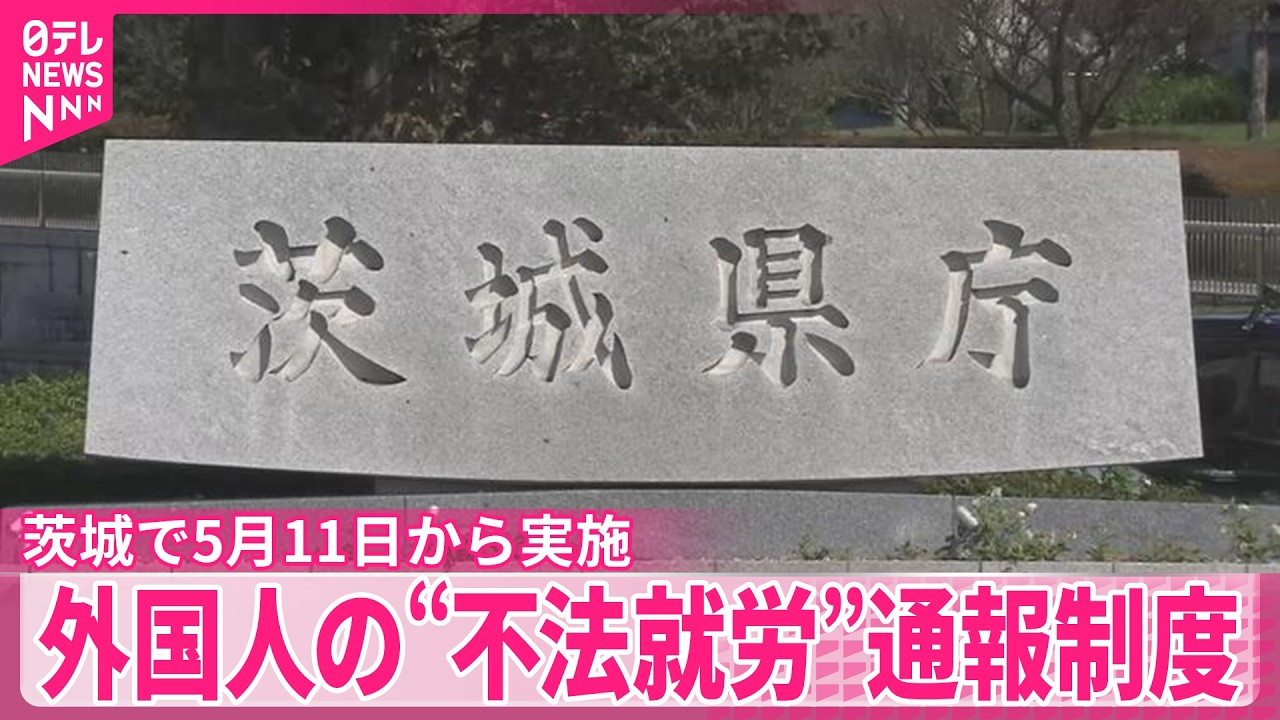
Immigration Ibaraki to pay for information on undocumented foreign workers

thomas

Unswerving cyclist
Admin
Joined
14 Mar 2002
Messages
21,050
Reaction score
18,904
Ibaraki faces the highest number of illegal employment cases in the country. Now, the prefectural government plans to introduce cash rewards for tips on undocumented foreign workers from fiscal 2026. The scheme will seek information on foreign nationals working without proper visas. A reward will be paid if a report results in a police arrest.

The national Immigration Services Agency operates a similar tip-based system. Programs at the prefectural level are uncommon, officials said. Governor Oigawa Kazuhiko said at a news conference that the situation requires strong action. He also addressed concerns that the policy could encourage excessive reporting or infringe on rights, saying the prefecture would not allow it to create an environment in which law-abiding foreign workers feel uneasy.

The move comes as Ibaraki prefectural officials seek to address the high number of foreigners working illegally, particularly in their agricultural sector. According to the Immigration Services Agency, of the slightly more than 14,000 foreigners identified as working illegally nationwide in 2024, 3,452 were in Ibaraki Prefecture—the highest number of any prefecture for the third consecutive year. Previously, prefectural staff focused on campaigns urging employers not to hire undocumented workers. The new online system is designed to strengthen information-gathering alongside industry groups and municipalities. Under the system, prefectural staff will investigate tips and contact police if illegal employment is suspected.

The reward is expected to be several tens of thousands of yen.

Interesting:

A similar national system has existed since 1951, offering up to 50,000 yen ($320) if a tip leads to a deportation order. However, according to the Immigration Services Agency, no rewards were paid out between 2021 and 2025. The Ibaraki prefectural announcement has drawn criticism from Jiho Yoshimizu, head of Nichietsu Tomoiki Shienkai, a Tokyo-based nonprofit organization that supports Vietnamese in Japan. Yoshimizu said many foreigners his group supports have lost their place to live after being fired from their trainee placements or fleeing abusive workplaces. Unable to afford a flight home, they have ended up overstaying their visas, he said.

 
As an agricultural province, along with its proximity, I wonder how true it would be to say that "Ibaraki feeds Tokyo". Or what proportion of its ag production ends up there?

Wikipedia says this:

Economy

Ibaraki's economy is based on energy production (particularly nuclear energy), chemical and precision machining industries, research institutes, and tourism. Agriculture, fishing, and livestock are also important sectors in the prefecture.[8]​

Ibaraki's vast flat terrain make it highly suitable for industrial development. This complements its proximity to the Tokyo metropolitan area, giving it a high reputation as an industrial base. The prefecture is also home to Tsukuba, Japan's most extensive research and academic city, and the birthplace of Hitachi, Ltd.[9]​

Agriculture

With extensive flat lands, abundant water, and suitable climate, Ibaraki is among the prefectures with the highest agricultural production in Japan. It plays an important role in supplying food to the Tokyo metropolitan area. Its main products include melons, pears, peppers, various varieties of rice and sugar cane, as well as flowers and ornamental plants.

It also supplies other food crops to the rest of the country. As of March 2011, the prefecture produced 25% of Japan's bell peppers and Chinese cabbage.[10]​

Fishing

It is one of the prefectures with the highest fish production in the country; in the Pacific Ocean, Lake Kasumigaura, other lagoons and rivers, various species of fish are obtained.
 
That seems like a great plan especially if coupled with large fines for employers who hire people without the appropriate visa. The fines could be used as the tip-off rewards!
 
How do you even know? Papers please? Hey Thomas I am just some random guy but I don't think you have a visa can I see your residence card? One would be correct to tell me to sod off as I am not any kind of law enforcement.
 
Concerns are mounting over a plan under consideration by Ibaraki Prefecture to reward members of the public who report information leading to the arrest of foreign nationals working illegally. Critics warn the measure could deepen social divisions and foster discrimination.

Under the proposal, residents would be invited to report suspected illegal employment of foreign workers. If the tip leads to an arrest or other enforcement action, the informant would receive a reward of about ¥10,000. Prefectural officials say they aim to introduce the system in the next fiscal year. Foreign labour is central to Ibaraki's agricultural sector, a major supplier of food to the Tokyo metropolitan area.


According to the Immigration Services Agency, more than 14,000 foreign nationals were identified nationwide as working illegally last year. Of those, 3,452 were working in Ibaraki, the highest number among prefectures for the third consecutive year. Japanese farmers who work alongside foreign labourers expressed mixed feelings. While some support stricter enforcement against illegal employment, others worry that the system could lead to suspicion and distrust. One farmer said that once people begin to suspect others, they tend to focus only on negative possibilities. Public opinion within the prefecture is also divided. Some residents support the measure, arguing that foreign workers should follow proper procedures before working in Japan. Others believe offering rewards for reports goes too far and could encourage prejudice. One resident whose mother is from the Philippines said he worries that bias against foreigners could affect family members who work legally.

However, some experts warn that the very act of encouraging people to report suspected illegal workers could foster social division. Because it is difficult to determine a person's employment status from appearance alone, reports may be based on prejudice or assumptions.

 
Despite criticism, Ibaraki will go ahead and introduce a controversial new reward system next month, offering cash bounties to citizens who provide tips that lead to police busting businesses that illegally employ foreign workers.

A new reporting system is due to start on 11 May, the first of its kind in Japan. Officials in Ibaraki Prefecture said the measure is aimed at rogue employers, not the foreign workers themselves. Under the scheme, people who provide information that leads to an arrest will receive a reward of 10,000 yen per case. Tips are to be submitted through a dedicated portal on the prefecture's website.

There are conditions. Informants will need to use their real name, provide identification and explain the specific circumstances of suspected illegal employment. The idea, officials said, is to discourage frivolous or racially driven complaints, though how that will work in practice is not entirely clear. The plan has already drawn criticism. Some argue it could fuel xenophobia or discrimination. Prefectural authorities said reports based on appearance, nationality or neighbourhood disputes, such as noise or rubbish issues, would not be accepted. They said the focus is strictly on businesses involved in illegal labour practices.

Ibaraki Prefecture, heavily reliant on its massive agricultural sector, currently hosts over 61,000 foreign workers. Frustrated by persistently high rates of illegal labor and the limits of conventional administrative warnings, authorities are now turning to citizen informants to root out exploitative employers once and for all.

 
I always thought the U.S. should do this instead of cracking down on immigrants. If they are serious about stemming illegal immigration they should penalize the people hiring them. But of course they never go after the fat cats. Occasionally they fine them for a million dollars or whatever. Peanuts. They are even employing school age children, pretending they don't know what's happening.
 
Perhaps some of you Japan-bound gents (and ladies, too, of course, if there are any) could elaborate on the situation in Japan? Is the number of illegal immigrants in employment really so high it warrants a 'call-to-phones' like this?
Or is it not just a way to oust the immigrants but also to protect them from abuse (long work-days, low pay, etc.)?

We had something here in Denmark a few years back where a lot of regular and greenhouse farms used Polish workers illegally and didn't pay them pensions, fair wages, and 'forgot' to not let them work 16 hrs. a day. The Poles didn't report them because they were afraid they'd get kicked out - when in fact the majority of them would, with a very minor amount of paperwork, get a work visa and thus proper working conditions.
 
Perhaps some of you Japan-bound gents (and ladies, too, of course, if there are any) could elaborate on the situation in Japan? Is the number of illegal immigrants in employment really so high it warrants a 'call-to-phones' like this?
Or is it not just a way to oust the immigrants but also to protect them from abuse (long work-days, low pay, etc.)?

We had something here in Denmark a few years back where a lot of regular and greenhouse farms used Polish workers illegally and didn't pay them pensions, fair wages, and 'forgot' to not let them work 16 hrs. a day. The Poles didn't report them because they were afraid they'd get kicked out - when in fact the majority of them would, with a very minor amount of paperwork, get a work visa and thus proper working conditions.
There are accurate figures for the number of illegal immigrants. The number of people entering Japan illegally is negligible, as Japan is too far away from other countries to allow much people smuggling. The people in Japan illegally are generally overstayers, who spend more than three months here after entering as a tourist, and immigration will become aware of such people as soon as their three months is up. The number of such people in Japan is about 70,000 and falling, a quarter of what it was in the early 1990s. (Anyone who says Japan has a major illegal immigration problem is talking nonsense.)

If we assume that most overstayers are working and a few 'tourists' allowed three months in Japan are working, the number of people working illegally is probably under 100,000. I heard that Ibaraki has a relatively high number of such people, probably because of its proximity to Tokyo and large agricultural sector. Whether that justifies encouraging people to snitch on suspected illegal workers is another thing.

Edit: I've just realised the hole in my argument: there will also be people who entered Japan on official work schemes and then left their jobs and started working unofficially somewhere else. There could be quite a few of these people, so I cannot give you a reasonable estimate for the number of illegal workers, though it suggests that local governments should be focusing on shady employers as much as illegal workers.
 
Last edited:
The JT article linked below is based on numbers released by the Immigration Services Agency of Japan (as of 1 January 2026). Officially, there are 68,488 overstayers who entered Japan legally, either as tourists, technical interns or on work contracts. However, there are no figures for illegal entrants or visa violators (people working outside their specified visa status). As @Lothor pointed out above, very few people enter Japan clandestinely.

The number of overstayers peaked in the 1990s (~300,000) and has gradually declined to around 70,000 today.

Top nationalities of overstayers per Immigration Services Agency of Japan, 2025–2026:

  1. Vietnam (11,600–13,000)
  2. Thailand (10,900–10,900+)
  3. South Korea (10,000–10,300)
  4. China (6,200)
  5. Philippines (4,500)
  6. Indonesia (4,300)
  7. Taiwan (2,700)
  8. Sri Lanka (2,000)
  9. Turkey (1,200–1,300)
  10. Cambodia (1,100)


More references:


Back
Top Bottom