Politics The Takaichi Sanae Thread - Japan's first female Prime Minister

So by their logic, we, the foreign residents, should start feeling guilty for the anxiety and unease our presence causes the Japanese people.
It would seem like it. Although some of this anxiety and unease is based on genuine concerns (overtourism, people being priced out of property hotspots, some foreigners committing crimes), a certain amount of it is based on old-fashioned racism (there's always a certain proportion of knuckleheads in a society who don't like people who look different). So we're expected to feel guilty about racists not being happy that we're in their country!
 
It would seem like it. Although some of this anxiety and unease is based on genuine concerns (overtourism, people being priced out of property hotspots, some foreigners committing crimes), a certain amount of it is based on old-fashioned racism (there's always a certain proportion of knuckleheads in a society who don't like people who look different). So we're expected to feel guilty about racists not being happy that we're in their country!
Holy buckets. That is a good point.
 
According to a Kyodo poll, Takaichi's support rate fell to 67.5%. Her approval rating held steady at 75% in the latest Nikkei/TV Tokyo survey, maintaining the 70% level for three consecutive months since the cabinet was formed. Those are heights any politician can dream of.


Paywall alert:

As for the Bank of Japan's decision last week to raise its key policy interest rate to 0.75%, the highest in 30 years, 55% of respondents nationwide said they approved of the move, surpassing the 26% who disapproved.

Ask those with variable-rate mortgages whether they like it.

I really wonder what those support rates are based on. Standing up to China?
 
The LDP's decision to install Takaichi as its leader and PM seems to be paying off: voters who had shifted to newer conservative parties are returning. Support for the LDP in a hypothetical national election has increased by about 40% over the past six months. The gains appear to be concentrated among voters who previously supported smaller right-wing parties. Many of them report a positive impression of PM Takaichi, indicating that her leadership is a key factor behind the shift.

LDP voter shift

The data indicates that voters who like Takaichi have returned to the LDP, while those who do not continue to back other parties. The most significant inflows into the LDP came from Sanseito, the Democratic Party for the People and the Conservative Party of Japan. Among supporters of these parties in June-July, 28.9%, 14.1% and 22.2%, respectively, had shifted to the LDP by November. As a result, support for Sanseito fell by 1.5 points to 4.7%, while support for the DPP declined by 2.1 points to 8.8%.

 
The LDP's decision to install Takaichi as its leader and PM seems to be paying off: voters who had shifted to newer conservative parties are returning. Support for the LDP in a hypothetical national election has increased by about 40% over the past six months. The gains appear to be concentrated among voters who previously supported smaller right-wing parties. Many of them report a positive impression of PM Takaichi, indicating that her leadership is a key factor behind the shift.


I wonder why they mapped the unknown/no answer people as a shift to LDP.
 
PM Takaichi kept even senior figures in her own party uncertain about whether she would move towards a snap election. While considering the option, she shared her thinking with only a small circle of trusted allies, telling senior party officials on Wednesday that the matter was still under review.

On Tuesday morning, Chief Cabinet Secretary Minoru Kihara met Liberal Democratic Party executives and suggested that the lower house could be dissolved at the opening of the Diet session on 23 January, adding that an announcement was likely around 19 January after a series of summits with visiting leaders. Closely aligned with Takaichi, Kihara was among the few insiders aware of her thinking and acted as an intermediary with ruling coalition leaders as she remained publicly silent.
At that stage, no final decision had been made. Although Takaichi contacted party leaders around 2.00 pm to say that immediate dissolution was one possible option and urged them to be prepared, she stopped short of committing. Kihara then sounded out the leaders of the LDP and the coalition partner, the Japan Innovation Party. Takaichi is believed to have settled on dissolving the lower house later on Tuesday night, consulting only a handful of advisers, including Takaya Imai, a Cabinet Secretariat special adviser and former aide to Shinzo Abe, her political mentor. The tightly controlled process is seen as carrying the risk of widening divisions within the LDP.

While dissolving the lower house is often described as the prime minister's prerogative, the decision is usually made after consultations with party leadership. But Takaichi did not give any advance notice to such key figures as LDP Secretary-General Shunichi Suzuki, the party's No. 2, LDP Vice President Taro Aso, considered to be Takaichi's most influential backer, or Executive Acting Secretary-General Koichi Hagiuda, with whom she is close. [...] No explanations were provided in advance to the Japan Innovation Party, or to the Democratic Party for the People, an opposition party that at times works with the LDP. This suggests Takaichi aspires to follow Abe's style of putting the prime minister's office over the party in decision-making. Takaichi's political foundation within the LDP is unstable, and her coalition holds a minority in the upper house of parliament. Her only option to push her policies forward was to win a popular mandate from the electorate.


Paywall alert:
 
Interesting times ahead in Japan's political landscape: the two main opposition parties, CDPJ and Komeito, agreed to form a new party to run in a likely snap election in February.

CDPJ and Komeito

The agreement is presented as an attempt to bring centrist parties together and form a united front against the conservative ruling bloc led by the Liberal Democratic Party and its coalition partner, the Japan Innovation Party. The move comes as PM Takaichi, known for her tough security views, continues to record high approval ratings, adding to expectations of a broader political shake-up. Senior figures in the ruling camp say an election is likely on 8 February, with campaigning set to begin on 27 January.

Lawmakers whom Komeito had been planning to field in single-seat constituencies, including Saito, will withdraw, he said. Candidates from Komeito are expected to be placed higher on proportional representation lists, sources familiar with the matter said. Noda said he has shared the view with Saito that it is desirable for them to jointly lead the new party. He added the party's name could be revealed as soon as Friday. Komeito is backed by Japan's largest lay Buddhist organization, Soka Gakkai, which long provided key campaign support to the LDP. The prospect of the Komeito support base being mobilized against the ruling camp is set to alarm it. Itsunori Onodera, a senior LDP lawmaker, told reporters prior to the new party announcement that he believed the arrangement "could have some impact in closely contested and highly competitive districts" for the ruling party.

The backing of Soka Gakkai is estimated to be worth around 10,000 to 20,000 votes in each constituency. With the CDPJ supported by Japan's biggest umbrella group for labour unions, the new party could have a strong base to compete.


The name of the new centrist party is Chūdō Kaikaku Rengō (中道改革連合, Centrist Reform Alliance):

A cut to the consumption tax is set to be a central policy of Chūdō Kaikaku Rengō, the new centrist party created through the merger of the Constitutional Democratic Party of Japan and Komeito. The party's launch was announced at the Diet on 16 January by Yoshihiko Noda, head of the former main opposition CDP, and Tetsuo Saito. The group will use "Centrist Reform Alliance" as its English name, with "Chudo" as its official abbreviation, and is expected to unveil its policy platform on 19 January.

Noda pointed to a lower consumption tax on selected items, including food, along with reductions in social insurance premiums, as key priorities. The party name was chosen to reflect a stance that avoids alignment with either the right or the left, emphasising solutions reached through careful debate, practical reform grounded in everyday concerns, and an open structure that welcomes broad participation.

Komeito, at odds with the conservative stance of Prime Minister Sanae Takaichi, left the ruling coalition last October, ending the party's 26-year partnership with her Liberal Democratic Party. Komeito's main support base is Soka Gakkai, the nation's largest lay Buddhist organization. It is believed to deliver 10,000 to 20,000 votes in each Lower House constituency. With a Lower House snap election expected in February, some within the LDP hoped to maintain electoral cooperation with Komeito. But Komeito's merger with the CDP has shattered those hopes and may force the LDP to rethink its election strategy. "Until now, we have cooperated with (Komeito) in election campaigns. This will have a considerable impact in closely contested districts," Itsunori Onodera, a former LDP policy chief, told reporters at party headquarters on Jan. 15. A veteran LDP lawmaker known for being critical of Takaichi said of the new party, "It's like a gathering of doves, and 'centrism' is appealing." Chudo's emphasis on taking a "centrist" position differentiates it from the LDP, which is expected to strengthen its conservative leanings under Takaichi.


https%3A%2F%2Fcms-image-bucket-productionv3-ap-northeast-1-a7d2.s3.ap-northeast-1.amazonaws.co...jpg


Paywall alert:
 
The campaigning hasn't started, but the LDP starts with pre-election sweeteners:

PM Takaichi is weighing whether to include a pledge to temporarily cut the consumption tax on food to 0%, down from the current 8%, in her party's campaign platform for an expected House of Representatives election, according to government and party sources. A time-limited suspension of the food tax has already been outlined in the coalition agreement between the LDP and the Japan Innovation Party. Officials say the agreement's provisions are likely to feature prominently in the campaign.

Fumitake Fujita, a co-leader of the Japan Innovation Party, reiterated his party's long-standing position in Tokyo on Saturday, backing a two-year zero-rate tax on food. If the ruling camp secures a win in a lower house election that could be held as early as February, it is considering submitting a tax reform bill that includes the measure at an extraordinary session of the Diet convened after the vote. The change could take effect as early as January 2027, the sources said.


The opposition parties aren't amused:

 
Why two years? Either food should have sales tax because the revenue is needed, or it shouldn't because it's an essential. I lean towards the latter, but both are tenable. Removing sales tax for two years benefits nobody in the long term, and it's not as if the government will turn around 30 years of stagnant economy and falling living standards in the next two years.
 
I heard today that Takaichi's husband is named Yamamoto.

But then I also read: (wikipedia)
  • 2004年の結婚後から2017年の離婚までは、高市は改姓して本名「山本早苗」となったが、旧姓を通称として「高市早苗」を名乗って活動していた。
  • 2017年に「政治的スタンスの違いから」離婚したが[508]、2021年12月に再婚した(山本は同年10月の選挙で落選していた)。再婚時には山本が高市姓に改姓し、「高市拓」が本名となった[509]。その際の夫婦の姓は一発勝負のじゃんけんで決めたという
 
My wife added some comments:

2004: Takaichii Sanae lost the parliament election and became a professor at Kinki University.
Yamamoto Taku proposed to her, saying he could cook really well and has a chef's license.
They got married and Sanae became Yamamoto.

2012-2017: They belonged to different sects and supported different leaders, had too much heated discussions at home. They got divorced in 2017.

2021: Yamamoto Taku lost the election, and he had to move out his government housing.
He was really in trouble. He asked Sanae if they could get back together and live in her housing.
In order to live the government housing, you have to be an official family member.
(In fact, at that time she asked Abe Shinzo for advice about this. He smiled and said いいんじゃない?, she said.) They remarried and did janken to decide which name to take. This time Sanae won.

2025: Yamamoto got a stroke, and the right side of his body is paralyzed.
Takaichi has been a caregiver to him since then.

Also, Takaichi Sanae is known to be against having separate surnames for husband and wife.
Personally I feel that people should be able to use the name they like.
Yet Takaichi-san also insists that she is the one who has worked hardest so that married women could keep using their 旧姓・通称 (I couldn't find a good translation for this) at work, in your passport, or other places. (it is written as the third name) My impression is that she thinks that to be able to confirm the person has the priority, and your personal attachment to it is not.

I'll add that my wife didn't change her name to mine when we got married (38th anniversary coming in a matter of days). This was possible since I'm a foreigner, with no koseki here (I'm on hers, in parentheses). Back then, and all along, she found this liberating (a progressive woman, but supports Takaichi now). This caused a little extra work when our kids were born, since they took her name--but we later went to family court for each one and had theirs changed to mine.
 
When you think things can't get worse. :oops:


Today, Japanese media reported that PM Takaichi's approval ratings have taken a dent:

Public support for PM Takaichi has weakened in the latest opinion polls ahead of a national election next month, which she has positioned as a judgment on her leadership of the world's fourth-largest economy. Polling released on Monday by the Nikkei showed approval of her administration falling to 67%, down from 75% in December and below 70% for the first time since she took office as Japan's first female prime minister in October. Other surveys pointed in the same direction. A Kyodo voter poll put approval at 63%, down from 68%, while a Mainichi Shimbun survey reported a sharper 10-point decline to 57%.

By dissolving the lower house and calling an early election for all 465 seats, Takaichi is attempting to turn her personal standing into backing for her expansionary fiscal agenda and to consolidate her authority within the ruling LDP. The party and its coalition partner, the Japan Innovation Party, currently hold a one-seat majority. The polling also points to growing unease over her economic programme. In the Nikkei survey, 56% of respondents said they did not believe the proposed stimulus package would ease the pressure from rising living costs. At the same time, concerns in financial markets that additional government borrowing may be required to fund the measures have driven up Japanese government bond yields.

Takaichi's decision to call an election before lawmakers approve her record $793 billion national budget has drawn criticism from opposition lawmakers as political opportunism. Two-fifths of the respondents in the Mainichi survey said they were unhappy with the timing, compared with fewer than a third who approved. She heads into the Feb 8 election leading a party far less popular than she is personally, with the LDP polling at around 30% in several recent polls. She has also lost the backing of the centrist Komeito party, which last year ended its 26-year alliance with the LDP and joined forces with the main opposition Constitutional Democratic Party of Japan, depriving the LDP of a crucial vote-getter in dozens of urban constituencies.


More from Tobias Harris:

 
All the signs indicate that a substantial win by the LDP would be dangerous for Japan. Takaichi's recent endorsement of Mio Sugita and various scandal-hit members and nasty pieces of work, not to mention Taro Aso lurking in the background casting his baleful eye over everything, indicates exactly the sort of party she would lead if given unlimited power. I'm all for another hung parliament, where politicians are at least forced to cooperate.
 
Interesting times ahead in Japan's political landscape: the two main opposition parties, CDPJ and Komeito, agreed to form a new party to run in a likely snap election in February.


The agreement is presented as an attempt to bring centrist parties together and form a united front against the conservative ruling bloc led by the Liberal Democratic Party and its coalition partner, the Japan Innovation Party. The move comes as PM Takaichi, known for her tough security views, continues to record high approval ratings, adding to expectations of a broader political shake-up. Senior figures in the ruling camp say an election is likely on 8 February, with campaigning set to begin on 27 January.


The backing of Soka Gakkai is estimated to be worth around 10,000 to 20,000 votes in each constituency. With the CDPJ supported by Japan's biggest umbrella group for labour unions, the new party could have a strong base to compete.


What issues caused Komeito to break away from the LDP?
 
I'm all for another hung parliament, where politicians are at least forced to cooperate.

Most polls suggest otherwise.


According to Sankei and Daily Shincho, 20% of Kōmeitō voters will vote for the LDP. Roughly 70% of people who voted for the CDP last year and 60% who voted for Kōmeitō said that they will back the new opposition party, the CRA.

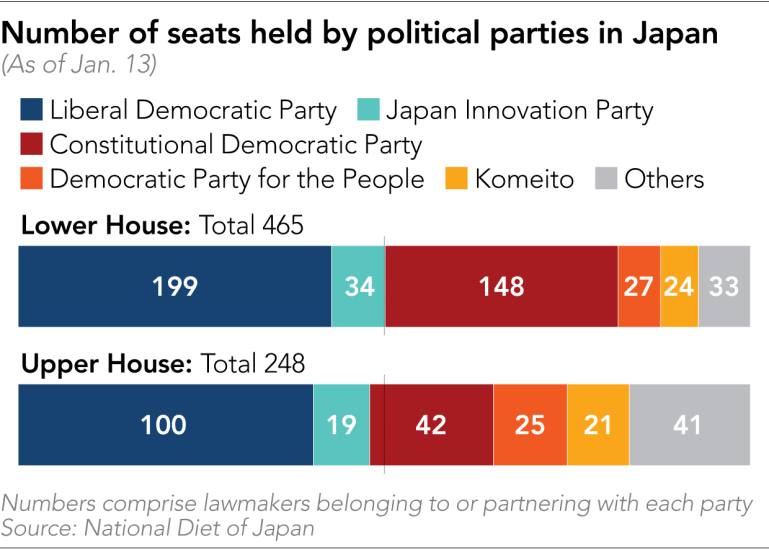
Based on a national survey using random-digit dialling that collected 117,533 responses, Nikkei and the Daily Yomiuri report that the LDP stands a chance of winning an absolute majority, picking up at least 35 seats relative to its 198 seats before the election.

It suggests that the LDP is already favored in roughly 115 of 289 seats, roughly halfway to the simple majority line. Of the more competitive 150 seats, the LDP is ahead in roughly 100, which would put the LDP close to a majority of its own even before proportional representation seats are included – and Nikkei anticipates that the LDP could win close to 70 of 176 PR seats, up from 59 in 2024.


According to Nikkei Asia, the LDP could gain a majority of the 465 seats in the Feb. 8 lower house election, up from 198, according to a new Nikkei poll conducted immediately after the election announcement. Meanwhile, the Centrist Reform Alliance -- newly formed by the Constitutional Democratic Party and Kōmeitō -- is expected to decline from its pre-campaign total of 167 seats.

The Centrist Reform Alliance, founded Jan. 22, has not yet established name recognition. With about 10 days remaining until the election, more than half of the single-seat constituencies are competitive, and the landscape could shift considerably as the election nears. [...] The Centrist Reform Alliance, meanwhile, could lose seats, and is at risk of winning fewer than 100. Japan Innovation, the second-largest party in the ruling coalition, and the Democratic Party for the People, the second-largest opposition party, are not faring well in early polls. Japan Innovation may lose some of its previous 34 seats. It is expected to secure seats in its stronghold of Osaka, but is struggling in most other regions. Its proportional representation seats are also expected to decrease from the previous 15. Its goal of gaining nationwide support by joining the ruling coalition appears to have not panned out.

Paywall alert:
 
Back
Top Bottom