Politics The Takaichi Sanae Thread - Japan's first female Prime Minister

thomas

Unswerving cyclist
Admin
Joined
14 Mar 2002
Messages
21,050
Reaction score
18,903
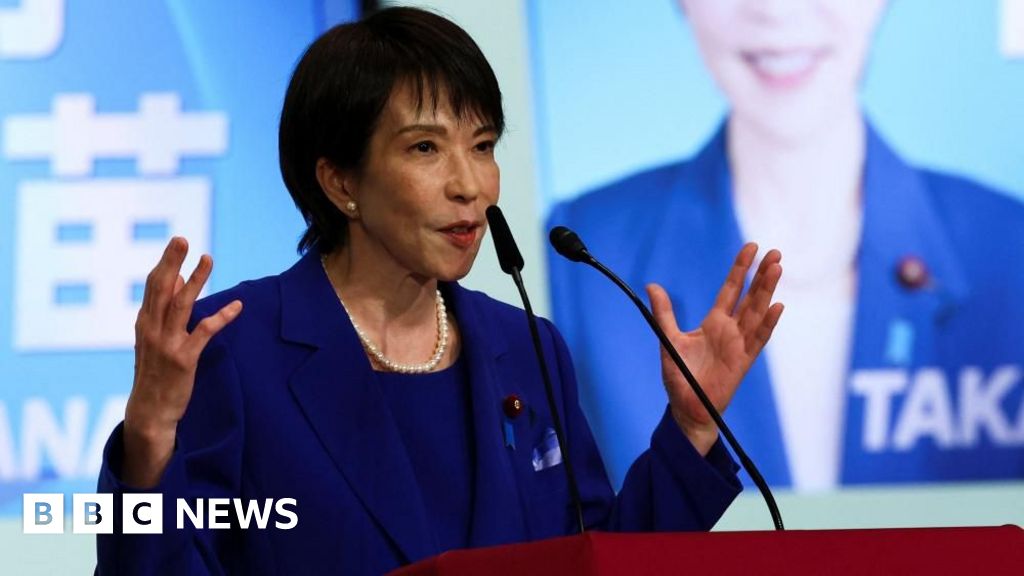
In a runoff election against Koizumi Shinjiro, Ms Takaichi became the first female president of the LDP. She will likely be elected Japanese PM on 15 October.

Sanae Takaichi, former economic security minister, was elected leader of Japan's ruling Liberal Democratic Party on Saturday and is likely to become the first female prime minister within two weeks, succeeding the outgoing Shigeru Ishiba. She defeated Agriculture Minister Shinjiro Koizumi in a runoff held after none of the five candidates secured a majority in the first round of voting. She is also the first female president in the LDP's 70-year history. The arch-conservative was close to the late Prime Minister Shinzo Abe, another prominent leader of the right wing within the LDP. She has publicly stated that she sees former U.K. Prime Minister Margaret Thatcher as her role model. Voting by LDP lawmakers started at 1 p.m. at the party headquarters in Tokyo.

The first round was a combination of 295 votes by the party's lawmakers in parliament and the same number allocated based on the votes of rank-and-file party members for a total of 590 ballots. Voting by party members was completed by Friday, and all ballots were tallied and announced after the lawmakers' vote. In the first round, Takaichi received 183 votes and Koizumi 164. Chief Cabinet Secretary Yoshimasa Hayashi won 134 votes. As no candidate earned a majority, the top two proceed to a runoff and compete for 342 votes -- 295 for lawmakers and 47 for the chapters in all prefectures. The prefectural chapter votes went to the runoff candidates who won more in the party members' vote.

 
Takaichi, 64, a conservative nationalist who lists former British leader Margaret Thatcher as one of her role models, was an ally of assassinated former Prime Minister Shinzo Abe, Japan's longest-serving leader. But there are concerns that Takaichi's nationalistic historical views could cause friction with China, Japan's top trading partner.

Koizumi, 44, the son of former Prime Minister Junichiro Koizumi, would have been Japan's youngest leader since Hirobumi Ito, who was just a few months younger than Koizumi when he became the country's first prime minister in 1885.

 
Takaichi has been a long-time admirer of Britain's first female prime minister, Margaret Thatcher. She is now ever closer to fulfilling her Iron Lady ambition. But many women voters don't see her as an advocate for progress. Takaichi is a staunch conservative who's long opposed legislation allowing women to keep their maiden names after marriage, saying it is against tradition. She is also against same sex marriage. A protégé of the late former leader Shinzo Abe, Takaichi has vowed to bring back his economic vision, known as Abenomics – which involves high fiscal spending and cheap borrowing. The LDP veteran is hawkish on security and aims to revise Japan's pacifist constitution. She's also a regular visitor of the controversial Yasukuni shrine where Japan's war dead including some convicted war criminals are memorialised. She will likely be confirmed by parliament, although not automatically like her predecessors because the ruling party is in a much weaker position now having lost its majority in both houses.

 
From Substack:

It's early days, but here's an excellent analysis by Tobia Harris:


Jack Adelstein, meanwhile, doesn't hide his disdain:

 
This is not going to end well. Perhaps the best we can hope for is the usual pattern of mediocre performance, increasing disillusion from the population leading to low approval ratings, another power struggle, and a different leader in 18 months before she can do too much damage.

The elegant ladies at Mrs Lothor's tea ceremony class were universally dismayed by today's news.
 
And now Japan lurches to the right. She doesn't seem very nice especially if one of her idols was Hitle…sorry, Thatcher. If other PMs are anything to go by, she won't be in position for very long anyway 🤞🏽
 
The markets are reacting strongly to Takaichi's election. Here's the GBP/JPY graph (the exchange rate I'm most interested in) and article giving more context.

Yen plunges to 149 against dollar, Nikkei rises to record high after Takaichi elected LDP leader

1759721500260.webp
 
Last edited:
The yen started the year at 158, and gained to 140 in April. It's bounced around the mid to upper 140s since then, even touching 150 a couple times recently. It was 147 to 147.5 most of Friday (3rd).

I wouldn't call a move of 1.5 yen (or 2 if you try to stretch it) a "plunge", as in the headline.

There are other confounding--or better--catalyzing factors. Eg, the US shutdown continues, job numbers and some other economic numbers are not being released, and trump continues to go more and more senile/berserk.
 
Yes, a 'plunge' is an overstatement, but the move was definitely a response to Takaichi's election. Here's the corresponding EUR/USD graph. No big change when the markets opened.

1759736930022.webp
 
And it seems Don Taro has already taken over Team Takaichi:


/.jpeg.webp


Former Finance Minister Shunichi Suzuki, a key member of a faction led by former Prime Minister Taro Aso, has been tapped as the next secretary-general of the Liberal Democratic Party, making Suzuki the right-hand man of new party president Sanae Takaichi and reflecting Aso's growing influence. Suzuki, 72, Aso's brother-in-law, will be in charge of the LDP's overall operations. Former Secretary-General Toshimitsu Motegi, an Aso ally who also supported Takaichi, is expected to be appointed to one of the Cabinet posts, possibly foreign minister.

 
I just read up on her. Seems she opposed to immigrants, like what I hope to be. Not sure how I feel.
 
I just read up on her. Seems she opposed to immigrants, like what I hope to be. Not sure how I feel.
Rather a lot of Americans in Japan post on social media about how Japan should be tough on immigration, seemingly without any understanding that such policies would affect them.
 
Bloomberg TV on the political and financial impact of Ms Takaichi's election, interviewing, among others, Tobias Harris:


Here's what Richard Katz had to say on Substack:

Gerry Curtis declared that, going to hasten the decline and the eventual collapse of the LDP." In a speech to the Foreign Correspondents Club of Japan, Curtis said, "It's not if, it's just when. It could happen fairly soon," as the LDP is likely unable to deliver what the people need. He also stressed that Japanese politics is going through the same process seen elsewhere, with the incumbent ruling and opposition parties losing popular support to more extreme parties, because they remain unable to provide answers to the "anger and resentments" of their voters. [...] I'd note two other details. While other leading candidates for LDP President vowed to increase wages—without giving a clear idea of how they'd so—Takaichi did not even bother to make even an empty promise. She just offered the same promises that lost the LDP the Lower and Upper House elections: some cash handouts and perhaps some temporary tax credits (not tax cuts, even temporarily). Initially, in a debate, Takaichi was the only candidate who said that trade pact former PM Shigeru Ishiba negotiated with Donald Trump had some unfair elements and she might seek to renegotiate it. Then she walked that back, praising Ishiba's handling of the issue and dropping any intention to renegotiate.
 
More on Gerry Curtis' speech at the Foreign Correspondents' Club of Japan on Monday. Mr Curtis is a professor emeritus of political science at Columbia University and a veteran Japan watcher:

According to him, Takaichi's win would only accelerate what he saw as the steady decline and eventual collapse of the LDP. It was no longer a question of if but when: the party and its leaders seemed incapable of addressing the real needs of the public. Having spent the past three weeks in Japan, Curtis described the 12-day campaign leading up to Saturday's vote as "the most uneventful" he had witnessed in decades of observing Japanese politics since the 1960s. He noted that all five candidates appeared cautious and defensive, avoiding any remarks that might provoke debate. Despite the party's shared sense of crisis—after a series of electoral defeats that cost it control of both houses of the Diet for the first time—none of the contenders offered any vision for how the LDP or Japan might overcome its challenges.

Instead, they projected a show of unity for the cameras, holding hands and declaring themselves a team while sidestepping the country's pressing issues. The campaign lacked substance and inspiration. "Why," he asked, "would anyone feel moved to vote for any of them?" To Curtis, the political formula that had long sustained the LDP had run its course.

As for the coalition with Komeito:

As for the existing coalition partner Komeito, Curtis believes it will remain, despite its chief, Tetsuo Saito, clearly hinting at a potential dissolution of the decades-long partnership immediately following Takaichi's election if its concerns are not addressed. Curtis revealed a conversation he had two days ago with a former Komeito leader whose further identity he left anonymous. The former leader told him that Komeito has no real choice but to remain in the coalition. Even if the LDP is to court the Japan Innovation Party, which is competing with Komeito for supporters in the Osaka area, the party cannot afford to lose its current status in the government and its guaranteed cabinet position.

On Yasukuni:

The Yasukuni Shrine issue, which has been a source of controversy, will test the LDP-Komeito coalition, as Saito has explicitly raised concerns about Takaichi's visit to the Shinto shrine as prime minister. Curtis foresees Takaichi refraining from doing so, saying such an act would be "so foolish of her, especially in her first year, to create a major diplomatic incident because she wants to go" there as prime minister. Unlike previous LDP prime ministers, Curtis believes Takaichi does not need to prove herself by visiting the shrine for "domestic political reasons," as she is already popular among the party's conservative supporters.

On China:

Similarly, Curtis believes Takaichi will not do much regarding Japan's relationship with China. His wish is for Takaichi, a well-known China hawk, to use "common sense" and "find ways to get along" with a neighbour that 15 years ago surpassed Japan to become the second-largest economy and also has one of the most well-funded militaries. However, he senses a "danger" in Takaichi where "she will be only focused so hard on security."

And on Japan's political outlook:

"If the Japanese are not careful, they are going to end up like us, and I don't wish that on anybody," he said, alluding to President Donald Trump winning the presidency for a second time. "This country, and the party, is at a dead end. They have to find a new route, or it's going to disappear."

Paywall alert:
 
I agree with that analysis. The rise in populism worldwide is reflecting the fact that people are increasingly dissatisfied with established politicians, and Takaichi reflects the old type of thinking that Japan seems to have moved on from. The article below, which reports wide criticism for her pledge to abandon any idea of work-life balance for her and her cabinet, suggests that her mindset is of 20th-century Japan, where gambaru was valued above almost everything else.

Such strong criticism so early on also suggests that she's in for a hard time.

 
On the global rise of populism, I want to gift this article to JREF:


It not only applies to Europe and the US, but also to Japan and other non-Western industrialised nations.
 
I wasn't able to access the article, but the title is a good one and reflects my feelings on the current trends in those countries.

In some ways, things were better in the past. In the US and the UK, a single wage-earner could easily get a mortgage for a house for their family, and in Japan, you had a job for life and would be 'looked after' by the company. All that has gone.

Conservative and populist movements have tapped into this, but the error they have made (either genuinely or cynically) is to mistake some of the circumstances during those earlier eras (a segregated US with the woman's role limited to the homemaker; an overwhelmingly white, pre-EU Britain; a homogeneous Japanese population) with the causes of these more benign economic conditions. From this, they have argued that immigration, gender equality, gay marriage, etc., have caused the decline of the West.
 
The news makes it sound like all of Europe is having trouble with immigrants causing disruption and crime. Since I don't live there , no idea if it a major problem.
 
The news makes it sound like all of Europe is having trouble with immigrants causing disruption and crime. Since I don't live there , no idea if it a major problem.
It's complicated. Here's the situation for the UK as best as I understand.

First of all, most of the immigrants in the UK are like me in Japan. They've moved to another country for reasons of work, study, or family and have stayed there through legal channels. A large number of people have entered the country in that way over the last 50 years, which has led to some parts of towns becoming predominantly South Asian Islamic. Whether that is a problem or not depends on your viewpoint – one person may watch a video of such an area and see a bustling community of people going about their lives (my view), and another may see it as their country being taken over by people with different values. I never had any problems when I worked as a student teacher in such an area of Manchester.

One thing that muddies the immigration issue is the blurring between non-white people whose families are in their second or third generation in the UK and recent immigrants. For example, there have been some horrific high-profile crimes by some British Asians, such as this child sex ring run by British Pakistanis Rochdale child sex abuse ring - Wikipedia. The criminals (I believe) were all UK citizens and may well have been born there, but many people will use such crimes as an argument against immigration, even though those people weren't immigrants.

So far I've been talking about legal immigration. Then there are the high-profile 'small boats' crossing the English Channel from France, which is problematic for several reasons: the risk to life, the cost to the UK to process them, and the exploitative work culture it encourages: unscrupulous companies knowingly using such people as delivery drivers, etc., and paying them low wages or making them work under unsafe conditions. To some extent, British governments have created this problem themselves by shutting down legal ways for people to enter the country, so more people have tried to enter illegally. The Home Office has such a hostile attitude towards immigration that it would take a lot of time and effort for me to move to the UK with my Japanese wife of 21 years - many British people in Japan with Japanese wives have decided not to bother returning to the UK except for visits. Anyone telling you that it is easy to get into the UK as an immigrant is lying.

To answer your original question, I'm of the view that immigrants, both legal and illegal, have more incentives NOT to commit crime, so on the whole are less likely to commit crimes and cause disruption. However, when you have a large section of society aiming to demonize them, it is going to appear that they are causing unrest because of the amplification of the crimes that they do commit on social media.

Finally, an indirect way in which immigration IS causing problems is the polarization of society, with some people having similar views to mine and others thinking that immigration is the root of society's problems. The fact that these people are usually unable to talk to each other with civility is having a corrosive effect on society.

I can't speak for other countries, but that's my best understanding of the UK. I've tried to make it clear what is widely accepted fact and what is my opinion.
 
I couldn't read the article either so I asked AI to give me a summary of it.

The writer of the New York Times article entitled "The West is Lost" expresses an opinion that loss has become a pervasive and defining condition in contemporary life in both Europe and America. The article argues that economic, demographic, infrastructural, and geopolitical setbacks have eroded the optimism and power that Western societies once took for granted. The writer sees a decline marked by deindustrialization, aging populations, degraded public systems, housing crises, and a retreat from the liberal democratic order, which breeds a strong sense of insecurity and grievance.

The writer further critiques the modern Western ethos by highlighting the denial of loss amid a secular faith in continuous progress, stating that this denial is no longer tenable. The rise of right-wing populism is framed as a predictable response to widespread loss and disillusionment, though populism offers only false hopes.

The article proposes several ways to confront this pervasive loss: through a politics of resilience that strengthens societies against harm, redefining progress towards sustainability rather than endless growth, redistributing gains and losses more justly, and ultimately acknowledging and integrating loss into collective narratives. The writer concludes that liberal democracies must abandon naive promises of perpetual improvement in favor of narratives that accept loss, vulnerability, and redefined progress to find a possible path to renewal.

In sum, the writer's opinion is a somber but thoughtful call to confront and integrate inevitable losses rather than deny them, suggesting this is crucial for the future health of Western societies and liberal democracy itself.
 
I couldn't read the article either so I asked AI to give me a summary of it.

The writer of the New York Times article entitled "The West is Lost" expresses an opinion that loss has become a pervasive and defining condition in contemporary life in both Europe and America. The article argues that economic, demographic, infrastructural, and geopolitical setbacks have eroded the optimism and power that Western societies once took for granted. The writer sees a decline marked by deindustrialization, aging populations, degraded public systems, housing crises, and a retreat from the liberal democratic order, which breeds a strong sense of insecurity and grievance.

The writer further critiques the modern Western ethos by highlighting the denial of loss amid a secular faith in continuous progress, stating that this denial is no longer tenable. The rise of right-wing populism is framed as a predictable response to widespread loss and disillusionment, though populism offers only false hopes.

The article proposes several ways to confront this pervasive loss: through a politics of resilience that strengthens societies against harm, redefining progress towards sustainability rather than endless growth, redistributing gains and losses more justly, and ultimately acknowledging and integrating loss into collective narratives. The writer concludes that liberal democracies must abandon naive promises of perpetual improvement in favor of narratives that accept loss, vulnerability, and redefined progress to find a possible path to renewal.

In sum, the writer's opinion is a somber but thoughtful call to confront and integrate inevitable losses rather than deny them, suggesting this is crucial for the future health of Western societies and liberal democracy itself.
All fair points, but while the billionaire-owned New York Times glosses over the fact that there is a fascist in the throes of serious cognitive decline in the White House in its political reporting, it lacks credibility when it talks about wealth distribution and what is best for Western democracies.
 
Honestly, as a potential immigrant, Shinjiro Koizumi would be a better PM. I don't agree with him on the issue of separate surnames and same sex marriage, but at least, he's generally more inclusive and has a more positive stance for immigration. It would, from what I know, give more breathing room and be more flexible for visas. I agree with Takaichi on a few of her views, but, at the current time I don't really know what's really better for Japan as a whole, I just know as a potential immigrant, Shinjiro seems to be a bit better, though not by much. Also, for what @Ukigumo said, I don't see what's wrong with having Thatcher as her idol and role model.


Edit: not political views, just my thoughts on this.
 
Last edited:
Back
Top Bottom