History Japanese history and archaeology: articles, news, and comments

The final instants of Japan's colossal warship, the Yamato, were recorded in an exceptionally uncommon color video shot from American military planes during World War II, as stated by a war-history organization. The video from American archives showcasing the Imperial Japanese Navy's esteemed vessel was made public in Japan on 12 May. A segment of the film reveals the warship enduring an American onslaught on 7 April 1945, near Kagoshima Prefecture, as reported by Toyonokuni Usashijuku, a regional collective dedicated to examining and pinpointing American wartime archival content.


The clip was filmed from a U.S. military plane at around 12:40 p.m., less than two hours before the battleship sank. Another piece of aerial footage shows the Yamato moving off the coast of Iwakuni, Yamaguchi Prefecture, while evading U.S. attacks on March 19 of the same year. The group identified the ship as the Yamato based on its characteristic shape. The scene shown in the footage matches photos attached to a battle report stored in the National Diet Library in Tokyo, the group said. The two pieces of footage, totaling 82 seconds, are part of 17 clips captured across 12 prefectures in Japan between February and August 1945. The running time for all 17 clips is 8 minutes and 28 seconds. Since 2011, the group has been trying to determine dates, times and locations of footage obtained from the U.S. National Archives by cross-referencing them with U.S. military war reports and Japanese records.


The video footage is in the link below.

 
More on the dakoken long sword recently unearthed in Nara (read the news here):

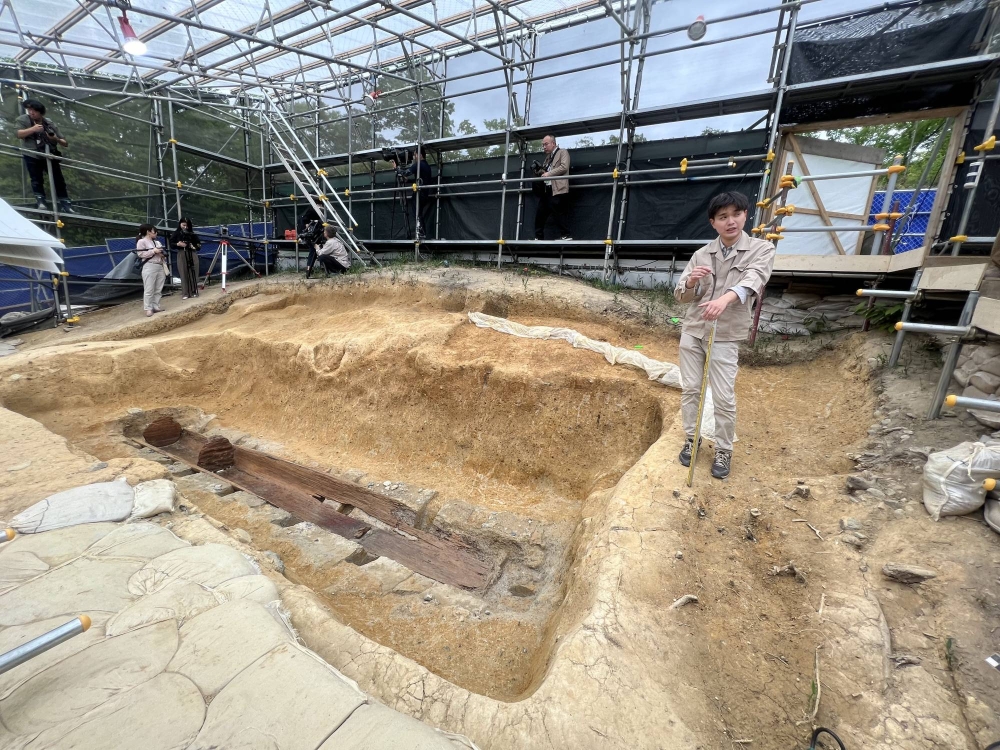
The 2.3-meter long dakо̄ken sword — called that due to its wavy snake-like shape — is by far the longest sword found in East Asia from the Kofun Period (310 to 700) and possibly the world. It is also the oldest among the 90 or so dakо̄ken to have been discovered so far across Japan. In another surprise, the bronze mirror — elaborately decorated with images of gods and animals — is shaped like a shield. Ancient mirrors are typically round; none with such a shape has ever been found.


Photo credit: Otake Tomoko (via JT)


Photo credit: Archaeological Institute of Kashihara, Nara Prefecture


More on the sword and the Tomio Maruyama burial site:

 
In a recent excavation at Kyōhōin (教法院), a sub-temple of Ryūhonji Temple (立本寺) in the Kamigyō Ward of Kyōto , several bones believed to belong to Shima Sakon (島左近), a confidant of Sengoku warlord Ishida Mitsunari , were discovered. Shima, whose bravery in the Battle of Sekigahara in 1600 had been praised, was believed to have been killed in battle, but his body was never found. Various theories circulated about his fate after the battle, including the possibility that he survived.


ADKq_Nbp_8rsmNQGooWuJAsTU6lg0AeXUerI3k8oFSN7amd3hZ2S5nff1pZqLJoNwrrDdK9vXFOWLD-rW5uUTFxyqJUXKllrQh9FDZssyXClylHW_7NjQwWaFR--wgvHr3XHzEeCLr1Hv1bipxA1Dx4QUj9RoxpWF73J9MlJ8qx6VYIp_RVN-lJtOONEdub-JFCP-eLBZb6AV4CS3kZkOSLteLmnHU95uNWE4n09iZ7oP14iz9guspfPdRwFaXKd6AH01GUlnMyYqXYGLlCvujx9D60AyU-nQoMHo8XzRXtZKtCon84aGGyENyza7A=s0-d-e1-ft

Photo credit: Sankei Shinbun

Kyōhōin is home to one of approximately five gravesites for Shima across the country. Notably, the Kyōhōin gravestone is the only engraved with the word "burial." Shima's grave plaque and death register remain at this location, indicating that he passed away in 1632—32 years after the Battle of Sekigahara. Priest Miki emphasized that testimonies suggest Shima survived in Kyoto after the battle.

The excavations were conducted during a general restoration of Shima's grave. At a depth of approximately 20 centimetres, a jar containing a skull, a pelvis, and other bones was found. Based on the bone condition, they are believed to belong to an adult over 18 years old. Shima remains a historical mystery due to the scarcity of documents relating to his life. Kyōhōin and other affiliated institutions will continue their research to shed light on the legend of Shima's survival.

Shima Sakon (島左近)

Shima Sakon (島左近)

Shima Sakon (島左近)

Osaka Castle Collection


Kyōhōin is home to one of approximately five gravesites for Shima across the country. Notably, the Kyōhōin gravestone is the only engraved with the word "burial." Shima's grave plaque and death register remain at this location, indicating that he passed away in 1632—32 years after the Battle of Sekigahara. Priest Miki emphasized that testimonies suggest Shima survived in Kyoto after the battle.

The excavations were conducted during a general restoration of Shima's grave. At a depth of approximately 20 centimetres, a jar containing a skull, a pelvis, and other bones was found. Based on the bone condition, they are believed to belong to an adult over 18 years old. Shima remains a historical mystery due to the scarcity of documents relating to his life. Kyōhōin and other affiliated institutions will continue their research to shed light on the legend of Shima's survival.
Any theories what was in the jar? are they going to analyze them?
 
Any theories what was in the jar? are they going to analyze them?


戦国武将・石田三成の重臣・島左近のものと伝わる墓の発掘調査が5日、京都市上京区の教法院(きょうぼういん)で行われ、ほぼ全身の骨が見つかった。左近の骨かどうかは不明だが、今後、骨の年代などを調べるという。

It looks like they will take a closer look at the bones found in the jar.

If there are DNA traces left, they could compare them with the DNA of surviving Shima descendants. I guess.
 

Japan diplomatic archives see visitor surge

The Diplomatic Archives of the Ministry of Foreign Affairs exhibition room, which displays historical diplomatic records from the late Edo era , has experienced an increase in foot traffic following its move in April to the nearby Azabudai Hills skyscraper complex in Minato Ward, Tokyo.

Now situated on the fifth floor of Mori JP Tower, Japan's highest skyscraper inaugurated in November 2023, the exhibition space features a dedicated area showcasing artefacts linked to Chiune Sugihara, known for his "visas for life" to Jewish refugees during WWII as a vice-consul in Lithuania for the Japanese Empire, and Shigeru Yoshida, a notable diplomat who held positions as foreign minister and prime minister.

From its inauguration on 8 April until the end of May, the new exhibition room welcomed 4,032 guests, almost twice the number of visitors (2,109) the previous venue attracted in fiscal 2022, surpassing the annual goal of 3,500. The visitors' profile includes families and young couples, many of whom seem to have visited the exhibition while exploring the complex, a prominent feature in the Tokyo skyline.

The new exhibition room displays items such as Yoshida's favourite cigar case and the brush and inkstone he carried to the San Francisco Peace Conference 1951. The facility introduces the contrasting figures of Yoshida, a graduate of Tokyo Imperial University (now the University of Tokyo) who reached the summit of the political world, and Sugihara, a non-career diplomat who dropped out of Waseda University to study abroad before entering the foreign ministry. Sugihara, who independently issued his "visas for life," left the foreign ministry after the war. In 2000, then-Foreign Minister Yohei Kono offered Sugihara's bereaved family a posthumous apology, acknowledging "rudeness and communication failures." To restore his honour, a commemorative plaque and a visa issuance list were placed in the main lobby of the Diplomatic Archives. These were relocated to the new exhibition room for easier viewing.

Admission to the new exhibition room is free, and unlike the prior facility, it is open on Saturdays, too. It remains closed on Sundays and public holidays.

 
Armour designated as an Important Cultural Property by the government and believed to have been worn by Sengoku warlord Uesugi Kenshin , and a helmet belonging to Uesugi senior retainer Naoe Kanetsugu, whose slogan "love" (愛) is displayed on the crest, is to be renovated. Packaging was carried out on 12 June at Keishoden, the Uesugi Shrine in Yonezawa City, where the items are kept. Both are scheduled to be displayed publicly after repairs.


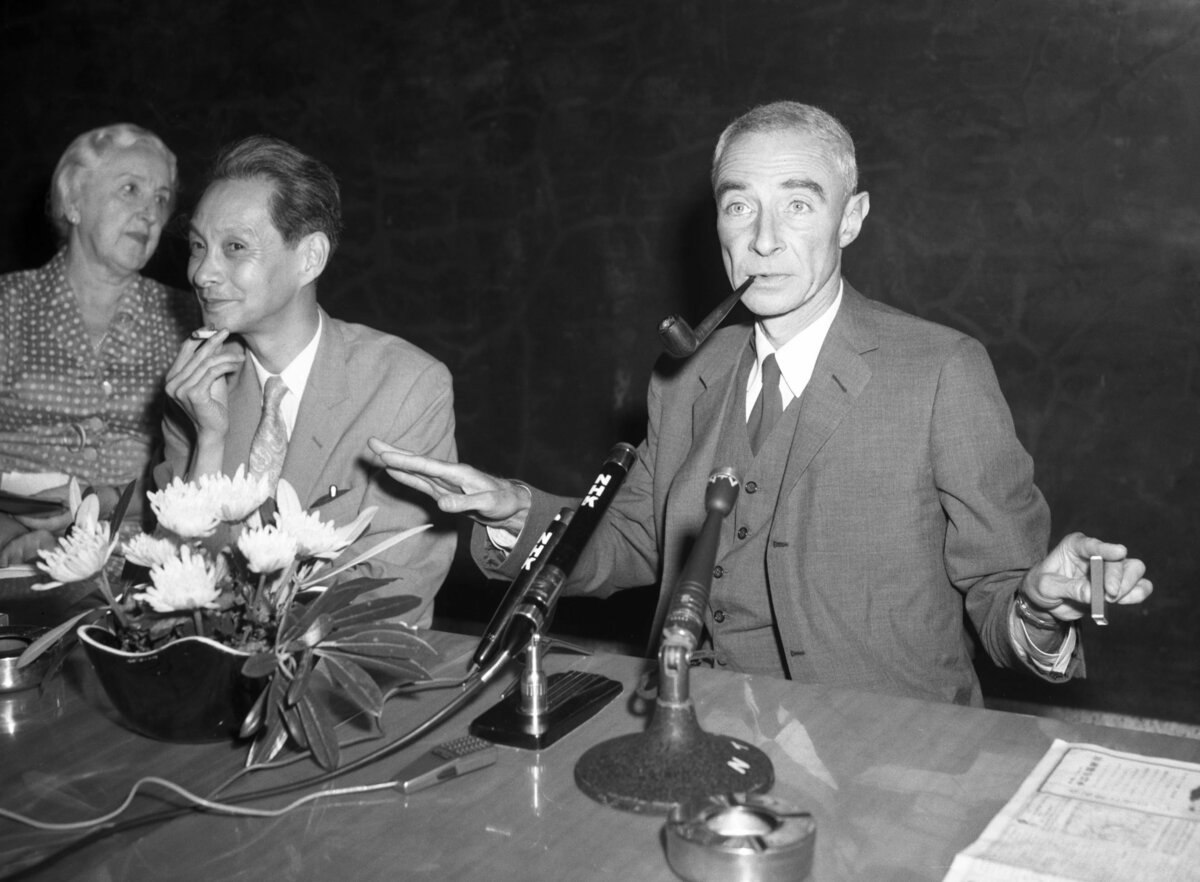
A piece of more contemporary history: recently found footage showed that Robert Oppenheimer, known as the "father of the atomic bomb," reportedly apologized to an atomic bomb survivor during a closed-door meeting in the United States in 1964. The apology came during an interaction between Oppenheimer and others, including the late Naomi Shono, an A-bomb survivor from Hiroshima who was also a theoretical scientist, the late Yoko Teichler said in the 2015 footage in Japanese. Teichler was an interpreter at the meeting.


Robert Oppenheimer (R) speaking at a press conference in Tokyo in September 1960

Robert Oppenheimer speaking at a press conference in Tokyo in September 1960


During the 50-minute footage held by non-profit organization Hiroshima-based World Friendship Center, the interpreter said that Oppenheimer had started crying as soon as he entered the room and apologized repeatedly. Oppenheimer, who helped develop the U.S. atomic bombs used on Hiroshima and Nagasaki in 1945 in the closing days of World War II, did not visit either city during his 1960 trip to Japan. But he later met Shono, who toured eight countries on a "World Peace Study Mission" in 1964. The footage includes interviews with Teichler and two other people who took part in the tour. "It is surprising that there are records of him apologizing. It must be a consolation for the hibakusha to hear an apology from the person who was responsible for the development (of the bomb)," said Noriyuki Kawano, director of the Center for Peace, Hiroshima University.


In an interview in 1965, though, Oppenheimer declared: "The ending of the war by this means, certainly cruel, was not undertaken lightly. But I am not, as of today, confident that a better course was then open. I have not a very good answer to this question."


The Fukui Cave in Sasebo, Nagasaki Prefecture, a site from the Paleolithic era, is being considered for designation as a special historic site. If approved, it would be the oldest site to receive such recognition. The Council for Cultural Affairs has recommended this designation to the education ministry. The cave, found in 1935, offers insights into human life from 19,000 to 10,000 years ago, spanning the Paleolithic and early Jomon Pottery Culture periods. This nomination could lead to the first Paleolithic site being officially recognized as a special historic site.

Fukui Cave (福井洞窟)

Excavation surveys of as many as 15 layers of accumulations in the soil in the cave revealed, for the first time in Japan, the process of how ancient stone tools evolved in shape and earthenware appeared. Fukui Cave is significantly older than the Sannai Maruyama Site of the Jomon period in Aomori Prefecture, a special historic site, which dates back 5,900 to 4,200 years ago.


Not archaeological but with a historical touch:

A plastic model of Gundam, inspired by the armour worn by Tokugawa Ieyasu , the founder of the Tokugawa Shogunate, is a huge hit this season. The MG 1/100 Musha Gundam Mk-II Tokugawa Ieyasu Nanban-Dogusoku Ver. model showcases the iconic robot from the "Mobile Suit Gundam" series in European-style armor, known as "nanban-dogusoku." The original armour, an important cultural property, is housed at Nikko Toshogu shrine and is believed to have been worn by Ieyasu during the Battle of Sekigahara in 1600. The model features design elements from historical armour, including a Spanish-style helmet and black paint with red "kusazuri" plates. Released exclusively at the shrine in late May for 7,700 JPY (USD 48), the initial batch of 2,000 sold out quickly.

MG-musha-gundam-mk-II-tokugawa -ieyasu-nanban-dogusoku.jpg


The special kit is the brainchild of Takamasa Inaba, 55, the shrine's "gonguji," or second-ranking priest, who is a diehard Gundam fan. Late last year, Inaba approached Bandai Namco Holdings Inc., which produces plastic models of robots from the Gundam series collectively known as Gunpla, to ask for its collaboration. The company, which runs a toy museum in Mibu in the prefecture, was happy to comply, saying it was a chance to give back to the local community. The plastic model is aimed at promoting the 25th anniversary of the registration of shrines and temples of Nikko as a collective World Heritage site. But Inaba also hopes it will help make the history surrounding nanban-dogusoku armour more widely known. According to shrine officials, only a few people visiting the shrine's museum bothered to look closely at the armour until now.


An exhibition titled the "Perfect Guide to Japanese Swords, Revived: Studying the Great Swords of the Kamakura Period " is currently held at the Seikado Bunko Museum of Art in Tokyo. Visitors can see swords purportedly owned by famous historical figures such as Oda Nobunaga , Toyotomi Hideyoshi , and Tokugawa Yoshimune .


The exhibition also features specific historical swords:

A sword once owned by Nobunaga, characterized by its wide blade and powerful appearance. A blade favored by Yoshimune, identified by its shallow curve and gentle hamon, representing the era's craftsmanship. A piece associated with Hideyoshi, known for its sharpness and historical significance. These swords and their fascinating histories and unique characteristics are on display at the Kado Bunko Museum of Art until 25 August. This exhibition showcases the beauty of these historical weapons and offers a deeper understanding of their craftsmanship and significance.


The exhibition galleries are relocated on the first floor of the Meiji Seimei Kan (明治生命館), an important cultural property building located on the edge of the Imperial Palace moat in the Marunouchi district of Tokyo:

2-1-1 Marunouchi, Chiyoda City, Tokyo 100-0005

It is open daily from 10:00 to 17:00, Saturdays until 18:00, the third Wednesday of each month until 20:00, Mondays closed, but open on 12 August.

Link:

 
A ceiling board featuring graffiti of a man's face is among 3,284 wooden pieces from the Kondo main hall of Horyuji temple that is set to be designated as a national treasure. This board was part of the coffered ceiling of the main hall, built during the Asuka Period (592-710), and is the world's oldest surviving wooden structure. Although a large portion of the board was burned in a 1949 fire, the graffiti survived, protected by timber. Coffered ceilings are created by cutting wood into squares and assembling them into a lattice, over which boards are laid.

Graffiti of a man's face and a hand were found on a charred ceiling board from the Kondo main hall of Horyuji temple

Graffiti of a man's face and a hand were found on a charred ceiling board from the Kondo main hall of Horyuji temple (Photo credit: Jiro Tsutsui).


The ink-drawn graffiti measures about 5 centimetres on each side and depicts a man with a cloth crown, wrinkles, and a beard. Yoshitaka Ariga, a Japanese art history expert, believes an artist doodled a colleague's portrait during a break. Above the face is a drawing of a hand with slightly bent fingers. "The delicate brushwork makes it hard to believe that (the paintings) were drawn by an amateur," Ariga said. A photograph of the graffiti ran in a March 2023 report published by Horyuji temple about historical wooden pieces related to the Kondo main hall. In a May report, the Council for Cultural Affairs proposed that the 3,284 wooden pieces be designated a national treasure. The collection includes pieces not used during repairs of the main hall between 1934 and 1955.


A meeting of truly "historical proportions" took place at a Nagoya high school this week: the descendants of Nakahama Manjiro, aka John Manjiro, (Commodore) Matthew Perry , and Captain William H. Whitfield reunited to discuss with students the importance of international exchange.

Scott and Wyatt Whitfield, Matthew Perry, and Nakahama Kyo in Nagoya

Scott and Wyatt Whitfield, Matthew Perry, and Nakahama Kyo in Nagoya (photo credit: Mainichi/Shinichiro Kawase)

John Manjiro was a Japanese linguist who promoted the U.S.-Japan exchange after being rescued in 1841 by an American whaling ship under Captain William H. Whitfield. Because of Manjiro's rescue, the Nakahama and Whitfield families have been in contact for over 180 years. In 1991, 150 years after the incident, the Japan-America Grassroots Exchange Summit was established to promote citizen-level exchange between Japan and the U.S., modelled after the interaction between the two families. Also present was Matthew Calbraith Perry, a fifth-generation descendant of Commodore Perry.

 
Another fascinating, perhaps not so well-known, historical insight: Italian author Dacia Maraini returned to Japan to confront the traumatic experiences of her childhood. Interned as an "enemy national" during the Asia-Pacific War, the 87-year-old writer shared her harrowing ordeal to foster a brighter future.

Over 1,200 civilians from Allied countries were imprisoned in Japanese camps under the guise of protection, but harsh conditions led to the deaths of 50 individuals. Maraini's family, including her father, a renowned Ainu culture researcher, faced persecution after Italy's surrender in 1943. Their refusal to support the Nazi-backed Republic of Salo branded them "enemy aliens." Consequently, they endured two years of captivity in an Aichi Prefecture camp marked by severe brutality.


Dacia Maraini speaks in Tokyo in June 2024

Dacia Maraini speaks in Tokyo in June 2024 (photo credit: Sekiguchi Kayoko)


The camp authorities dropped rotten oranges in front of starving children and beat internees with sticks even when they were so weakened by hunger that their gums bled. The authorities frequently subjected internees to psychological torment. Maraini recalled eagerly awaiting a letter from her grandmother in Italy, only to be told by the authorities that she must wait a week to receive it. When she went to pick it up a week later, they tore the letter to pieces in front of her. "The authorities took pleasure in hurting people emotionally," she said. "The camp was a breeding ground for absolute power." "Absolute power makes people sadistic. The authorities believed that any cruelty toward traitors to the homeland was justified," she added. After the war, Maraini returned to Italy and debuted as an author in the 1960s. She has since created works that use a feminist and anti-fascist lens to examine human violence, addressing issues such as abortion and sexual violence. Last year, Maraini compiled her experiences in the camp in a book titled "Vita mia" (My life).


81CDhWDN5lL._SL1500_.jpg
 
A newly launched website offers a harrowing visual record of the Hiroshima atomic bombing. The archive features over 1,500 photographs and videos captured by 28 individuals and organizations in the aftermath of the August 6, 1945, attack, providing a stark portrayal of the devastation. This collaborative project, involving Hiroshima city and major Japanese media outlets, has been nominated for UNESCO's Memory of the World register. The website offers advanced search and filtering options to explore this powerful historical resource.


A replica of a Korean royal ship is set to embark on a historic journey to Japan. Built to resemble the vessels used by Joseon Dynasty envoys during the Edo Period, the boat will arrive in Shimonoseki this August, marking the first visit by such a vessel in 260 years. The voyage commemorates the 20th anniversary of a local event reenacting the Joseon Tongsinsa procession. Constructed for 2.15 billion won (238.5 million yen, or $1.5 million) based on historical records, the 34-meter-long replica can accommodate up to 72 people. Its arrival coincides with the Bakan Matsuri festival, promising a spectacular cultural exchange. The Joseon Tongsinsa missions, initiated in 1607 to mend ties severed by Toyotomi Hideyoshi 's invasion, played a crucial role in diplomatic relations between the two nations.

The vessel visited the Tsushima Izuhara Port Festival on 5-6 August 2023.


bc128974933528abf12258865eeb2f2e.webp

 
The remains of a prisoner-of-war camp, located just over a mile from the Nagasaki atomic bomb hypocenter, were discovered during construction in 2022 but subsequently destroyed. Despite the site's historical significance, city officials deemed it unworthy of preservation as a relic of the bombing. Many POWs perished in the camp due to illness or the atomic blast, prompting local citizens to hold memorial services. However, the city chose not to publicize the discovery. A citizens' group representing POW families has criticized the city's decision, demanding greater public involvement in determining the future of the site.

Japanet Holdings has defended its actions regarding the unearthed POW camp remains. The company stated that the Nagasaki Municipal Government confirmed the limited nature of the ruins, exempting them from preservation regulations. They further explained that the discovered materials were either repurposed or appropriately disposed of.

The remains belonged to Fukuoka POW Camp No. 14. According to sources including a historical work published by the Nagasaki Municipal Government covering the five decades after the bombing, the POW branch camp was established during World War II in 1943. It accommodated about 540 Dutch, Australian and other prisoners of war from the Allied forces who had been transferred from the southern front. Before the bomb was dropped on Aug. 9, 1945, about 100 prisoners perished due to illness and other reasons, and eight Dutch POWs are said to have died in the bombing. The seven buildings at the camp were almost completely destroyed. After the war, the remains of the camp became part of Mitsubishi Heavy Industries Ltd.'s Nagasaki Shipyard & Machinery Works' Saiwaimachi plant. In 2018, major mail-order company Japanet Holdings Co. based in Sasebo, Nagasaki Prefecture, acquired the approximately 7.5-hectare site from Mitsubishi Heavy Industries. A multipurpose complex that will include a soccer stadium and arena, a hotel and commercial facilities is being constructed there, scheduled to open this October. Before construction commenced, the city informed Japanet Holdings that the site was once home to the 14th branch camp.

More here:
 
A newly discovered document reveals that a naval officer misinterpreted an imperial inquiry, triggering the catastrophic decision to send the behemoth battleship Yamato on a suicide mission to Okinawa in 1945. Sunk by U.S. forces on 7 April 1945, the Yamato and its crew of over 4,000—a number equaling the total kamikaze fatalities—were sacrificed in a desperate gamble to turn the tide of the Pacific War. Ordered to beach itself and become a floating fortress, the ship was a tragic symbol of Japan's dwindling fortunes.

As the 80th anniversary of the Yamato's sinking approaches, this newly unearthed document challenges the long-held belief that the decision to launch the mission was made on 29 March 1945. Instead, evidence suggests that Emperor Hirohito made a fateful query just days before the operation was greenlit on 5 April 1945. Kazushige Todaka, director of the Yamato Museum, says the hasty decision reflects the navy's desperate desire to fulfil the emperor's perceived wishes and maintain honour. This undue pressure, he argues, may have led to a reckless disregard for the mission's feasibility.

Model of the Yamato in Kure

The discovery is based on the recollection of Sakuo Mikami (1907-1996), who once served as part of the Combined Fleet's staff. His account was recorded in 1988 during a gathering of the Suikokai group for exchanges among personnel from the Imperial Japanese Navy as well as the Maritime Self-Defense Force. While the record was kept inaccessible to the public, it was checked and heard with the permission of his bereaved family. Mikami's recollection shows that he received a phone call from staff officer Shigenori Kami at the Combined Fleet's headquarters on April 4, 1945, during Mikami's business trip to Kanoya, Kagoshima Prefecture. Kami told Mikami that the "head of the Navy General Staff was asked if the navy had any ships left when he notified His Majesty the Emperor (of a special aviation operation above Okinawa)." Referring to the navy general staff head's embarrassment when leaving, Kami reportedly stated the specialized mission "must take shape as soon as possible given this." The emperor's question about vessels had previously been believed to have been asked on March 29, 1945, in what is currently known as "Document Senkan Yamato" (Documentary on the battleship Yamato).


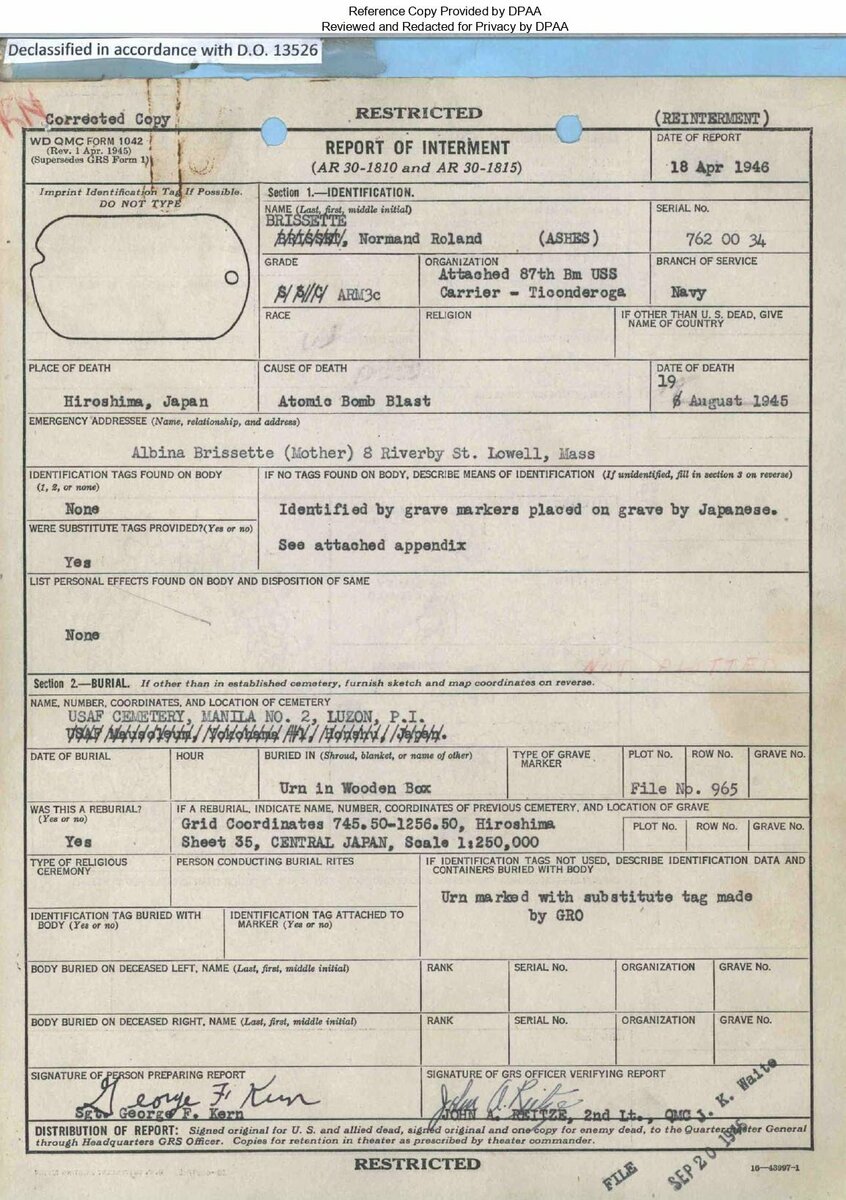
Record of 3rd class Navy radio operator Normand Brissette
Newly declassified U.S. government documents released on Tuesday revealed the identities and detailed personal information of American soldiers who perished in the 1945 atomic bombing of Hiroshima while held captive by Japan. This disclosure follows the recent discovery of a U.S. report confirming the deaths of 12 American troops in the 6 August 1945 atomic blast that devastated the city. However, the original report lacked specific details about the victims.

To obtain comprehensive information, Kyodo News submitted requests for documents to the U.S. Department of the Army and the National Archives and Records Administration. Through these efforts, complete records on all 12 soldiers were obtained, building upon the names initially identified by Shigeaki Mori, an 87-year-old Hiroshima survivor and historian.


The photo above shows the record of "3rd class Navy radio operator" Normand Brissette, who died in the atomic bombing of Hiroshima on 6 August 1945. The document is included in the U.S. Department of the Army's "Individual Deceased Personnel Files." (Record kept by the U.S. National Archives and Records Administration, via Kyodo).


Researchers are excited by the recent discovery of a 1,300-year-old multiplication table: the wooden fragment, unearthed in 2001 during excavations at a site believed to be a guards' office in Japan's ancient capital, Fujiwara-kyo, was announced on 4 September by the Nara National Research Institute for Cultural Properties. Measuring 16.2 centimetres long and 1.2 centimetres wide, the wooden strip is considered part of a larger multiplication table dating back to the late 7th or early 8th century. According to Kuwata Kuniya, a senior researcher at the institute, if the table were complete, it would measure 33 centimetres in length and contain all the necessary equations.

089b85c5beddd95c7b0ec83fdb1514d8.webp

Photo credit: Nara National Research Institute for Cultural Properties

While the discovery may seem insignificant to the untrained eye, it is a significant milestone in understanding ancient Japan's mathematical knowledge and practices. The multiplication table provides valuable insights into the educational and administrative systems of the time.


Researchers believe Emon-fu workers in the capital used the table at their office because of its size. During the initial stage of research, only a portion of the multiplication table was legible. Because the characters seemed to lack any regularity, the team previously classified it as someone's practice tablet. However, after using an infrared device when revisiting the scrawl, it revealed three equations: "9 times 9 is 81," "4 times 9 is 36" and "6 times 8 is 48." All were written in what researchers presume is kanji or Chinese characters. The layout is the source of their ambiguity. The multiplication table is arranged from right to left, with five rows containing equations written from top to bottom—likely the upper right corner of the larger table. Previous tables found in Japan have only two to three rows. This five-row style matches those from China's Qin and Han dynasties, which lasted from around the third century B.C. to the third century A.D. In Japan, the use of the multiplication table as written characters is confirmed from the artifacts that date to the late seventh century.


Repair work has commenced on a white hood believed to have been worn by Uesugi Kenshin (1530-1578), a prominent Japanese feudal lord during the Sengoku Period (1482-1573), a tumultuous era marked by a succession of civil wars. Currently housed at Uesugi Shrine, a sanctuary dedicated to Kenshin in Yonezawa City, Yamagata Prefecture, the white hood is a significant cultural artefact designated as such by the Japanese government. However, its existence remained largely obscure, even among local inhabitants, due to a document created during the Meiji Era (1868-1912) that prohibited its public disclosure.

Following the completion of repair work, the white hood is anticipated to be unveiled to the public in either 2028, marking the 450th anniversary of Kenshin's demise, or 2030, commemorating the 500th anniversary of his birth. The repair work on the white hood is a significant undertaking that will allow the public to gain a deeper appreciation for the life and legacy of Uesugi Kenshin, a pivotal figure in Japanese history.


Uesugi Kenshin's hood

Photo credit: Uesugi Jinja via Japan Times


The white hood's pointed hat section is 54 centimetres high, while two attached pieces of cloth are each 96 centimetres long. The hood is made of silk and has a pattern of pine, bamboo and plum, known as a good omen symbol in Japan, on the surface. As there is no record of the white hood having been repaired in the past, its inside structure will be examined using X-ray and other methods in advance. Kenshin is believed to have worn a white hood over his kabuto helmet. The warlord, who ruled mainly what is now Niigata Prefecture, is depicted in the hood in drawings of the Battles of Kawanakajima (1553-1564), in which he fought against another Sengoku Period warlord, Takeda Shingen, and in his portraits. The battles took place in an area in what is now Nagano Prefecture, which neighbours Niigata Prefecture. There are few documents on the white hood. However, so many details are not known. "The pointed shape (of the white hood) is like a monk's hood," said Yumiko Sumiya, the 65-year-old head of the Keishoden treasure hall at Uesugi Shrine. "I assume Kenshin wore it in battle, mindful of the Shingon school (of Buddhism), in which he was a believer," she said.

The repair work on the white hood commenced in June of this year at the Conservation Center for Cultural Properties of the Kyoto National Museum in Kyoto. In addition to the white hood, three other artefacts are undergoing restoration, including a velvet cloak believed to have been bestowed upon Uesugi Kenshin by his contemporary warlord, Oda Nobunaga . The entire repair project is scheduled to conclude in March 2028. The white hood cannot stand independently due to a damaged inner bamboo frame. Nevertheless, the repair work is anticipated to rectify this issue successfully.

 
Four traditional Japanese paintings on sliding doors owned by an old family in a northern Japanese town have been matched with works at the British Museum in London by the same artist, according to the local board of education. The Nakadomari Municipal Board of Education in Aomori Prefecture announced the discovery on 17 September. The sliding doors in the town belong to the Miyakoshi family, and the paintings were created by an artist from the Kano school of painting, which flourished for approximately 400 years from the Muromachi period (1336-1573). "These are precious cultural assets and will significantly advance research on the history of painting," the municipal government stated.


Miyakoshi Kano School paintings


Miyakoshi Kano School paintings


The paintings in the town comprise three sets, totalling 18 pieces. They adorned an annexe built in 1920 for the wife of Masaharu Miyakoshi, the ninth-generation head of the Miyakoshi family. The family was known as local wealthy farmers since the Edo period (1603-1867). The three sets of paintings are each made up of "bird and flower," "bamboo", and "landscape and genre" designs. [...] It has already been found out that the paintings on the sliding doors owned by the British Museum were created during the late Momoyama period (in the late 16th to the early 17th century) to the early Edo period and were likely to have been displayed at Tanzan Jinja Shrine in the city of Sakurai, Nara Prefecture. The Miyakoshi family's sliding door paintings were believed to be similarly created and stored. These sets of painted sliding doors were sold during the chaos of the Meiji Restoration in the late 19th century, with four of the pieces ending up in Britain and another four in Aomori. While the bird and flower paintings on the Miyakoshi family's sliding doors portray spring and summer scenery, the British Museum counterparts depict autumn and winter scenes.


A third Mongol ship from the 1281 invasion has been confirmed off the coast of Nagasaki: archaeologists have confirmed that artefacts discovered off Takashima Island are remnants of a Mongol warship from the 13th-century invasion of Japan. The findings, including wooden ship parts and a sword, date back to the 1281 Battle of Koan. This marks the third confirmed shipwreck from this historic event. The Mongol Empire, led by Kublai Khan, attempted to invade Japan twice in the 13th century, but powerful storms thwarted both attempts.

Mongol ship from the 1281 invasion has been confirmed off the coast of Nagasaki

Photo credit: Municipal Education Board of Matsuura


Parts of the third ship were first discovered in October last year in waters about 18 meters deep and 50 meters south of the second shipwreck site. During the initial excavation last fall, archaeologists uncovered wooden structures ranging from 2 to 5 meters long, along with fragments of Chinese porcelain dating from the late 13th to early 14th centuries. After analyzing these items and additional objects found this month, researchers concluded that this site is another shipwreck location from the Battle of Koan. Remains from the Mongol invasions are believed to be scattered across a vast seabed area of 1.5 million square meters off the island. Of this area, 384,000 square meters became Japan's first nationally designated underwater archaeological site in 2012, after the first shipwreck was discovered.

 
Being an avid fan of haniwa , this is a must-visit:

A captivating exhibition of ancient clay "haniwa" figures unearthed from various locations across Japan opened on 16 October at the Tokyo National Museum in Ueno. Sponsored by The Asahi Shimbun and other organizations, a private preview was held on 15 October. The exhibition commemorates the 50th anniversary of the "Warrior in Keiko Armor" being designated a national treasure. This sixth-century masterpiece was excavated from the Iizukacho district of Ota City, Gunma Prefecture. This exhibition includes approximately 120 pieces of haniwa and funerary decorations placed at "kofun" burial mounds from the fourth to seventh centuries.

Warrior in Keiko Armour

"Warrior in 'Keiko' Armour" at the Tokyo National Museum (photo credit: Noriko Yamamoto)


One highlight is a corner display of the "Warrior in Keiko Armor" and four other warrior haniwa that can be viewed at different angles. All five are believed to have been made at the same studio in what is now Gunma Prefecture and are sometimes called siblings because of their similar appearances. Usually, they are housed at different museums in Japan and the Seattle Art Museum in the United States. There is also a full-scale replica of the national treasure, which has its original colouring restored. It was discovered during an examination conducted along with the statue's dismantling and repair work that it used to be white, red and grey. These are not the only warriors on display, as visitors can see figures from the keyhole-shaped Imashirozuka Kofun in Takatsuki, Osaka Prefecture. Soldiers as well as shield-shaped haniwa were found there. However, haniwa do not exclusively depict figures of battle. Other statues chosen for the exhibition include women offering gifts and house-shaped haniwa that were also excavated at the same tomb. Additionally, a display features two rows of over a dozen haniwa of fish, dogs, cows, deer and horses.

The exhibition will be held until 8 December. Once concluded, the pieces will be transported to the Kyushu National Museum in Dazaifu, Fukuoka Prefecture, where they will be exhibited from January 2025.


Murasakiji Otorigata Nishiki no Onshoku, a 1,200-year-old masterpiece and its perfect replica:
nara-era-armrest.webp

This fall, the Nara National Museum will unveil a genuinely extraordinary exhibit: a 1,200-year-old armrest once owned by Emperor Shomu, displayed alongside its exact replica. The original armrest, a stunning piece adorned with phoenix and grapevine motifs, is part of the Shosoin Repository's treasured collection. This repository, a testament to the emperor's refined taste, houses many precious artefacts. The armrest is listed in the "Kokka Chimpo Cho," a document detailing the emperor's most cherished possessions. The replica, meticulously crafted by the Imperial Household Agency's Office of the Shosoin Treasure House, offers visitors a unique opportunity to appreciate this historical artefact's intricate details and craftsmanship up close.


Links:


Back
Top Bottom