

Matthew Calbraith Perry (1794–1858) was a United States naval officer whose 1853–1854 expedition to Japan ended more than two centuries of Japanese isolation and reshaped the country's relationship with the outside world. Best known for leading the squadron of warships remembered in Japan as the "Black Ships" (kurofune), Perry negotiated the Convention of Kanagawa in 1854, the first treaty between Japan and the United States. His mission marked the beginning of Japan's gradual integration into the international system and helped set in motion the political and social changes that culminated in the Meiji Restoration .
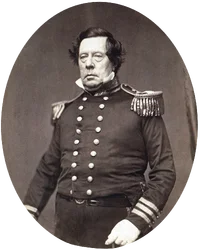
Matthew Calbraith Perry (1794–1858)
Matthew Perry entered the Navy in 1809 as a midshipman aboard the USS Revenge, commanded by his brother. The following year, he was transferred to the USS President, one of the original six frigates of the young United States Navy. He was present during the exchange of fire with HMS Little Belt in May 1811, an incident that foreshadowed the War of 1812. During the war, he served under Commodore John Rodgers and later under Stephen Decatur aboard the USS United States. A severe outbreak of scurvy led him to take an interest in sailors' health, and he later investigated both nutritional diseases and illnesses commonly contracted during shore leave, including malaria. In 1814, he married Jane Slidell while his ship remained blockaded in New London. He narrowly avoided sharing the fate of the USS President, which was captured by the Royal Navy in early 1815 after illness prevented him from joining the vessel. Later that year, he served with his brother James during the Second Barbary War before taking leave to command one of his father-in-law's merchant ships in the European trade.
Following the war, Perry resumed active naval service. He sailed to West Africa aboard the USS Cyane, escorting freed African Americans whom the American Colonisation Society sent to establish what would become Liberia. He also took part in anti-piracy and anti-slavery patrols in the Atlantic and served along the coast of newly acquired Florida.
North American Ship Illustration (北アメリカ船図 Kita Amerika senzu), anonymous woodblock-printed kawaraban, 1853–1854. Issued soon after Commodore Matthew C. Perry arrived at Uraga, the sheet combines a large illustration of an American steam warship with maps of Edo Bay, diagrams of the Black Ships, and explanatory notes on the unfamiliar vessels and their equipment. These illustrated news broadsheets were produced in response to intense public interest and documented one of the most significant encounters between Tokugawa Japan and the Western powers.
In 1830, Perry assumed command of the first USS Concord with the Mediterranean Squadron. While stationed in Smyrna, he distinguished himself during efforts to fight a major fire. He also transported the American diplomat John Randolph of Roanoke to St Petersburg, where Tsar Nicholas I inspected Perry's ship and reportedly invited him to enter Russian service, an offer he declined.
Returning to the Brooklyn Navy Yard in the early 1830s, Perry became one of the Navy's strongest advocates for steam-powered warships. He supervised the construction of the USS Fulton, the Navy's first steam-powered warship, became its first captain in 1837, and helped modernise naval officer training. His support for an apprentice system contributed to the eventual curriculum of the United States Naval Academy. Because of these efforts, he later became known in the United States as the "Father of the Steam Navy". He was promoted to the honorary rank of commodore in 1842.
During the Mexican–American War (1846–1848), Perry succeeded Commodore David Conner as commander of the Home Squadron in the Gulf of Mexico. He directed naval operations against several Mexican coastal cities and played an important role in the Gulf Coast campaign. He also presented President James K. Polk with an illustrated account of the naval bombardment of Veracruz, which he later gave as a diplomatic gift to Japan.
By the early 1850s, American commercial and strategic interests in the Pacific had expanded rapidly. Whaling fleets operated across the North Pacific, trade with China was growing, and steamships required regular supplies of coal. At the same time, American sailors shipwrecked on Japanese shores were often treated harshly under the Tokugawa shogunate's isolation policy (sakoku). Washington, therefore, sought secure ports where vessels could obtain provisions and fuel while establishing formal diplomatic relations with Japan.
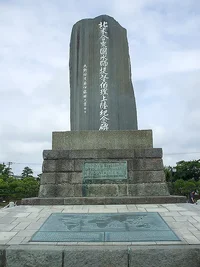
The Perry Landing Memorial (ペリー上陸記念碑 Perī Jōriku Kinenhi) at Kurihama, Yokosuka, Kanagawa Prefecture, marks the site where Commodore Matthew C. Perry came ashore in 1853 to present U.S. President Millard Fillmore's letter to representatives of the Tokugawa shogunate. The monument was erected to commemorate Perry's landing and was unveiled on 14 July 1901 (Meiji 34).
On 8 July 1853, Perry entered Uraga at the entrance to Edo Bay with four heavily armed steam-powered warships: the Mississippi, Plymouth, Saratoga and Susquehanna. Ignoring instructions from Tokugawa officials to proceed to Nagasaki, the port designated for limited foreign contact, he insisted on delivering a letter from President Millard Fillmore directly to the shogunate's representatives. He also refused to negotiate with lower-ranking officials.
The American demands included humane treatment for shipwrecked sailors, protection for damaged vessels, access to provisions and fuel, and the opening of Japan to American trade. Although presented diplomatically, the mission made clear that refusal might carry military consequences. The arrival of the smoke-belching steamships shocked many Japanese observers, who associated them with legends of invading "black ships". Perry heightened the sense of drama by remaining aboard his vessels for several days before landing with a large, carefully choreographed escort of sailors and marines. After formally presenting the President's letter, he announced that he would return the following year to receive Japan's answer.
After leaving Japan, Perry returned to Okinawa before continuing to Hong Kong and Macau. There he learned that both Russia and France were considering their own diplomatic missions to Japan, and that Russia had even proposed a joint expedition with the United States. Determined to secure American interests first, Perry brought forward his planned return.
When Perry sailed back to Japan in February and March 1854, his force had grown substantially. Sources differ slightly on the squadron's size, but it was considerably larger than the previous year and ultimately comprised up to 11 vessels during the negotiations. After anchoring in Edo Bay, Perry again staged an impressive landing, accompanied by military bands, artillery salutes and hundreds of armed personnel.
The negotiations were more productive than during the first visit. Japanese leaders remained concerned about American military power, but domestic political changes, growing commercial interests and the perceived threat from Russia also encouraged compromise. The two sides exchanged gifts, with Perry presenting a miniature steam locomotive, a telegraph apparatus and books, including his illustrated history of the Mexican War.
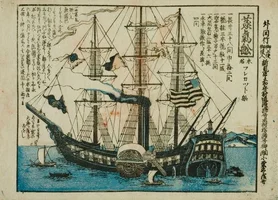
Commodore Perry's flagship, the USS Powhatan, as seen by a Japanese artist.
The agreement proved to be only the beginning. Britain concluded a similar treaty later in 1854, Russia followed in 1855, and France in 1858. The Treaty of Amity and Commerce, negotiated by Townsend Harris in 1858, opened additional ports and granted American citizens extensive commercial rights, including the right to reside and to exercise extraterritorial jurisdiction. Together, these became part of the series of "unequal treaties" through which Japan surrendered tariff autonomy and accepted significant legal privileges for foreign nationals.
Perry's expedition is widely regarded as the event that ended Japan's policy of national seclusion. While the Tokugawa government retained power for another decade, foreign pressure exposed the shogunate's weaknesses and intensified domestic political conflict. These developments contributed directly to the collapse of the Tokugawa regime and the beginning of the Meiji Restoration in 1868.
One episode from the expedition later acquired symbolic importance. While the American squadron lay at Shimoda in April 1854, two young Japanese secretly attempted to leave the country aboard Perry's ships. One of them was Yoshida Shōin (吉田松陰, 1830–1859), who would later become one of the most influential political thinkers of the late Tokugawa period and a major inspiration for many leaders of the Meiji Restoration. Perry refused their request and returned them to shore.
Perry retired soon after completing the mission. He died in New York City on 4 March 1858 at the age of 63 and was buried at Island Cemetery in Newport, Rhode Island. His daughter Caroline married the German-American banker and diplomat August Belmont.
His legacy remained significant long after his death. During the Japanese surrender aboard the USS Missouri on 2 September 1945, the 31-star American flag flown by Perry during the 1853 expedition was displayed above the ceremony. Carefully removed from its case at the United States Naval Academy Museum, the fragile flag served as a symbolic reminder that the formal relationship between Japan and the United States had begun with Perry's arrival in Edo Bay ninety-two years earlier.
Matthew C. Perry (1794–1858) as imagined in a Japanese woodblock print , 北亜墨利加人物ペルリ像 (Kita Amerika jinbutsu Peruri zō, "Portrait of Perry, a North American"), artist unknown, Edo period , 1853 or later. The exaggerated features and unfamiliar costume reflect the fear, curiosity, and visual guesswork surrounding the arrival of Perry's Black Ships at Uraga.
References:
- Beasley, W. G., The Meiji Restoration, Stanford University Press, 1972.
- Cullen, Louis M., A History of Japan, 1582–1941: Internal and External Worlds, Cambridge University Press, 2003.
- Feifer, George, Breaking Open Japan: Commodore Perry, Lord Abe, and American Imperialism in 1853, HarperCollins, 2006.
- Gonoi, Takashi, The History of Christianity in Japan, 1549–1900, Tuttle Publishing, 2000.
- Jansen, Marius B., The Making of Modern Japan, Harvard University Press, 2000.
- McOmie, William, The Opening of Japan, 1853–1855: A Comparative Study of the American, British, Dutch and Russian Naval Expeditions to Compel the Tokugawa Shogunate to Conclude Treaties and Open Ports to Their Ships, Global Oriental, 2006.
- Perry, Matthew C., Narrative of the Expedition of an American Squadron to the China Seas and Japan, 3 vols, Washington, DC: A.O.P. Nicholson, 1856.
- Totman, Conrad, A History of Japan, 2nd ed., Blackwell Publishing, 2005.

