

Inari (稲荷) stands among Japan's most enduring and many-layered deities, uniting the realms of faith, livelihood, and the land itself. First honoured as a kami (神) of rice and grain, Inari's worship took shape in the early eighth century, around 711, in the Fushimi area near Kyōto . The Hata clan (秦氏), which had immigrated from Korea and was renowned for its weaving and silk-making skills, is thought to have established the earliest shrine on the wooded slopes of Mount Inari. The name Inari, drawn from inanari—meaning "to cause rice to grow"—captures the spirit of its origin: a ta no kami (田の神), guardian of the fields, whose power ensured the fertility of the soil and the promise of a good harvest.
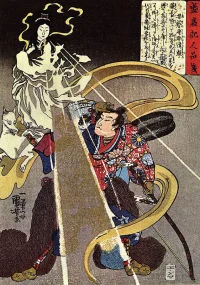
Utagawa Kuniyoshi (歌川国芳, 1798–1861), Inari appears to a Warrior.
The dual nature of Inari — as both a Shintō agricultural deity and a Buddhist protector — gave rise to a vast range of forms and interpretations. In some regions, Inari is portrayed as an elderly man carrying a sack of rice, flanked by two white foxes; elsewhere, as a beautiful woman with flowing hair, holding sheaves of rice; or, in syncretic Buddhist depictions, as a radiant figure riding a white fox. The gender of Inari has never been fixed — the deity may appear male, female, or androgynous — reflecting both regional diversity and the spiritual fluidity of Japanese belief.
From these early agricultural roots, Inari's domain expanded steadily. As Japan's economy and urban life developed, Inari came to embody the fertility of the fields, prosperity in trade, industry, and craftsmanship. The deity became known as a yashikigami (屋敷神), or household guardian. It was worshipped for business success, family safety, traffic protection, and even good fortune in entertainment and the arts.
In the Edo period (1603–1867), when blacksmiths and swordsmiths flourished under the Tokugawa shogunate, Inari's sphere extended to metallurgy and foundries. Swordmakers prayed to Inari for precision and strength in their work, viewing the deity as a patron of their craft. Merchants, meanwhile, sought Inari's blessing for profitable trade, and farmers continued to invoke the deity for fertile crops and favourable weather.
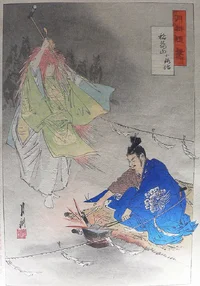
Ogata Gekkō (尾形月耕, 1859–1920), Inari and their fox spirits help the blacksmith Munechika forge the blade Kogitsune-maru; from the Noh play Sanjo Kokaji.
The veneration of the kitsune likely stems from Japan's agrarian past. Foxes were familiar neighbours to rural villagers, known for preying on rats and mice that threatened the rice harvest. Their natural behaviour was thus interpreted as a form of divine guardianship. Over time, these animals took on supernatural attributes in folklore, becoming yōkai (妖怪) — spiritual beings with the power to shape-shift. Ancient texts such as the Nihon shoki already mention foxes as mysterious, prophetic creatures. Later legends distinguished the benevolent zenko (善狐), the good foxes serving Inari, from the mischievous nogitsune (野狐), wild tricksters who deceived or possessed humans. Such possession, called kitsune-tsuki (狐憑き), became a common motif in Edo-period tales, reflecting both fascination and fear toward these creatures.
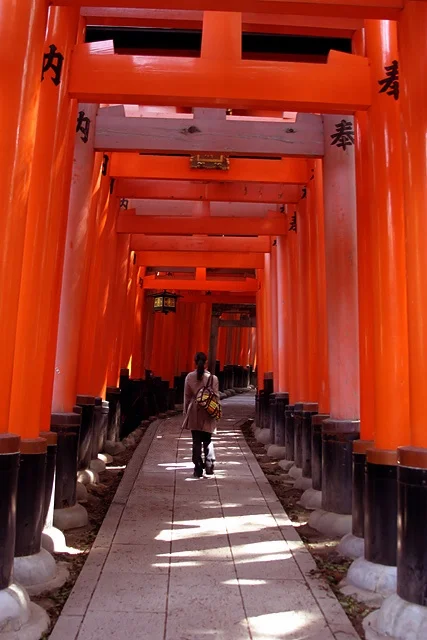
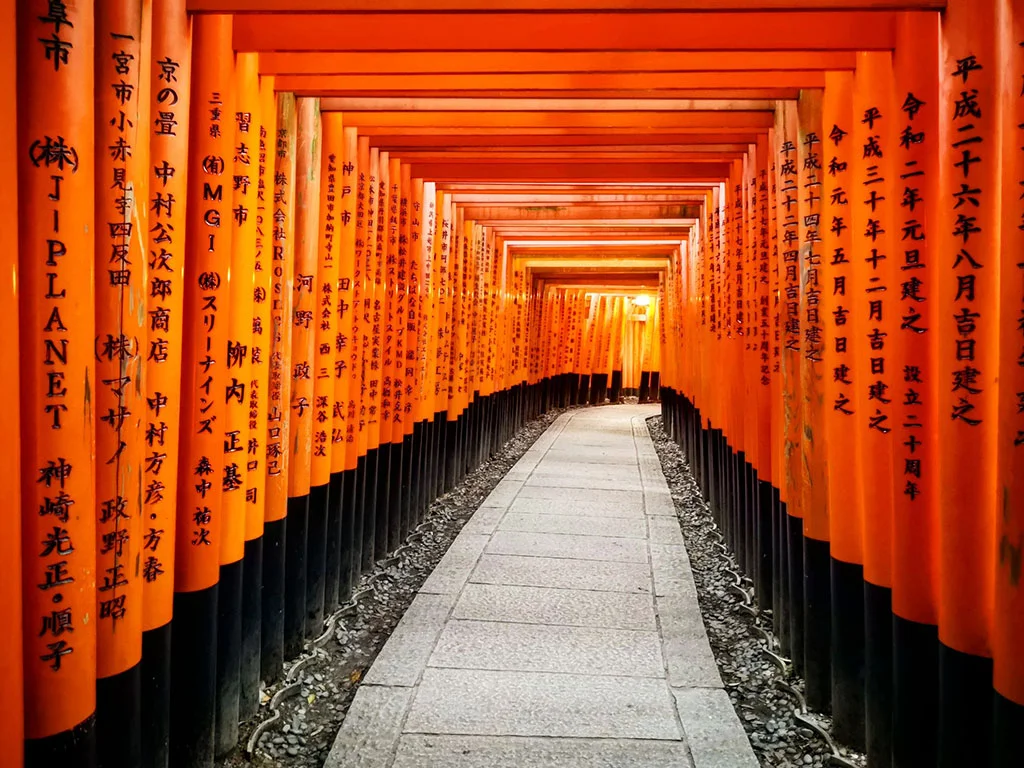
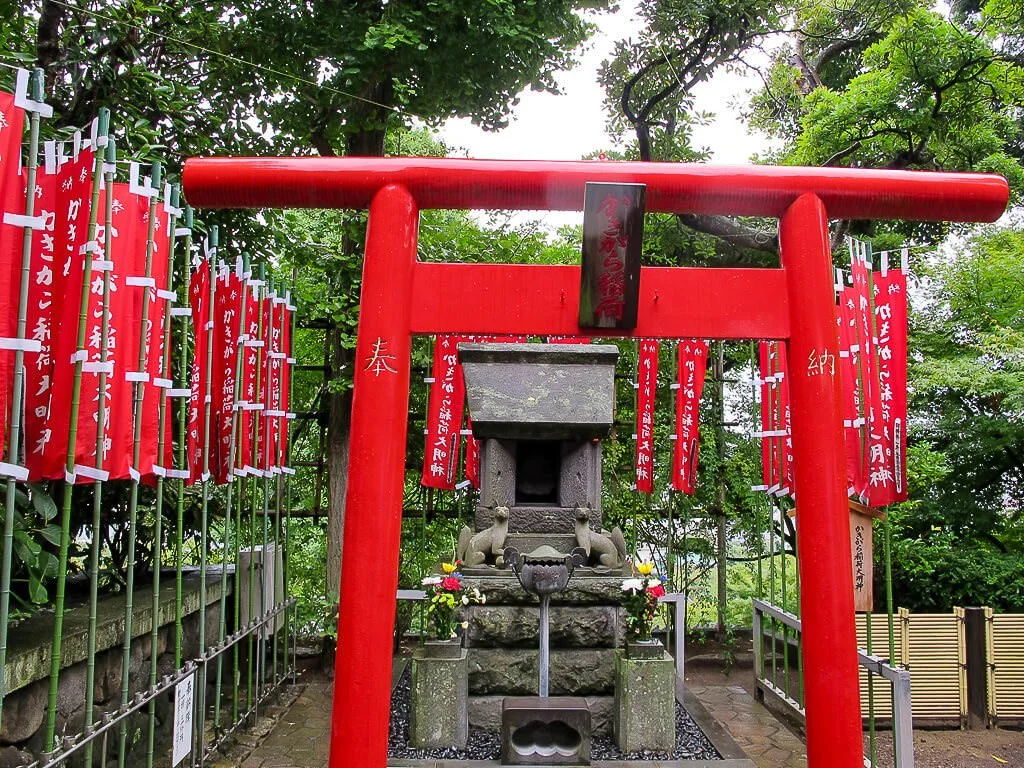
By the Heian period, Inari worship had become firmly established nationwide. The Fushimi Inari-taisha (伏見稲荷大社) in Kyōto grew into the central shrine of an immense network of over 30,000 Inari shrines across Japan. Its winding mountain paths, lined with vermilion torii gates donated by devotees, create a seemingly endless corridor of prayer and gratitude. Each gate bears the name of an individual, family, or company that offered it in thanks for a wish fulfilled. Along the paths stand countless fox statues, often wearing red bibs, a sign of reverence. Offerings of rice, sake, and fried tofu — said to be the foxes' favourite food — are left at the altars to please the divine messengers.
Inari's roots lay in agriculture; the deity's role, however, shifted as Japan changed in the Meiji era (1868–1912), opening up to modern capitalism and industrial development. Inari's ancient link to harvests and abundance was reinterpreted: The god of rice became the guardian of enterprise, presiding over workshops, factories, and shopfronts. Even great companies such as Shiseido turned to Inari for creative inspiration and good fortune — a reminder that success, like the harvest, still depends on unseen blessings. After the Meiji Restoration , State Shintō elevated Inari among the nation's principal kami, and new shrines were built across Japan's expanding cities and industrial centres.
Inari's appeal has never diminished. Even after the disestablishment of State Shintō following the Second World War, Inari shrines remained the most numerous in Japan. Modern companies still hold jichinsai (地鎮祭) — ground-breaking ceremonies — before Inari altars to bless new projects. Individuals visit to pray for business prosperity, family safety, or personal fortune.
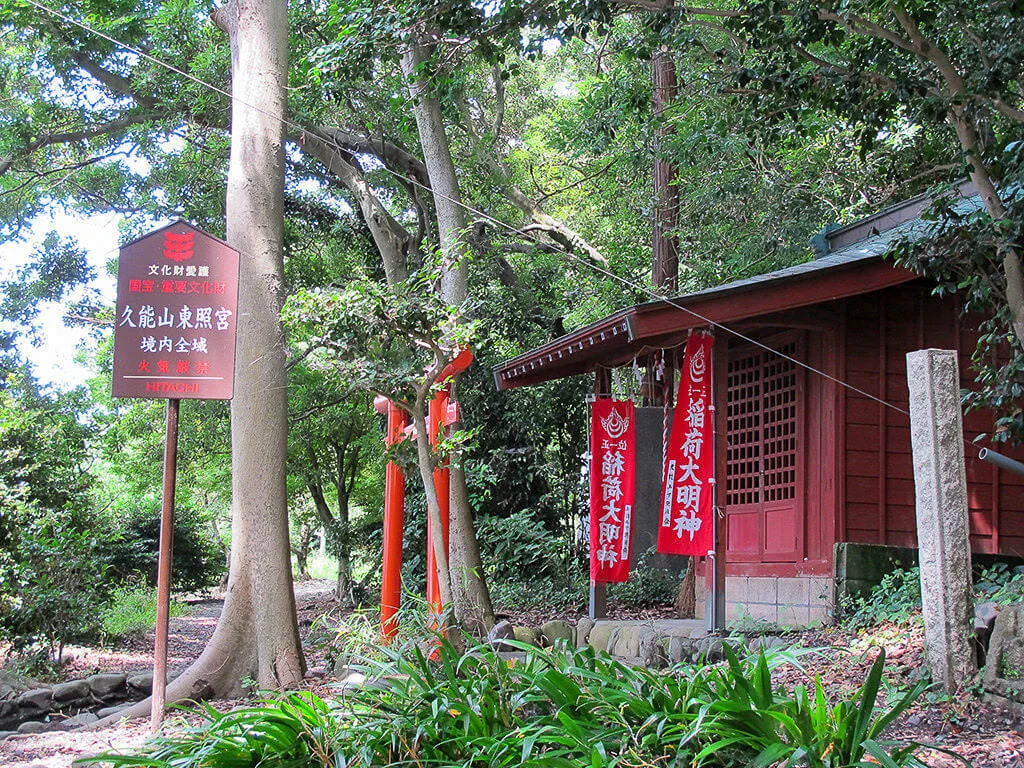
Across Japan, Inari's shrines are instantly recognisable: vermilion gates, white foxes, red-roofed sanctuaries, and white-plastered walls. The most magnificent of all Inari sites is Fushimi Inari in Kyōto, whose buildings were reconstructed in 1499 in the rich, graceful Momoyama style. Its mountain paths, lined with vermilion gates and stone foxes, are a familiar sight to pilgrims and travellers. In Aichi Prefecture , the Zen temple Myōgon-ji (妙厳寺) serves as another key place of Inari worship, where the deity is revered as the principal image (本尊 honzon).
The deity's universal adaptability — appearing male or female, singular or multiple, humble or divine — has allowed Inari to transcend eras and social boundaries. Sometimes known collectively as Inari sanza (稲荷三座) or Inari goza (稲荷五座), the deity may encompass several aspects of abundance, creation, and protection: Inari is a gentle guardian of harvests and homes, and a powerful source of industrial prosperity or artistic inspiration. In the words of old legends, Inari could appear in any form — even as a spider — to teach humility or gratitude to the arrogant.
Today, too, Inari is part of daily life in Japan. The deity stands at the meeting point of earth and spirit, holding together the steady turn of the seasons and the restless drive of human imagination. Inari's presence feels fluid and familiar — never distant, never fixed — moving between the seen and the unseen, much like the fox that serves as its messenger, always near yet just out of sight.
References:
- Inari Shinkō, in: Encyclopedia of Shinto, d-museum.kokugakuin.ac.jp.
- Ashkenazy, Michael. Handbook of Japanese Mythology. Santa Barbara, California: ABC-Clio, 2003.
- Herbert, Jean. Shintô - At the Fountainhead of Japan. George Allen & Unwin, 1967.
- Nussbaum, Louis-Frédéric, Japan Encyclopedia, Harvard University Press, 2005.
- Ono, Sokyo. Shinto: The Kami Way. Translated by William Woodard. Charles E. Tuttle Company, 1962.


