

Kubi Jikken: Head Inspection in Sengoku Japan
In the violent and honour-bound world of Japan's Sengoku period (戦国時代), the taking of enemy heads was more than a gruesome souvenir—it was proof of battlefield merit. Warriors presented these heads to their commanders in a formal and highly ritualised process called kubi jikken (首実検), meaning "head inspection." The practice confirmed a warrior's claim of having killed a particular enemy and bolstered morale, and demonstrated the defeat of a worthy foe.
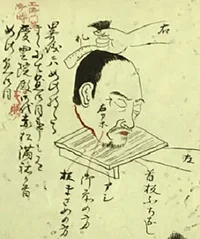
Kubi jikken of Akamatsu Mitsusuke (赤松満祐, 1381-1441)
The actual inspection typically took place at a nearby temple or other solemn site. The commanding general and his retainers, all in full armour, participated not just for security—there was always the risk of a raid to recover an important head—but also as a show of discipline and reverence. The head was presented on a wooden stand (首台 kubi dai). A name tag (首札 kubi fuda) was attached, stating both the identity of the slain and the name of the warrior who had taken the head.
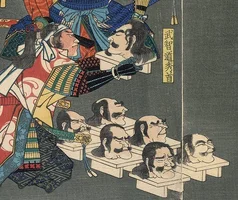
Head inspection by Toyotomi Hideyoshi (detail, see ukiyo-e below)
The general would not gaze directly at the head. Instead, he turned slightly, glancing with the corner of his left eye while keeping his right hand on his sword. The inspection was swift—never repeated—and followed by symbolic gestures. Offerings of sake and kelp (konbu) were made as if to serve the head itself. Cups were stacked, sake poured twice into each, and the head was eventually turned to face north—associated with the verb nigeru (to flee)—before being cast aside or respectfully buried.
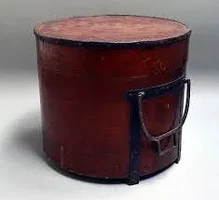
Kubi-oke (首桶), a head bucket to transport severed heads.
Even after inspection, the treatment of the head was dictated by rank and respect. Some were buried in mounds called kubizuka (首塚), others returned to the enemy side in special containers (kubi oke). The heads of particularly notable enemies, such as those taken by Oda Nobunaga (織田信長) in the 1570s, including Azai Nagamasa and Asakura Yoshikage , were even cleaned and displayed ceremonially. Though modern eyes might see this as cold or barbaric, many contemporaries understood it as a sign of solemn respect. Far from humiliation, the head was treated with dignity, cleansed, named, honoured, and finally released.
Tsukioka Yoshitoshi (月岡芳年), "Illustration of the Inspection of the Heads of Mashiba Hisayoshi (Toyotomi Hideyoshi) and his Lord and Servant Takechi," 1866 「真柴久吉武智主従之首実検之図」慶応二
Tsukioka Yoshitoshi (1839-1892), Tokugawa Ieyasu Examining the Head of Kimura Shigenari at the Battle of Osaka Castle, Series: Brief Account of the Rulers of the Tokugawa Clan, colour woodblock print, 1875. 大蘇芳年筆「徳川十五代記略」より『神君大坂御勝利 首実検之図』
Totoya Hokkei (魚屋 北渓, 1780-1850), Samurai Carrying a Kubi-oke.
References:
- Nussbaum, Louis-Frédéric. Japan Encyclopedia. Harvard University Press, 2005.
- Turnbull, Stephen, Samurai Sourcebook, London 1998
- Turnbull, Stephen, War in Japan: 1467-1615, Oxford 2002

