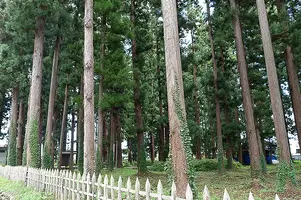
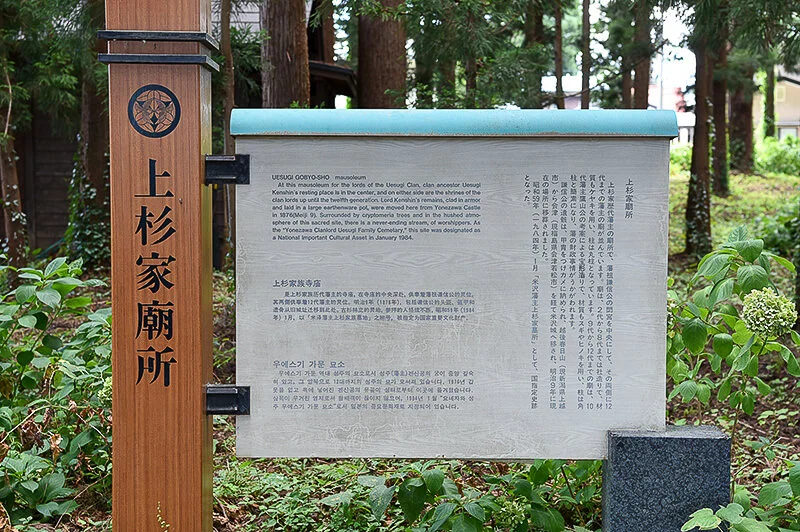
The Uesugi Clan Mausoleum (上杉家廟所 Uesugi Gobyōsho), also known as Yonezawa Domain Uesugi clan cemetery (米沢藩主上杉家墓所 Yonezawa-han-shu Uesugi-ke bosho), is the last resting place of the Uesugi family, the feudal lords of Yonezawa Domain. It was designated a National Historic Site in 1984 and contains the graves of thirteen generations of Uesugi, from Kagekatu, Kenshin's adopted son, to Mochinori, the last daimyō of Yonezawa.
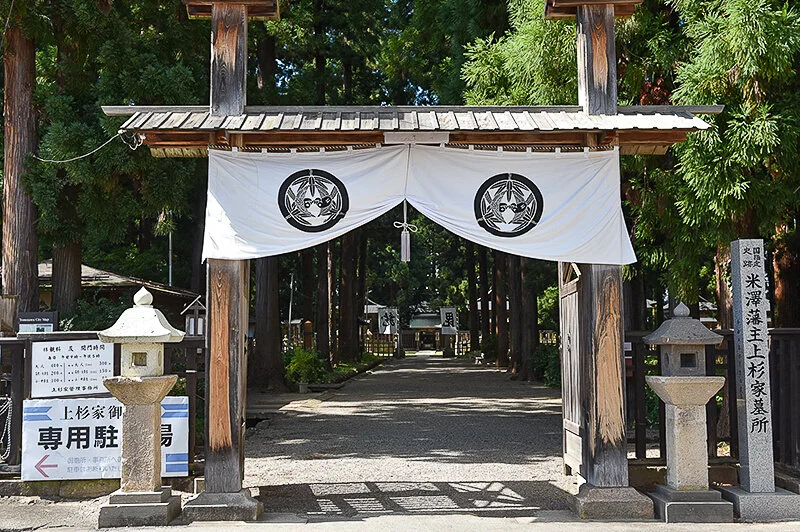
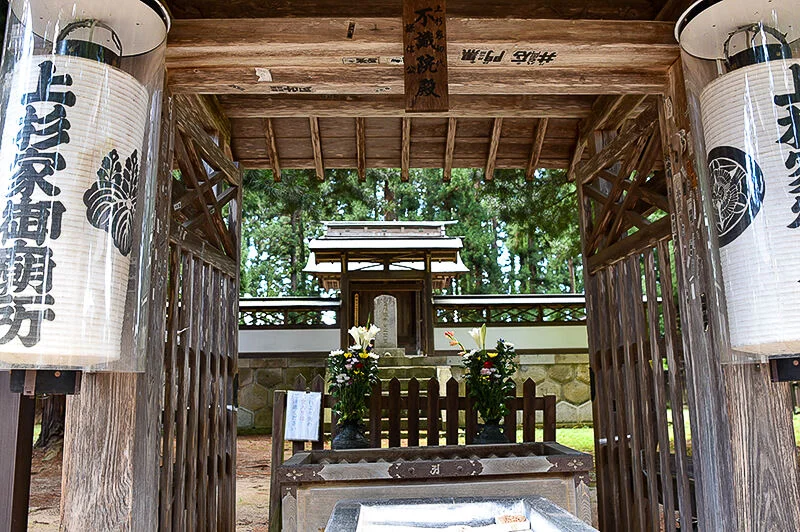
The current Uesugi family mausoleum is located west of the Yonezawa Castle ruins. Initially, this site was established as a temporary location for Kenshin's tomb. When Kagekatsu passed away in 1623, he was buried at the present mausoleum, and from then on, successive lords up to the 13th generation were also laid to rest there. After the Meiji government issued the castle abolition order in 1871, Yonezawa Castle was dismantled, and Kenshin's coffin was relocated to the cemetery.
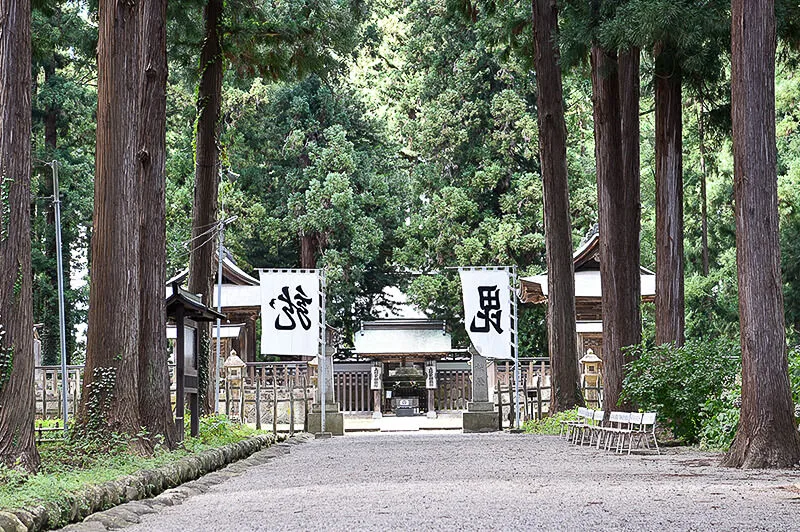
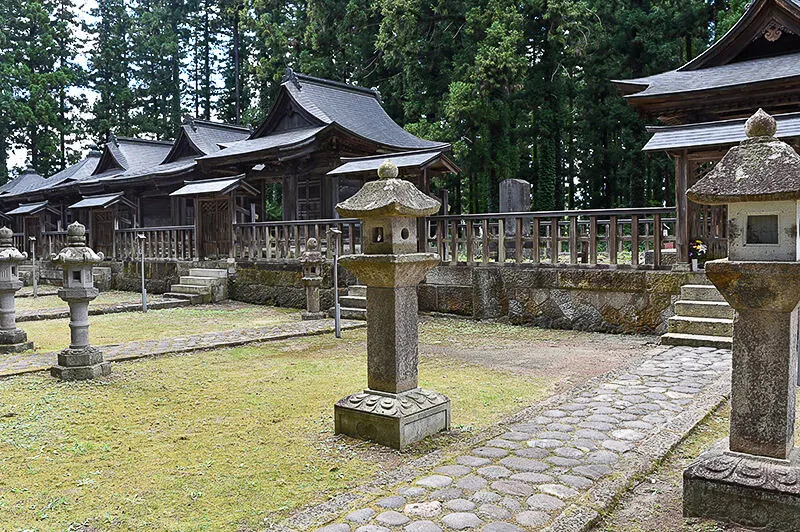
Today, Kenshin's mausoleum stands at the centre, flanked by the tombs of successive daimyō. From the second daimyō, Kagekatsu, to the eighth, Shigenari, cremation burials were performed, and their mausoleum buildings were constructed in the irimoya-zukuri style (入母屋造, a hip-and-gable roof structure). From the ninth daimyō, Harunori, to the twelfth, Narinori, burials were conducted by inhumation, with their mausoleums built in the hōgyō-zukuri style (宝形造, a square pyramidal roof). Due to Harunori's sumptuary edicts, the structures became more simplified, and the materials were of lower quality.
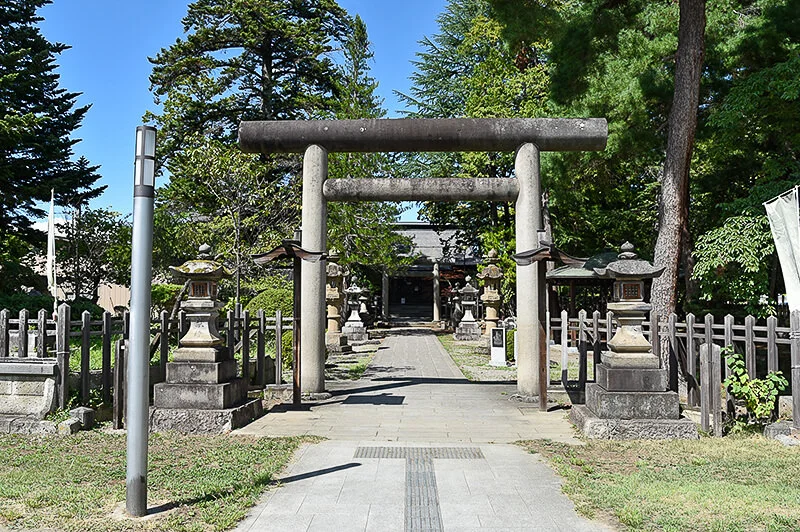
Although not a domain lord, Akitaka (顕孝) — the biological son of Harunori and his adopted heir — is also enshrined here. After the Meiji era , from the eleventh daimyō, Narisada, the family graves were moved to Kōzen-ji Temple in Shirokane, Minato-ku in Tōkyō. However, a monument for the thirteenth daimyō, Mochinori, was erected alongside the historical lords' mausoleums by volunteers from Okinawa to recognise his achievements as the governor of Okinawa. Locally, the mausoleum is also called "Otamaya" (御霊屋).
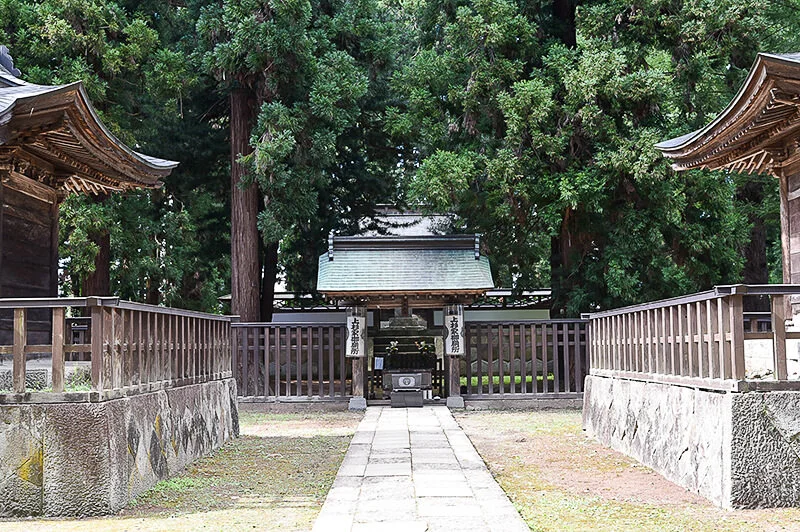
Even after his death, Uesugi Kenshin remained a crucial spiritual figure for his clan. His remains, clad in armour, were placed in an earthen jar, which was poured with lacquer to harden it. When Uesugi Kagekatsu moved from Echigo to Aizu, Kenshin's coffin was transported from Fushikian (不識庵) at Kasugayama Castle, along with the surrounding soil. Later, during the Uesugi family's relocations from Echigo to Aizu and eventually to Yonezawa, Kenshin's coffin was carefully carried and guarded by chosen monks and retainers. The family built a mausoleum on a hill in the inner citadel of Yonezawa Castle. Kenshin's coffin was placed in the centre, with a statue of Amida Buddha from Zenkoji Temple (善光寺) and Doroashibishamonten (泥足毘沙門天) on either side, facing west.
After that, by order of Uesugi Kagekatsu, the Nohkeshu of Shingon Buddhist temples, like Daijōji (大乗寺) and Hōonji (法音寺), performed daily memorial services. This was strictly followed until the Meiji era. Successive heads of the Uesugi family also visited the temple to hold memorial services on the anniversary of his death. Kenshin was a devoted Shingon Buddhist sect during his lifetime and was given the rank of Gon Daisōzu (権大僧都). It is said that Kenshin's remains were interred at Mount Koya and that there are only partial remains in Yonezawa.
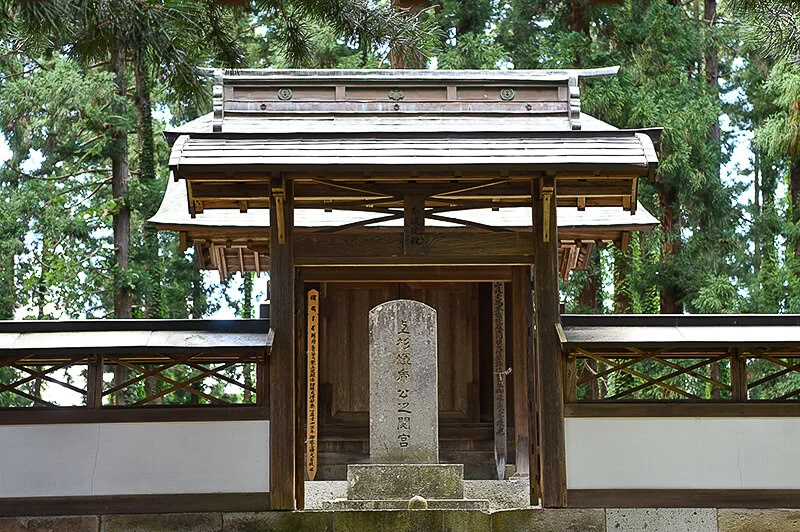
In the Meiji era, Kenshin's tomb was moved from the Honmaru of Yonezawa Castle to the Uesugi family mausoleum, and the statues of Zenkōji Buddha and Bishamonten were moved to Hōonji. The original burial hall was relocated to Chōmei-ji Temple (長命寺) in Yonezawa, where it serves as Hondō (本堂) to this day.
The following Yonezawa daimyō have grave sites at the mausoleum:
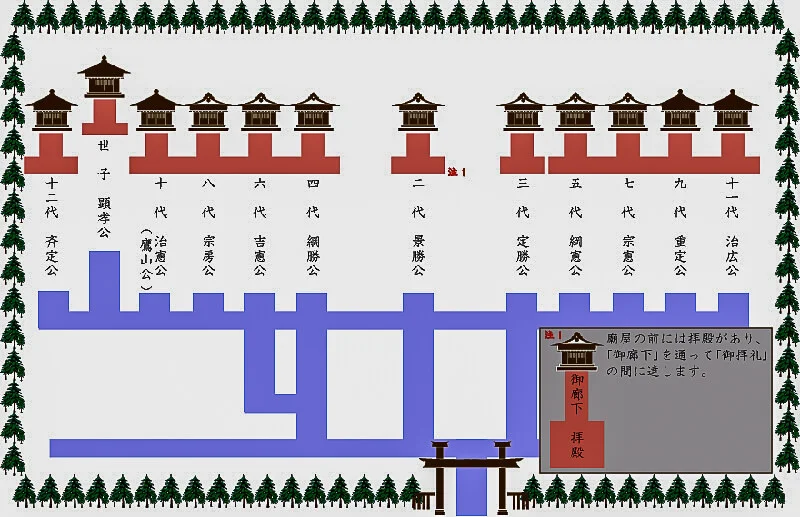
The original layout of the mausoleum (the images were taken from the now-defunct website of the mausoleum).
The grave sites were built alternately on the left and right sides of Kagekatsu's mausoleum. A worship hall was constructed in front of the mausoleum. The approach to each mausoleum also extended further forward than it is now, and it is said that more than a thousand stone lanterns were donated and lined up around it. Kenshin's remains were moved from Echigo Kasugayama to Aizu and then to Yonezawa, enshrined in the Honmaru of Yonezawa Castle.
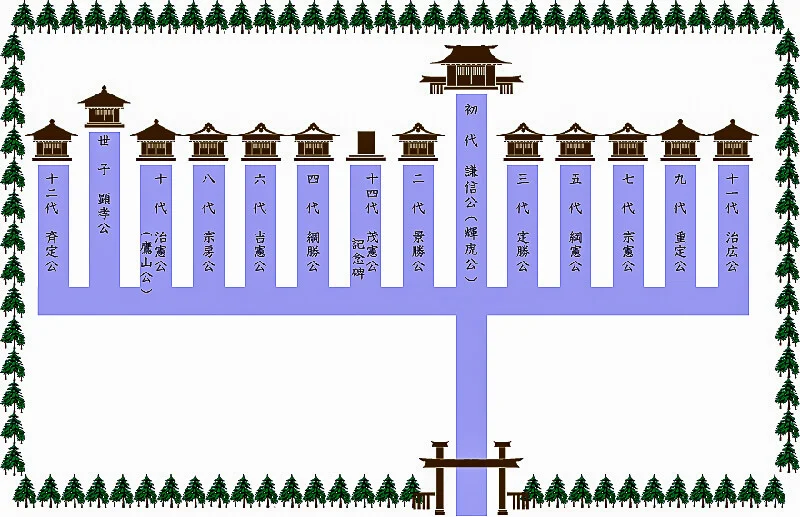
The current layout of the mausoleum
In 1876, Kenshin's remains were relocated to this site. As a result, the worship hall and stone lanterns were removed, and the approach to the shrine was rebuilt, resulting in the current layout. The mausolea of successive feudal lords, neatly lined up among the cedar groves, tell the history of the Uesugi family and Yonezawa. In 1984, it was registered as a National Historic Site, becoming Japan's fifth daimyō gravesite.
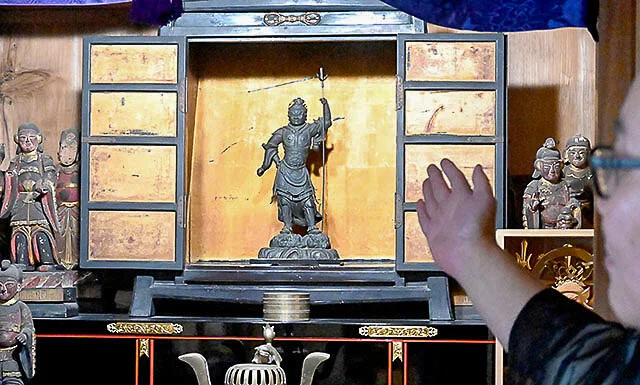
Photo credit: Yamagata Shimbun
Uesugi Kenshin was deeply devoted to Bishamonten from a young age. He built a Bishamonten Hall in Kasugayama Castle, where he prayed daily. On the battlefield, Kenshin's ferocity earned him a fearsome reputation as an avatar of Bishamonten.
According to legend, after returning from a campaign, Kenshin found muddy footprints leading to the Mud-Footed Bishamonten (泥足毘沙門天) statue, believing the deity had fought beside him. The statue, dating to the Kamakura period , holds a trident instead of a pagoda, with one hand on its hip while standing on a demon — a depiction similar to a statue at Kurama-dera Temple (鞍馬寺) in Kyōto .
After Kenshin's death, his successor, Uesugi Kagekatsu, relocated the statue to Yonezawa following orders from Toyotomi Hideyoshi and Tokugawa Ieyasu . In Yonezawa, the statue was enshrined alongside Kenshin's remains in his mausoleum, even though no separate Bishamonten Hall was built.
During the Meiji era, after the castle's abolition, Kenshin's remains were moved to the Uesugi Family Mausoleum. The statue was relocated to Hōonji Temple (法音寺), where it remains today. The statue was heavily damaged over time but restored during the Shōwa period (昭和時代). A duplicate statue containing fragments of the original was created and placed as the main object of worship in the rebuilt Bishamonten Hall at the Kasugayama Castle ruins. Another duplicate statue of the Mud-Footed Bishamonten (泥足毘沙門天) is housed in Nichichōji Temple (日朝寺) in Yonezawa. This statue is tied to a legend involving Nichiren , the founder of the Nichiren school (日蓮宗), during his exile to Sado Island.
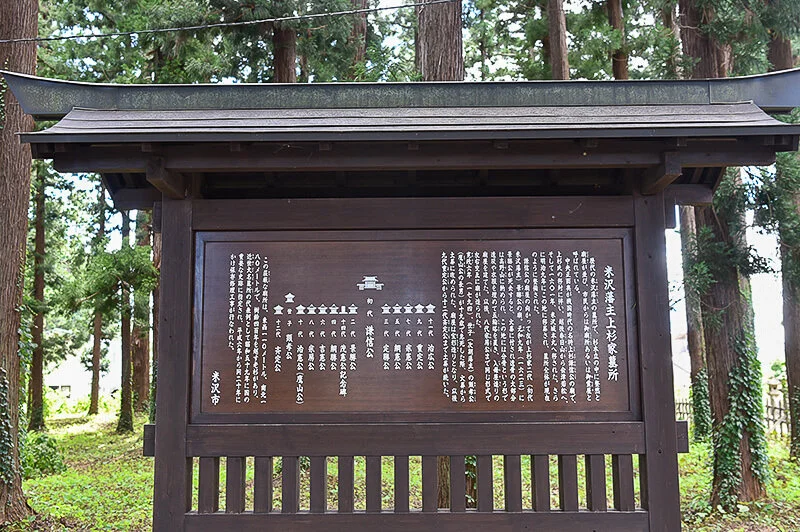
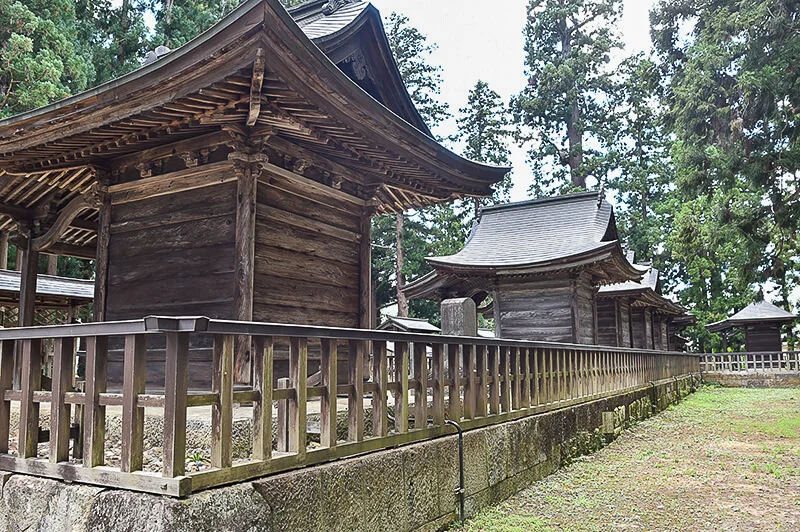
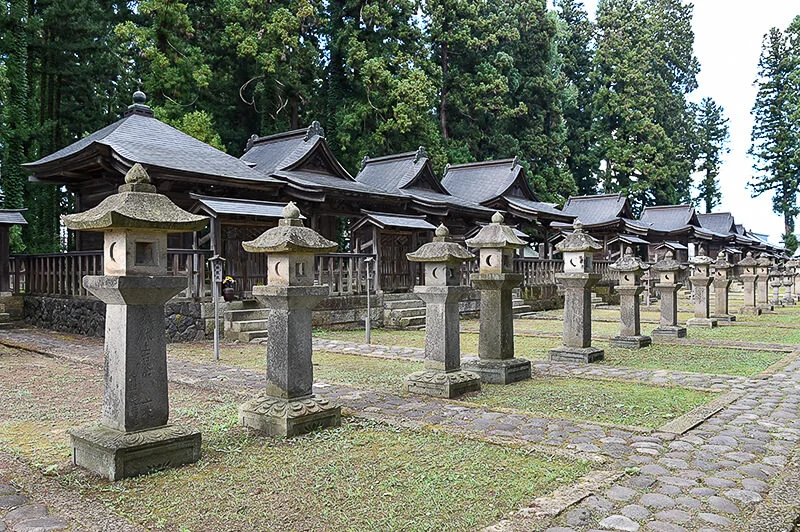
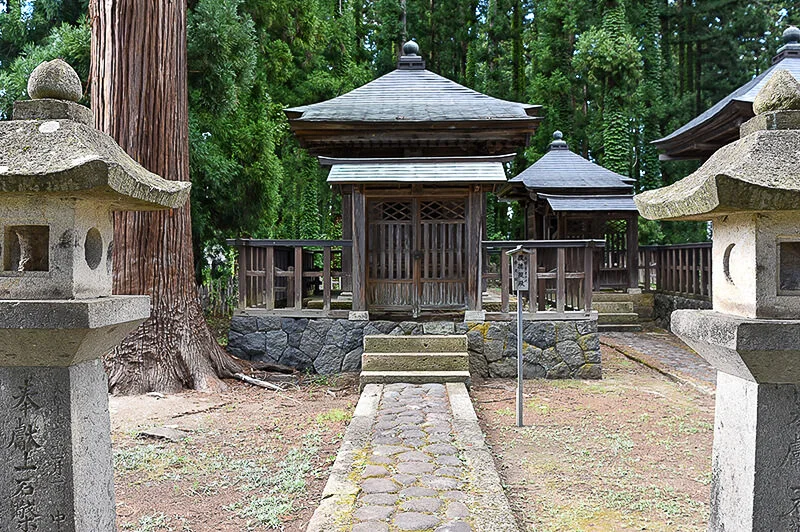
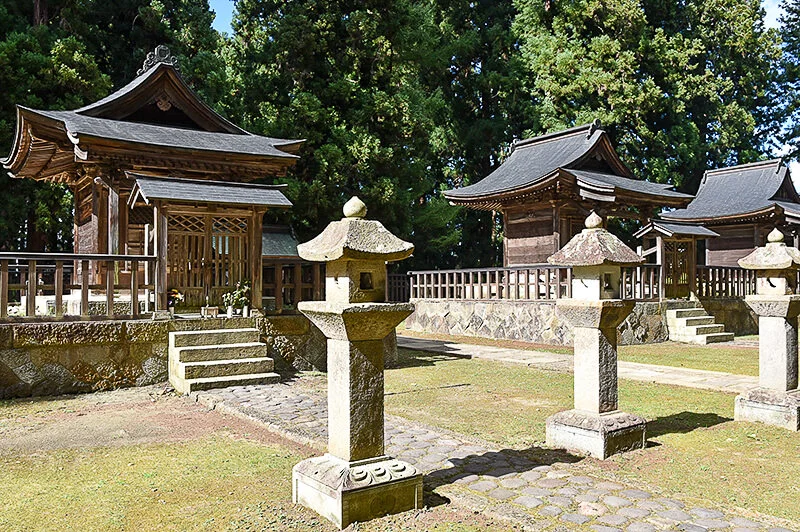
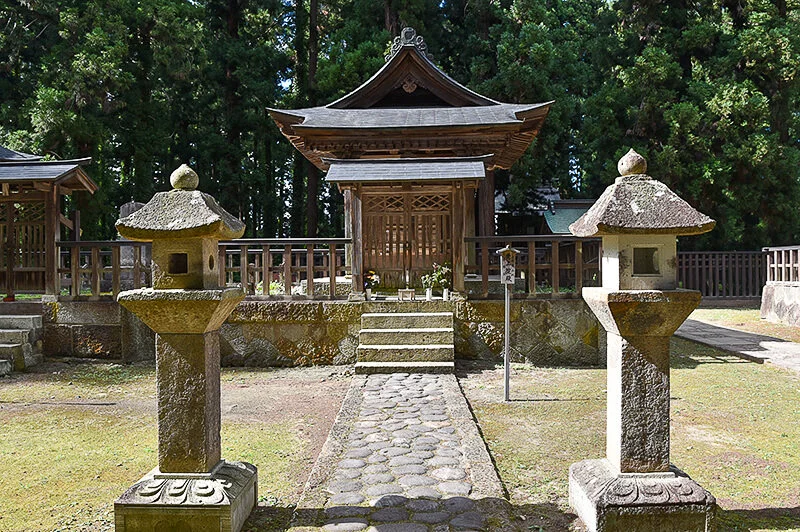
The current Uesugi family mausoleum is located west of the Yonezawa Castle ruins. Initially, this site was established as a temporary location for Kenshin's tomb. When Kagekatsu passed away in 1623, he was buried at the present mausoleum, and from then on, successive lords up to the 13th generation were also laid to rest there. After the Meiji government issued the castle abolition order in 1871, Yonezawa Castle was dismantled, and Kenshin's coffin was relocated to the cemetery.
Today, Kenshin's mausoleum stands at the centre, flanked by the tombs of successive daimyō. From the second daimyō, Kagekatsu, to the eighth, Shigenari, cremation burials were performed, and their mausoleum buildings were constructed in the irimoya-zukuri style (入母屋造, a hip-and-gable roof structure). From the ninth daimyō, Harunori, to the twelfth, Narinori, burials were conducted by inhumation, with their mausoleums built in the hōgyō-zukuri style (宝形造, a square pyramidal roof). Due to Harunori's sumptuary edicts, the structures became more simplified, and the materials were of lower quality.
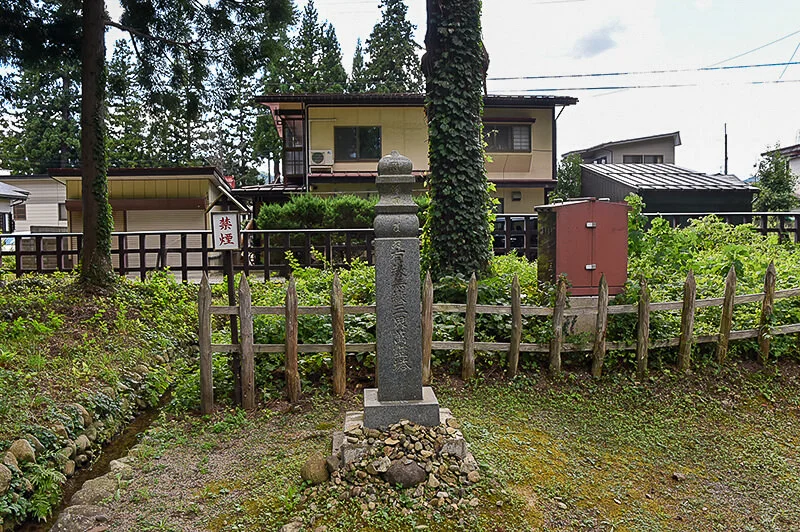
Although not a domain lord, Akitaka (顕孝) — the biological son of Harunori and his adopted heir — is also enshrined here. After the Meiji era , from the eleventh daimyō, Narisada, the family graves were moved to Kōzen-ji Temple in Shirokane, Minato-ku in Tōkyō. However, a monument for the thirteenth daimyō, Mochinori, was erected alongside the historical lords' mausoleums by volunteers from Okinawa to recognise his achievements as the governor of Okinawa. Locally, the mausoleum is also called "Otamaya" (御霊屋).
Even after his death, Uesugi Kenshin remained a crucial spiritual figure for his clan. His remains, clad in armour, were placed in an earthen jar, which was poured with lacquer to harden it. When Uesugi Kagekatsu moved from Echigo to Aizu, Kenshin's coffin was transported from Fushikian (不識庵) at Kasugayama Castle, along with the surrounding soil. Later, during the Uesugi family's relocations from Echigo to Aizu and eventually to Yonezawa, Kenshin's coffin was carefully carried and guarded by chosen monks and retainers. The family built a mausoleum on a hill in the inner citadel of Yonezawa Castle. Kenshin's coffin was placed in the centre, with a statue of Amida Buddha from Zenkoji Temple (善光寺) and Doroashibishamonten (泥足毘沙門天) on either side, facing west.
After that, by order of Uesugi Kagekatsu, the Nohkeshu of Shingon Buddhist temples, like Daijōji (大乗寺) and Hōonji (法音寺), performed daily memorial services. This was strictly followed until the Meiji era. Successive heads of the Uesugi family also visited the temple to hold memorial services on the anniversary of his death. Kenshin was a devoted Shingon Buddhist sect during his lifetime and was given the rank of Gon Daisōzu (権大僧都). It is said that Kenshin's remains were interred at Mount Koya and that there are only partial remains in Yonezawa.
In the Meiji era, Kenshin's tomb was moved from the Honmaru of Yonezawa Castle to the Uesugi family mausoleum, and the statues of Zenkōji Buddha and Bishamonten were moved to Hōonji. The original burial hall was relocated to Chōmei-ji Temple (長命寺) in Yonezawa, where it serves as Hondō (本堂) to this day.
The following Yonezawa daimyō have grave sites at the mausoleum:
| Generation | Daimyō | Rank and name | Tenure | Lineage |
|---|---|---|---|---|
1. | Uesugi Kagekatsu (上杉景勝, 1556-1623) | Junior Third Rank Chūnagon Echigo no Kami (従三位 中納言 越後守) | 1601-1623 | Second son of Nagao Masakage , husband of Kenshin's elder sister, and his successor. |
2. | Uesugi Sadakatsu (上杉定勝, 1604-1645 | Junior Fourth Rank Sakon'e-shōshō (従四位下 左近衛少将) | 1623-1645 | Kagekatsu's eldest son |
3. | Uesugi Tsunakatsu (上杉綱勝, 1639-1664) | Junior Fourth Rank Harima no Kami Jijū (従四位下 播磨守 侍従) | 1645-1664 | Sadakatsu's second son |
4. | Uesugi Tsunanori (上杉綱憲, 1663-1704) | Junior Fourth Rank Danjō Daihitsu Jijū (従四位下 弾正大弼 侍従) | 1664-1703 | Eldest son of Takaie Kira Yoshinaka. His mother was Sadakatsu's daughter. |
5. | Uesugi Yoshinori (上杉吉憲, 1684-1722) | Junior Fourth Rank Minbu-taifu Jijū (従四位下 民部大輔 侍従) | 1703-1722 | Tsunanori's eldest son |
6. | Uesugi Munenori (上杉宗憲, 1714-1734) | Junior Fourth Rank Danjō Daihitsu Jijū (従四位下 弾正大弼 侍従) | 1722-1734 | Yoshinori's eldest son |
7. | Uesugi Munefusa (上杉宗房, 1718-1746) | Junior Fourth Rank Minbu-taifu Jijū (従四位下 民部大輔 侍従) | 1734-1746 | Yoshinori's second son |
8. | Uesugi Shigesada (上杉重定, 1720-1798 | Junior Fourth Rank Ōi no Kami Jijū (従四位下 大炊頭 侍従) | 1746-1767 | Yoshinori's fourth son |
9. | Uesugi Harunori (上杉治憲, 1751-1822) | Junior Fourth Rank Danjō Daihitsu Jijū (従四位下 弾正大弼 侍従) | 1767-1785 | Second son of Akizuki Tanemi, Daimyō of Takanabe Domain |
10. | Uesugi Haruhiro (上杉治広, 1764-1822) | Junior Fourth Rank Danjō Daihitsu Jijū (従四位下 弾正大弼 侍従) | 1785-1812 | Shigesada's fourth son |
11. | Uesugi Narisada (上杉斉定, 1788-1839) | Junior Fourth Rank Danjō Daihitsu Jijū (従四位下 弾正大弼 侍従) | 1812-1839 | Eldest son of Katsuhiro, adopted son of Haruhiro. |
12. | Uesugi Narinori (上杉斉憲, 1820-1889) | Junior Fourth Rank Danjō Daihitsu Chūjō (従四位上 弾正大弼 権中将) | 1839-1869 | Narisada's son |
13. | Uesugi Mochinori (上杉茂憲, 1844-1919) | Second Rank Shikibutaifu Jijū (正二位 式部大輔 侍従) | 1869-1871 | Narinori's son |
The original layout of the mausoleum (the images were taken from the now-defunct website of the mausoleum).
The grave sites were built alternately on the left and right sides of Kagekatsu's mausoleum. A worship hall was constructed in front of the mausoleum. The approach to each mausoleum also extended further forward than it is now, and it is said that more than a thousand stone lanterns were donated and lined up around it. Kenshin's remains were moved from Echigo Kasugayama to Aizu and then to Yonezawa, enshrined in the Honmaru of Yonezawa Castle.
The current layout of the mausoleum
In 1876, Kenshin's remains were relocated to this site. As a result, the worship hall and stone lanterns were removed, and the approach to the shrine was rebuilt, resulting in the current layout. The mausolea of successive feudal lords, neatly lined up among the cedar groves, tell the history of the Uesugi family and Yonezawa. In 1984, it was registered as a National Historic Site, becoming Japan's fifth daimyō gravesite.
Mud-Footed Bishamonten (泥足毘沙門天)
Bishamonten (毘沙門天) is a Buddhist deity revered as a protector of the north and a god of war and treasure. The term "泥足" (doroashi, muddy feet) symbolizes a god who descends to the human world, enduring hardship to protect people.Photo credit: Yamagata Shimbun
Uesugi Kenshin was deeply devoted to Bishamonten from a young age. He built a Bishamonten Hall in Kasugayama Castle, where he prayed daily. On the battlefield, Kenshin's ferocity earned him a fearsome reputation as an avatar of Bishamonten.
According to legend, after returning from a campaign, Kenshin found muddy footprints leading to the Mud-Footed Bishamonten (泥足毘沙門天) statue, believing the deity had fought beside him. The statue, dating to the Kamakura period , holds a trident instead of a pagoda, with one hand on its hip while standing on a demon — a depiction similar to a statue at Kurama-dera Temple (鞍馬寺) in Kyōto .
After Kenshin's death, his successor, Uesugi Kagekatsu, relocated the statue to Yonezawa following orders from Toyotomi Hideyoshi and Tokugawa Ieyasu . In Yonezawa, the statue was enshrined alongside Kenshin's remains in his mausoleum, even though no separate Bishamonten Hall was built.
During the Meiji era, after the castle's abolition, Kenshin's remains were moved to the Uesugi Family Mausoleum. The statue was relocated to Hōonji Temple (法音寺), where it remains today. The statue was heavily damaged over time but restored during the Shōwa period (昭和時代). A duplicate statue containing fragments of the original was created and placed as the main object of worship in the rebuilt Bishamonten Hall at the Kasugayama Castle ruins. Another duplicate statue of the Mud-Footed Bishamonten (泥足毘沙門天) is housed in Nichichōji Temple (日朝寺) in Yonezawa. This statue is tied to a legend involving Nichiren , the founder of the Nichiren school (日蓮宗), during his exile to Sado Island.
Address: 1-5-30 Gobyo, Yonezawa, Yamagata, 992-0055
Phone: 0238-23-3115
Visiting hours: daily 09:00-17:00
Admission: adults: 400 (300) yen; high school and university students: 200 (150) yen; elementary and junior high school students: 100 (50) yen. Prices in brackets indicate the group rate for groups of 20 or more.
Phone: 0238-23-3115
Visiting hours: daily 09:00-17:00
Admission: adults: 400 (300) yen; high school and university students: 200 (150) yen; elementary and junior high school students: 100 (50) yen. Prices in brackets indicate the group rate for groups of 20 or more.