

Tokugawa Ietsugu (徳川家継, 1709–1716) became the seventh shōgun (将軍) of the Edo bakufu (江戸幕府) in 1713, but his youth and ill health overshadowed his brief rule. He was born on 3 July 1709 in the Nishinomaru (西ノ丸) of Edo Castle as the fourth son of Tokugawa Ienobu (徳川家宣, 1662–1712), the sixth shōgun, and the concubine Okisonokata of the Katsuda family. As a child, he was named Serada Nabematsu (世良田鍋松). Within months of his birth, he was moved into the main compound (Honmaru) of Edo Castle, but he remained the sole surviving son in a family marked by the premature deaths of Ienobu's other children. His mother later took the name Gekkō-in (月光院, 1689–1752).
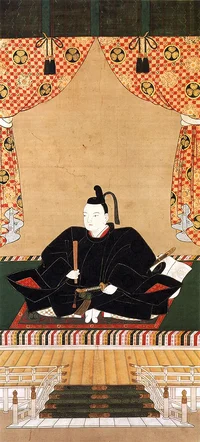
Tokugawa Ietsugu; 将軍吉宗と宮廷「雅」: 象がゆく(Shōgun Yoshimune to Kyūtei Miyabi), Kasumi Kaikan (霞会館), 1735.
Hakuseki later wrote that he advocated for the child's appointment, worried that direct Owari control might upset the established bakufu bureaucracy and powerful daimyō . While some feared that the boy's death without an heir would plunge succession into chaos, Hakuseki assured them that Yoshimichi remained available if circumstances demanded it. According to another account, Ienobu had even made provisions for adoption from either the Owari or Kishū branches should Nabematsu's health fail.
Ienobu died on 14th October 1712, before his son could undergo his coming-of-age ceremony (元服 genpuku). In an extraordinary intervention, the retired Emperor Reigen (霊元上皇, 1654–1732), exercising cloistered rule (院政 insei), personally issued a rescript (宸翰 shinkan) on 12th December 1712, bestowing upon the boy the adult name Ietsugu. This imperial recognition made him the only Tokugawa shōgun to receive his name directly from the court. By month's end, he had been elevated to junior second rank and appointed Provisional Grand Counsellor (大納言 dainagon).
On 25th March 1713, his genpuku took place at Edo Castle, with Ii Naotomo (井伊直該, 1655–1715) serving as his adoptive father for the ritual. Emperor Nakamikado (中御門天皇, 1702–1737) sent a crown, whilst the cloistered Emperor Reigen contributed an eboshi cap. On 2nd April, formal installation as shōgun followed, accompanied by promotion to senior second rank and the granting of high court and military offices, including Commander of the Right Imperial Guards. At merely four years old, he became the youngest person ever to hold the office of shōgun.
Given his tender age, absolute authority rested with his regents. His mother, Gekkō-in, chamberlain Manabe Akifusa, and adviser Arai Hakuseki maintained the "Shōtoku reforms" (正徳の治 Shōtoku no chi) that had begun under Ienobu. Hakuseki personally supervised the boy's education, describing him as both intelligent and compliant. However, influence within Edo Castle soon became a matter of contention. The women of the Ōoku (大奥) expanded their reach into the shōgun's private quarters, whilst rumours circulated—though probably without foundation—of an illicit relationship between Gekkō-in and Akifusa. These tensions culminated in 1714 with the Ejima–Ikushima affair, a scandal that rocked the Ōoku and provided abundant material for court gossip.
Gradually, the authority of Hakuseki and Akifusa began to wane: without Ienobu's personal backing or strong familial ties, they found themselves struggling against the senior councillors (老中 rōjū) and emerging powerbrokers such as Kuze Shigeyuki, Matsudaira Nobutsune, and Toda Tadamasa. Nevertheless, because the young shōgun held Akifusa in regard, they managed to retain some leverage, allowing reform policies to continue, albeit inconsistently.
In 1716, Ietsugu became formally betrothed to Princess Yaso-no-miya, daughter of retired Emperor Reigen, though this arrangement never came to fruition. Plans to marry him to Shōshi, daughter of Konoe Iehiro (近衛家煕, 1667–1736), were given up when she was instead married into the imperial court. These manoeuvres underscored the precarious nature of the young shōgun, dependent upon court alliances to strengthen Tokugawa legitimacy.
On 30th April 1716, Ietsugu died in Edo Castle at the age of six by Western calculation, eight by Japanese reckoning. His death, ascribed to pneumonia, brought the line of Ienobu to an end. He was interred at Zōjōji Temple, and on 25th May received posthumously the title of Chancellor of the Realm (太政大臣 Daijō Daijin) together with the Buddhist name Yūshō-in.
Throughout his brief reign, one edict was promulgated in his name that demonstrated the bakufu's persistent wariness of Western influence: it commanded that any European vessel landing on Japanese shores should be destroyed and its crew executed. This severe measure aligned with the exclusionary policies that defined the Tokugawa state.
Following his death, the succession remained uncertain. Initially, Tokugawa Tsugutomo (徳川継友, 1692–1731) of the Owari branch appeared to be the preferred candidate, having even received the character "継" from Ietsugu's name. He commanded support from both Hakuseki and Akifusa. However, opposition from within the bakufu and political manoeuvring within the Ōoku determined otherwise. Ultimately, Tokugawa Yoshimune (徳川吉宗, 1684–1751) of the Kishū branch, then thirty-three years old, was selected as the eighth shōgun, inaugurating a new era of Tokugawa governance.
Ietsugu's grave at the Zōjō-ji in Tōkyō.
References:
- Tokugawa Ietsugu (徳川家継). From Japanese Wikipedia.
- Chaplin, Danny. Sengoku Jidai - Nobunaga, Hideyoshi, and Ieyasu: Three Unifiers of Japan. Createspace, 2018.
- Nussbaum, Louis-Frédéric. Japan Encyclopedia. Harvard University Press, 2005.
- Papinot, Edmond. Historical and Geographical Dictionary of Japan. Tuttle, third printing 1988.
- Sadler, Arthur Lindsay. Shogun: The Life of Tokugawa Ieyasu. Tuttle, paperback 2009.
- Totman, Conrad. A History of Japan. Wiley-Blackwell; second edition 2005.


