

Oda Nobuhide (織田信秀, 1511–1552) was a Sengoku-period warlord of Owari Province and the father of Oda Nobunaga (織田信長, 1534–1582), later the first of Japan's three great unifiers. Although he formally was a deputy to the shugo administration, Nobuhide rose from a relatively modest branch position within the Oda family to become the most powerful military and economic force in Owari, laying the foundations for Nobunaga's later expansion.
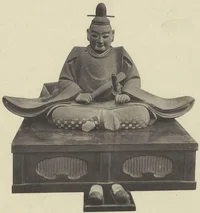
Wooden statue of Oda Nobuhide at Banshō-ji (万松寺)
Between April 1526 and June 1527, while his father was still alive, Nobuhide succeeded to the family headship. Soon after, in 1532, he clashed with both his nominal overlord, Oda Tatsukatsu of the Yamato-no-kami line and another of the Kiyosu magistrates, Oda Kanetoki of Odai Castle. The dispute ended in reconciliation, and Nobuhide chose to underline it through visible cultural gestures. In the summer of 1533, he invited Asukai Masatsuna (飛鳥井雅綱, c.1453–1538), head of the kemari tradition, from Kyōto , together with the court noble Yamashina Tokitsugu (山科言継). Kemari matches were held at Shobata Castle on 8 July and later at Kiyosu Castle from 27 July, attracting large crowds and showing Nobuhide's rising status, as noted in Tokitsugu's diary. The following year, in 1534, his heir Nobunaga was born.
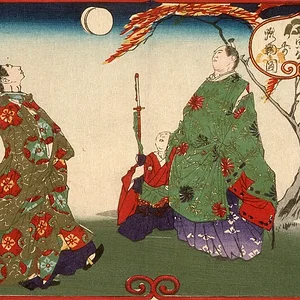
By the early sixteenth century, Masatsuna was frequently invited by powerful provincial lords seeking cultural legitimacy to preside over or participate in kemari gatherings. Such invitations had a clear political purpose, not just a social one. By linking themselves to court traditions, rising Sengoku warlords could borrow the prestige of Kyōto's aristocracy. Asukai's 1533 visit to Owari, at Nobuhide's invitation, reflects this broader use of cultural patronage to reinforce authority and relationships beyond the capital.
From the late 1530s, Nobuhide began to expand more actively. Around 1538, he took Nagoya Castle from Imagawa Ujitoyo, probably through some form of ruse later recorded in the Nagoya Kassenki, and made it his base, bringing the Aichi District around present-day central Nagoya under his influence. The following year, in 1539, he built Furuwatari Castle and made it his residence, thereby securing control of Atsuta, a major commercial centre of comparable importance to Tsushima. Nagoya Castle was handed over to the young Nobunaga either during his childhood or shortly before his coming-of-age ceremony in 1546. In 1548, Nobuhide moved his residence again, this time to Suemori Castle in eastern Nagoya. Most Sengoku daimyō stayed in one main castle for life. Still, Nobuhide changed his base when necessary, choosing locations that afforded him greater control over key routes, resources, and strategic positions.
This mobility was supported by steady economic growth, which underpinned his power. Nobuhide cultivated relations with the imperial court, travelling to Kyōto, making substantial donations, and receiving a court rank. He was promoted to junior fifth rank, lower grade, and appointed Governor of Bingo. He also paid respects to the Muromachi shogunate and was received by the thirteenth shōgun , Ashikaga Yoshiteru (足利義輝, 1536–1565). Between 1540 and 1541, he provided timber and 700 kanmon in cash to rebuild Ise Shrine . In 1543, he also donated 4,000 kanmon for repairs to the imperial palace after storm damage, a contribution recorded in temple diaries and reflecting his attention to court affairs.
Nobuhide was under steady military pressure from his neighbours. In 1529, Matsudaira Kiyoyasu (松平清康, 1511–1535) invaded Owari and took several castles in the Higashi-Kasukai and Aichi districts. After Kiyoyasu was assassinated in 1535 in the Moriyama Incident, Nobuhide exploited the ensuing disorder to strike back into Mikawa, winning battles such as the Battle of Idano and capturing Anjō Castle in 1540. There, he installed his eldest son by a concubine, Oda Nobuhiro (織田信広, ?–1574). In the same period, he also confronted Saitō Dōsan (斎藤道三, 1494–1556) of Mino. In 1542, allied with supporters of the exiled Toki family , Nobuhide invaded Mino and briefly took Ōgaki Castle. Later chronicles state that he also defeated Imagawa Yoshimoto (今川義元, 1519–1560) at the First Battle of Azukizaka, allowing the Oda to keep their position in western Mikawa.
By the mid-1540s, Nobuhide had, in practice, become the strongest warlord in Owari, surpassing both the Yamato-no-kami line and the formal authority of the Shiba shugo. He stationed brothers and trusted retainers at key points across the province and subdued other local powers, while not abandoning the existing order. He kept his position as a shugo-daikan and continued to recognise the shugo and senior Oda lines as his nominal superiors. Even when relatives such as Oda Nobukiyo of Inuyama or rival magistrate families rebelled, he refrained from exterminating them. This caution limited his ability to bring Owari fully under his control, and the final removal of these rival houses was left to Nobunaga.
From 1544, Nobuhide's fortunes declined. An invasion of Mino reached the outskirts of Inabayama Castle but ended in defeat at the Battle of Kanōguchi. In 1547, he captured Okazaki Castle, forcing Matsudaira Hirotada (松平広忠, 1526–1549) to submit; it was likely at this time that Hirotada's young son Takechiyo, the future Tokugawa Ieyasu (徳川家康, 1543–1616), was taken as an Oda hostage. The following year, however, Hirotada, encouraged by Saitō Dōsan and allied with the Imagawa, rose again. Although Nobuhide put down rebellions at home and made peace with Dōsan, confirmed by the betrothal of Nobunaga to Dōsan's daughter Kichō (帰蝶, also known as Nōhime, 1535–1569), his position soon weakened. In March 1548, he was severely defeated at the Second Battle of Azukizaka by an Imagawa–Matsudaira force led by the monk Taigen Sessai.
Kichō entered the Oda household in February 1549. Later that year, the Imagawa launched a significant attack on Anjō Castle, the centre of Oda's power in western Mikawa. Nobuhiro resisted fiercely, and Hirate Masahide (平手政秀, 1492–1553) was sent with reinforcements, but the castle fell in November 1549. Nobuhiro was taken prisoner and exchanged for Takechiyo, and Oda's influence in Mikawa quickly collapsed. Around this time, Nobuhide fell seriously ill. In November, documents were issued in Nobunaga's name, the earliest surviving records of his independent authority.
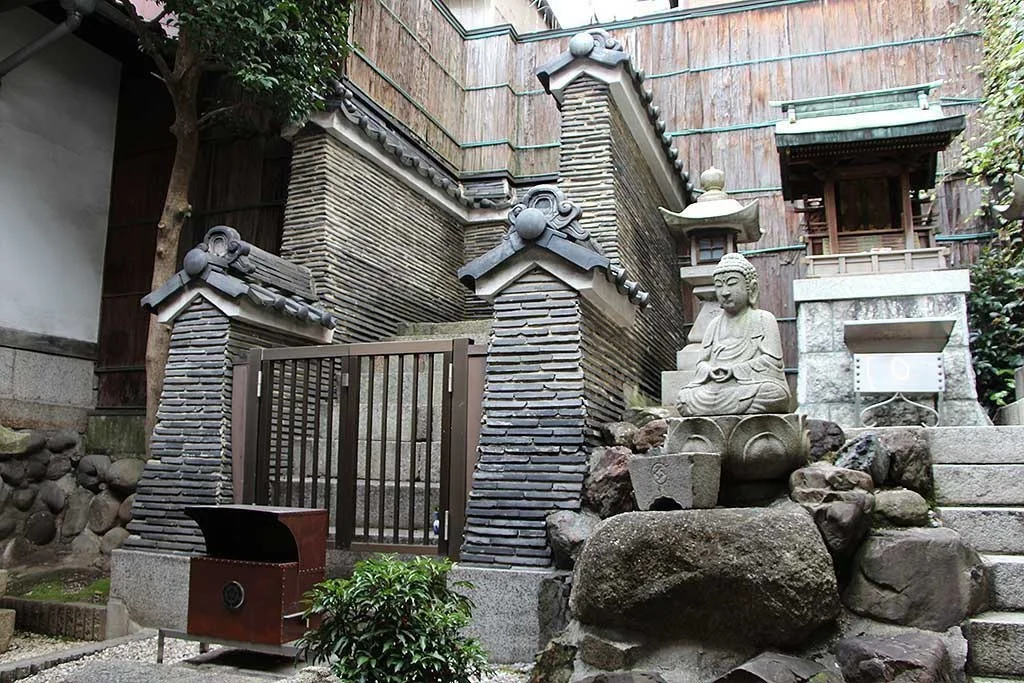
Further losses marked his last years. In 1550 and 1551, pressure from the Imagawa grew stronger, and several local lords in the Chita and Aichi districts switched sides. Nobuhide died at Suemori Castle on 3 March 1552 (27 March 1552), aged forty-two. Other dates appear in later accounts, but documents bearing his seal from 1551 support 1552 as the most likely year of his death. His funeral was held at Banshō-ji in Nagoya and attended by around 300 monks. He was succeeded by his son Nobunaga.
Known in some sources as the "Tiger of Owari, Nobuhide did not live to place the whole province under his rule. Even so, he elevated the Oda from a local deputy to a significant regional power and left behind the political conditions that Nobunaga would later build upon.
References:
- Oda Nobuhide (織田信秀). From Japanese Wikipedia.
- Chaplin, Danny. Sengoku Jidai - Nobunaga, Hideyoshi, and Ieyasu: Three Unifiers of Japan. Createspace, 2018.
- Lamers, Jeroen P. Japonius Tyrannus - The Japanese Warlord Oda Nobunaga Reconsidered. Hotei Publishing, 2000.
- Nussbaum, Louis-Frédéric, Japan Encyclopedia, Harvard University Press 2005
- Papinot, Edmond, Historical and Geographical Dictionary of Japan, Tuttle, third printing 1988
- Sansom, George. A History of Japan 1334-1615. Stanford University Press, 1961.
- Totman, Conrad; A History of Japan, Wiley-Blackwell; second edition 2005


