

Fuchibe Yoshihiro (淵辺義博, d. 1335) was a samurai commander active during the early Nanbokuchō period . He served under Ashikaga Tadayoshi (足利直義, 1306–1352) as the castellan of Fuchinobe Castle (淵野辺城) and held the title Iga-no-kami (伊賀守). A native of Ōno Village in Kōza District, Sagami Province (modern-day Chūō Ward, Sagamihara City, Kanagawa Prefecture), he belonged to a cadet branch of the Nobe (野辺) clan, themselves descendants of the Yokoyama line, one of the seven samurai bands of Musashi (武蔵七党 Musashi-shichitō).
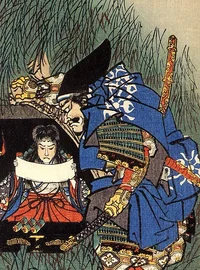
Fuchibe Yoshihiro
According to the Taiheiki (太平記), when the prince was confined at Tōkō-ji Temple (東光寺) in Kamakura after his political downfall, Tadayoshi, fearing that the imprisoned royal might be rallied as a symbolic leader by the rebel Hōjō Tokiyuki (北条時行, 1322–1353), ordered Yoshihiro to execute him. The chronicle recounts how the samurai entered the earthen cell and attempted to strike down the prince, only for Moriyoshi to bite through the sword blade in defiance. After a desperate struggle, Yoshihiro decapitated him, but when he carried the head into the moonlight, its eyes glared back as if still alive. Shaken by the sight, he decided that such a head should never be shown to his lord and, recalling the ancient Chinese tale of the swordsmiths Gan Jiang and Mo Ye (干将・莫耶), he cast it into a nearby bamboo grove. The grove, known as Okamae-dokoro (御構廟), still forms part of the grounds of Kamakura-gū Shrine (鎌倉宮), built centuries later on the temple's site.
Another local tradition, however, preserves a very different version of Yoshihiro's actions. It claims that he disobeyed Tadayoshi's command out of pity for the prince and secretly spirited him away from Kamakura, eventually helping him escape north to Ishinomaki in present-day Miyagi Prefecture. Aware that his defiance would endanger his family, Yoshihiro is said to have renounced his ties to them, parting from his wife and children beneath a great hackberry tree by a bridge over the Sakai River (境川), marking the boundary between modern Sagamihara and Machida. The spot, later known as Wakare-bashi ("Parting Bridge"), became the site of the "Enkiri-enoki" — the "Severance Hackberry" — which still stands as a relic of that farewell.
A second legend from the region tells of Yoshihiro's battle against a dragon that had taken up residence in a pond called Ryūike (龍池) along the same river, terrorising the surrounding villages. He is said to have led his men in pursuit and slain the creature by shooting an arrow into its eye. The dragon's body, according to the story, split into three parts that fell in different locations, prompting the construction of three temples — Ryūtō-ji (龍頭寺), where the head fell, Ryūdō-ji (龍胴寺, now Ryūzō-ji 龍像寺), where the body landed, and Ryūbi-ji (龍尾寺), where the tail was said to have struck the ground — to calm its vengeful spirit. Only Ryūzō-ji remains today, where the tale continues to be told, and an old stretch of the Kamakura Highway near the Sakai River is still remembered as the place "where the dragon was shot."
Yoshihiro's life ended amid the chaos of the Nakasendai no Ran (中先代の乱 ) in 1335, when Hōjō Tokiyuki, son of the last Hōjō regent, rose against the Ashikaga. As the Hōjō army pressed toward Kamakura, Tadayoshi fled westward to Suruga, ordering Yoshihiro to ensure that Moriyoshi could not be used as the rebels' rallying figure. This act sealed the prince's fate. After the fall of Kamakura, Ashikaga Takauji returned from Kyoto , crushed the Hōjō forces, and soon rebelled against Emperor Go-Daigo, setting the stage for the division between the Northern and Southern Courts (南北朝 Nanbokuchō). Yoshihiro continued to serve in Tadayoshi's forces during these campaigns but was eventually killed in battle at Tegoshi-gawara (手越河原) in Suruga. According to the Nantaiheiki (難太平記), he charged into enemy lines and fell fighting while covering his lord's retreat.
Fuchibe Yoshihiro remains a shadowy but compelling figure — remembered at once as a loyal retainer, a reluctant executioner, a dragon-slayer, and a man whose name lingers in the place-names, temples, and riversides of Sagami's old countryside.
Utagawa Kuniyoshi (歌川国芳, 1798-1861), Prince Morinaga is visited by the murderer Fuchibe Yoshihiro while reading the Lotus Sutra in his cave.
Ogata Gekkō (尾形月耕, 1859-1920), Fuchibe Yoshihiro Attacking Prince Moriyoshi.
Unknown Meiji-era artist, Fuchibe Yoshihiro attacking the exiled Prince Oto no Miya.
References:
- Fuchibe Yoshihiro (淵辺義博). From Japanese Wikipedia
- Baldessari, Francesco. Kamakura: A Historical Guide, 2016.
- Mutsu, Iso. Kamakura: Fact and Legend. Tuttle 2012.
- Nussbaum, Louis-Frédéric. Japan Encyclopedia. Harvard University Press, 2005.
- Papinot, Edmond. Historical and Geographical Dictionary of Japan. Tuttle, third printing 1988.
- Sansom, George. History of Japan to 1334. Stanford University Press, 1965.
- Totman, Conrad. A History of Japan. Wiley-Blackwell; second edition 2005.

