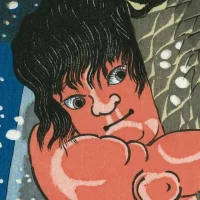
Kintaro, the Golden Boy
Kintarō (金太郎), widely known in Japanese folklore as the "Golden Boy," was the childhood name of Sakata no Kintoki (坂田金時), a legendary strongman and one of the four famed retainers known as the Shitennō (四天王) who served the Heian -period (794–1185) warrior Minamoto no Yorimitsu (源頼光, 948–1021). While Sakata no Kintoki is believed to have been a historical figure, with early references found in the eleventh-century collection of Buddhist and secular tales Konjaku Monogatari (今昔物語集), his image gradually evolved into that of a larger-than-life hero in later literary and theatrical traditions.In later folklore and the performing arts, Kintarō is depicted not merely as a retainer of a mighty warrior (武士 bushi) but as a prodigious child of supernatural origins. According to popular legend, he was born to a yamamba (山姥, mountain witch) and raised on Mount Ashigara (足柄山), a forested area renowned for its mystery and spiritual power. From an early age, he is said to have demonstrated astonishing strength, wrestling with wild animals, befriending bears, and roaming the mountains clad only in a red haragake (腹掛け, traditional child's apron) while wielding a hatchet—sometimes identified with the weapon of a thunder god (雷神 raijin).

Oniwakamaru and the Giant Carp fight underwater (Utagawa Kuniyoshi, 1835)
Kintarō's enduring popularity stems not only from his childlike appearance and mythical strength but also from his strong association with agricultural fertility and mountain kami (神, deities). His red complexion and divine lineage hint at ancient regional cults that revered the thunder god as a bringer of rain and harvest. This connection was especially strong in the Ashigara region, suggesting that Kintarō may originally have been worshipped as a local fertility deity before becoming entwined with the historical memory of Sakata no Kintoki.
By the early Edo period (1603–1868), Kintarō had become a mainstay of jōruri (浄瑠璃) narrative ballads and kabuki theatre, where he frequently appeared under the name Kaidōmaru (怪童丸). These performances emphasised his strength and loyalty to Minamoto no Yorimitsu as well as the mythical aspects of his origin by fusing folk religion, storytelling, and historical warrior myth into a singular cultural figure. In this way, Kintarō came to symbolise both supernatural might and idealised warrior virtue, embodying a seamless fusion of rural folk belief and courtly military legend.

Kintarō and the Yama-uba (Kitagawa Utamaro 喜多川歌麿; 1796)

The Moon of Kintokisan (by Tsukioka Yoshihiro)

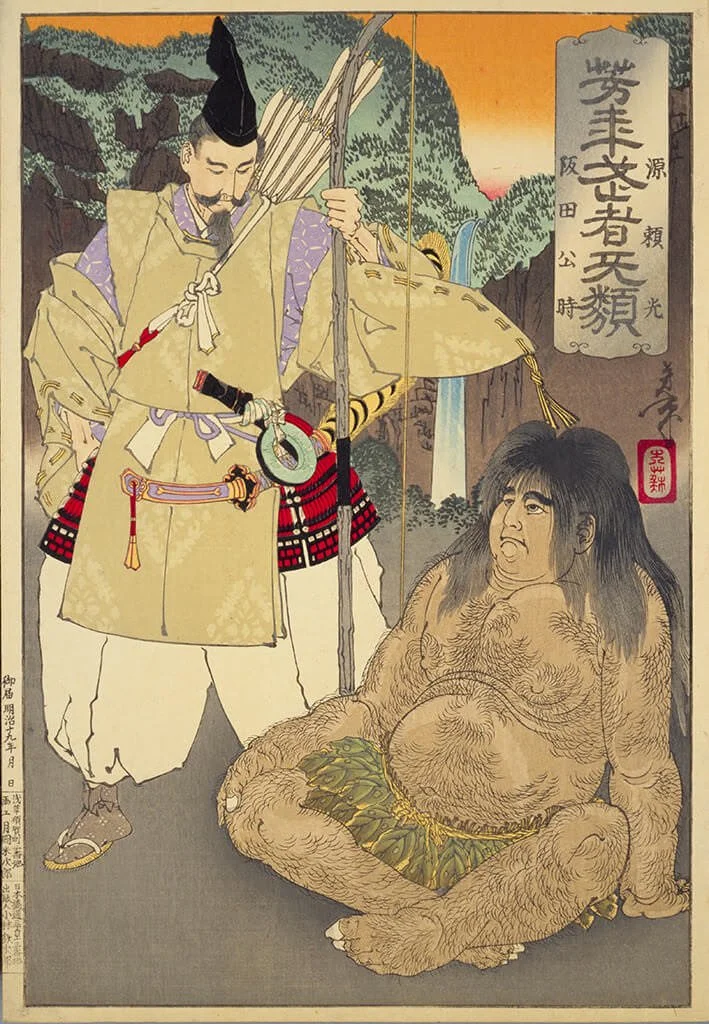
Tsukioka Yoshitoshi (月岡 芳年, 1839-1892), Minamoto no Yorimitsu and Kintarō, 1886, Warriors Trembling with Courage.