Tsurugaoka Hachimangū (鶴岡八幡宮) stands as the spiritual and cultural heart of Kamakura, Kanagawa Prefecture—a city once at the centre of Japan's medieval warrior government. Overlooking the former shogunal capital from the rise known as Tsurugaoka, or the "Hill of Storks", this grand shrine has long served as a symbol of martial devotion and political authority. Revered primarily as a sanctuary dedicated to Hachiman (八幡), the guardian kami of warriors, it has also played a central role in the religious and civic life of Kamakura for centuries. Deeply entwined with the legacy of Minamoto no Yoritomo (源頼朝, 1147-1199), the founder of the Kamakura shogunate, Tsurugaoka Hachimangū evolved into a unique religious complex—part Shintō shrine, part Tendai Buddhist temple—mirroring the syncretic nature of premodern Japanese belief. From sacred rituals and public festivals to legendary moments involving figures such as the Buddhist priest Nichiren (日蓮, 1222-1282), the shrine has been both witness and participant in the unfolding of Japanese history. Even today, long after its political significance has faded, it remains a site of national heritage, memory and quiet reverence.
Tsurugaoka Hachimangū Shrine – Quick Facts
- Name (Japanese): 鶴岡八幡宮 (Tsurugaoka Hachimangū)
- Founded: 1063 by Minamoto no Yoriyoshi (源頼義 ), current site established 1180 by Minamoto no Yoritomo (源頼朝)
- Main Deity: Hachiman (八幡神), syncretised form of Emperor Ōjin (応神天皇)
- Clan Association: Guardian deity of the Minamoto (源氏) clan
- Architecture Style: Shinmei-zukuri with later Edo-period additions
- Current Main Hall: Rebuilt in 1828 under Tokugawa Ienari (徳川家斉) after fire
- Formerly Syncretic: Combined Shinto and Buddhism until 1868 (shinbutsu bunri)
- Sub-Shrines: Wakamiya (若宮), Shirahata-no-miya (白旗宮), and others
- Festivals:
- Reitaisai (例大祭): Mid-September
- Yabusame (流鏑馬): Traditional horseback archery display
- Setsubun (節分): Bean-throwing festival in early February
- Approach Road: Dankazura (段葛), cherry tree-lined path built by Yoritomo for his wife Masako
- Nearby Sites: Komachi-dōri (shopping street), Genjiyama Park, Kenchō-ji temple
- Access: ~10-minute walk from Kamakura Station (JR Yokosuka Line)
History:
The origins of Hachiman worship trace back to the ancient province of Buzen in Kyushu , where the first shrine was established at Usa (宇佐). The deity enshrined there—ultimately identified with Emperor Ōjin (応神天皇, 200-310)—was said to be a direct descendant of the sun goddess Amaterasu (天照大神), and became known as Hachiman (八幡), a name derived from the miraculous descent of eight white banners (yahata) said to have fluttered from the heavens during the shrine's dedication. These "celestial banners" gave the sanctuary its first name, Yahata no Yashiro (八幡社, 'Shrine of the Eight Banners').By the sixth century, Hachiman had come to be widely identified with the deified Emperor Ōjin, son of the legendary Empress Jingū (神功皇后, 169-269), a figure remembered for her strategic acumen and reputed leadership of a military expedition to the Korean peninsula. In the year 859, Emperor Seiwa (清和天皇, 850-881) established a new shrine at Iwashimizu (石清水) in Yamashiro Province, now southern Kyōto , transferring the kami from Usa. As Emperor Seiwa became the direct ancestor of the Minamoto clan (源氏), and Hachiman came to embody martial prowess, the deity was naturally embraced as the clan's patron protector.
It was in this context that Minamoto no Yoriyoshi (源頼義, 985-1078), forefather of the later shōgun Yoritomo, had a Hachiman shrine erected in Kamakura in 1063. Seeking divine favour for his military campaigns in northern Japan, Yoriyoshi dedicated this shrine as a spiritual ally in warfare. His son, Minamoto no Yoshiie (源義家, 1039-1106), was so distinguished in battle that he came to be regarded as a living incarnation of Hachiman himself. Before Yoshiie's birth, Yoriyoshi is said to have prayed fervently for a child worthy of the god of war—an appeal answered in the form of his valiant son, later revered as Hachiman Tarō (八幡太郎), or "firstborn son of Hachiman."

The first Hachiman shrine in Kamakura stood closer to the coast and was more modest in scale than the complex that exists today. A small shrine still marks that original site. When Minamoto no Yoritomo (源頼朝, 1147-1199) chose Kamakura as the seat of his new government in 1180, he relocated the shrine to its current site, formerly known as Matsugaoka (松ヶ岡, "Pine Hill"), renaming it Tsurugaoka (鶴岡) after the previous location.
Yoritomo's shrine was initially built in the lower precincts, but after a devastating fire in March 1191, he ordered its reconstruction on the higher terrace where it now stands. The rebuilding was swift: the main hall and associated structures were completed within the year, and a formal dedication ceremony was held on 21 November 1191. Though rebuilt with great care, the shrine was again destroyed by fire in 1821. It was subsequently reconstructed under the patronage of Tokugawa Ienari (徳川家斉, 1773-1841), the eleventh Tokugawa shōgun, and the current main building dates from 1828.
Over many centuries, Tsurugaoka Hachimangū belonged to a syncretic religious tradition known as ryōbu shintō (両部神道), which blended Buddhist and Shintō elements. According to this doctrine, shaped by the Buddhist monk Kūkai (空海, 774–835), also known as Kōbō Daishi, Shintō deities were regarded as manifestations of Buddhist figures, and the Hachiman complex reflected this belief. Elaborate structures once filled the precincts, including a scripture hall, a great bell tower, a Goma-dō (護摩堂) incense hall containing statues carved by the renowned sculptor Unkei (運慶, c.1150–1223), a Chinese-style pagoda, and several temple halls, including the Rokkaku-dō (六角堂) and the Benzaiten (弁財天) shrine built on an island in the lotus pond.
The Rinzō (輪蔵), or scripture repository behind the great ichō (銀杏) tree, once stored sacred texts said to have been brought from Korea at the request of Yoritomo's grandson, Minamoto no Sanetomo (源実朝, 1192-1219). Sanetomo also had a memorial shrine built in his honour within the complex. Another hall was dedicated to Takeshiuchi no Sukune (武内宿禰), the loyal retainer who is said to have carried the infant Emperor Ōjin in his arms.
This flourishing synthesis came to an end after the Meiji Restoration in 1868. The newly formed imperial government declared State Shinto the national religion and enforced a sharp separation of Buddhism and Shintō. Known as shinbutsu bunri (神仏分離), this policy led to the destruction, removal, or sale of many Buddhist-associated structures, statues and artefacts. Several, including the former Niōmon (仁王門), were relocated to Buddhist temples elsewhere, such as the gate now at Jufuku-ji (寿福寺). The reformed shrine, stripped of its Buddhist ornamentation, emerged in the simplified, austere style more characteristic of pre-Buddhist native worship.
Of the once-vast complex, only two notable auxiliary shrines remain today. Below the eastern staircase stands the Wakamiya (若宮), dedicated to Emperor Ōjin's son, later Emperor Nintoku (仁徳天皇, 313-399). Nearby is the Shirahata-no-miya (白旗宮, "Shrine of the White Flag"), which honours Yoritomo himself. This distinctive structure, rebuilt in its present location in 1887, features iron pillars, gilded doors, and bears the Minamoto crest. Within, a statue of Yoritomo is enshrined. A famous anecdote tells of the military leader Toyotomi Hideyoshi (豊臣秀吉, 1537-1598) tapping the effigy on the shoulder in 1591 and declaring himself the greater of the two rulers, having risen from obscurity without ancestral privilege.
With the fall of the shogunate, the shrine came under direct state control until after the Second World War, when it was reconstituted as an independent religious institution. Today, Tsurugaoka Hachimangū remains one of the three great Hachimangū (八幡宮) shrines in Japan, alongside Usa Hachimangū in Ōita and Iwashimizu Hachimangū in Kyōto. Attracting around 10 million visitors annually, it remains a vibrant centre of tradition. During the first three days of the New Year alone, more than two million pilgrims make their way from Kamakura Station along the bustling approach to the shrine, now a place of solemnity, history and enduring cultural presence.
Things to see:
Dankazura (段葛)
Leaving from the east exit of Kamakura Station and heading straight towards the traffic lights, one will soon come upon a tall torii gate rising six metres into the air, flanked on either side by a pair of stone-carved guardian dogs. These statues, known as komainu (狛犬), and the torii gate itself are unmistakable signs of a Shintō (神道) shrine and serve to distinguish it from a Buddhist temple. The gate in question is the second of three torii (鳥居) gates that mark the approach to Tsurugaoka Hachimangū (鶴岡八幡宮), Kamakura's most historically and spiritually significant shrine. The first torii once stood further south, facing the sea, while the third and final gate stands near the shrine's main entrance to the north.
Dankazura stretches for approximately 500 metres along the central axis of Wakamiya-ōji (若宮大路), beginning at the street's northern end and continuing to the location of the second torii gate. The term "dan" refers to an elevated or raised section of ground. "Kazura" is an abbreviated form of "kazurasashi," a word describing the square stones placed along the outer edges of an elevated structure to stabilise it and prevent erosion or collapse. As such, the Dankazura is essentially a stone-bordered elevated causeway built along a broad avenue, blending practical engineering with the ceremonial grandeur of a shrine approach.
From this second gate stretches an elevated walkway known as the Dankazura (段葛), a structure unlike any other in Kamakura. Measuring approximately 50 centimetres in height, three metres in width, and extending for some 460 metres, this slightly raised path is flanked on either side by hundreds of cherry trees and azalea bushes. In spring, particularly from late March through early April, these trees blossom into a breathtaking tunnel of flowers that draws visitors from across the country. The cherry trees along the Dankazura were planted in 1918, and their species—Prunus Yedoensis—is the same as that of the famous cherry trees along Washington D.C.'s Potomac River. Those American specimens had been a gift in 1912 from the Governor of Tokyo to Helen Herron Taft, the First Lady of the United States.
The Dankazura itself was commissioned by Minamoto no Yoritomo, the founder and first shōgun (将軍) of the Kamakura shogunate, as an offering to the shrine's tutelary deity Hachiman, long venerated as the patron god of warriors. The path was built in 1182, a deeply personal and symbolic gesture during a pivotal moment in Yoritomo's life. At the time, he and his wife, Hōjō Masako (北条政子, 1157-1225), already had two daughters, but Yoritomo, then 36 years old, still lacked a male heir. Under the political structure of the Kamakura bakufu , only a legitimate firstborn son could inherit the office of shōgun. This rule, incidentally, still holds for Japan's Imperial Family to this day. Deeply desiring a son, the couple offered prayers to Hachiman and dedicated this carefully planned walkway as a form of devotion, hoping that their next child would be a boy.
That same year, their prayers were answered. Their son Yoriie (源頼家, 1182-1204) was born and would later become the second shōgun of the Kamakura regime. The path built in celebration and anticipation of his birth became known as Wakamiya-ōji (若宮大路), or "Avenue of the Young Prince." Its design was inspired by Miyako Ōji (都大路), the grand ceremonial boulevard of the imperial capital, Kyōto. Archaeological findings revealed that the original construction was larger than what remains today: the entire roadway once spanned approximately 33 metres, with moats on either side, each three metres across and 1.5 metres deep, serving as a defensive barrier against invaders. The full length of the processional route ran for around 1,500 metres, extending from the first torii gate near the coastline to the entrance of the shrine proper.
The stretch between the first and second torii gates was flattened in 1878 to accommodate the growing traffic demands of the modern era. The remaining Dankazura still preserves the essence of a sacred passageway, hinting at its history, aspiration, and former glory.
Genpei Pond (源平池)
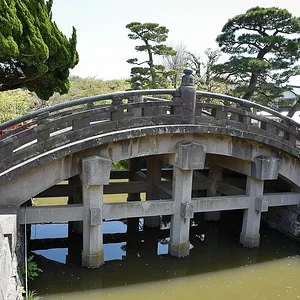
Taikobashi (太鼓橋), or "drum bridge near the second torii.
These ponds represent the two great rival clans of the late Heian period : the Genji (源氏), or Minamoto, and the Heike (平家), or Taira. The larger right-hand pond stands for the Minamoto, while the smaller one on the left represents the Taira. Masako's intention to create the ponds was political and devotional, reinforced by floral symbolism: the Genji pond was once planted with white lotus blossoms, the clan's heraldic colour, while the Taira pond bore red lotuses, their traditional hue. Though both red and white flowers now grow in each pond, the original separation remains historically meaningful.

During summer, the ponds are transformed by a sea of broad lotus leaves, their surfaces almost entirely obscured by the thick green canopy. In winter, by contrast, the water lies exposed, stark and still beneath the grey sky, the flowers and leaves having vanished with the season.
Further layers of symbolism are embedded in the arrangement of islets within the ponds. The Minamoto pond has three small islands, the Taira pond four. The number three, san, also means "birth" or "creation," and is used to wish for continuity and vitality for the Minamoto line. The number four, shi, on the other hand, is a homonym for death (死), a deliberate gesture expressing hope for the demise of the rival clan. Such symbolism would not have been lost on Masako's contemporaries, who well remembered the ferocity and consequences of the Genpei War . Positioned beside the Taira pond stands the Kanagawa Prefectural Museum of Modern Art.
Hata-age Benzaiten (旗上弁財天社)
Within the Minamoto pond at Tsurugaoka Hachimangū (鶴岡八幡宮) lies a small yet culturally significant sub-shrine known as Hata-age Benzaiten (旗上弁財天社), which stands on one of the three artificial islets carefully arranged within the waters. The shrine is dedicated to Benzaiten (弁財天), the Japanese manifestation of the ancient Indian goddess Sarasvatī—originally a river deity in Hindu belief, associated with water, eloquence, music and knowledge. In her journey through the pantheon of Buddhist and Shintō syncretism, Benzaiten came to be revered in Japan as a goddess not only of learning and the arts, but also of fortune and wealth. Owing to her aquatic origins, her shrines are traditionally near ponds, lakes or rivers.The presence of Benzaiten within the Genji pond reflects both religious devotion and a layered symbolism tied to the ambitions of the Minamoto clan. The sub-shrine was removed during the early Meiji period when the newly established government launched a campaign of Shinbutsu Bunri (神仏分離), or the enforced separation of Buddhism and Shintō, aimed at purifying Shintō shrines of Buddhist influences, as Benzaiten did not originate as a pure kami (神) within native Japanese belief; she was deemed unsuitable for inclusion at a state-sanctioned shrine like Tsurugaoka Hachimangū. Consequently, her shrine was dismantled during this wave of reform. The current structure was reconstructed in 1956 and given the name Hata-age, which translates roughly as "raising the banner" or "starting anew."
The shrine housed a unique statue of Benzaiten, carved in 1266 during the mid-Kamakura period . This figure is now exhibited in the Kamakura Museum, a rare example of an early Japanese female deity. Crafted from wood and coated with a distinctive white pigment to suggest the pale complexion considered ideal at the time, the statue depicts Benzaiten seated in a relaxed, almost informal pose, with one leg bent and the other resting gently to the side. She appears poised as if about to pluck the strings of a biwa (琵琶), the traditional Japanese lute. Her only clothing is a cloth draped around her waist, further emphasising her association with nature, femininity and artistic sensuality. An inscription on her right leg reads "1266," marking the year of her creation. She is believed to have been donated by a court musician named Nakahara no Mitsuuji (中原光氏), a figure about whom little is known but who may have served in the imperial court's music bureau.
The shrine celebrates its annual festival on the first Serpent Day of April, according to the lunar calendar , a date traditionally associated with Benzaiten due to her links to water and serpentine imagery. As one of the Shichifukujin (七福神), or Seven Deities of Good Fortune, Benzaiten holds a cherished place in Kamakura's rich religious landscape, and this shrine is one of the key stops on the pilgrimage circuit devoted to the seven gods.
Behind the shrine is a pair of stones known as the Masako Stones (政子石 Masako Ishi), named after Hōjō Masako, the widow of Yoritomo. They are thought to symbolise her spiritual presence at the shrine. Masako was often called the "nun shōgun" for her decisive political role after her husband's death and remains one of the shrine's central figures in its long history. The stones serve as a subtle memorial to her legacy.
Yabusame-baba (流鏑馬馬場)
Just past the halfway point along the main approach to Tsurugaoka Hachimangū Shrine, a broad dirt path intersects the central axis, cutting east to west between two torii gates. This path, about six metres wide and stretching roughly 300 metres across, is known as the Yabusame-baba (流鏑馬馬場). On this ceremonial riding ground, traditional mounted archery, or yabusame (流鏑馬), is performed. This striking ritual takes place twice a year: once on the third Sunday of April during the Kamakura Festival (鎌倉まつり), and again on 16 September as part of the shrine's annual rites. Each occasion draws large crowds, with spectators lining both sides of the path to witness an ancient martial spectacle once central to samurai identity.The modern performance is an annual re-enactment rooted in the martial traditions of the late 12th century, based on those established by Yoritomo. In the early years of his rule, he initiated yabusame contests to sharpen and maintain his warriors' prowess. In 1187, just a few years after securing political control over eastern Japan, he institutionalised this ritualised form of combat training at Tsurugaoka Hachimangū. Archery on horseback had been a fundamental part of the cavalry-based warfare of the period, and Yoritomo understood that such training could be both spiritually meaningful and practically necessary. The contests were also a means to display the prowess of his vassals—samurai whose reputations were measured not only by loyalty and lineage but by their accuracy in hitting the mark while galloping at full speed. Victors were often rewarded with favours, rank, or land.
The path today remains essentially as it was: a straight, narrow lane running for about 260 metres, with three wooden targets spaced approximately 70 metres apart. During the event, archers clad in hunting attire inspired by Kamakura-period military fashion urge their horses forward at full gallop. With a bow in hand, they shoot at the targets in rapid succession, a display of timing and balance.
Historically, this yabusame path marked the beginning of the Kamakura High Roads (鎌倉街道)—a network of ancient highways extending north, northeast, and east from Kamakura, linking it with the rest of the country, including the imperial capital of Kyōto. These roads were arteries of commerce, communication and military movement, underscoring Kamakura's political significance during the age of the shōgun.
Alongside yabusame, the mounted warriors of the Kamakura period also engaged in bloodier pastimes, such as inuoumono (犬追物), or dog-hunting games. These contests involved twelve mounted archers pursuing and shooting at ten live dogs within an enclosed arena. A single competition could last fifteen rounds and result in the deaths of as many as 150 dogs. Though popular among samurai elites at the time, such spectacles would be unimaginable today and are no longer practised—abandoned due to their brutality and the changing moral sentiments of subsequent eras.
Beyond the yabusame course, visitors approaching the shrine soon come into view of two copper-roofed structures. The first is the maiden, or Ritual Dance Stage (舞殿 maiden), situated in front of the more imposing Main Hall. This architectural arrangement preserves the visual and spiritual layering of sacred space that defines Tsurugaoka Hachimangū—a shrine established initially in the 11th century and later expanded under Yoritomo's patronage into a grand site symbolising both religious devotion and warrior rule. As with the ritual of yabusame, the spatial organisation of the shrine reflects the enduring legacy of Kamakura's samurai past and the careful balance it maintained between faith, ceremony, and martial discipline.
Maiden (舞殿)
Situated at the heart of the courtyard, some 200 metres ahead along the central approach, stands a striking red-lacquered, square ritual stage, raised about 1.5 metres off the ground. Known as the Maiden, or Ritual Dance Stage, a covered stage or pavilion within a Shintō shrine precinct, traditionally used for performing sacred dances (kagura) and music during rituals and ceremonies. At Tsurugaoka Hachimangū (鶴岡八幡宮), it holds profound historical and emotional significance, as it commemorates an episode from 1186 involving Lady Shizuka (静御前), the tragic lover of Minamoto no Yoshitsune (源義経, 1159-1189), half-brother to Kamakura's first shōgun, Yoritomo.
Maiden (舞殿), famous for Lady Shizuka's dance.
Lady Shizuka, a refined court dancer raised in Kyōto, was renowned for her beauty and her elegant performance in the traditional courtly arts. Amid the turmoil of the Genpei War and its aftermath, Yoshitsune's growing popularity and independent military success angered his elder brother, Yoritomo, who saw him as a threat. Branded a traitor, Yoshitsune went into hiding, and Shizuka, pregnant with his child, was captured and brought to Kamakura.
Yoritomo sought to assert his authority and humiliate his brother's consort. He demanded that Shizuka perform before him and his household at Tsurugaoka Hachimangū. She refused outright, unwilling to dance for the man who had condemned her lover. At the request of Hōjō Masako, Yoritomo's wife, Shizuka reluctantly agreed.
Her performance became an act of defiance: rather than praising Yoritomo as expected, she danced and sang with deep emotion, expressing unwavering love for her beloved fugitive, Yoshitsune. The sincerity and tenderness of her song stirred the onlookers, but it also deeply enraged Yoritomo. At that time, Shizuka was still carrying Yoshitsune's unborn child. Yoritomo, suspicious and resentful, declared that if the child were a boy, he should be put to death.
Maiden (舞殿) with the Rōmon gate in the background.
Lady Shizuka prayed fervently that her child would be a girl, but she gave birth to a boy. Yoritomo, keeping his word, had the infant killed and his body discarded along the shore of Kamakura. It was a merciless act emblematic of the brutal consolidation of power that marked the early Kamakura period. To this day, the shrine honours Lady Shizuka's memory and mourns the tragedy of her tale. Every year, during the Kamakura Festival held in April, dancers and musicians perform dedicatory pieces on the very same stage, recalling her poignant dance and the sad events that followed.
Ginkgo tree and flight of stairs
Just beyond the Maiden, a broad stone staircase rises toward the main sanctuary. This flight of 61 stone steps is not only an architectural feature but also a silent witness to one of Kamakura's most tragic and politically charged episodes. On the left-hand side of the steps stood, until 2010, a towering ginkgo tree—a massive, ancient specimen said to be more than a thousand years old. According to the nearby plaque, it measured over 30.5 metres in height with a root diameter of around 1.5 metres. That venerable tree marked the very spot where Minamoto no Sanetomo (源実朝, 1192-1219), the third shōgun of the Kamakura bakufu and second son of Minamoto no Yoritomo, was assassinated in the early 13th century.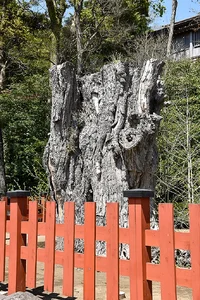
The trunk of the big gingko tree destroyed by lightning in 2010.
The precise motive for this assassination has long been debated: some historians suggested that Kugyō resented his uncle's close alignment with Kyōto's aristocratic culture and his pursuit of court titles. In a military society that harboured deep distrust of courtly authority, Sanetomo's swift promotion by the imperial court may have seemed suspicious, even effeminate. It may have alienated him from more hardline figures within the shogunate. Others point to a more personal and dynastic jealousy. Kugyō was the son of Minamoto no Yoriie (源頼家, 1182-1204), Sanetomo's elder brother and the second shōgun, who had died under mysterious circumstances after being sidelined by the Hōjō clan , the regents of the time. Kugyō may have believed Sanetomo's position was rightfully his. There is even speculation that the assassination was not an isolated act of madness, but part of a broader conspiracy, possibly orchestrated or at least tacitly approved by the powerful Hōjō patriarch Hōjō Tokimasa (北条時政, 1138-1215), the father of Sanetomo's mother, Hōjō Masako (北条政子, 1157-1225). In this reading, Kugyō was merely the blade of a larger political mechanism.
In any case, Kugyō's revenge was short-lived. Almost immediately after the attack, he was captured and executed by the shōgun's guards. Sanetomo died without an heir, and with his death, the direct line of the Minamoto shōgun came to an end, plunging the Kamakura bakufu into a period of uncertainty and power consolidation by the Hōjō.
The ginkgo tree, though silent for centuries, had become a beloved emblem of Tsurugaoka Hachimangū and of Kamakura itself. Its sudden fall on the morning of 10 March 2010, after a night of fierce winds, was met with sorrow nationwide. News of its collapse was widely reported in the press, not merely as the toppling of a natural monument, but as the symbolic loss of a living witness to one of medieval Japan's most dramatic turning points.
Rōmon (楼門)
At the top of the steps leading further into Tsurugaoka Hachimangū stands the striking two-storey tower gate (楼門 rōmon), painted in bright red and built in a style inspired by the Niōmon gates often seen at prominent Buddhist temples. This reflects a time when Shintō and Buddhism were closely linked in Japan, with many shrines and temples sharing rituals, buildings, and even deities under a blended religious tradition known as shinbutsu shūgō (神仏習合).
Rōmon (楼門)
At Buddhist temples, gates like this usually house the fierce and muscular guardian figures known as the Niō (仁王), meant to protect the temple from evil spirits. But here at this shrine, things are a little different. Instead of warrior statues, there are two calm-looking figures of court nobles (公卿 kugyō) dressed in formal robes from the Heian period. Their presence is a testimony to the shrine's long-standing connections with the Imperial Court (朝廷 chōtei) and the aristocratic traditions of ancient Japan, rather than the martial world of Buddhist temples.

Rōmon (楼門)
The current version of the gate was rebuilt in 1828, during the late Edo period , when many important buildings across the country were being repaired or restored under the Tokugawa shogunate. Even though the gate itself is from the 19th century, the statues inside are much older, dating back to 1624, at the start of the Kan'ei era—a time when Tokugawa rule was firmly established. There was a strong interest in supporting both religion and the arts. This gate is a reminder of how deeply blended religious practices once were in Japan, before the Meiji government enforced a strict separation of Shintō and Buddhism through a policy known as shinbutsu bunri (神仏分離) in the late 19th century.
Hongū (本宮)
The main sanctuary (本宮 hongū) of Tsurugaoka Hachimangū is composed of two interconnected structures, following the gongen-zukuri (権現造り) style of shrine architecture. At the front stands the haiden, or oratory hall, where both priests carry out all formal rites, offerings, and prayers and lay worshippers. Behind it lies the honden, the inner sanctum, considered the most sacred part of the shrine and closed to the general public. The layout—two halls beneath a tiered gabled roof—conveys an unmistakable sense of reverence and authority, combining elegance with solemn grandeur.The deity enshrined here is Emperor Ōjin, traditionally counted as the 15th emperor of Japan. He is venerated as the kami of warriors (武神 bushin), and his spirit was identified with Hachiman, a central Shintō deity. Alongside him are honoured Empress Jingū, a legendary consort famed for her mythical conquest of the Korean peninsula, and another divine figure linked to the founding myths of the imperial line. It's worth noting that the character used for "Jingū" in her name is different from the one used for "shrine" (神宮 jingū). These figures were widely worshipped as ancestral and protective deities, particularly among warriors.
For the Minamoto clan (源氏 Genji), their connection to Hachiman was deeply personal and politically symbolic. The clan traced its lineage directly back to Emperor Seiwa (清和天皇, 850-880), the 56th emperor. As descendants of the imperial line, they claimed a divine right to rule and saw Hachiman—once the deified Emperor Ōjin—as their guardian deity. Minamoto no Yoritomo (源頼朝, 1147-1199), founder of the Kamakura shogunate, was a devout worshipper of Hachiman and used this connection to legitimise his rise to power. His great-great-grandfather, Minamoto no Yoriyoshi (源頼義, 985-1078), had established a small Hachiman shrine near the shores of Kamakura in 1063, which is now known as Yui Wakamiya. But by Yoritomo's time, that modest seaside sanctuary was no longer sufficient to reflect the scale of his authority or ambition.
Determined to build a spiritual centre that matched the Minamoto clan's power and vision, Yoritomo relocated the shrine to its current location and renamed it Tsurugaoka Hachimangū. The site he chose, set back from the shore and elevated above the town, gave the shrine both physical prominence and symbolic command over the Kamakura landscape. It was no mere act of devotion—it was a bold statement of political legitimacy in an era when control of ritual space was intertwined with the right to rule.
The vermilion sanctuary seen today is not the original structure. It was rebuilt in 1828 under the patronage of Tokugawa Ienari (徳川家斉, 1773-1841), the 11th Tokugawa shōgun. The Tokugawa family, like many powerful clans before them, claimed descent from the Minamoto line and maintained protection over Tsurugaoka Hachimangū as a symbolic link to the imperial past and warrior tradition. The red-painted woodwork of the hall stands out brilliantly against the surrounding greenery, while the elaborate carvings and gilded ornamentation recall the aesthetic tastes of the late Edo period. Though the building is visually striking, the inner sanctum houses no statues—unlike Buddhist temples, where icons are central to devotion. Instead, sacred objects such as a polished bronze mirror, a ritual sword, and strips of folded white paper (御幣 gohei)—symbols tied to imperial regalia and ancient kami worship—are arranged on the inner altar, representing the deity's presence.
When visiting the oratory, there is a traditional way to show respect and offer a prayer: one bows twice, claps, then bows once more. Money is typically offered beforehand—some wealthier visitors may quietly drop in a 10,000-yen note, but most people toss a 10-yen coin. It's said that the kami do not judge by the amount offered, but by the sincerity behind it. Inside the haiden, one might find individuals seated on tatami mats, waiting for priests to perform special rites on their behalf. These can be for a wide range of personal matters—family safety, business success, academic achievement, recovery from illness, or spiritual protection.
One of the busiest times for the shrine priests arrives in early to mid-November, during the Shichi-Go-San (七五三) festival. Families with children aged three, five or seven—ages considered key milestones in a child's development—come dressed in colourful kimonos or Western-style clothing to receive blessings. The custom, dating back to the Heian period, is believed to ensure a child's health and future happiness. Many parents continue to observe it today as a way of preserving tradition while hoping for a good life for their sons and daughters.
Hōmotsuden (宝物殿, Treasure House)
To the left of the main sanctuary of Tsurugaoka Hachimangū stands the Treasure House (宝物殿 hōmotsuden). In this long corridor-style building, many of the shrine's most precious objects are displayed. This modest yet significant space preserves relics tied closely to the history of both the shrine and the Minamoto clan. Among the exhibits are seven intricately crafted mikoshi (portable shrines), produced between the 17th and 18th centuries, which would once have been carried through the streets during grand festival processions. Also on display are several antique swords, traditional bugu (武具 military gear), and ceremonial garments, all evoking the shrine's patrons' martial and aristocratic heritage.Two seated statues of Yoritomo, founder of the Kamakura shogunate, are of particular interest. They offer rare visual interpretations of his presence, crafted after his death. A dramatic folding screen painted with vivid scenes from the Genpei War, the 12th-century conflict between the Minamoto and Taira clans, brings to life the battles that shaped Japan's political fate. Equally compelling is an exquisite twelve-layered court robe (jūni-hitoe) for noblewomen, a suit of armour once used in ceremonial or possibly battlefield contexts, various examples of brush-written calligraphy, and carved wooden masks hinting at the shrine's long-standing ritual traditions.
A lacquered inkstone case, decorated with thin layers of mother-of-pearl arranged to form delicate chrysanthemum blossoms alongside birds in flight, stands out among the other treasures. It was gifted to Yoritomo by Emperor Go-Shirakawa (後白河天皇, 1127-1192), underlining the recognition the shōgun received from the court even as he consolidated military power. Other lacquered items include gold-inlaid quivers and a set of black-lacquered arrows inlaid with mother-of-pearl, renowned examples of high Edo-period craftsmanship.
These arrows have a living legacy. Every New Year, the shrine sells decorative arrows known as hamaya (破魔矢 demon-quelling arrows), derived from the original black arrows on display. They are sold as charms to ward off evil and bring fortune and are immensely popular, with some 250,000 sold during the festive season.
The most precious lacquered treasures are no longer housed in the hōmotsuden but conserved in the Kamakura Museum. Nevertheless, the Treasure House remains open to the public, offering visitors a glimpse into the shrine's rich cultural past. The admission is 200 yen for adults, 100 yen for elementary school children, and discounted rates for groups. It welcomes guests daily from 09:00 to 16:00, except on Mondays when it is closed.
Wakamiya-sha or Shitanomiya (若宮社 又は 下宮) sub-shrine
At the foot of the broad stone stairway—consisting of sixty-one steps—that ascends to the honden (本殿 main sanctuary) of Tsurugaoka Hachimangū stands a more minor yet historically significant auxiliary shrine known as Wakamiya (若宮). Situated on the eastern side of the approach, this sessha or sub-shrine is dedicated to Emperor Nintoku (仁徳天皇, d. 399), traditionally counted as the sixteenth sovereign of Japan. According to early chronicles, Nintoku was the son of Emperor Ōjin (応神天皇), another semi-legendary figure revered as a paternal ancestor of Hachiman, the god of war and protector of warriors. While the historical existence of these emperors remains shrouded in myth, their cults were central to early Yamato rule and later co-opted by military elites for legitimacy.The present-day structure of Wakamiya owes its form to the efforts of Tokugawa Hidetada (徳川秀忠 , 1579-1632), the second shōgun of the Tokugawa bakufu, who ordered its reconstruction during his reign. The rebuilding was completed in 1624, under the tenure of his son, Tokugawa Iemitsu (徳川家光, 1604-1651), who would go on to centralise Tokugawa rule further and intensify the role of religious institutions in upholding the political order. Erected in the gongen-zukuri (権現造) style, a syncretic form of architecture that had gained popularity in the early Edo period, its style reflects the continued blending of Shintō and Buddhist elements. This style, characterised by its interconnected worship and sanctuary halls beneath a single roof, was seen as particularly appropriate for shrines that venerated deified human figures—such as emperors or shōgun—within a Shintō-Buddhist (神仏習合 shinbutsu shūgō) framework.
Wakamiya remains one of the oldest intact buildings within the shrine precinct, offering a rare insight into early Edo-period shrine construction sponsored directly by the shogunate. It has been designated an Important Cultural Asset (ICA) by Kanagawa Prefecture.
Shirahata sub-shrine (白旗神社)
Further east of the main complex at Tsurugaoka Hachimangū is a modest, sombre shrine entirely coated in black lacquer. This is the Shirahata Jinja (白旗神社), a sub-shrine steeped in both symbolism and familial legacy. It was constructed in the year 1200 by Hōjō Masako, a key figure in the early Kamakura shogunate. The name Shirahata, which translates as "white banner," refers directly to the colour traditionally associated with the Minamoto (源) clan, whose military standard was white. The sub-shrine was built to honour the memory of her late husband, Yoritomo, the founder of Japan's first shogunate, and their younger son, Minamoto no Sanetomo, who became the third shōgun. Notably absent from this memorial is their elder son, Minamoto no Yoriie (源頼家, 1182-1204), the second shōgun, likely because of his strained relationship with his mother and the Hōjō regents, which ultimately led to his downfall and untimely death.Shirahata sub-shrine (白旗神社)
Shirahata Shrine was envisioned as a spiritual stronghold of the Minamoto lineage. The architectural details reflect this lineage pride, with several beams and pillars bearing the family crest: the sasarindō (笹竜胆), a stylised design of gentian flowers and bamboo leaves that had become the heraldic emblem of the Minamoto clan. In the early centuries, a statue of Yoritomo himself stood enshrined within the small building. When Toyotomi Hideyoshi (豊臣秀吉, 1537-1598) visited Kamakura in 1590, he paid his respects at Shirahata Shrine. As he stood before Yoritomo's statue, he is said to have gently stroked its shoulder and remarked, "You and I are the true heroes of Japan." Though the statue is no longer housed there, it survives and is now kept in the Tokyo National Museum in Ueno.
The term shirahata (白旗) evokes the white banner of the Minamoto and has become a symbol of the clan's valour and legacy. Shrines bearing the name Shirahata are found throughout Japan and are dedicated to the Minamoto family.
Maruyama Inari Shrine (丸山稲荷社)
On a slight rise to the left of the Main Hall at Tsurugaoka Hachimangū stands the modest yet historically rich Maruyama Inari Shrine (丸山稲荷社). Though small in stature—less than two square metres—this vivid red structure is of great significance, both architecturally and spiritually. It is dedicated to Inari (稲荷), the ancient kami associated with rice and staple grains. Gradually, Inari's role evolved into other fields, such as prosperity in business, agriculture, and commerce, mirroring Japan's social shifts, particularly from the late Heian period into the medieval and early modern periods, when commerce and artisan communities began to play more prominent roles in urban centres.Foxes (狐 kitsune) are closely linked with Inari worship, believed to be sacred messengers that mediate between the deity and the human world. In some local traditions, Inari and the fox are even regarded as the same. Foxes are also fondly imagined to have a particular taste for aburaage—fried slices of bean curd—which is why dishes like kitsune udon have become part of everyday Japanese cuisine. These thick, slippery white wheat noodles served in hot broth and topped with sweet soy-simmered fried tofu are said to be a fox's delight, hence the name.
Despite its compact size, the shrine is the oldest surviving structure within the entire shrine complex, dating back to the Muromachi period (室町時代, 1336-1573). Its construction reflects the restrained architectural sensibilities of that era, particularly in the design of its beams and gabled roof. As a result, it has been designated an Important Cultural Asset (ICA). The shrine's survival through the centuries can be attributed in part to its secluded location on Maruyama—meaning "round mountain"—a low hill somewhat removed from the main buildings. Thanks to this positioning, it was spared from the numerous fires that ravaged other parts of the shrine precinct over the centuries.
Historical records suggest that this Inari shrine may predate even the foundation of Tsurugaoka Hachimangū itself. Some sources place its original construction as far back as the 9th century, a time when localised kami worship was often centred around landscape features such as hills and forests. It is also said that before the Main Hall was erected by Minamoto no Yoritomo in 1191, this Inari shrine originally stood on that very spot. It was moved to its current location on the hillside when construction of the Main Hall commenced. Though now quiet and overshadowed by grander halls, the Maruyama Inari Shrine offers a glimpse into an earlier layer of sacred history at Tsurugaoka Hachimangū.
Kamakura Museum (鎌倉国宝館)
When the Great Kantō Earthquake struck on 1 September 1923, it devastated much of Kamakura. Countless temples and shrines, some centuries old, were severely damaged or reduced to ruins. Beyond the physical destruction of the buildings themselves, the quake brought widespread loss to Kamakura's cultural and religious heritage—fragile Buddhist statues, sacred paintings, and ceremonial artefacts were cracked, shattered or lost in the chaos. These were objects that had survived for generations, many dating back to the Kamakura period (鎌倉時代, 1185-1333), when the city served as the political and military heart of Japan under the rule of the Kamakura shogunate.Kamakura Museum (鎌倉国宝館)
Amidst the grief and confusion that followed the disaster, the people of Kamakura came together in a rare and heartfelt act of civic resolve. They donated money from their own pockets to create a space where what remained of their cultural treasures could be safeguarded from future destruction. Their determination resulted in the construction of the Kamakura National Treasure Museum (鎌倉国宝館 Kamakura Kokuhōkan), which opened its doors in 1928, five years after the earthquake. Though formally designated as a public museum, it was, in many ways, the product of an intensely local effort—a testament to how ordinary citizens recognised the need to protect what centuries of devotion had created.
The museum was designed with resilience and reverence in mind. Its architecture was modelled on the Shōsōin (正倉院) of Nara, the imperial treasure house originally constructed in the 8th century to store the belongings of Emperor Shōmu (聖武天皇, 701-756). That ancient structure had withstood the test of time thanks to its distinctive log construction and elevated flooring. It served as a natural model for a museum meant to protect sacred and historic objects from fire, moisture and earthquakes alike.
Since its founding, the Kamakura Kokuhōkan has housed many thousands of precious items. Some 3,500 artefacts are stored within its carefully controlled interiors today. Many of these were initially held by temples and shrines across Kamakura, brought here either for long-term safekeeping or temporary refuge. Among them are statues of the Buddha (仏像 butsuzō), mandalas, temple furnishings and scroll paintings—some created during the Kamakura period itself, a time known for its innovative and emotionally expressive Buddhist sculpture, and others crafted in the centuries that followed.
The museum's collection includes objects that have been formally designated as National Treasures (国宝 kokuhō) and Important Cultural Properties (重要文化財 jūyō bunkazai). These classifications reflect both the craftsmanship of the items and their irreplaceable value to Japanese cultural history. While many of the pieces are not on permanent display, rotating exhibitions allow the public to experience the aesthetic and spiritual legacy of Kamakura in a space born directly from the effort to preserve it.
The Peony Garden (ぼたん庭園)
The Peony Garden beside the Genpei Ponds was established in 1980 to mark the 800th anniversary of the shrine's founding by Yoritomo. Intended not only as a botanical display but also as a gesture of cultural reverence, the garden was carefully planned to harmonise with the shrine's historical atmosphere and natural surroundings.Spanning 10,000 square metres, the garden houses around 200 varieties and more than 2,000 individual peony plants. Its design reflects both Japanese and Chinese garden traditions. The inner sections are covered in pine moss from Kyōto, while the arrangement of stones and paths was created by a specialist gardener from Suzhou, a region in China known for its intricate and contemplative garden designs.
Among the garden's most distinctive features is its winter peony display, something rarely seen in Japan. Around 500 of these hardy blooms open in the depths of the coldest season, typically from early January through to the end of February. To shield their delicate, paper-thin petals from wind and frost, each plant is carefully protected beneath a hand-constructed straw canopy known as a warabōshi. These conical shelters not only serve a practical function but lend the garden a timeless visual character, reminiscent of agricultural traditions and seasonal rites of old.
As the cold recedes and spring deepens, the garden enters its most vivid phase. From mid-April through to late May, more than 2,000 spring peonies come into full bloom. In June, just as the peonies begin to fade, native hydrangeas (紫陽花 ajisai) emerge.
Admission fees vary with the season, typically ranging from 300 to 600 yen, but the experience, especially during the peak months, offers a quiet, reflective contrast to the shrine's main approach, which is bustling.
References:
- Baldessari, Francesco, Kamakura: A Historical Guide, 2016
- Cooper, Michael, Exploring Kamakura, Weatherhill 1979
- Mutsu, Iso, Kamakura: Fact and Legend, Tuttle 2012