

When Japanese tie the knot
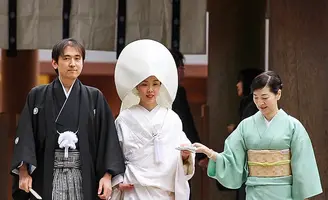
In the old days, the bride and groom always had to be from households (家, ie) of equal social standing. That meant that every person considered a member of the household of the bride and the groom had to be of roughly equal standing – an issue of crucial importance in selecting a marriage partner. Inept selection of mates was a mistake attributed to all household members. As the social standing of others besides the bride and groom was at stake, each marriage had to be considered carefully.
Therefore, marriages were not celebrated merely because two young people were attracted to one another but only after careful consideration by other adult household members and skilled go-betweens. The wedding ceremony required a go-between (仲人 nakōdo) for ceremonial roles in recognition of the continuing need for consultation and mediation.
Japanese marriage was commonly characterised as a system of arranged marriages, where the bride and groom were introduced to one another by a go-between, and the wedding was celebrated. At the same time, both partners were still comparative strangers. The higher the social standing of either the bride's or the groom's family, the more likely this is still the case, even in modern Japan.
While love marriages have become common, traditional beliefs and social pressure still play a role in selecting a spouse. The urge to comply with social expectations and the wish for children often seem to outweigh other individual considerations, leading many to believe that marriage in Japan is still based on societal or pecuniary determinants rather than love and affection.
History
The bulk of the Japanese population before industrialisation was agricultural and settled in small permanent communities (村 mura). The portion of the population not involved in agriculture was similarly stable in occupation and status and usually restricted to reside in certain localities. In these communities, status mobility was marginal from generation to generation, and the relative standing of households within and nearby villages was well known.Due to these tightly knit communities, households had to rely on geographically and socially well-placed relatives or go-betweens' services to ascertain household similarity whenever they contemplated marriages at any distance. Because there was a mutual affirmation of the equality of households of bride and groom through marriage, marriages tended to be within restricted groups of families. Marriage within the community solved many of the problems of spouse selection; approximately twenty per cent of marriages in preindustrial Japan were between households already related through adoption or marriage. Furthermore, marriage equality resulted in connections between households with similar economic and political views. Traditional, status-conscious unions rarely occur across group or factional boundaries, resulting in social and political stability.
Nowadays, there is no longer an emphasis on continuing occupational or trade networks between in-laws but on young couples breaking away from their initial social placement at marriage by their abilities to maintain higher social status.
Marriage in the Heian Era
During the Heian Period (794-1185), marked by the flowering of Japanese court aristocracy, there was considerable emphasis on marriage between equals. As a ceremony of social importance, marriage itself was not the focus of attention. It was merely the selection of mates to produce offspring. High-ranking men could have more than one mate. Their children did not automatically receive their father's rank but could also be placed at a lesser rank he was entitled to or their mother's rank if her father or brother approved. Adopting other households to achieve rank was widespread, allowing a woman's family to place her children on a more prestigious path than their father could.The husband often lived temporarily with his wife at her family's residence while maintaining his bachelor's quarters elsewhere. His clothes were supplied by his wife's household and indicated his rank. Young men and women of the Heian Period could engage in relatively permanent relationships, with their parents or guardians as guarantors for their fidelity. Any children of this guaranteed union were automatically recognised during their mother's pregnancy by the formal presentation of a gift as recognition of their child, usually a sash. On the other hand, there was no understanding between the young men and women concerning other potential mates. As a result, high-ranking men and women often had several mates in their lifetimes. A powerful man of aristocratic society was not bound at any time to a single mate in a monogamous marriage. He could maintain one wife in her residence, permit another wife's father to maintain her in his residence and conduct relationships with other women. A more formal relationship was established by building a separate residence in which he lived and to which he brought one wife.
As pregnancies needed recognition by a man from another household of equal status for her children to have any importance in society, women had to conduct themselves carefully. By attracting and retaining the constant attention of a man from a household of slightly higher status, a woman could increase the importance of her own household, an option that women from low-ranking families usually did not have. A higher-ranking child meant a higher social status for a woman's household, as long as the child was alive and not adopted by another home. More children increased the chances of attaining higher social status, while for men, several wives increased the resources available to them, which resulted in the birth of children.
Among members of the imperial household, the residence of children at the household of their mother led to what was, in fact, "governance by maternal relations". This system of marriage politics depended upon continued ties of adoption and marriage and often involved the marriage of cousins to keep a link between households. Marriages were endogamous, meaning they took place within a group of households. Endogamous marriage likely characterised all levels of Heian society; marriages to cousins or adoptive cousins were frequent, and influential men of each rank were permitted to have more than one wife.
Farmers, artisans, and low-ranking warriors or attendants had less chance of building their household name through recognised relationships with higher-ranking women. They had an easier guarantee of firm status through permanent marriages with one wife. However, they could easily change wives without difficulty if their wife's family were not in a position to challenge their right to do so, especially if the man had been taken by his wife's family (婿入婚 mukoirikon, matrilocal or uxorilocal residence) rather than building a residence or maintaining a residence for her.
Post-Heian: permanent marriage
Due to the stable agricultural base established between the 11th and 15th centuries, marriages began to be contracted between households at some geographical distance. Political imbalance, warring factions, and reprisals were common in that period and often involved households related through marriage. Thus, marriage itself became an important means of ceremonially cementing alliances between factions and groups. The focus of social attention shifted from the parentage of children to a guarantee of equality and cooperation by households through marriage.With the establishment of domains, lower-status marriages across domain boundaries were discouraged. In contrast, high-status marriages were politically reviewed and channelled by domain officials in large part because of the loyalties built up through kinship in military alliances. With the change to permanent domains, the bushi gradually became a bureaucracy, and titles became more hereditary. At the same time, polygynous marriage or marriage with many wives became less common. In the case of higher-status marriages, wives were taken from households at some distance. Their residence was with their husband, and the marriage ceremony increasingly tended to guarantee the legitimacy of children. Where the bride resided in the husband's residence (嫁入婚 yomeirikon, patrilocal or virilocal residence), the children of other women by her husband were guaranteed only the chance of adoption into the household.
Confucian ethics, imported from China, supported many of the preferences of military and bureaucratic households in marriage, such as marrying at a distance rather than within a close group and marrying with lavish pomp. The Chinese ranking of wives and concubines also accorded with the Japanese marriage style of this era.
Marriage in the Edo Period
Once households of the Japanese military class achieved permanent recognition of their relative status and their domains after the establishment of the Tokugawa shogunate, the marriage system, along with other matters of private life became subject to many rules and regulations to preserve the status quo—these marriage-related regulations aimed at inhibiting unions that could pose potential dangers to the existing order. The shogunate required all domains to report marriages that households were contemplating before any marriage ceremony. Each domain prepared a central repository of all data on its populace for the central government and the domain administration.These registries fixed the status of each household by the titles to which it could aspire and by the marriages it had managed to make. Later, unions had to be approved by officials in each residential unit and their legitimacy was confirmed by go-betweens. Only the children born of registered, equally-ranking primary marriages seem to have inherited their father's titles.
The households of all classes were registered, allowing us to trace how well the population complied with those strict regulations. Although marriages between cousins were sometimes restricted, they appear to have frequently occurred in rural areas and among households of high noble rank. Strict endogamy (marriage among a minimal number of families) indicated both low, practically unranked status and high, protected status.
An elaborate system of permanent ranks and titles established by the bakufu in the seventeenth century required go-between. It ensured that both households were equal and the marriage was stable. In cities, commoners such as artisans and shopkeepers seem to have followed the monogamous marriage pattern employing go-between and guarantor; officials carefully scrutinised their marriages. In rural areas, however, villagers continued the aristocratic patterns of multiple relationships, including "night-visiting" (夜這い yobai, lit. night-crawling), use of "young people's lodges" (若者宿 wakamono yado) and dormitories, and similar institutions. Sometimes, younger sons remain unmarried, unable to establish households of their own and unable to inherit the households of their birth. The idea of marriage was tied to the existence of an ie (household). Even when marriages were formally recognised, it was often after the birth of one or more children. This reflected the broader choice of mates from equal households available to villagers and their greater distance from official registry offices. In some areas, it was considered acceptable for the wife to remain at her parents' residence for some years, even after the formal marriage registration.
The age of industrialisation
Industrialisation dramatically changed Japan's social structures: more people moved into the urban centres, taking up new professions that quickly gained new social standing, while traditional occupations lost their former esteem. This shift resulted in cities crowded with unrelated household members from all over Japan.However, even in the age of industrialisation, equality and marriage within a known group continued to be necessary, with the only difference being that households were now related through economic endeavours and the profession of either the bride, the groom, or other family members. While equal status was still based on the same principles, it was no longer based on class but occupation. Households of higher status were careful to limit the contacts of their daughters. Despite coeducational schooling, a marriage partner was not likely to be found in the public domain, such as schools or universities. Occupational equality through working in the same industry or company was and perhaps still is a more common determinant of similar status. Moreover, the selection of a bride or groom during childhood became a thing of the past.
Marriage in modern Japan
Efforts to locate a compatible spouse were extended to company contact networks or civic events designed to introduce young people from the same professional or social background. The nakōdo played a significant role in marriages where the bride and groom had not known one another previously. Until the 1940s, almost 70 per cent of all marriages were arranged (お見合い omiai). The modern system of marriage has adjusted to pressure from the Western custom of love marriages (恋愛結婚 ren'ai kekkon), which surpassed arranged marriages in number in the mid-1960s. The acceptance of the love match meant that households, particularly the parents of a young couple, did not have the final say in the marriage any more.Thus, if match-makers are still sought for advice on appropriate mates, their services are usually restricted to the first introduction; the young couple decides through dating before arrangements are made for eventual marriage. Arranged marriages have dropped to just 6.4 per cent, according to the National Institute of Population and Social Security Research.
Modern matchmaking: konkatsu
Japan currently sees a marked increase in the number of people who choose to stay single and get married later on in life, resulting in a plunging birth rate. Against this backdrop, professional agencies and local authorities have initiated campaigns to encourage people to get married, such as match-making parties not only for singles, who have little opportunity to meet potential spouses due to busy work hours but also for parents to meet other parents with offspring in the same situation. In the case of mutual interest, they would set up their children for a blind date.This trend is called konkatsu (婚活), which is an abbreviation of kekkon katsudo (結婚活動), which literary translates as "marriage activities", or in the given context, "spouse hunting".
According to the Nomura Research Institute, 83.9 per cent of single men under the age of 50 earn an annual income of less than 4 million JPY (43,000 USD), whereas single women looking for partners making between 5 and 7 million JPY (54,000 to 75,000 USD), which accounts only for 4.9 per cent of single men in the same group. Interestingly, even men with this income expect their future wives to work after marriage. On the other hand, the number of women who wish to stay home after marriage is surging after they have experienced despair in finding employment due to Japan's ongoing financial crisis and recession, resulting in a severe disproportion between the number of potential brides who want to be a housewife and grooms willing to provide for a family.
Konkatsu stress is the other side: people who actively indulge in match-making parties feel exhausted and despaired after experiencing repeated failures. According to one mental clinic, the number of people who develop insomnia or anxiety disorder is on the increase. Nevertheless, the match-making industry is thriving: in 2006, the Ministry of Economic, Trade and Industry (METI) estimated that it generated sales of between 50 to 60 billion JPY.
Trends in marriage
Until the early 1970s, marriage rates were steadily increasing. Scholars attribute this high marriage percentage to Confucian ethics of fidelity, household continuity, and the obligation of every person to marry. The social pressure to tie the knot included the perception, however, that few unmarried persons were considered responsible adults until they married and established their households with the abolition of the old Civil Code of 1898 that gave parental rights over women to the heads of household and with the process of democratisation after World War II women gained more equal rights in the 1970s.Trends in marriage rates (per 1,000)
| 1935 | 1947 | 1950 | 1955 | 1960 | 1965 | 1970 | 1975 | 1980 | 1985 | 1990 | 1995 | 2005 | 2008 | 2009 | 2010 | 2011 |
| 8 | 12 | 8.6 | 8 | 9.3 | 9.7 | 10 | 8.5 | 6.7 | 6.1 | 5.9 | 6.4 | 5.7 | 5.8 | 5.6 | 5.5 | 5.2 |
| 2012 | 2013 | 2014 | 2015 | 2016 | 2017 | 2018 | 2019 | 2020 | 2021 | 2022 | 2023 |
| 5.3 | 5.3 | 5.1 | 5.1 | 5.0 | 4.9 | 4.7 | 4.8 | 4.3 | 4.1 | 4.1 | 3.9 |
More freedom in choosing a partner has translated into people getting married at a later stage in life:
Trends in the mean age of bride and groom at marriage (for first marriage)
| Year | 1950 | 1960 | 1970 | 1980 | 1990 | 2000 | 2003 | 2004 | 2005 | 2006 | 2007 | 2008 | 2009 | 2010 | 2011 |
| Bride | 23 | 24.4 | 24.2 | 25.2 | 25.9 | 27 | 27.6 | 27.8 | 28 | 28.2 | 28.3 | 28.5 | 28.6 | 28.8 | 29 |
| Groom | 25.9 | 27.2 | 26.9 | 27.8 | 28.4 | 28.8 | 29.4 | 29.6 | 29.8 | 30 | 30.1 | 30.2 | 30.4 | 30.5 | 30.7 |
| Year | 2012 | 2013 | 2014 | 2015 | 2016 | 2017 | 2018 | 2019 | 2020 | 2021 | 2022 | 2023 |
| Bride | 29.2 | 29.3 | 29.4 | 29.4 | 29.4 | 29.4 | 29.4 | 29.6 | 29.4 | 29.5 | 29.7 | 29.7 |
| Groom | 30.8 | 30.9 | 31.1 | 31.1 | 31.1 | 31.1 | 31.1 | 31.2 | 31.0 | 31.0 | 31.1 | 31.1 |
The figures provided by the Japan Statistics Bureau reveal that half of all Japanese women aged 29 are still single. Japan has the highest rate of single women between ages 20 and 40, much higher than in the United States and on par with Scandinavia. These days, women often put off their wedding until they are 35 years old or later.
Contrary to well-educated men, better-educated and successful women tend to decide against marriage and child-rearing:
- 80% to 90% of single Japanese women live with their parents, as do about half of the men in their 20s; most pay little or no rent and do no housework (one study estimates that Japan has 10 million of these parasite singles, a term coined by sociologist Masahiro Yamada of Tokyo Gakugei University)
- 56% of single women do want to marry eventually; however, marriage is widely seen as a farewell to personal freedom (according to a 2001 Mainichi newspaper survey of single women ages 20 to 40, fewer than a third wanted to marry "soon."
- 10% of single women ages 35 to 39 told the survey they have resolved never to marry, as did 25% of single women in their 40s; in 1950, only 1.4% of women never married.
Moreover, national surveys revealed that the age difference between husband and wife is also dwindling: while the once-dominant couples, where the husband is senior in age, have been decreasing to less than sixty per cent of all marriages, couples with a wife older than the husband exceeded 25 per cent in the early 2000s, while the number of same-age couples is also growing. The reason cited for this trend is the diminishing role of arranged marriages, which used to focus exclusively on older groom-younger bride arrangements.
One thing is certain: women's roles and perceptions in Japanese society have changed remarkably within less than a century. Sumiko Iwao describes the role of women in the Meiji Period as follows:
The head of the household, who was, as a rule, male, exercised unchallengeable authority over the lives of all family members. Women (wives) were seen primarily regarding their role as bearers of male offspring who would carry on the family line and assume the responsibilities of the family head. Women exercised no authority over marriage, divorce, or inheritance.
While a widespread feminist movement campaigning for female empowerment is absent in Japan, many things have changed since the Meiji era . Despite a two-decade economic recession that has forced many of them into joining the workforce, Japanese women enjoy the unprecedented freedom of deciding—more or less free of social pressure and conventions—whether they want to marry or not and who to wed.
The "Three H" requirement women applied to their prospective husbands during Japan's "bubble economy," namely, "high education, high salary, and height," has been replaced with a "Three C" standard: "financially comfortable, emotionally communicative, and cooperative in housework and childcare." Thus, in light of declining female willingness to compromise, this ups the ante for potential spouses.
References:
- Blood, Robert O; Love Match and Arranged Marriage; a Tokyo-Detroit Comparison; New York, Free Press, 1967
- Edwards, Walter; Modern Japan Through Its Weddings: Gender, Person, and Society in Ritual Portrayal; Stanford University Press, 1989
- Frédéric, Louis; Japan Encyclopedia; Harvard University Press, 2005
- Hendry, Joy; Marriage in Changing Japan; London: Croom Helm, 1981
- Iwao, Sumiko; Japanese Woman; New York, Free Press, 1998
- Mochizuki, Takashi; Changing Pattern of Mate Selection; Journal of Comparative Family Studies Summer 1981: 317-328
Related links:
- Omiai and Compa (Yamasa Student Network)
- Fear over the future keeps Japanese from marrying and having children (The Asahi Shimbun, February 2, 2019)
- Tying the knot: Marriage ever-changing institution (Masami Ito, Japan Times, November 3, 2009)
- Me, Find a Husband? Later, Maybe (Sonni Efron, LA Times, June 26, 2001)
- Tying the knot: The Changing Face of Marriage in Japan (Web-japan.org, July 28, 1998)


