Translation Help Please

ted583

Registered
Joined
13 Aug 2024
Messages
4
Reaction score
8
Hello Everyone,
15 years ago I spent a lovely 4 weeks in Japan.
Two weeks travelling - Tokyo - Morioka - Osaka - Hiroshima - Itsukushima - then back to Kyoto for a two week stay.
While in Kyoto I went to the Tōji Temple markets and purchased a scroll as a souvenir. I have tried to google its meaning on occasion with no success.
Help translating it would be appreciated.
Dōmo arigatō
Ted
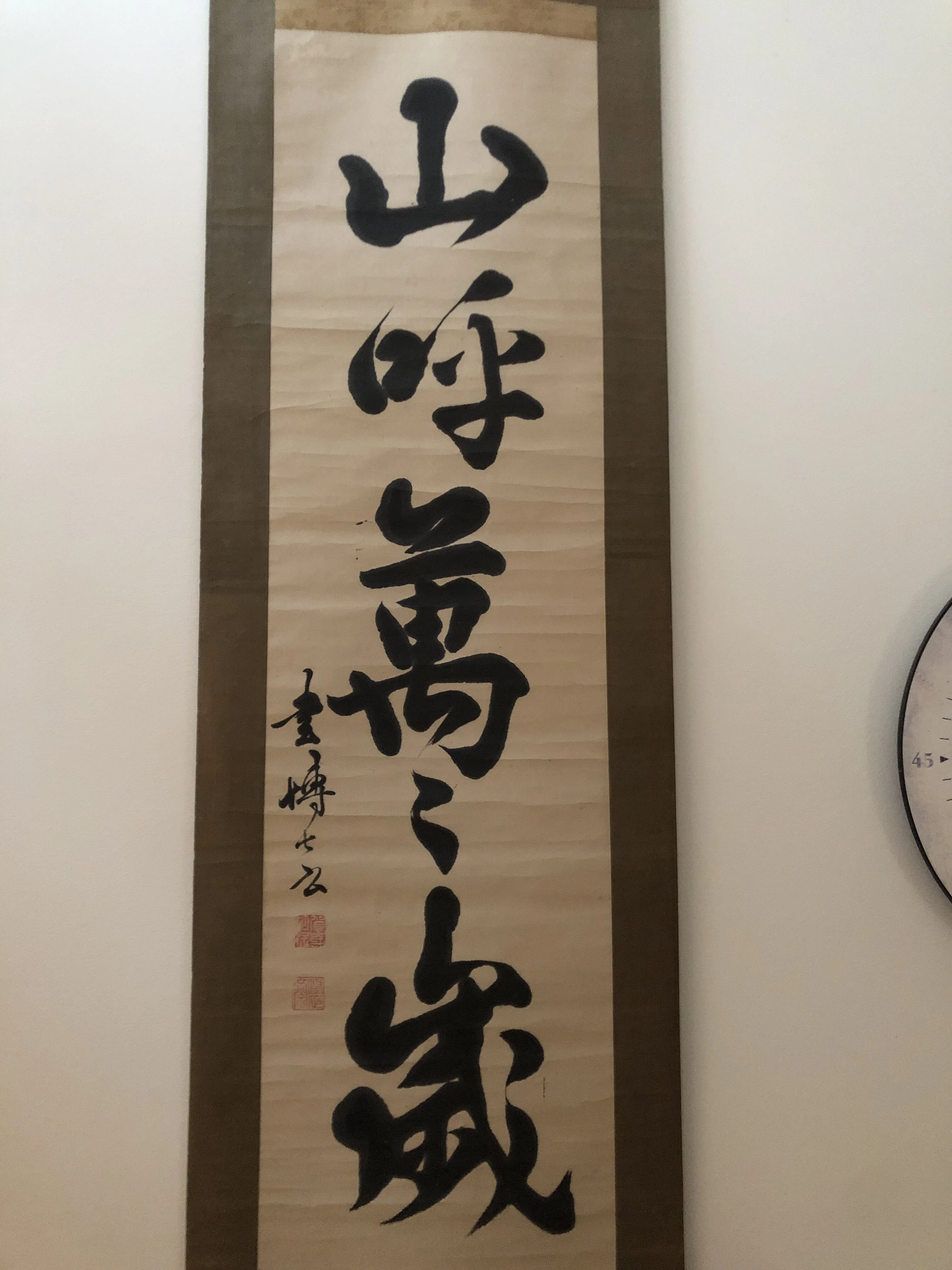
IMG_6109.webp
 
There's a similar scroll available here:


The saying dates back to (the Chinese) Emperor Wu in the Book of Han and was a popular motif for scrolls used in Japanese tea ceremonies.


However, please wait for the experts to confirm. :)
 
Thomas,
Wow, that sounds lovely. There is a good similarity between the two sets of characters. Interestingly, I was invited to participate in a tea ceremony with a teacher and her students whilst in Kyoto. I also grew up in a "mountains" area here in Australia. Nice memories, both.
Thank you.
Ted
 
Looking into it further, I have found this-


The phrase 山呼萬歲 (shān hū wàn suì) is a Chinese expression with deep historical and cultural significance. Let's break down the meaning of each character:
山 (shān)
Primarily means "mountain" or "hill"
Can also refer to anything resembling a mountain
呼 (hū)
In this context, it means "to shout" or "to call out loudly"
萬 (wàn)
Means "ten thousand" or figuratively "countless"
歲 (suì)
Means "years" or "age"

Combined Meaning
When these characters are put together, 山呼萬歲 (shān hū wàn suì) creates a powerful expression:

Literally, it means "mountains shouting ten thousand years"
Figuratively, it describes a thunderous, collective cheer of "Long live!" or "May you live for ten thousand years!"

Historical Context
This phrase has its roots in ancient Chinese imperial ceremonies:
It originated from a ritual where officials would prostrate themselves and shout praises to the emperor

The "mountain" (山) in this context symbolizes a large, impressive gathering of people.
The shouting (呼) of "ten thousand years" (萬歲) was a way to wish long life to the emperor.

Modern Usage
Today, 山呼萬歲 is used more broadly to describe:

An overwhelming show of support or enthusiasm
A massive, collective expression of acclaim or celebration
A powerful, unified response from a large crowd

While it retains its historical connotations, the phrase is now used in various contexts to describe any situation where there's an impressive, enthusiastic response or show of support, not necessarily limited to political settings.
 
When I read this thread, I am reminded of the Banzai charges Japanese soldiers made during WWII. Banzai means, "May the emperor live 10,000 years."
 
Banzai itself means 10,000 years. You may be thinking of 天皇陛下万歳. People use banzai today in many cheers at company events, weddings, drinking parties etc. without invoking the emperor.
 
Back
Top Bottom