- 14 Mar 2002
- 21,050
- 18,903
The right wing of the LDP must have fumed.
On Friday, Prime Minister Shigeru Ishiba pledged that Japan would continue to pursue peace while remaining mindful of the nation's "remorse" over the Second World War, marking the first time in more than ten years that a premier has used the word at the annual memorial for the war dead, held on the anniversary of Japan's surrender. His remarks were interpreted as a sign of his determination to ensure the war's lessons are not forgotten, and to hand down what he described as the "sorrowful" memories to younger generations as the number of surviving witnesses steadily declines.
Unlike some of his predecessors, however, Ishiba has decided not to issue a Cabinet-endorsed statement to coincide with the 15 August anniversary of the war's end. Previous prime ministers had done so on the 50th, 60th, and 70th anniversaries, but such declarations tend to draw close attention from neighbouring Asian countries that endured Japan's wartime aggression. Ishiba's choice, therefore, marks a clear shift in approach.

 mainichi.jp
To better understand the LDP's political battles over historical interpretation, I recommend Tobias Harris' excellent articles:

 observingjapan.substack.com

On Friday, Prime Minister Shigeru Ishiba pledged that Japan would continue to pursue peace while remaining mindful of the nation's "remorse" over the Second World War, marking the first time in more than ten years that a premier has used the word at the annual memorial for the war dead, held on the anniversary of Japan's surrender. His remarks were interpreted as a sign of his determination to ensure the war's lessons are not forgotten, and to hand down what he described as the "sorrowful" memories to younger generations as the number of surviving witnesses steadily declines.
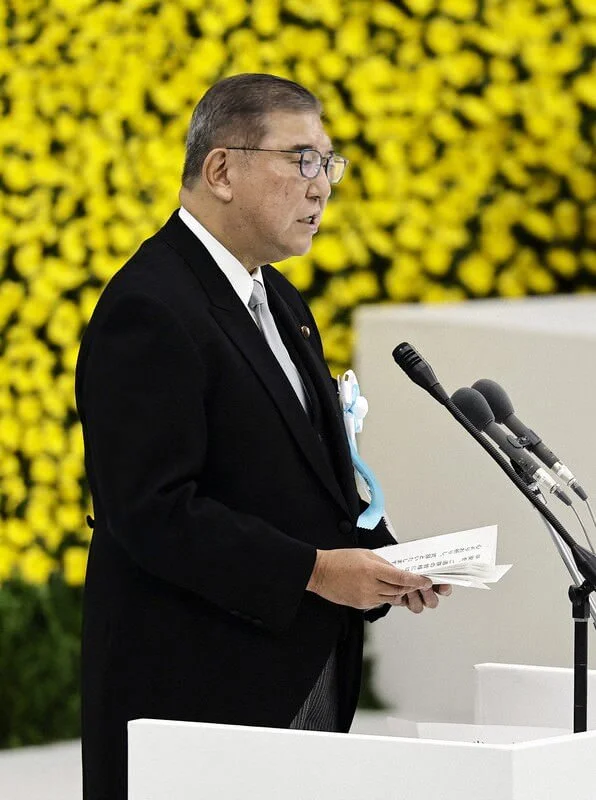
PM Ishiba delivers an address at a memorial ceremony for war dead in Tokyo on 15 August 2025, the 80th anniversary of Japan's surrender in WW II (photo credit: Kyodo)
Unlike some of his predecessors, however, Ishiba has decided not to issue a Cabinet-endorsed statement to coincide with the 15 August anniversary of the war's end. Previous prime ministers had done so on the 50th, 60th, and 70th anniversaries, but such declarations tend to draw close attention from neighbouring Asian countries that endured Japan's wartime aggression. Ishiba's choice, therefore, marks a clear shift in approach.
The last time a Japanese premier mentioned "remorse" at the memorial event was in 2012. The word was not used by Shinzo Abe, a conservative politician who led for approximately eight years from December 2012 and issued the 70th anniversary statement, a practice followed by his successors. Ishiba's grip on power has been significantly weakened due to his party's poor election results. He has faced calls from hawkish members of his party not to override the Abe statement that acknowledged Japan was a "challenger" to the global order but offered no new apology over the war. In this year's address, Ishiba did not directly mention Japan's wartime aggression and the suffering it caused across Asia, following the precedent set by his recent predecessors. A moment of silence was observed at noon, the same time 80 years ago when Emperor Hirohito declared his country's surrender in a radio broadcast.
Japan PM vows to pursue peace, be mindful of 'remorse' on WWII anniv. - The Mainichi
TOKYO (Kyodo) -- Prime Minister Shigeru Ishiba on Friday vowed to keep in mind Japan's
Ishiba recalled he was at a loss for words when Lee asked him if he knew what Japan did when it occupied Singapore during the war. Lee reminded Ishiba that even though the Japanese may forget what took place, the people of Singapore will never forget. Ishiba wrote that he took home from that experience the fact that even though the aggressor in war may forget as time passes, the victims will never forget. Because of his long interest in national security issues, Ishiba has sought to gain better insights into Japan's push to wage war all those decades ago.
To better understand the LDP's political battles over historical interpretation, I recommend Tobias Harris' excellent articles:
Behind Japan's political battles, a war over history
A guest essay from Daniel Sneider
observingjapan.substack.com