

Navigation
Install the app
How to install the app on iOS
Follow along with the video below to see how to install our site as a web app on your home screen.
Note: This feature may not be available in some browsers.
More options
Style variation
System
Light
Dark

You are using an out of date browser. It may not display this or other websites correctly.
You should upgrade or use an alternative browser.
You should upgrade or use an alternative browser.
Need a word or phrase translated?
- Thread starter Buntaro
- Start date

Eristy
後輩
- 28 Oct 2014
- 72
- 0
Hi, I have a problem understanding pretty much all that's going on on that picture.
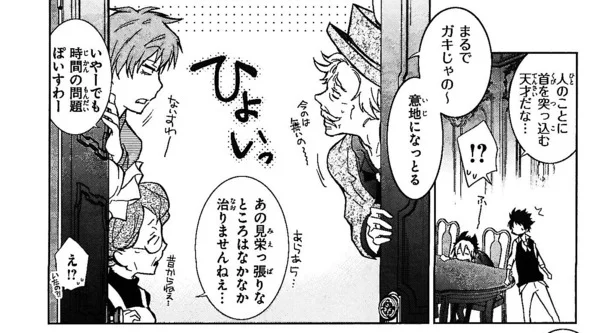
Here's some background information: Previously the two guys in the first frame were talking to a man, who is the owner and master of the house they are all in. The master was talking about some mistakes he made: he hid some secrets from his son. And when the dark haired boy, now in the right corner, confronted the master, he got up, said I'm sorry and left the room. The three people at the door are servants in the house, who apparently have been listetning to the conversation (Sorry for the sloppy explanation, I am not a native English speaker).
So, the things I am struggling with are:
1. Who speaks the first sentence 人のことに首を突っ込む... Is it someone from behind the door or the guy sitting at the table? Is it about the dark haired boy, who confronted the master of the house?
2. What does 今のは無いの mean? I have no clue.
3. In the sentence あの見栄っ張りなところはなかなか治りませんね, what does 見栄っ張り mean?
I will be grateful for any help.
Here's some background information: Previously the two guys in the first frame were talking to a man, who is the owner and master of the house they are all in. The master was talking about some mistakes he made: he hid some secrets from his son. And when the dark haired boy, now in the right corner, confronted the master, he got up, said I'm sorry and left the room. The three people at the door are servants in the house, who apparently have been listetning to the conversation (Sorry for the sloppy explanation, I am not a native English speaker).
So, the things I am struggling with are:
1. Who speaks the first sentence 人のことに首を突っ込む... Is it someone from behind the door or the guy sitting at the table? Is it about the dark haired boy, who confronted the master of the house?
2. What does 今のは無いの mean? I have no clue.
3. In the sentence あの見栄っ張りなところはなかなか治りませんね, what does 見栄っ張り mean?
I will be grateful for any help.

- 27 Apr 2014
- 940
- 243
1. The guy slumping at the table is being sarcastic at the standing one for ruining the atmosphere by sticking his nose where it doesn't belong.
2. Me neither
3. 見栄っ張り - Jisho.org
2. Me neither
3. 見栄っ張り - Jisho.org

- 22 Feb 2008
- 18,266
- 4,926
2)
今の refers to what the the sitting guy said, thus, it's something like "he shouldn't say such a thing".
今の refers to what the the sitting guy said, thus, it's something like "he shouldn't say such a thing".

- 22 Feb 2008
- 18,266
- 4,926
打撃陣の調子が最近上がってきてるわ makes sense?Hey there, having trouble with the 打撃陣上がってきてるわ。part. I first thought just meant that they're at bat, but with the game being over already and all, I really don't understand what they're actually talking about.
Thanks in advance!

DWolfs
先輩
- 21 Jan 2013
- 78
- 0
Yes, it does, thank you!打撃陣の調子が最近上がってきてるわ makes sense?
DWolfs
先輩
- 21 Jan 2013
- 78
- 0
Hey again, the main character here is talking about wanting to become a jazz musician, but I don't get the line そんだけなんだけど... well. I found some results online, but not really any explanations. I added the page down here in case it's necessary.
Thank you in advance!

Thank you in advance!
- 22 Feb 2008
- 18,266
- 4,926
それ in そんだけ(=それだけ) refers to his previous words ただ、中学の時からずっと好きで。本当に、ただ…大好きで……, thus, he says "I just love jazz / the only reason I want to become a jazz musician is just because I love jazz, but... (I want to become a jazz musician)".
DWolfs
先輩
- 21 Jan 2013
- 78
- 0
Ok that clears it up. Thanks, Toritoribe!それ in そんだけ(=それだけ) refers to his previous words ただ、中学の時からずっと好きで。本当に、ただ…大好きで……, thus, he says "I just love jazz / the only reason I want to become a jazz musician is just because I love jazz, but... (I want to become a jazz musician)".
- 22 Feb 2008
- 18,266
- 4,926
Context?
All I know is that the person is in Melbourne with her sister...
I have confused about what hantoshi buri refers too..
Does it mean they're back again to stay in Melbourne for 6 months or does it mean they came back to Melbourne after six months?
Is it six months or half year? what does that mean?
Just confused about that. thanks and hope to hear from you
I have confused about what hantoshi buri refers too..
Does it mean they're back again to stay in Melbourne for 6 months or does it mean they came back to Melbourne after six months?
Is it six months or half year? what does that mean?
Just confused about that. thanks and hope to hear from you
- 22 Feb 2008
- 18,266
- 4,926
The latter is correct.Does it mean they're back again to stay in Melbourne for 6 months or does it mean they came back to Melbourne after six months?
Aren't those the same?Is it six months or half year?
- 22 Feb 2008
- 18,266
- 4,926
同じところ refers to "one leg of the pants".
Irv Ferguson
Registered
- 21 Feb 2016
- 2
- 0
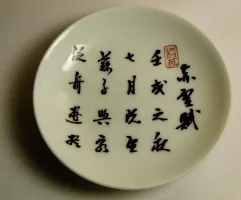
I have a decorative plate we would like to put on our wall, but.... we do not know what it is saying....could any one help? its very cool....but I understand traditions and we dont want to put something up if it is relating to the dead out of respect...Need a word or phrase translated? Feel free to ask.
Many bilingual people on this forum would be more than happy to help beginners with questions about Japanese vocabulary. Even grammar questions.
What word or phrase would anyone like translated into Japanese or English?
Attachments
- 22 Feb 2008
- 18,266
- 4,926
That's the beginning of a well-known Chinese poem 赤壁賦 Sekiheki no Fu(Chinese reading Chibifu) (Former) Ode to the Red Cliff written by 蘇軾 So Shoku/Su Shi.
壬成之秋,七月既望,蘇子與客泛舟游於(赤壁之下)
In the autumn of the year of the Yang Water Dog (1082C.E.), during the full moon of July on the lunar calendar, I, Su Shi, went boating with my guests (under the Red Cliff).
(The last four characters are omitted probably due to the lack of the space, so, to tell the truth, it doesn't make much sense, just like it ends with "traveled in" and the location is not mentioned at last.)
壬成之秋,七月既望,蘇子與客泛舟游於(赤壁之下)
In the autumn of the year of the Yang Water Dog (1082C.E.), during the full moon of July on the lunar calendar, I, Su Shi, went boating with my guests (under the Red Cliff).
(The last four characters are omitted probably due to the lack of the space, so, to tell the truth, it doesn't make much sense, just like it ends with "traveled in" and the location is not mentioned at last.)
Irv Ferguson
Registered
- 21 Feb 2016
- 2
- 0
if this message was for me, thank you so much for translating the Plate....that is cool... I can put a note near the plate as to what it means and Poem....thank you so much. Irv.That's the beginning of a well-known Chinese poem 赤壁賦 Sekiheki no Fu(Chinese reading Chibifu) (Former) Ode to the Red Cliff written by 蘇軾 So Shoku/Su Shi.
壬成之秋,七月既望,蘇子與客泛舟游於(赤壁之下)
In the autumn of the year of the Yang Water Dog (1082C.E.), during the full moon of July on the lunar calendar, I, Su Shi, went boating with my guests (under the Red Cliff).
(The last four characters are omitted probably due to the lack of the space, so, to tell the truth, it doesn't make much sense, just like it ends with "traveled in" and the location is not mentioned at last.)
DWolfs
先輩
- 21 Jan 2013
- 78
- 0
Hey there. There's this line "へでもねえや。" that the main character of something I'm reading, said after failing and contemplating over it for a while. I'm guessing it's something of an "Ah, who cares" kind of expression, but I'd just like to make sure where it comes from.
Thanks in advance.
Thanks in advance.

- 22 Feb 2008
- 18,266
- 4,926
The more detailed context is needed, but it seems to be the sound of her sitting down to me.
Similar threads


- Replies
- 11
- Views
- 115K