Need a word or phrase translated?

I saw this on a friend's facebook wall posted by his girlfriend:

はーい昨日私私の男と寝た女は正直に挙手
ちょっと話があるから面貸しな

Am I reading this wrong, or does it say he slept with someone else? I'm afraid to ask him upfront. I'm also not sure what 面貸し means.
面[つら]貸しな = 顔貸しな = こっち来い Come here!
 
I had spoken to a friend but was unsure of the translation. He only just got back to me now. The end result will give me some commission so I am thankful for your help. This is the last one I promise 😊


What did you mean by With the extra bit after it? Am i missing something
Just FYI : Number 3 (努力する者が尊重される) is also natural....although I am still not sure exactly what you are trying to say. :?
 
Two questions

1. 4:26, これまでの火力mobile suitsに~~~? what did they say after this?
2 right after 4:26.敵mobilesuits~~? What is the word they said that is translated as "Retreating", I know 後退 means retreat (I heard this in shingeki no kyojin lol), I guess there's another word for it?
 
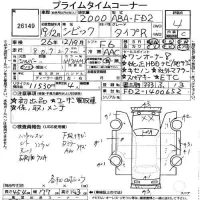
Auction sheet

Hello everyone, greetings from the small island of Antigua, I need some help translation a Japanese/kanji auction sheet for a car which I am importing into English. If someone could please assist me by translating the selling points and negative details of the car. The basic information is not needed, mainly the comments on the right and left and bottom of the sheet. Please find the image attached.

Civic Type R auction sheet.webp
 
1. これほどまでの火力、モビルスーツに持たすとはな
2. 離脱, I think.
 
Thanks, Im having a hard time hearing ridatsu in the part he said, but its probably because he said it so fast right?
 
Hi everyone,
I would like to get the characters of a japanese saying: "Two lovers walking in the rain under the same umbrella." Literally two wet swallows under one umbrella. I know the words are "Ai-ai kasa no nure tsubame", but I want to put it in characters on a painting. (Also, if anyone knows some other cool japanese saying about love, I'd like to hear about it!) Thank you in advance! :D
 
相合傘の濡れ燕

I've never heard this phrase. Where did you get it from? (That's aiaigasa, not aiaikasa, btw.)
 
Here's interesting Google search results.

Ai-ai kasa no nure tsubame 7hits
Aiai kasa no nure tsubame 0hit
Aiaikasa no nure tsubame 0hit

Ai-ai gasa no nure tsubame 0hit
Aiai gasa no nure tsubame 0hit
Aiaigasa no nure tsubame 1hit

相合傘の濡れ燕 1hit(this page in JREF)

I checked all other possible forms 相合傘の濡燕, 相合傘の濡れつばめ, 相合傘のぬれつばめ,,,,,あいあいがさのぬれつばめ on Google, but there is NO site where this "proverb" is written in Japanese. What does this result suggest?

Interestingly, the only site that has the correct reading "aiaigasa" says that "Aiaigasa no nure tsubame" is the same meaning as 一石二鳥 "Kill two birds with one stone".
http://www.lit.osaka-cu.ac.jp/UCRC/2006/ja/issue/pdf/pdf_zasshi06/08arimi.pdf
(pdf file)

FYI, I found several misreadings similar to "aiaigasa" in the book you mentioned...
 
Wow, thanks for all the research you did. I guess we can assume it's no real Japanese proverb then, or that it just doesn't mean what I thought it ment. I'll continue my search for a real one and thanks again!
 
@daphne : I think it suggests that you shouldn't trust a book that uses that awful "asian-y" font.

Not a proverb, but a very famous saying by the author Natsume Soseki , when asked by a student how to translate "I love you" (in a romantic sense) from English into Japanese. His very non-literal answer:
月が綺麗ですね (tsuki ga kirei desu ne).
 
Haha, I guess so.
That's a beautiful saying! I think I will use that for the painting, thank you very much!
 
咄嗟に脱出を始めたダルノスに、反応が僅かに遅れたカヤも走り始めた。だが俺は、いつもの慣習から、もう一度だけ戦場を振り返った。その瞬間ーー

I have a question about に particle in the following sentence. Is it shows here "comparison"? So is it correct to translate it as "To the Darnos who is started running instantly, Kaya who has reacted a bit slowly, begun to run too."
 
I think に is for listing, similar to と. (In addition, I feel that clause has a nuance of に続いて.)
 
Last edited:
What does he say like at 1:45, かしこやつは ? Dont think thats what he said, unless he meant kashikoi

Also at 4:23

道の無限の可能性だなんて、何の根拠もないむせぎ妄想

Not sure about the second part of the sentence I don't think I know all the wards he said
 
He clearly says かしこやつは.

未知の無限の可能性だなんて、何の根拠もない無責任な妄想を
 
Is there a difference in how one pronounces 未知 and 道 or this is just obvious by context? Now that you say it it makes sense, this is a new word for me though. But 道 no mugen would make sense to right, as in like a "road of infinite possibilities."
 
They have different pitch accents; 未知の (み\ち_の high-low-low) vs. 道の (み_ち/の low–low–high).
道の無限の可能性 doesn't make sense. A modifying clause/phrase, e.g. 未来の, これからの, お前たちが進むべき, is needed for 道. ("Road of infinite possibilities" means 無限の可能性の道, by the way.)
 
Hey folks,

Could I ask someone to clarify on the meaning of 眼先 in the phrase below:

眼先の事しか考えられない三流商人はひっこんでやがれ!

Couldn't find anything online to be certain of that specific bit but, if I'm not mistaken, 眼先の事しか考えられない as a whole seems to mean something like "short-sighted" (as in lack of foresight, not the medical term).

If context is needed, the speaker is shielding a noblewoman from slavers right as his country's in the middle of a crisis; so, him calling them short-sighted seemed to make sense as them kidnapping the woman would just worsen the overall situation for everyone.

Thanks for the input.
 
We would say "right in front of your noses".

That whole phrase could be translated figuratively with "short-sighted", but that is not the literal meaning of 目先
 
We would say "right in front of your noses".

That whole phrase could be translated figuratively with "short-sighted", but that is not the literal meaning of 目先

Ah, I see. Didn't remember 眼先 was the same as 目先. Is there any difference between those or is it just how you prefer to write it?
 
Thanks for the responseToritoribe, I have another listening question


0:52, what does he say 弁護はかり 勉強はかり, i cant really hear the word hes trying to say and i cant really tell by context either, I think he said bengo but that word was said pretty fast for me.

0:59 , この三百万の~~ what is said here? After does he say いっぷにつき? im not sure about the "ippu" part.

1:10 , whats the word the guy says? そんなこというなら、俺たちみんなこの船に折れるぞ not to sure about the verb but i think there trying to say they are all gonna leave if he keeps saying stuff like that.

235. 自分の胸はり?? Yeah just not too sure about this over all, also what does he say right after "something ならば"
 
Back
Top Bottom