

Navigation
Install the app
How to install the app on iOS
Follow along with the video below to see how to install our site as a web app on your home screen.
Note: This feature may not be available in some browsers.
More options
Style variation
System
Light
Dark

You are using an out of date browser. It may not display this or other websites correctly.
You should upgrade or use an alternative browser.
You should upgrade or use an alternative browser.
Need a word or phrase translated?
- Thread starter Buntaro
- Start date


- 22 Feb 2008
- 18,266
- 4,926
Those are the same. The former might sound a little bit formal than the latter.
letianchen
先輩
- 17 Jun 2013
- 560
- 25
is there a structure for nasai ja nai to ?
今すぐイチャイチャをやめて別けれなさいじゃないとタイホしちゃうぞ
or do i break it up as nasai(a command), ja nai to
If you don't stop making out now and disperse , then(じゃないと) you are under arrest
or
Unless you stop making out and disperse, you are under arrest
今すぐイチャイチャをやめて別けれなさいじゃないとタイホしちゃうぞ
or do i break it up as nasai(a command), ja nai to
If you don't stop making out now and disperse , then(じゃないと) you are under arrest
or
Unless you stop making out and disperse, you are under arrest

undrentide
Japa'n vagyok
- 18 Jan 2006
- 3,652
- 310
It's 別れなさい。じゃないと.
じゃないと=さもないと meaning "or", "otherwise"
じゃないと=さもないと meaning "or", "otherwise"

Teka Lanza
後輩
- 17 Sep 2013
- 1
- 0
Hello ! Can anyone help me with this phrase: " 私がそう作られたからじゃない" ?
Thank you
Thank you
- 22 Feb 2008
- 18,266
- 4,926
I guess it's probably because I was made to be so.

kazuchii
後輩
- 16 Sep 2013
- 2
- 0
What is the context? (It can have multiple meanings.)
It was background noise in a comic, so I am not sure of the context. I believe I transcribed it right...
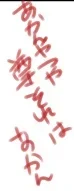
It refers to Mikoto, who is a rather...apathetic character?
I am not sure if this helps...
- 22 Feb 2008
- 18,266
- 4,926
やつ doesn't always refer to a person. It can be thing or event. The sentence seems to mean "Mikoto, you shouldn't do that" or along the line.
- 22 Feb 2008
- 18,266
- 4,926
Or rather, I mean, Instead or something along the line.
It's impossible to "list them all", since the nuance of the phrase differs depending on the situation. You should give us the context if you want to know the appropriate one. In fact, the initial translation was completely different from the correct one in your previous question, right?
It's impossible to "list them all", since the nuance of the phrase differs depending on the situation. You should give us the context if you want to know the appropriate one. In fact, the initial translation was completely different from the correct one in your previous question, right?
Or rather, I mean, Instead or something along the line.
It's impossible to "list them all", since the nuance of the phrase differs depending on the situation. You should give us the context if you want to know the appropriate one. In fact, the initial translation was completely different from the correct one in your previous question, right?
Umm... This question has nothing to do with my last question a few days ago. I'm not even on the same manga anymore. Anyway, here's the context:
The scene takes place at a crowded amusement park. A man has become angry with another man when he sees him with his arm around a woman, who happens to be the daughter of a Yakuza. The SFX occurs in a panel near the jealous man, who is well-built.
I hope that's detailed enough.
- 22 Feb 2008
- 18,266
- 4,926
I mean how crucial the context is in translating a phrase/sentence especially in Japanese which is a context-driven language, as you must be aware of in your previous question.
Is there only one phrase つか there? Are there any other phrases next to it?
Is there only one phrase つか there? Are there any other phrases next to it?
Last edited:
I mean how crucial the context is in translating a phrase/sentence especially in Japanese which is a context-driven language, as you must be aware of in your previous question.
Is there is only one phrase つか there? Are there any other phrases next to it?
Oh, ok. Sorry, I do realize that context is important, but I figured that the SFX would have no more than like 4 meanings. Anyway, I just reslized that I forgot a crucial piece of information. The men are bodyguards and the man is jealous because he thanks he could do a better job at guarding the woman.
There is no phrase near the SFX, although the SFX does occur twice. The last line before the SFX is: "It seems I need to have a word with him!" The manga has been translated, but the SFX hasn't.
- 22 Feb 2008
- 18,266
- 4,926
Ah, I see. Sorry, I misinterpreted the word "SFX". つかつか is an onomatopoeia to express a person is walking, often boldly, straight to the viewer/speaker. The single つか is mostly used especially for just one step.
letianchen
先輩
- 17 Jun 2013
- 560
- 25
はじけ飛ぶほど笑い合えた日も
大切に育てていけるように
とぎれとぎれの時を越えて
I heard this in the song, how do I interpret this part?
大切に育てていけるように
とぎれとぎれの時を越えて
I heard this in the song, how do I interpret this part?
Ah, I see. Sorry, I misinterpreted the word "SFX". つかつか is an onomatopoeia to express a person is walking, often boldly, straight to the viewer/speaker. The single つか is mostly used especially for just one step.
No problem. And thanks!
- 22 Feb 2008
- 18,266
- 4,926
はじけ飛ぶほど笑い合えた日も
大切に育てていけるように
とぎれとぎれの時を越えて
I heard this in the song, how do i interpret this part
Again (third or forth times?), you SHOULD give us the whole lyrics. 気持ちも and 日も are both the objects of 育てていける. Have you ever come across a phrase 気持ちを育てる?
ん is the n-euphonic change of a classical auxiliary verb む for presumption. It's close to あるであろうことを. (This might be needless to say, 望む is omitted at the end of the sentence.)我らの間に、国を越えた信頼と友情があらんことを
Could someone explain あらんこと here? あらん feels similar to ある, but feels somewhat more majestic. :?
letianchen
先輩
- 17 Jun 2013
- 560
- 25
Anime Lyrics dot Com - Kimi ni Todoke - Reaching You - Kimi ni Todoke - Anime
気持ちを育てる = bottle up feelings?
気持ちを育てる = bottle up feelings?
- 22 Feb 2008
- 18,266
- 4,926
That's almost contrary to the nuance the verb 育てる has.
- 5 May 2013
- 962
- 509
For what it's worth, SFX is a creative abbreviation of 'special effects', and in the context of manga means onomatopoeia written into the action, not the dialogue. (However, since dialogue sometimes occurs outside of bubbles, learners do sometimes mistake dialogue 'asides' for onomatopoeia, or vice versa.)"SFX". / onomatopoeia
letianchen
先輩
- 17 Jun 2013
- 560
- 25
Alright, thanks.

- 22 Feb 2008
- 18,266
- 4,926
What is the relation between you and the addressee? Do you want to say it in polite form or casual form? The translation differs depending on these and some other factors.
Similar threads


- Replies
- 11
- Views
- 115K