

Navigation
Install the app
How to install the app on iOS
Follow along with the video below to see how to install our site as a web app on your home screen.
Note: This feature may not be available in some browsers.
More options
Style variation
System
Light
Dark

You are using an out of date browser. It may not display this or other websites correctly.
You should upgrade or use an alternative browser.
You should upgrade or use an alternative browser.
Need a word or phrase translated?
- Thread starter Buntaro
- Start date

MrKanister
先輩
- 3 Aug 2012
- 56
- 0
How was I challenging you? :? I was simply wondering why it was a misconception as you said.Don't challenge a native speaker who has lived in Tokyo over 20 years. Judging from the questions you have been asking, your Japanese proficiency is nowhere near a native speker's.
I am well aware that my Japanese sucks. It's the reason why I am asking questions here. I never claimed nor even thought anything else.
Anyway, can someone please help me with my question above?
- 5 May 2013
- 962
- 509
At the very top of the wikipedia article you linked, it says of Standard Japanese "while it was based initially on the Tokyo dialect, the language of Japan's capital has since gone in its own direction to become one of Japan's many dialects".
In other words it was never -exactly- a dialect, it was a committee-standardized language -based- on a dialect that has since independently evolved making it even less like that dialect.
In other words it was never -exactly- a dialect, it was a committee-standardized language -based- on a dialect that has since independently evolved making it even less like that dialect.
Hey guys! I'm new here and have been trying to self-teach myself Japanese, but have been having difficulty understanding some of the more complexly phrased sentences, and was hoping someone could help me out. This is the sentence:
ただでさえ病がちだったところへこの痛手は大きく、それ以来床に伏せるようになった。
This is my attempted translation of it: He became sickly and his wounds soon worsened. Since then, he has been bedridden.
Can someone check on it??
What I do want to confirm is if ところへ is being used as a cause and effect marker, for linking his worsening wounds with him becoming sickly in condition. Or is it a simple "He got sickly, and then his wounds worsened" with no implied correlation.
Thanks a bunch in advance!
ただでさえ病がちだったところへこの痛手は大きく、それ以来床に伏せるようになった。
This is my attempted translation of it: He became sickly and his wounds soon worsened. Since then, he has been bedridden.
Can someone check on it??
What I do want to confirm is if ところへ is being used as a cause and effect marker, for linking his worsening wounds with him becoming sickly in condition. Or is it a simple "He got sickly, and then his wounds worsened" with no implied correlation.
Thanks a bunch in advance!
Xした / しているところへY = Y happened (unexpectedly) while X was happening.Hey guys! I'm new here and have been trying to self-teach myself Japanese, but have been having difficulty understanding some of the more complexly phrased sentences, and was hoping someone could help me out. This is the sentence:
ただでさえ病がちだったところへこの痛手は大きく、それ以来床に伏せるようになった。
This is my attempted translation of it: He became sickly and his wounds soon worsened. Since then, he has been bedridden.
Can someone check on it??
What I do want to confirm is if ところへ is being used as a cause and effect marker, for linking his worsening wounds with him becoming sickly in condition. Or is it a simple "He got sickly, and then his wounds worsened" with no implied correlation.
There is no cause and effect relationship between X and Y. It just signifies that a new event/situation followed while another event/situation was in progress.
- 5 May 2013
- 962
- 509
ただでさえ病がちだったところへこの痛手は大きく、それ以来床に伏せるようになった。
This reads to me like, "He had been sickly even beforehand, and then he received this terrible wound. Since then he has been bedridden."
In addition to masaeguさん's observation, this sentence also has no indication of 'became' sickly, it just says he -was- sickly. For all we know from this sentence, this could have been since birth, but at any rate, we certainly know that being sickly was the (relatively constant) state he was in before the injury.
Hmm, for the sake of reducing confusion, a more literal reading is, "He was sickly at the best of times, before this large serious injury; since then, he has been laid out flat on the floor" (or possibly bed as your original translation suggested, but anyway, he's incapacitated. I think 床に伏せる usually means laid out on the floor, but perhaps not in this case.)
Ahh that clears up a bunch of questions. Thanks to masaegu and Chris! It was mentioned that he had sustained an injury in the previous sentence, "あの人は戦いで傷を負っていた" and now that I look at it, It makes a lot more sense how his sickly disposition would have exasperated the wound.
And to Chris, the reason I assumed bedridden was because of the ように. I translated it as something like "He had entered a state where it was as if he was lying on the floor" -> bedridden. Or am i jumping to too big a conclusion with just this statement alone?
And to Chris, the reason I assumed bedridden was because of the ように. I translated it as something like "He had entered a state where it was as if he was lying on the floor" -> bedridden. Or am i jumping to too big a conclusion with just this statement alone?

- 22 Feb 2008
- 18,266
- 4,926
The kanji is the same, but there are two meanings/readings in this idiom; 床[ゆか](= floor)に伏せる and 床[とこ](= bed)に伏せる(the kanji 臥せる is also used in this meaning). The latter one is used here.
That ように doesn't mean "like / as if". It's ようになる "to become".
That ように doesn't mean "like / as if". It's ようになる "to become".

I Am A Baka
先輩
- 5 Apr 2012
- 69
- 3
This is kind of a basic question, but I'm not sure if 崖 is correct here (I used a dictionary to find the word 'cliff')
A: どこにいますか。
B: 崖にいます。
I would have checked with my sensei, but he wasn't here today.
Thanks!
EDIT: Oh, I might also add that the reason person B is at a cliff is because he/she is going bungee jumping.
A: どこにいますか。
B: 崖にいます。
I would have checked with my sensei, but he wasn't here today.
Thanks!
EDIT: Oh, I might also add that the reason person B is at a cliff is because he/she is going bungee jumping.
That is correct. We might say 崖の上 more often, though.This is kind of a basic question, but I'm not sure if 崖 is correct here (I used a dictionary to find the word 'cliff')
A: どこにいますか。
B: 崖にいます。
I would have checked with my sensei, but he wasn't here today.
Thanks!
EDIT: Oh, I might also add that the reason person B is at a cliff is because he/she is going bungee jumping.
I came across this phrase 教えてもくれなかった and wanted to confirm its meaning. I'm assuming もくれなかった is the past negative of the adj. 目礼, so putting the two together, would the phrase mean something along the lines of "was not courteously informed"?
Can someone confirm on this? Thanks in advance.
Can someone confirm on this? Thanks in advance.
- 22 Feb 2008
- 18,266
- 4,926
目礼 is not an adjective but a noun or the stem of a -suru verb. EVEN IF it were an i-adjective or a na-adjective, the negative past forms should be もくれくなかった and もくれいではなかった, respectively. 教えてもくれなかった is 教えてくれなかった + a perticle も, which means "even" here.
(FYI, there is NO i-adjective that ends in "ei" in Japanese.)
(FYI, there is NO i-adjective that ends in "ei" in Japanese.)
MrKanister
先輩
- 3 Aug 2012
- 56
- 0
What does 頭が回んないや mean?
It seems to be equivalent to 頭が回らない
A woman says this shortly after waking up after having fainted.
Does it mean "my head has stopped spinning" / "My head is clear now"?
To me it seems to be something negative. "I can't turn my head" maybe?
It seems to be equivalent to 頭が回らない
A woman says this shortly after waking up after having fainted.
Does it mean "my head has stopped spinning" / "My head is clear now"?
To me it seems to be something negative. "I can't turn my head" maybe?
- 22 Feb 2008
- 18,266
- 4,926
Yes, 頭が回んない is a colloquial form of an idiom 頭が回らない, which means "one's head is unclear (literally, one's head doesn't work well)".
blackcat24
後輩
- 1 Jul 2013
- 1
- 0
Translation of text on a statue
Hello
I hope I am posting in the correct place. Can someone translate a text on a statue? Pictures attached.
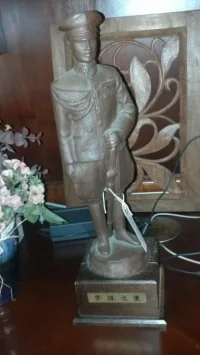
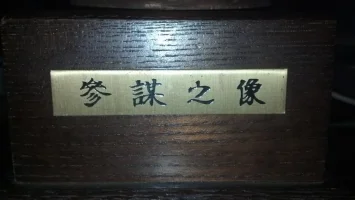
Hello
I hope I am posting in the correct place. Can someone translate a text on a statue? Pictures attached.
Hello
I hope I am posting in the correct place. Can someone translate a text on a statue? Pictures attached.
It says 参謀之像, which means "Statue of the officer / adviser / counselor".
- 3 Jan 2012
- 842
- 9
畳は、自由に動かせる"家具"でしたから、いろいろ組み合わせたり、たたんだりして、一つの部屋を、お客さんが来たときは客間に、楽しくおしゃべりするときは居間に、昼は仕事部屋にと使い分けていました。
What is the purpose of を doing here? I've seen many times this particle appears like this in long sentences. And how does ''一つの部屋を'' translated?
What is the purpose of を doing here? I've seen many times this particle appears like this in long sentences. And how does ''一つの部屋を'' translated?
- 5 May 2013
- 962
- 509
In this case, 一つの部屋 is 'one room' and your sentence structure is,
(some description)一つの部屋を、Aに、Bに、Cにと使い分けていました
Basically, 'one room is divided into this use, that use, and the other use'.
Whenever you see を and don't know why, you have to look later in the sentence and find the verb that it matches, although in a sentence with this many clauses it can be difficult. The comma does often indicate that you should look further along than the next clause, though, so that's a clue in this case. Even in long sentences, を still marks a direct object that is connected to a particular verb just as in simple sentences. Understand which verb and you should understand the meaning.
(some description)一つの部屋を、Aに、Bに、Cにと使い分けていました
Basically, 'one room is divided into this use, that use, and the other use'.
Whenever you see を and don't know why, you have to look later in the sentence and find the verb that it matches, although in a sentence with this many clauses it can be difficult. The comma does often indicate that you should look further along than the next clause, though, so that's a clue in this case. Even in long sentences, を still marks a direct object that is connected to a particular verb just as in simple sentences. Understand which verb and you should understand the meaning.
- 3 Jan 2012
- 842
- 9
Um, that's clear. Thanks!
Precisely. Not that we consciously "shorten" だろう to ろう, though. ろう or just ろ is the way it comes out of our mouths when speaking colloquially. The shortest form ろ has been pretty common in the recent years, especially among male speakers.I couldn't find anything on あったろう. Is it a shortened version of あっただろう?
Ohhh thanks masaegu! It certainly does feel more natural just using ろ. Pronouncing だ after った gets me tongue-tied. It just sounds like ったた instead of っただ if i don't take a slight pause. Might just be because my tongue isn't well versed in pronouncing japanese yet.
I also found a sentence that used 申し訳 in a very interesting way. Until now, I've only seen it used as 申し訳ない, and its polite form.
それから申し訳程度のパンとスープで食事を済ませ、
"And then (I) finished a meal with a forgivingly small amount of bread and soup,..."
Can someone double check my translation? I'm assuming 申し訳程度 means something like bare minimum.
EDIT: Nvm, I got it.
I also found a sentence that used 申し訳 in a very interesting way. Until now, I've only seen it used as 申し訳ない, and its polite form.
それから申し訳程度のパンとスープで食事を済ませ、
"And then (I) finished a meal with a forgivingly small amount of bread and soup,..."
Can someone double check my translation? I'm assuming 申し訳程度 means something like bare minimum.
EDIT: Nvm, I got it.
Last edited:
- 22 Feb 2008
- 18,266
- 4,926
Indeed the meanings of ろう and だろう are the same here, but ろう is not a shortened version of だろう. In fact, the present form あるだろう is never shortened to あるろう. (あろう, which is an an euphonic change of あらむ, is used, instead.) あったろう is an euphonic change of ありたらむ(the conclusive form of a classical verb あり + the imperfective form of a classical auxiliary verb for the perfective たり + the conclusive form of a classical auxiliary verb for conjecture む).I couldn't find anything on あったろう. Is it a shortened version of あっただろう?
Hello.
I'm having difficulty translating the sentence:回りあってるのは、誰と誰かな? Can someone please give a hint as what does るのは mean here?
I think it translates something like: "I wonder who (of rotating objects) met whom?"
Nevermind. I already got the answer.
I'm having difficulty translating the sentence:回りあってるのは、誰と誰かな? Can someone please give a hint as what does るのは mean here?
I think it translates something like: "I wonder who (of rotating objects) met whom?"
Nevermind. I already got the answer.
Last edited:
Similar threads


- Replies
- 11
- Views
- 115K