

Navigation
Install the app
How to install the app on iOS
Follow along with the video below to see how to install our site as a web app on your home screen.
Note: This feature may not be available in some browsers.
More options
Style variation
System
Light
Dark

You are using an out of date browser. It may not display this or other websites correctly.
You should upgrade or use an alternative browser.
You should upgrade or use an alternative browser.
Need a word or phrase translated?
- Thread starter Buntaro
- Start date

Elizabeth
先輩
- 22 Apr 2003
- 9,839
- 135
What are you asking, if 失った風?? is the same as 失われた風 ??失った風?
What are you asking, if 失った風?? is the same as 失われた風 ??
Sorry. I meant to put space before the question marks. I know what this (失った風) means but im not sure if it is correct. I need the translation of 'The lost wind'. I'm thinking of getting a tattoo of it done on my forearm. And by the way, do you think a tattoo of just '風' would be odd? I know it means wind but does the word have any awkward meaning? I just don't want to find out any other meaning after getting the ink.
Last edited:
Elizabeth
先輩
- 22 Apr 2003
- 9,839
- 135
It isn't wrong exactly, just confusing....is this related to the game Lostwinds or to the song (失われた風景) or what ?Sorry. I meant to put space before the question marks. I know what this (失った風) means but im not sure if it is correct. I need the translation of 'The lost wind'. I'm thinking of getting a tattoo of it done on my forearm. And by the way, do you think a tattoo of just '風' would be odd? I know it means wind but does the word have any awkward meaning? I just don't want to find out any other meaning after getting the ink.
失った風 is possible, grammatically correct usage; however, it's pragmatically hard to imagine.
Last edited:
It isn't wrong exactly, just confusing....is this related to the game Lostwinds or to the song (失われた風景) or what ?
失った風 is possible, grammatically correct usage; however, it's pragmatically hard to imagine.
No its not related to any of those. The word 'wind' has a special meaning to me.
Do you think just '風' would better for a chest tattoo? I just need to make sure before getting it done.
Thanks
Elizabeth
先輩
- 22 Apr 2003
- 9,839
- 135
風 fu (style) /kaze (wind or breeze) I don't have an issue with as a tattoo, the image is a common enough one that the artist shouldn't screw around....but then I am not sure exactly what you are trying to translate it for either....No its not related to any of those. The word 'wind' has a special meaning to me.
Do you think just '風' would better for a chest tattoo? I just need to make sure before getting it done.
Thanks

- 15 Mar 2002
- 16,758
- 2,298
No its not related to any of those. The word 'wind' has a special meaning to me.
Then why not get "Wind" tattooed on your chest?
Which "wind" do you mean, by the way? The rapid movement of air? Like winding your watch? An athlete becoming winded?
Then why not get "Wind" tattooed on your chest?
Which "wind" do you mean, by the way? The rapid movement of air? Like winding your watch? An athlete becoming winded?
Yes the rapid movement. I want to get it done in kanji because I like
Japanese and I'm interested in the culture. And besides, '風' looks better then 'wind'

Rei Yahya
ぺらぺらになりたい生徒
- 17 Sep 2011
- 217
- 0
Recently I heard someone's phone blare a Japanese text tone, and it said: ただいま。留守にしています。メセージをおねがいします。
At first I'd think it means something like 'I'm out, leave a message' but I don't get why tadaima would be used considering I've learned it as 'I'm home' or an 'I'm back'.
At first I'd think it means something like 'I'm out, leave a message' but I don't get why tadaima would be used considering I've learned it as 'I'm home' or an 'I'm back'.

- 22 Feb 2008
- 18,266
- 4,926
ただいま、留守にしています。メッセージをおねがいします。
I'm out now.
I'm out now.
ただいま【只今】の英語・英訳 - 和英辞書 - goo辞書ただいま
1〔現在〕now; at present
ただ今の時刻は12時15分前です
It is now a quarter to twelve.
サーヴァントである私が士郎を襲い、
あなたは抵抗できなかった...
それで、いいでしょう?
To be clearer, サーヴァント is "Servant", meant as in a job that someone has, and 士郎 is a guy named Shirou. I get the general meaning, but a translation from someone more expert in japanese than me would be nice.
Also, what's with that "desu" in the middle of the first part?
あなたは抵抗できなかった...
それで、いいでしょう?
To be clearer, サーヴァント is "Servant", meant as in a job that someone has, and 士郎 is a guy named Shirou. I get the general meaning, but a translation from someone more expert in japanese than me would be nice.
Also, what's with that "desu" in the middle of the first part?
Alethiar
In some formal contexts and in writing you can see である used like that, in which case it usually has the same meaning as の
サーヴァントである私が士郎を襲い、 = サーヴァントの私が士郎を襲い、 = I, the servant, attacked Shirou,
あなたは抵抗できなった。。。 And you weren't able to fight back...
それで、いいでしょう? Isn't that great? (rhetorical..)
In some formal contexts and in writing you can see である used like that, in which case it usually has the same meaning as の
サーヴァントである私が士郎を襲い、 = サーヴァントの私が士郎を襲い、 = I, the servant, attacked Shirou,
あなたは抵抗できなった。。。 And you weren't able to fight back...
それで、いいでしょう? Isn't that great? (rhetorical..)
- 22 Feb 2008
- 18,266
- 4,926
それで、いいでしょう? (not それって、いいでしょう?) is more likely saying that the addressee should accept that story, something like "It's just the story like that...", often connoting "there's another actual story behind it, but don't pry anymore".
Elizabeth
先輩
- 22 Apr 2003
- 9,839
- 135
So you could put emphasis to the statement with a conjunction qualifier like "xxx nara" ? "Sore nara" or "Daijoubu nara" ...それで、いいでしょう? (not それって、いいでしょう?) is more likely saying that the addressee should accept that story, something like "It's just the story like that...", often connoting "there's another actual story behind it, but don't pry anymore".
Rei Yahya
ぺらぺらになりたい生徒
- 17 Sep 2011
- 217
- 0
ありがとうございました!
- 22 Feb 2008
- 18,266
- 4,926
それなら is used when the speaker denies the addressee's previous interpretation and gives his/her new idea. 大丈夫なら doesn't make sense here. 私が士郎を襲い、あなたは抵抗できなかった。大丈夫ならいいでしょう??? The story is completely changed. Thus, the answer is no. The speaker basically says "my explanation should be accepted", as I wrote previously.So you could put emphasis to the statement with a conjunction qualifier like "xxx nara" ? "Sore nara" or "Daijoubu nara" ...
- 10 Dec 2012
- 8
- 0
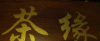
Hello. Please, don't hold against me if I'm sending you two mandarin characters from my tea tray. The first one is, of course, 'tea' (and it's written in the kanji same) but I can't really figure out the second one. If you could read it for me (and explaining the radical on the left, I've seen it a few times in other words) I would be very grateful. Thank you!
- 22 Feb 2008
- 18,266
- 4,926
Very close, but it's the traditional form or simplified Chinese of 縁, which is written in semi-cursive style. I can't find semi-cursive 縁, but hope the following picture makes sense.
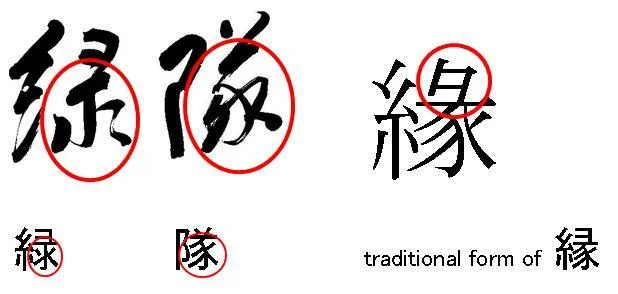
The radical is 糸, as in tokkyo-san's post.(and explaining the radical on the left, I've seen it a few times in other words)
- 10 Dec 2012
- 8
- 0
Thank you! Hmph... so the radical on the left actually looks like this ナス窶ヲ and that would mean 'thread', 'string'? Semi-cursive style. And with the second one which can be 窶ーツ ('edge'?) or 窶氾 ('green')... The 'green tea' is probably accurate considering this is a chinese style tea tray (ツ工窶「v窶卮?
Hello. I'd like some help with pronunciation instead of translation. Thus far all i've studied is hiragana and the opening chapters of katakana. Could someone please share a rule with me in regards to the way certain vowels are pronounced when next to one another. For example the 'e' in tsukue. It sounds strange to me unless u don't pronounce the 'e'. Does it sound like tsuku or tsuku-e ? Don't intend to waste time on something so basic but
i can't find the pronunciation anywhere. Ty (also my apologies if i asked in the wrong thread)
i can't find the pronunciation anywhere. Ty (also my apologies if i asked in the wrong thread)
Similar threads


- Replies
- 11
- Views
- 115K