Need a word or phrase translated?

Hello, glad to see you people helping others. Can you help me with these: "small steps" as in taking small steps toward the solutions (as in taking a 1000 miles journey one small step by one) and "diagram" as in scheme, a chart, making a plan on paper. I hope there is an one kanji character for the first and one for the second one. Thank you!
 
Don't think you're going to have much luck with a single kanji for "small steps".
小さな一歩 for "one small step" or 一歩ずつ for "one step at a time", perhaps?

図 is diagram (drawing, figure, etc).
 
There's a line from the anime "Vividred Operation" that I've hit a brick wall in trying to translate. The line is "oshide ga hiri hiri suru". I understand the "hiri hiri suru" and I'm fairly sure the "ga" is meant as a particle but "oshide" eludes me. The subtitles translate it as "My bottom hurts" but as far as I've found "oshide" does not translate to bottom or buttocks. I thought maybe she was saying "oshiri" but if she is then she's pronouncing it very strangely.

If you'd like to hear the line there's a link below. It occurs at 4:28.

Crunchyroll - Watch Vividred Operation Episode 4 - Promise

This is steadily driving me crazy so any help is greatly appreciated. 🙂
 
There's a line from the anime "Vividred Operation" that I've hit a brick wall in trying to translate. The line is "oshide ga hiri hiri suru". I understand the "hiri hiri suru" and I'm fairly sure the "ga" is meant as a particle but "oshide" eludes me. The subtitles translate it as "My bottom hurts" but as far as I've found "oshide" does not translate to bottom or buttocks. I thought maybe she was saying "oshiri" but if she is then she's pronouncing it very strangely.

If you'd like to hear the line there's a link below. It occurs at 4:28.

Crunchyroll - Watch Vividred Operation Episode 4 - Promise

This is steadily driving me crazy so any help is greatly appreciated. 🙂

That to me was a rather clear-cut "oshiri ga hiri hiri suru." It's pronounced fine (as you would expect). Listen again.

This has happened to me before though - it sounds like one character is just off. But you just listen again and again until you can finally hear what it's meant to be :L
 
This has happened to me before though - it sounds like one character is just off. But you just listen again and again until you can finally hear what it's meant to be :L

I think I can hear the "oshiri" now but I'd swear there's something between it and the "ga".

Maybe I'm just hearing things. Or trying to listen too hard. :?

Thank you for the help! 😄
 
I was looking through Iphone aps in Japanese and found こちらの楽曲には全てボーカロイド(ヤマハが開発した音声合成技術)が使用されております。

I had never seen subete used in this word order and it has confused me quite a lot.

I think the sentence is translated as these tunes use only Vocalo (Speech Synthesis Technology Developed by Yamaha)

Is this correct? I will look it up in my grammars now but if anyone has any input that would be great.
 
I think I can hear the "oshiri" now but I'd swear there's something between it and the "ga".

Maybe I'm just hearing things. Or trying to listen too hard. :?

Thank you for the help! 😄

Lol. I listened to it over and over again, with headphones even this time, and heard nothing different to what I heard the first time.

But I wanted to make sure, so I took the liberty of finding proof and found a video of the scene being played over and over again for a minute! (Haha! Nice! xD) And the title?

【ビビッド】お尻がひりひりするだけの動画


It seems you were trying too hard. Well now you know :)
 
Last edited:
I think I can hear the "oshiri" now but I'd swear there's something between it and the "ga".

Maybe I'm just hearing things. Or trying to listen too hard. :?

Thank you for the help! 🤩
You heard 鼻濁音 "nasal consonant が" maybe?

ファイル:Nasal consonant of Japanese.ogg - Wikipedia


Could you point me to a grammatical explanation of this point online please? Thanks for replying so quickly

こちらの楽曲には全てボーカロイドが使用されております。 = 全てのこちらの楽曲にはボーカロイドが使用されております。


これらの本はすべて読んだ
I have read all these books.

光るものすべて金ならず
((諺))All that glitters is not gold.
すべて【凡て】の英語・英訳 - 和英辞書 - goo辞書
 
I'm still looking at apps and saw this at https://itunes.apple.com/jp/app/zhe-xin-yin-chun/id500386659?mt=8

このアプリは音楽コンテストコミュニティ「クレオフーガ」で開催された第二回スマートフォン着信音コンテストの春夏秋冬部門に応募された楽曲が収録されています。

I was thrown off by how to translate に応募された楽曲が収録されています。 but came up with the following:

This App records music that was selected in second smart phone ring tone contest's four season section which was organised by online music contest community creofuga.

Any help would be much appreciated
 
Thank you! You helped me a lot! "Little steps" is more of an expresion so I hoped there would be something like one character. But here I see the character for 小 small 一 one 歩 step but I still have to figure out the use for さな. I have to learn this, I hope a few years might get me there. :) Does 小一歩ずつ means 'one small step at a time' and how do you write different kanji for step and steps?
 
Hello everyone.

I need someone to help me type out the characters from the following document:
dropbox.com/s/1l99kqj41tpd92y/PCo Japanese menus.doc

As I need to copy paste them for my website. I have found some of them but I am struggling a lot...

Many thanks.
 
Thank you! You helped me a lot! "Little steps" is more of an expresion so I hoped there would be something like one character. But here I see the character for 小 small 一 one 歩 step but I still have to figure out the use for さな. I have to learn this, I hope a few years might get me there. :) Does 小一歩ずつ means 'one small step at a time' and how do you write different kanji for step and steps?

Actually, just a few lessons from a beginners textbook should do the trick.

(Learning kanji does not equal learning Japanese).
 
Thank you

Then, that's 軽のです, maybe?
The first picture is a quotation from a poem "Tabibito kaerazu" Traveler never returned composed by Nishiwaki Junzaburō. It's too long and poetry is difficult to translate. The second and last one are written in kanbun, i.e. (Classical) Chinese. It's also difficult.

Thank you very much, my good friend, this has been of great help.
I even had the chance to know about Nishiwaki Junzaburō's life and work: amazing man he was! :-)
 
この造本でこの価格とはどういうことか。

I am kind of grasping the meaning.... Does this mean " In this book production/ produced book? what meaning does the price have?" But I really need an exact translation - please help!
 
この造本でこの価格とはどういうことか。

I am kind of grasping the meaning.... Does this mean " In this book production/ produced book? what meaning does the price have?" But I really need an exact translation - please help!

The speaker is remarking on such a well-made book being offered for such a low price. Unfortunately, you have to infer "well-made" and "low" from the context, which can make it sort of hard for you.
 
I'm still looking at apps and saw this at https://itunes.apple.com/jp/app/zhe-xin-yin-chun/id500386659?mt=8

このアプリは音楽コンテストコミュニティ「クレオフーガ」で開催された第二回スマートフォン着信音コンテストの春夏秋冬部門に応募された楽曲が収録されています。

I was thrown off by how to translate に応募された楽曲が収録されています。 but came up with the following:

This App records music that was selected in second smart phone ring tone contest's four season section which was organised by online music contest community creofuga.

Any help would be much appreciated
応募される means "to be entered into (the contest)", not "to be selected", and 収録 would be more likely "to contain/include" in this case.
 
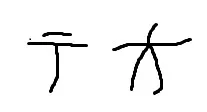
Hello everybody, my name is Adam, I'm from Brazil and I have a lot respect for japanese culture, but I don't know anything about japanese language. I saw these two "kanjis" (I don't even know if this is a kanji) and I want to know the meaning:
It's something like this:

janji.webp

PS: Yes, I did this on paint, I'm sorry. 😊
 
Can you please help me understand the bold parts?

お前ら… 伸二がこれから どうなるかを見せたるで~っ!

チンピラが殺される様をよぉく見さらせやぁ~!


A crime boss, who has some kind of dialect says this to his underlings. I think he wants to instill fear into them by showing how Shiniji gets killed.
I don't really get the bold parts, which I assume are conjugation + gobi. What would be the meaning/standard Japanese?


BTW, you just thank people only IN ADVANCE also in this case, AS USUAL?
Sorry if I seemed impolite, but I thought thanking in advance has the advantage of not making additional posts that don't contain information and that might clutter up this thread. The "as usual" I added because I've asked several questions here in the past 12 months or so and I have pretty much always gotten helpful replies, as far as I recall.
Anyway, then let me thank you here for your help from earlier. Thank you very much, Toritoribe! :)
 
Can you please help me understand the bold parts?

お前ら… 伸二がこれから どうなるかを見せたるで~っ!

チンピラが殺される様をよぉく見さらせやぁ~!


A crime boss, who has some kind of dialect says this to his underlings. I think he wants to instill fear into them by showing how Shiniji gets killed.
I don't really get the bold parts, which I assume are conjugation + gobi. What would be the meaning/standard Japanese?
見せてやるぜ makes sense for the first one?

さらす is a rather rude Kansai dialect for する. Unlike する, it can be used only for other person's action, though. さらせ is the imperative form, so 見さらせやぁ~ is close to 見とけ(=見ておけ)よ in this case.


Sorry if my words sound sarcastic.:p I just want to know if my answers make sense or not.:)
 
Last edited:
見せてやるぜ makes sense for the first one?

さらす is a rather rude Kansai dialect for する. Unlike する, it can be used only for other person's action, though. さらせ is the imperial form, so 見さらせやぁ~ is close to 見とけ(=見ておけ)よ in this case.
That makes sense! Thank you! 👍
 
Back
Top Bottom