Need a word or phrase translated?

Hello, here's a sentence I took from a game, but there are two things that I can't seem to find anywhere:

祈りを紡ぎ、クリスタルを輝かせし者
その生涯を捧げ、クリスタルに嫁ぎし者

紡ぐ means to spin or to make yarn, so I'm not sure how it relates to 祈り.
クリスタルに嫁ぎし, I guess this means something like adopted by? The topic is 巫女 by the way.


Thank you in advance.
 
紡ぐ can also mean "to do things continuously/constantly". It's from an action "to spin", of course.

the one married with the crystal


Those are both metaphorical expressions.
 
Ok I understand the meaning of 紡ぐ now, thank you. This is the first time I encountered such figurative speech, still used to taking everything too literally. :p

But can you tell me what the ぎし in 嫁ぎし (とつぎし) means? I tought the verb was derived from とつぐ?
 
「し」 is the attributive form of the past-tense auxiliary verb 「き」.

~~~し者 = the one who did ~~~

クリスタルに嫁ぎし者 = the one who married クリスタル
 
Last edited:
Thank you for your reply, masaegu. I understand the phrase completely now

Tthe past-tense auxiliary verb 「す」, is this possibly something that comes from classical Japanese?
 
The past-tense auxiliary verb 「す」, is this possibly something that comes from classical Japanese?
I made a mistake in my last post. For some reason, I said 「す」 but it is 「き」. And yes, it is a classical auxiliary verb.
 
FYI, し in 輝かせし is also the same. You can think they are the same as 輝かせた(the past causative of 輝く), 嫁いだ, respectively.
 
Yes, I looked it up on classical-japanese.net and found some more explanation there. Thank you!
 
だ別にそれでもいいんですけど- I have nothing particularly against that, still...... is that correct?

and:そのへんはまとめて私の友達がいます-

There are all of my friends? correct?

その部分をどうにかしないとどうにしようもない.

I'm confused, totally....

and: 派遣社員の福利厚生のためではなく、経営戦略上の投資と
言いました・

He said it is not for the welfare of the dispatch workers, but ------ how to say this in English? "an investment into managerial strategy"?
 
あなたの40代きれいだったけどもむだにすぎちゃったよね。
Does this mean- when You were in you 40s you were pretty, but its over now? How to translate: むだにすぎちゃったよね?
 
だ別にそれでもいいんですけど- I have nothing particulary against that, still...... is that correct?
It must be ~だ別にそれでもいいんですけど or だ別にそれでもいいんですけど or like that.

and:そのへんはまとめて私の友達がいます-

There are all of my friends? correct?
It's more likely "There are a group of my friends there." / "There are my friends in clusters there."

その部分をどうにかしないとどうにしようもない.

Im confused,totally....
It should be その部分をどうにかしないとどうしようもない or その部分をどうにかしないとどうにもしようもない.

There is nothing to do unless doing something about that part.

and: 派遣社員の福利厚生のためではなく、経営戦略上の投資と
言いました・

He said it is not for the welfare of the dispatch workers, but ------ how to say this in English? "an investment into managerial strategy"?
an investment on managerial strategy

あなたの40代きれいだったけどもむだにすぎちゃったよね。
Does this mean- when You were in you 40s you were pretty, but its over now? How to translate: むだにすぎちゃったよね?
You wasted your 40s.
 
Thanks again for helping with my last question.

There's a passage in this article I'm not sure about. I understand it's saying that the text in question was split up and published separately on the 5th and 6th of that year in the mentioned magazine but because both 一面(いちめん?) and 上下(じょうげ?) have many meanings and are used in various situations I'm not sure of the exact meaning here. I think it refers to either "front page" or "one full page" and "upper and lower part" respectively but not sure.

1909年10月に中国東北部(旧満州)で起きた伊藤博文暗殺事件に言及した夏目漱石(1867~1916年)の新聞寄稿記事を作家の黒川創さん(51)が韓国で見つけた。
7日発売の文芸誌「新潮」2月号掲載の黒川さんの小説「暗殺者たち」で紹介される。「韓満所感」と題し、大連で発行されていた日本語新聞「満洲日日新聞」の同年11月5、6日一面に上下に分けて掲載されていたが、全集には未収録だった。

Also, this newspaper "満洲日日新聞" of the Japanese empire, how should each of the two 日 in the name be read?
 
They refer to "the front page" and "part1 and part2", respectively. Part 1 was on the front page of the newspaper on Nov. 5, and Part 2 was on the front page on Nov. 6.

まんしゅうにちにちしんぶん
 
I appreciate your help! :)

What does this mean:

おっと 感動の再開は
そこまでに
してくれないかな

As for context, the villain says this to the hero. The hero only just arrived and the villain's hostage (hero's lover) said she was glad to see him.

I think it means something along the lines of "I don't think I can let you continue your moving reunion".

Is that about right? What do you think?
Thanks in advance!
 
~はそこまで(だ) is an idiom, meaning "~ is over."

~てくれないか is a polite way of asking to do something (lit. please give me your favor of doing something). In your example sentence, you can think it's a feigned polite form of the imperative; "Stop your moving reunion".
 
So a couple of my teams are merging and we came up with a sort of agreement to use syllables from the both to merge, and the best 'sounding' I can come up with is 'Chimetsuki'. It sounded a lot Japanese so I came here.

Does anybody know if this translates or can transform a little more to translate into anything related to Japanese language? I'm a newbie. >: I appreciate any suggestions and the name will be a mainstay for our media designs altogether.
 
Indeed "chimetsuki" sounds like Japanese, but unfortunately doesn't make sense. "Tsuki" can mean "moon", "month", "with", "attached to", etc., but "chime" is the drawback.
 
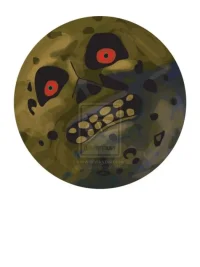
This is just a bad joke, but this could be a 血眼月 (Chime-tsuki) in my opinion.

majora__s_mask_moon_t_shirt_design_by_iamsare-d5hd5ck.webp
 
Well originally the one was Chi Me Go (not japanese at all ha ha). I wanted to at least keep two syllables from it. What's a Chime-tsuki? Is that essentially the same word?
 
I just wrote it apart to distinguish the two words because there is nothing called a Chimetsuki I think. I made it up from "bloodshot eyes" and "moon". Therefore, a joke.
 
XD Ha ha. Is there a word that sounds similar to it, then, that would work well in this situation? A moon with bloodshot eyes sounds a little daunting. Chi must mean blood I assume? It would make a little sense for it to, as when I think of Chi I think about the life force of things. (Or maybe that is Chinese). I should take up learning the language.
 
This is just a bad joke, but this could be a 血眼月 (Chime-tsuki) in my opinion.

View attachment 12087
Ah, "chi" + "me" is a good idea.:) Although 血眼 is usually read as a compound word "chimanako".;-)

There are so many homonyms in Japanese. "Chi" can mean earth, knowledge, thousand, etc. other than blood. The meaning is determined by kanji.
 
Back
Top Bottom