Need a word or phrase translated?

Can anyone please help me find out what this means?
今日もまたひとり…
住人の方が増えますね
A witch says this, after turning a villager into a small animal without anyone noticing.
I think I get the first part, but I'm not sure what is meant by the second part. Does she think that there are too many people in the village? Or does "住人" refer to the number of people she has already turned into animals?
I'm also confused by the meaning of の方 here.
I think 住人の方 simply refers to the people living in the village. If I'm correct, 方 is simply a polite way to say "person", in this case. So it'd be something line "The number of people living here is increasing, right?". [The first is "Today, [I am/you are/someone is] alone again".]edit:->that's false
edit: oh, yeah. I guess it must mean that "I got one again today", or something like that. Sorry about that.
Please, help me to translate to Japanese
How to tell "The World of Anime" in Japanese. Somebody help me please!
Thank you a lot in advance!
That'd be "Anime no sekai", or アニメの世界.
 
World of anime =
アニメの世界

Edit: Guess I was a bit too late.
I don't think ひとり means "alone" in this case, but thanks anyway, Gee.
 
Can anyone please help me find out what this means?

今日もまたひとり…
住人の方が増えますね

A witch says this, after turning a villager into a small animal without anyone noticing.

I think I get the first part, but I'm not sure what is meant by the secong part. Does she think that there are too many people in the village? Or does "住人" refer to the number of people she has already turned into animals?
I'm also confused by the meaning of の方 here.
Another possibility is that 住人の方[ほう]が増えますね "the number (of the people) of the dweller's side is increasing". However, in both interpretations "かた and ほう", your explanation of the context seems to show the opposite situation, unless 住人 refers to the small animals.
 
Another possibility is that 住人の方[ほう]が増えますね "the number (of the people) of the dweller's side is increasing". However, in both interpretations "かた and ほう", your explanation of the context seems to show the opposite situation, unless 住人 refers to the small animals.
Thanks for the answer.
I assumed that the witch is either commenting that the number of dwellers has been increasing (and therefore turning some of them in to animals wasn't a big deal), or that the number of people she's turned into animals is increasing (which would also make sense to me, since you could say that they are on her side once they've been turned).
I was just wondering which is more likely the case.
 
The former interpretation is impossible, I'm afraid. The form should be 住人の方が増えましたからね, 増えてますからね or like that for the case. As for the latter interpretation, 住人 must refer to animals, not PEOPLE she turned into animals so far, as I wrote. The animals must live in the witch's erea, maybe?
 
About the verb 迫られて here. I identify it as a passive form of 迫る. How should it be translated in this sentence?

これまでの消費は、必要に迫られてする古い消費だったので、低価格を志向してきました。

I read it as "because consumption up until now was old consumption you do pressed by necessity etc etc..." even though maybe "pressed" is a bad word here. 迫る has more the meaning of " be imminent" I think but I don't know how to capture this in a translation. Maybe I'm wrong altogether. Could 必要に迫られて maybe be a fixed phrase similar to 必要に応じて?
 
Yes, 必要に迫られて is a kind of set phrase, and doesn't have a nuance of "imminent" here. I think it usually just means "out of necessity".
 
Please help me translate this sentence. I have a few guesses as to what it can mean but I don't know what 茶色ベース is. If it's a brown paper base which is intended to be used for something (make paper bags etc) or if it's paper which is being recycled and has already been used or something.

Also the ところ after the verb here, is it with a "just took care of" meaning or does it refer to a physical place like "the place which took care of the previous 茶色ベース too" etc?

新しいデザインの紙袋が先ほどエストニアより届きました。前回の有機紙の茶色ベースのものでもお世話になっていたところです。

Here's another one I don't understand, who is doing what here exactly?

もし、自分の子供が勉強も仕事も嫌いで、自分で働くことをしなかったら、親の老後の負担は倍加します。

Especially the two 自分 do they both refer to the parent (ones' own children etc)? Also the first sentence here "自分の子供が勉強も仕事も嫌いで", is it the kids who hate studying and work or is it the parent who hate the kids?
I would guess it was "if your children dislikes studying and work and if they do not work themselves, the old age burden of the parent will double."
 
Last edited:
Please help me translate this sentence. I have a few guesses as to what it can mean but I don't know what 茶色ベース is. If it's a brown paper base which is intended to be used for something (make paper bags etc) or if it's paper which is being recycled and has already been used or something.

Also the ところ after the verb here, is it with a "just took care of" meaning or does it refer to a physical place like "the place which took care of the previous 茶色ベース too" etc?

新しいデザインの紙袋が先ほどエストニアより届きました。前回の有機紙の茶色ベースのものでもお世話になっていたところです。

Here's another one I don't understand, who is doing what here exactly?

もし、自分の子供が勉強も仕事も嫌いで、自分で働くことをしなかったら、親の老後の負担は倍加します。

Especially the two 自分 do they both refer to the parent (ones' own children etc)? Also the first sentence here "自分の子供が勉強も仕事も嫌いで", is it the kids who hate studying and work or is it the parent who hate the kids, and what does the "で" at the end do here? Maybe if this was worded differently I might have known.

I think the paper has some patterns of browny color. We usualy use 「~ベースのxx」to express "xx using something like ~".
In this context, 「ところ」indicate the company in Estonia. 「ところ」can indicate places, time, company, building, anything.

"If your child dislike both study and work, and never get job, your(= parent's) burden after retirement will become double."
 
The first 「自分」 is youself (parent), and second 「自分」is the kids.
「自分で」 means any of "by myself", "by yourself","by himself", "by herself" in the context.
In this sentence, 「で」 is simply "and".
 
Thanks. For some reason my brain must have melted so I somehow thought the で was like という場合で or something. Of course it's just like だ but in a way which continues the sentence. This is what happens when trying to overanalyze texts like I have a tendency to do, there's a domino-effect of misinterpretations. Not seeing the forest, just the trees etc... Sorry for taking up your time with this but I really appreciate the help so thanks again.
 
Can someone please help me understanding this?

驚くほど薄く
しっとりした
不思議な感触…

The context is that a guy says this while putting on a mysterious leather glove he found.

I'm having trouble understanding the first 2 lines. I think they mean, "it was stunningly thin and it was moist." I think しっとりした could also be part of the line below it, but I don't know.
What do you think this text means?

Thanks in advance.
 
Last edited:
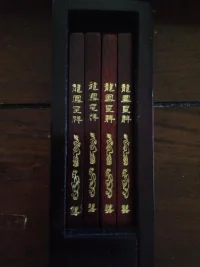
Hi, my sister just came back from visiting her mom in Japan a few days ago and she brought me this set of chopsticks. They have something in gold paint on them but I dont read Japanese. I was wondering if you could tell me what this says. IMG_1263.webp
 
Hi, my sister just came back from visiting her mom in Japan a few days ago and she brought me this set of chopsticks. They have something in gold paint on them but I dont read Japanese. I was wondering if you could tell me what this says. View attachment 11990

Enlarged it a bit to help. Click on my picture to enlarge it.

Uncle Frank

View attachment 11991
 
Hi, my sister just came back from visiting her mom in Japan a few days ago and she brought me this set of chopsticks. They have something in gold paint on them but I dont read Japanese. I was wondering if you could tell me what this says. View attachment 11990

It means your sister got re-gifted some stuff her mother got at a wedding.

It says "ryouhouteishou".
 
First Post

Hey you guys,
I started learning Japanese as my 4th language a little while ago. And I've been listening to the Japanese versions of SNSD's song a lot. But I came across some lines and words i can't quite figure out.
For example:
(SNSD-Genie, jap. version, lyrics: GENIE – Japanese Version – MV + lyrics (English + Romaji + Kanji) "AFTER TODAY" ):
そうよこの地球ほしは思い通り
二人なら 望み通り
未来さえも お見通し
叶えてあげる
sou yoko no hoshi wa omoidoori
futari nara nozomidoori
mirai sae mo omitooshi
kanaete ageru
translation:
Yes, the stars are within our reach
Together we will be unstopabble
I can even see our future prospect will be bright
I'll grant all your wishes
Sooo, i don't get the words "omoidoori", "nozomidoori" and "omitooshi". Can someone explain those to me?
And another (little) one:
(SNSD-Flower Power, lyrics: SNSD - FLOWER POWER Lyrics (English & Romanized) ):
誰もがbutterflyぶったspider
dare mo ga butterfly butta spider
translation:
Everyone is a spider pretending to be a butterfly
I don't get the "butta". I can't find a useful translation of this word. Is it a verb? I have really no idea -,-
I hope this is not too much for my first post here :emoji_stuck_out_tongue_winking_eye:. But i hope you guy can take some of your time and help me out^^
Thank you very much! :emoji_grinning:
 
Can someone please help me understanding this?

驚くほど薄く
しっとりした
不思議な感触…

The context is that a guy says this while putting on a mysterious leather glove he found.

I'm having trouble understanding the first 2 lines. I think they mean, "it was stunningly thin and it was moist." I think しっとりした could also be part of the line below it, but I don't know.
What do you think this text means?

Thanks in advance.

Both of 「しっとりとした」 and 「不思議な」 are adjective of 「感触」, I think.
So something like "dewy and mysterious feeling".
 
Hi, my sister just came back from visiting her mom in Japan a few days ago and she brought me this set of chopsticks. They have something in gold paint on them but I dont read Japanese. I was wondering if you could tell me what this says.
龍鳳呈祥 (I think Ryuuhouteishou/Ryūhōteishō would be more common.)
Dragon and Fenghuang show lucky.

Dragon and Fenghuang are the symbols of male and female, land/sea and sky, positive and negative(Yin and Yang), respectively. You can see these two animals engraved under the characters. The last character seems like a 双喜紋 "sōkimon".

Maybe the two chopsticks have different lengths? If so, that's 夫婦箸 "meoto-bashi"; two chopsticks for a (married) couple.


Hey you guys,
I started learning Japanese as my 4th language a little while ago. And I've been listening to the Japanese versions of SNSD's song a lot. But i came across some lines and words I can't quite figure out.
For example:
(SNSD-Genie, jap. version,lyrics: GENIE – Japanese Version – MV + lyrics (English + Romaji + Kanji) "AFTER TODAY"):
そうよこの地球ほしは思い通り
二人なら 望み通り
未来さえも お見通し
叶えてあげる
sou yoko no hoshi wa omoidoori
futari nara nozomidoori
mirai sae mo omitooshi
kanaete ageru
translation:
Yes, the stars are within our reach
Together we will be unstopabble
I can even see our future prospect will be bright
I'll grant all your wishes
Sooo, I don't get the words "omoidoori", "nozomidoori" and "omitooshi". Can someone explain those to me?
You need to make up the omitted part or transpose the order of words/phrases when interpreting lyrics.

my interpretation
そうよ。
二人ならこの地球は思い通り、望み通りにできる。
未来さえもお見通しだわ。(=未来さえも見通せる。)
夢を叶えてあげる。

And another (little) one:
(SNSD-Flower Power, lyrics: SNSD - FLOWER POWER Lyrics (English & Romanized)):
誰もがbutterflyぶったspider
dare mo ga butterfly butta spider
translation:
Everyone is a spider pretending to be a butterfly
I don't get the "butta". I can't find a useful translation of this word. Is it a verb? I have really no idea -,-
I hope this is not too much for my first post here :emoji_stuck_out_tongue_winking_eye:. But i hope you guy can take some of your time and help me out^^
Thank you very much! :emoji_grinning:
ぶる is a suffix to change a noun or adjective into a verb. I think "pretending" is a good translation.

ぶる【振る】
[接尾]《動詞五(四)段型活用》名詞や形容詞語幹などに付いて、そのようにふるまう、それらしいようすをする、などの意を表す。「学者―・る」「先輩―・る」「えら―・る」
ぶる - 国語辞書 - goo辞書

ぶる - 和英辞書 - goo辞書
 
とおい(遠い), おおきい(大きい), とおる(通る), おおい(多い), こおり(氷), おおかみ(狼), とお(十)etc, are written as とほい, おほきい, とほる, おほい, こほり, おほかみ, とを in Historical kana usage respectively, whereas, for instance, おう(王), とう(問う), とう(塔), おうぎ(扇) are わう, とふ, たふ, あふぎ. Thus, it's decided that in Modern Kana usage, the long vowel "o" is written '"o" row kana + う', but when ほ or を follows "o" row kana, it's '"o" row kana + お'.
 
Last edited:
Thanks for the info, now that I think of it, (not that the picture shows it too well) the 2 pairs of chopsticks are slightly different colors of dark brown. It wasn't a regift though, she said she bought them at a street front store. Thanks once again
 
Did she buy it in a China town or somewhere like that? Those words and marks are basically Chinese ones.
 
I'm curious why is 遠い spelled とおい instead of とうい?

Most of Japanese including me don't know the reason.
Basically we use「う」for this kind of pronunciation, but we use「お」for some exceptional words.
I've heard young pupils used to use the following sentence to remember such exceptional words.

「遠くの大きな氷の上を、多くの狼、十ずつ通った」
「とおくの おおきな こおりの うえを、おおくの おおかみ とおずつ とおった」
 
Back
Top Bottom