

Navigation
Install the app
How to install the app on iOS
Follow along with the video below to see how to install our site as a web app on your home screen.
Note: This feature may not be available in some browsers.
More options
Style variation
System
Light
Dark

You are using an out of date browser. It may not display this or other websites correctly.
You should upgrade or use an alternative browser.
You should upgrade or use an alternative browser.
Need a word or phrase translated?
- Thread starter Buntaro
- Start date

- 15 Mar 2002
- 16,758
- 2,298
I need to translate the following text to japanese.
I study japanese language. *For that* I have so many reasons.
私輪日本語を勉強します
そのためにはたくさん理由があります
or
それなればこそたくさん理由があります
are they both right?
None of the Japanese text in your post is right. Did you use an online translator?
私は日本語を勉強します。理由はたくさんあります。

- 22 Feb 2008
- 18,266
- 4,926
The particle "wa" MUST be a hiragana は.
(それ)なれば(こそ) corresponds to "therefore/consequently", thus, the two sentences should be in reverse order.
(それ)なれば(こそ) corresponds to "therefore/consequently", thus, the two sentences should be in reverse order.
Last edited:

BakabonPapa
BakabonPapa
- 11 Nov 2009
- 33
- 9
More precisely,「私は日本語を勉強します。その理由はたくさんあります。」.
- 23 Nov 2012
- 2
- 0
I don't read/write/speak Japanese.
I have a question about the word "カップ". Google translator says this is the most common translation for the English word "cup." I listened to the pronunciation at カップ麺 pronunciation: How to pronounce カップ麺 in Japanese and it sounds very much like the English word except for a vowel sound at the end. Sort of like "cup-oo." Well, not quite but similar. The sound after "cup" is shorter than the "oo" sound I put at the end.
Anyhow, because of the similarity of the word sounds, I was wondering if this Japanese word was a borrowed English word. I heard that foreign words are written in a different Japanese alphabet than Japanese words. So, first is this word written in the alphabet reserved for foreign words? Even if not, does the etymology go back to a foreign word? Or is it just a coincidence? :
:
Thanks.
I have a question about the word "カップ". Google translator says this is the most common translation for the English word "cup." I listened to the pronunciation at カップ麺 pronunciation: How to pronounce カップ麺 in Japanese and it sounds very much like the English word except for a vowel sound at the end. Sort of like "cup-oo." Well, not quite but similar. The sound after "cup" is shorter than the "oo" sound I put at the end.
Anyhow, because of the similarity of the word sounds, I was wondering if this Japanese word was a borrowed English word. I heard that foreign words are written in a different Japanese alphabet than Japanese words. So, first is this word written in the alphabet reserved for foreign words? Even if not, does the etymology go back to a foreign word? Or is it just a coincidence?
:Thanks.
- 15 Mar 2002
- 16,758
- 2,298
I don't read/write/speak Japanese.
I have a question about the word "カップ". Google translator says this is the most common translation for the English word "cup." I listened to the pronunciation at カップ麺 pronunciation: How to pronounce カップ麺 in Japanese and it sounds very much like the English word except for a vowel sound at the end. Sort of like "cup-oo." Well, not quite but similar. The sound after "cup" is shorter than the "oo" sound I put at the end.
Anyhow, because of the similarity of the word sounds, I was wondering if this Japanese word was a borrowed English word. I heard that foreign words are written in a different Japanese alphabet than Japanese words. So, first is this word written in the alphabet reserved for foreign words? Even if not, does the etymology go back to a foreign word? Or is it just a coincidence?
Thanks.
It is written in katakana, which is the syllabary typically (not exclusively) used for words of foreign origin. The word "cup" is borrowed into Japanese from English. Sometimes it is "kappu" and sometimes it is "koppu", with "kappu" being common for the thing you drink out of and "koppu" being common for the measurement of volume. At least I think that's the way it works.
- 23 Nov 2012
- 2
- 0
It is written in katakana, which is the syllabary typically (not exclusively) used for words of foreign origin. The word "cup" is borrowed into Japanese from English. Sometimes it is "kappu" and sometimes it is "koppu", with "kappu" being common for the thing you drink out of and "koppu" being common for the measurement of volume. At least I think that's the way it works.
Thanks, Mike, for the quick answer.
BakabonPapa
BakabonPapa
- 11 Nov 2009
- 33
- 9
I don't think so. I simply translate the word "For that". We don't need "For that" because it's clear.

undrentide
Japa'n vagyok
- 18 Jan 2006
- 3,652
- 310
It is written in katakana, which is the syllabary typically (not exclusively) used for words of foreign origin. The word "cup" is borrowed into Japanese from English. Sometimes it is "kappu" and sometimes it is "koppu", with "kappu" being common for the thing you drink out of and "koppu" being common for the measurement of volume. At least I think that's the way it works.
Koppu is believed to have come from either Dutch (kop) or Portuguese (copo), they are used for 'glass' in English (as in 'glass of water') while Kappu is used for the same thing for 'cup' in English.
- 15 Mar 2002
- 16,758
- 2,298
Koppu is believed to have come from either Dutch (kop) or Portuguese (copo), they are used for 'glass' in English (as in 'glass of water') while Kappu is used for the same thing for 'cup' in English.
I hate 外来語
Other pairs I especially dislike are ガム/ゴム and ガラス/グラス. It can very hard to remember the distinction in usage in Japanese since the distinction doesn't exist in English. Same for ストライク/ストライキ and バー/バール.

Alish
後輩
- 9 Sep 2012
- 15
- 0
私は日本語を勉強します。理由はたくさんあります。The pareticle "wa" MUST be a hiragana は.
(それ)なれば(こそ) corresponds to "therefore/consequently", thus, the two sentences should be in reverse order.
For the sentence "I have so many reasons" the word reason is the object, isnt it?
In the sentence you used, the word "reason" is the subject and I get it. But can't we use it as the object? If so, how?
Thanks in advance.
Last edited:
- 22 Feb 2008
- 18,266
- 4,926
I'm talking about the order of the two sentences (私は日本語を勉強します and たくさん理由があります), not the order of the words.
Alish
後輩
- 9 Sep 2012
- 15
- 0
I know it. I didn't talk about that. I want to know if there is any way of saying that sentence so that the "reasons" be the object of the sentence (be marked with ga) for example sth like this:I'm talking about the order of the two sentences (私は日本語を勉強します and たくさん理由があります), not the order of the words.
私の理由がたくさんあります.
what you said was:
私は日本語を勉強します。
I study japanese language.
理由はたくさんあります。
There exist many "reasons" (for that).
or
Many "reasons" exist (for that).
But that is not exactly what I wanted:
I study japanese language.
"I" have many reasons (for that)
In other word how can I use "理由" with mark "が"?
>>And there is another question
for the sentence "the most important reason is that I like japanese language very much."
Can we use this?
一番大事な理由は日本語が 大好きだ.
I saw this sentence somewhere in the web:
そのアメリカのブームが起こった一番大事な理由とは
in the end before "は" it has "と". What does that mean? is it necessary?
ありがとう
- 22 Feb 2008
- 18,266
- 4,926
That's not what I said.
Anyway, 理由はたくさんあります。 is EXACTLY what you want to say. 私に(は) is just omitted there. 理由は is the topicalization of 理由が, thus, 理由が is used in appropriate situations. That's a は/が issue. In that sentence structure, the two interpretations, 理由 as the subject and 理由 as the object, are both possible. To interpret as the object is more common, though.
とは is for explanation/definition.
Anyway, 理由はたくさんあります。 is EXACTLY what you want to say. 私に(は) is just omitted there. 理由は is the topicalization of 理由が, thus, 理由が is used in appropriate situations. That's a は/が issue. In that sentence structure, the two interpretations, 理由 as the subject and 理由 as the object, are both possible. To interpret as the object is more common, though.
とは is for explanation/definition.
Alish
後輩
- 9 Sep 2012
- 15
- 0
That's not what I said.
Anyway, 理由はたくさんあります。 is EXACTLY what you want to say. 私に(は) is just omitted there. 理由は is the topicalization of 理由が, thus, 理由が is used in appropriate situations. That's a は/が issue. In that sentence structure, the two interpretations, 理由 as the subject and 理由 as the object, are both possible. To interpret as the object is more common, though.
とは is for explanation/definition.
Arigatou
Macrobiotic
Sempai
- 12 Oct 2012
- 230
- 6
I don't get the bold marked part. Although I understand the point here is that it's no good pointing out mistakes after someone (a child student in this case) already finished writing.
更に、書いたあと間違いを次々と指摘されでもしたら目もあてられません(笑)。
間違いは、書き出す前にアドバイスしておくものです。
書いたあとは、ただ褒めるだけ。
更に、書いたあと間違いを次々と指摘されでもしたら目もあてられません(笑)。
間違いは、書き出す前にアドバイスしておくものです。
書いたあとは、ただ褒めるだけ。
Last edited:
So, I can not do anything with the Japanese language, but have a big interrest in the (medieval) history of Japan. I have here a map about the Nanboku-chō period (I suppose) and I would really like to be able to read it.
Is there somebody willing to translate all elements on this map?
It seems like a hell of a job, but you would make me VERY happy!
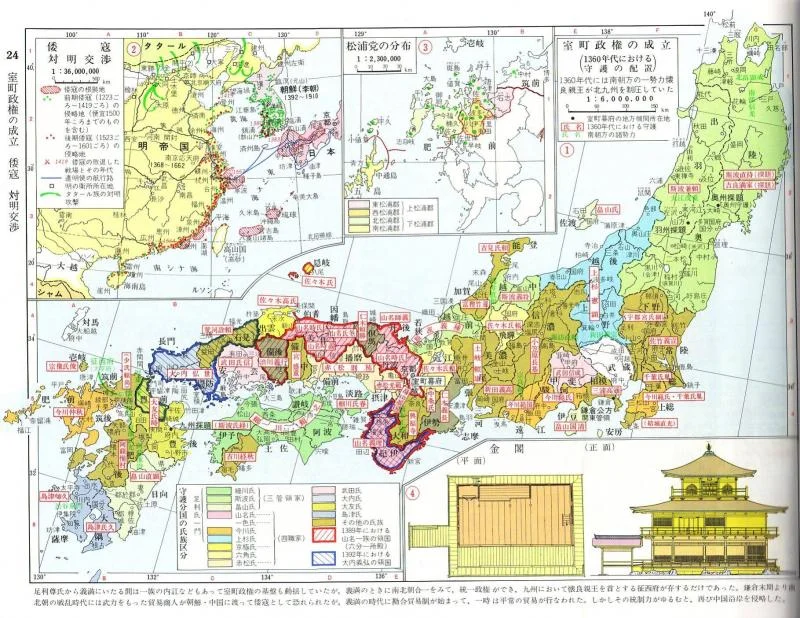
Is there somebody willing to translate all elements on this map?
It seems like a hell of a job, but you would make me VERY happy!
- 22 Feb 2008
- 18,266
- 4,926
目も当てられない is an idiom, meaning "hideous"(lit, "can't look something squarely").I don't get the bold marked part. Although I understand the point here is that it's no good pointing out mistakes after someone (a child student in this case) already finished writing.
更に、書いたあと間違いを次々と指摘されでもしたら目もあてられません(笑)。
間違いは、書き出す前にアドバイスしておくものです。
書いたあとは、ただ褒めるだけ。
指摘され is the passive "to be pointed out (mistakes)". The sentence is written on the viewpoint of the writer of the composition(= the child).
Macrobiotic
Sempai
- 12 Oct 2012
- 230
- 6
Thanks Toritoribe.
Well, no actually... I'm really hoping someone helps me out.You must be joking....
But if not, maybe somebody knows a company that would translate it for me for a reasonable price... I'm just a poor student

- 22 Feb 2008
- 18,266
- 4,926
It goes without saying but most parts of the map are proper nouns; place names and person's names. Do you want all of them transliterated?
Macrobiotic
Sempai
- 12 Oct 2012
- 230
- 6
Let's see if I understood this right in the last two parts.
おっ、買ってくれるのかい。
まいどあり・・・ってお客さん、お金足りませんよ。
いくら儲けを考えてない私でも
生活はかかってんで勘弁してくださいよ。
I think the seller is saying that, in a very free translation, that even though his goal isn't mainly profit, he needs to make a living and asks the customer to be understanding about this.
It's hard for me to translate it literally but in a more literal translation I think it would be:
"no matter how little I'm thinking of profit, because my livelihood depends/hangs on it please have forebearance/be forgiving".
Is this okay?
Although the way the sentence いくら儲けを考えてない私でも is constructed, I think a true literal translation to english is impossible. It has to be reconstructed freely in english to carry the meaning across. I might be wrong.
Also, the かっかてんで, when not contracted like that would it be かかっているので?
おっ、買ってくれるのかい。
まいどあり・・・ってお客さん、お金足りませんよ。
いくら儲けを考えてない私でも
生活はかかってんで勘弁してくださいよ。
I think the seller is saying that, in a very free translation, that even though his goal isn't mainly profit, he needs to make a living and asks the customer to be understanding about this.
It's hard for me to translate it literally but in a more literal translation I think it would be:
"no matter how little I'm thinking of profit, because my livelihood depends/hangs on it please have forebearance/be forgiving".
Is this okay?
Although the way the sentence いくら儲けを考えてない私でも is constructed, I think a true literal translation to english is impossible. It has to be reconstructed freely in english to carry the meaning across. I might be wrong.
Also, the かっかてんで, when not contracted like that would it be かかっているので?
Similar threads


- Replies
- 11
- Views
- 115K