Need a word or phrase translated?

It totally depends on the words and the writing style. I can't judge that without seeing the drawing.
 
Can you please translate these sentences to Japanese? (in Japanese alphabet)

"Are you sure they won't notice?"
"It's fine, I've done it loads of times before."
"Yeah, **** it! We're too cool for school anyway."
"Whatever!"

Thank you
 
I was watching some anime (again) and heard this:

What is this person saying? It sounds like "いやりそうすだ" (even though I know this is wrong) but I can't really tell. For context, this guy is with his two other friends and they're trapped. The previous sentence was "逃げ場ない."

Any help is appreciated!
 
It totally depends on the words and the writing style. I can't judge that without seeing the drawing.
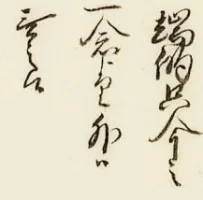
It is supposed to depict an object with two kanji words "恐怖 希望" inscribed on it horizontally and a line from Hagakure written besides it as a connotation in vertical cursive. Would it look like a style mish-mash to a japanese person?
And I forgot to ask another thing: on the original page that you posted, vertical lines start on a little bit different level at the top. Is there some rule to it or is it just hand-writing ? Would this alignment of lines be ok?
Hagakure-3 lines.webp
I presume the count of stupid questions from my side is pretty high by now)
 
It is supposed to depict an object with two kanji words "恐怖 希望" inscribed on it horizontally and a line from Hagakure written besides it as a connotation in vertical cursive. Would it look like a style mish-mash to a japanese person?
If it's an art, i.e, not calligraphy, it would be OK.

And I forgot to ask another thing: on the original page that you posted, vertical lines start on a little bit different level at the top. Is there some rule to it or is it just hand-writing ? Would this alignment of lines be ok?
Just because it's handwritten.
 
行って(い)て is the -te form of 行って(い)る, and used as a command in your example sentence, as in the wiki page I linked.
 
Got to get back into studying and improving my Japanese.
昨日の夜、妻と話して言いたい事があるけど、意味が分かりませんでした。それで、言いたい事を説明してみました。やっと妻は私が分かられました。
言いたい事は:"To live life that way is unnecessary"
言いてみた事は:
"その生き方はだめと思います。"
unnecessaryは日本語でなんとい事を知りませんでした。「だめ」って言うは大丈夫と思いました。

I am pretty sure I messed up quite abit explaining so let me know where I screwed up.
 
Hi,

Please can someone translate the attached image for me? I am having great difficulty.

Thanks,

Steve
 

Attachments

  • 228165_334086186686676_816070229_n.webp
    228165_334086186686676_816070229_n.webp
    24.6 KB · Views: 155
Hi,

Please can someone translate the attached image for me? I am having great difficulty.

Thanks,

Steve

Please don't double post.

Are you sure that's not Chinese?

---------- Post added at 06:25 ---------- Previous post was at 06:21 ----------

Got to get back into studying and improving my Japanese.
昨日の夜、妻と話して言いたい事があるけど、意味が分かりませんでした。それで、言いたい事を説明してみました。やっと妻は私が分かられました。
言いたい事は:"To live life that way is unnecessary"
言いてみた事は:
"その生き方はだめと思います。"
unnecessaryは日本語でなんとい事を知りませんでした。「だめ」って言うは大丈夫と思いました。

I am pretty sure I messed up quite abit explaining so let me know where I screwed up.

This sort of falls outside the scope of this thread and should have one of its own.
 
Well I wasn't sure if it would be considered a translation question or a question on grammar.
 
Well I wasn't sure if it would be considered a translation question or a question on grammar.

I think I may have misunderstood you. I thought you were asking for corrections to the whole thing in addition to the one phrase translation. Simply by volume of material that was why I thought a separate thread might be better.
 
My bad, I thought I would attempt to ask my question in Japanese. For practice but It basically boils down to How do you say, Living life that way is unnecessary.

I was hoping this:
unnecessaryは日本語でなんとい事を知りませんでした。「だめ」って言うは大丈夫と思いました。

Would be considered the question. My mistake.
 
My bad, I thought I would attempt to ask my question in Japanese. For practice but It basically boils down to How do you say, Living life that way is unnecessary.

It could go several ways.

その生き方をする必要はない

なにのその生き方をしなくてはならない訳はない

are a couple of patterns that could be used. Depending on the situation it might be more appropriate to use 生活 instead of 生き方.
 
Hi, I am thinking of getting a tattoo with my best friend. Since we are both orthodox (Greeks) and we believe in God, we chose to make the following "Whoever acknowledges me before men, I will also acknowledge him before my Father in heaven" that's the English translation.We are thinking of writing this phrase in ancient Greek or Japanese. The problem is that we don't know Japanese. I would like to question, how is the Japanese translation of "Whoever acknowledges me before men, I will also acknowledge him before my Father in heaven" ? How is that in Japanese? And how is written (if its possible in Bible...either an orthodox or a catholic through google search or something)?
I would really really apreciate any kind of help

I found this on google search is that the correct one? "同様に、レビ人もこの場所にさしかかってきたが、彼を見ると向こう側を通って行った。"
i found also this " だから、だれでも人々の前で自分をわたしの仲間であると言い表す者は、
わたしも天の父の前で、その人をわたしの仲間であると言い表す" which one is the correct one? or both?
 
Last edited:
Thank you, I didn't know about it and I just read it. It may be seem wrong but I am going to make that tattoo either way. Can you please tell me if this is the right phrase? And how it should be written? From left to right? Or from top to bottom?
 
"Hi, I'm a devout Orthodox Christian and I am going to have a Bible verse tattooed on my body in a language I don't have the first clue about....even though God specifically forbade it."

Nice.

You get to honor God and spit in His face all at the same time. That's quite a trick.
 
Well, iI should also not smoke or drink alcohol but I do. I can understand that I hurt myself, but I do hurt me. I should love my enemies but I can't. Some things are just too complicated or very difficult to avoid. I am human, not a perfect machine. Some things are just complicated enough for us to figure out. I really appreciate your "advice", l learned something new, but.... I don't know how to explain it...but I do understand that what I am about to do isn't right one hundred percent , maybe not even 50% or maybe its 100% false.
Except all that I would be thankful if someone approves if the phrase that I quoted is the right one in Japanese and how it must be written.
 
It just strikes me as the height of irony that you plan to persist in disobeying God for the purpose of glorifying God.

You dishonor your God in the name of honoring your God. Which means either:

1. You're just "playing church" and don't take your religion seriously.
2. You're not smart enough to see the contradictory nature of your choice.
3. You place yourself above God, as you're determined to adorn and bring adulation upon yourself through ostentatiously committing the sacrilege of not only tattooing yourself against his command, but to add insult to injury by having the content be His scripture.
4. Some combination of the above.
 
Hi, i am thinking of getting a tatto with my best friend. Since we are both orthodox (Greeks) and we believe in God, we chose to make the following "Whoever acknowledges me before men, I will also acknowledge him before my Father in heaven" thats the English translation.We are thinking of writting this phrase in ancient greek or japanese. The problem is that we dont know Japanese.o i would like to question, how is the japanese translation of "Whoever acknowledges me before men, I will also acknowledge him before my Father in heaven" ? How is that in japanese? And how is written (if its posible in bible...either an orthodox or a catholic through google search or sth)?
I would really really apreciate any kind of help

I found this on google search is that the correct one? "同様に、レビ人もこの場所にさしかかってきたが、彼を見ると向こう側を通って行った。"
Classical
されど凡そ人の前にて我を言ひあらはす者を、我もまた天にいます我が父の前にて言ひ顯さん。

Modern
だから人の前でわたしを受けいれる者を、わたしもまた、天にいますわたしの父の前で受けいれるであろう。

Translation by Tsukamoto Toraji
それだから(恐れずに説け。)だれでも人の前で(公然)わたしを(主と)告白するものを、わたしも(裁きの日に)、わたしの天の父上の前で(弟子として)認める。

Translation by Maeda Gorō
だれでもわたしを人々の前で認めるものはわたしも天にいます父の前で認めよう。

The New Interconfessional Translation
だから、だれでも人々の前で自分をわたしの仲間であると言い表す者は、わたしも天の父の前で、その人をわたしの仲間であると言い表す。


My basic idea about tattoo is the same to the statement "I don't really agree with the idea of getting a tattoo in a language you don't understand" in the thread linked below, though.

WANT A KANJI TATTOO? Read before you ask | Japan Forum
 
Back
Top Bottom