Need a word or phrase translated?

I now understand , that the subject is 偶然 [ぐうぜん] coincidence/es and the verb is 重ねてた[かさねてた] .
Have you ever learned 連体修飾節[れんたいしゅうしょくせつ] "the adnominal/attributive clause", which is the equivalent to the relative clause in English grammar?

ふたりを重ねてた偶然
coincidences that stuck two of us

偶然がふたりを重ねてた。
Coincidences stuck two of us.

Thus, 偶然 is the subject, and 暗転(し、)断線(した) are the main verbs. 重ねてた is the verb in the modifying clause.
 
し is the 連用形 (れんようけい, continuative form) of する. They left する off because it's a play on words, and probably fits the rhythm better. The word order is different for the same reason. Remember: it's a song. They tend to break the rules of language (along with poems) more frequently than any other format.
Indeed. About the れんきょうけい , that is the chopped form of the verb right? The one you use without the masu. For example in たべる it's たべ . How does adding that half part help in the sentence if you don't add any other endings to it? Just the し doesn't make sense to me, please enlighten me.
Have you ever learned 連体修飾節[れんたいしゅうしょくせつ] "the adnominal/attributive clause", which is the equivalent to the relative clause in English grammar?
ふたりを重ねてた偶然
coincidences that stuck two of us
偶然がふたりを重ねてた。
Coincidences stuck two of us.
Thus, 偶然 is the subject, and 暗転(し、)断線(した) are the main verbs. 重ねてた is the verb in the modifying clause.
The absence of a subject particle makes it a relative clause to the くうぜん clause , is that what you're trying to convey ?
 
Indeed. About the れんきょうけい , that is the chopped form of the verb right? The one you use without the masu. For example in たべる it's たべ . How does adding that half part help in the sentence if you don't add any other endings to it? Just the し doesn't make sense to me, please enlighten me.

It's れんようけい. It's called the continuative form because it's used to connect to clauses, so it isn't a full form with tense, just like the -te form doesn't have tense. Its meaning is "V, and..."

eru777;704093 said:
The absence of a subject particle makes it a relative clause to the くうぜん clause , is that what you're trying to convey ?

So-called relative clauses in Japanese are formed by placing the modifying clause directly before the head noun. In this case 偶然 is the head noun (the noun being modified), and ふたりを重ねてた is the modifying clause. It doesn't have anything to do with the subject marker. For instance, you can say 犬が食べた肉, where 肉 is the head noun and 犬が食べた is the modifying clause, and it would mean "the meat that the dog ate".
 
It's れんようけい. It's called the continuative form because it's used to connect to clauses, so it isn't a full form with tense, just like the -te form doesn't have tense. Its meaning is "V, and..."


So-called relative clauses in Japanese are formed by placing the modifying clause directly before the head noun. In this case 偶然 is the head noun (the noun being modified), and ふたりを重ねてた is the modifying clause. It doesn't have anything to do with the subject marker. For instance, you can say 犬が食べた肉, where 肉 is the head noun and 犬が食べた is the modifying clause, and it would mean "the meat that the dog ate".
I see.
 
肉をラップでくるんで冷蔵庫にしまいましょう

I will wrap the meat in the refrigerator.

Anyone explain for me the grammar, especially しまいましょう?
 
I will wrap the meat AND PUT IT IN the refrigerator.

しまう "put away"
 
Hi Everyone,

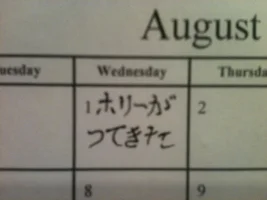
Can somebody help me please? My girlfriend left me this message in Japanese on my calendar before she went on holiday. She is back on Wednesday.

note3.webp

I've had a look, and I think it could say 'Hollie back today'. If somebody could help me I would really appreciate it.

Many thanks!

Owen
 
If it meant to say 'Hollie is back', one letter is missing, and another letter is written far too big.
ホリーが帰ってきた。 (Hollie was back or Hollie has come back, not Hollie is back.)
帰 is missing, it means 'to return'.
っ is written too big.
This sentence does not include 'today'.
 
肉をラップでくるんで冷蔵庫にしまいましょう
I will wrap the meat in the refrigerator.
Anyone explain for me the grammar, especially しまいましょう?
To interprete ましょう as a gentle command, "Wrap the meat and put it in the refrigerator.", is more common here.
 
To interprete ましょう as a gentle command, "Wrap the meat and put it in the refrigerator.", is more common here.
It is slightly confusing. Normally the indirect, euphemized command I have seen is limited to instruction situations. So if ましょう is politely showing ones own volition it would have to be an act benefiting or on behalf of the hearer, is that correct ? "Let me explain this/put the meat away" etc.
 
The example sentence seems to be taken from a recipe or something, even if the OP quoted it from a textbook.
 
How would I say "I'm trying to find time for____" in Japanese? As in, "I'm trying to find time to practice music."

Thanks.
 
How would I say "I'm trying to find time for____" in Japanese? As in, "I'm trying to find time to practice music."

Thanks.
How about like this ?

Nantoka jikan wo mitsukete (activity verb) you ni shite imasu.


The example sentence seems to be taken from a recipe or something, even if the OP quoted it from a textbook.
That makes huge sense. It sounds like the OP was reading straight out of a food preparation handbook or such. :)
 
彼女は何でも人のせいにするから嫌われている。

She is hated because doing trouble to every person?

Any correct translation?
 
人のせいにする is an idiom.

何でも人のせいにする: to blame everything on others
 
I've just found out that we can make negative verbs with ず and ぬ, so it become something like this:
適う → 適わず
or
適う → 適わぬ

Do they have any differences in the meaning if turned into negatives using ず or ぬ instead of the normal negative form with ない?
 
There is no difference in meaning, although ず/ぬ sounds more classical.
FYI, there are differences in grammatical functions between ず and ぬ (e.g. ず is not used as 連体形). Furthermore, when ず/ぬ is attached to -suru verbs, せ, which is a 未然形 of す, is used.

適用する --> 適用しない/適用せず/適用せぬ
 
So, that means this one is wrong:
適わず夢

And this one is okay:
適わぬ夢

Is that right?
 
Yes, that's right.

The following explanations might be helpful.

(1) この助動詞の活用には「ぬ」(「(な)・(に)・○・ぬ・ね・○」)、「ず」(「ず・ず・ず・○・○・○」)、「ず」にラ変動詞「あり」が熟合して生じた「ざり」(「ざら・ざり・(ざり)・ざる・ざれ・ざれ」)の三系列がある。これらのうち、「ぬ」の系列が最も古く、次いで「ず」の系列があり、のちにはさらに「ざり」の系列が補助活用として生じ、中古以降多く用いられた。 (2) 「ぬ」の系列のうち、未然形「な」、連用形「に」は、上代において、ク語法「なく」の「な」、「飽かに」「知らに」「かてに」の「に」としてわずかに用いられるだけである。(3) 中世以降、口語では連体形「ぬ」の終止法が一般化し、現代語の打ち消しの助動詞「ぬ」の活用へと転じていった。また、連用形「ず」には、「ずして」「ずて」「ずと」「ずとも」「ずに」などの連語形が派生してそれぞれ用いられた
「ず」の検索結果 - Yahoo!辞書

(1) 現代語の打ち消しの助動詞としては他に「ない」がある。「ない」は話し言葉や書き言葉に広く用いられるが、「ぬ」は「ない」より用法が限られる。「ぬ」はやや古風な言い方や書き言葉的なものに用いられる。「ぬ」の終止形・連体形は話し言葉では「ん」の形で用いられることが多い。特に助動詞「ます」に付くときは、「ません」のように「ん」の形が一般に用いられる。
「ぬ」の検索結果 - Yahoo!辞書
 
I need translation for:

オレの兄ちゃんの足を
引っぱったら
タダじゃおかないからな!

My attemp is: ''If you pull my brother's leg you will gonna pay!''
 
The idiom has an entirely different meaning in Japanese.
 
Back
Top Bottom