

Navigation
Install the app
How to install the app on iOS
Follow along with the video below to see how to install our site as a web app on your home screen.
Note: This feature may not be available in some browsers.
More options
Style variation
System
Light
Dark

You are using an out of date browser. It may not display this or other websites correctly.
You should upgrade or use an alternative browser.
You should upgrade or use an alternative browser.
Need a word or phrase translated?
- Thread starter Buntaro
- Start date

- 22 Feb 2008
- 18,266
- 4,926
 !!!!!
!!!!!
- 22 Feb 2008
- 18,266
- 4,926
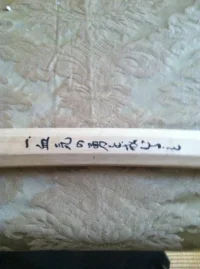
Your picture is rotated 90 degrees to the left.
It seems like a karate slogan 一. 血気の勇を戒むること Kekki no yuu wo imashimuru koto; "Caution yourself not to be hot-blooded." A karate site translated it "Develop self-control."
It seems like a karate slogan 一. 血気の勇を戒むること Kekki no yuu wo imashimuru koto; "Caution yourself not to be hot-blooded." A karate site translated it "Develop self-control."
- 3 Jan 2012
- 842
- 9
こちらのほうがなんとなくいいと思いますけど
My translation: I don't know why I think that has more advantage.
Is のほうが~いい here mean ''more than''?
My translation: I don't know why I think that has more advantage.
Is のほうが~いい here mean ''more than''?
- 22 Feb 2008
- 18,266
- 4,926
Yes, but けど is used as a kind of euphemism; softening the speaker's opinion.
I think this is somewhat better.
I think this is somewhat better.
- 3 Jan 2012
- 842
- 9
若いひとほどマナーを知らないとお年寄りは言います。
Old people say that they can't act without knowing manner like young people.
Is ほど here mean ''as much as''?
Old people say that they can't act without knowing manner like young people.
Is ほど here mean ''as much as''?

- 15 Mar 2002
- 16,758
- 2,298
No, I'm pretty sure it's "the ~er, the...". In this case, "Old people say the younger one is, the less they know of manners."
Not quite. There is no mention of correlation between degrees of youth and not knowing.
More like, "Nobody is as ignorant of manners as the young"
- 22 Feb 2008
- 18,266
- 4,926
No. Glenn-san's initial interpretation is correct. Although I think ほど would be more close to ~のほうが than 若ければ若いほど, i.e., "the more~, the more" here. 若いひとほどマナーを知らない人は(年寄りには)いない is the one for Mike-san's.
Depending on the context, this structure cam mean "don't know much about manners comparing to the younger people".
e.g.
今度フランス料理を食べに行くのだが、若いひとほどマナーを知らないので、箸を使えるところに行きたいと思っている。
I'm going to go out to eat French cuisine, since I don't know about the manners as much as the younger people, I want to go to a restaurant where I can eat with chopsticks.
Depending on the context, this structure cam mean "don't know much about manners comparing to the younger people".
e.g.
今度フランス料理を食べに行くのだが、若いひとほどマナーを知らないので、箸を使えるところに行きたいと思っている。
I'm going to go out to eat French cuisine, since I don't know about the manners as much as the younger people, I want to go to a restaurant where I can eat with chopsticks.
- 22 Feb 2008
- 18,266
- 4,926
ナスO窶ケSナ?テオ is the anniversary of the death of a haiku writer ツ青シ窶愬椎スO窶ケS[Saitō Sanki], i.e., April 1st.
https://ja.wikipedia.org/wiki/ツ青シ窶愬椎スO窶ケS (all in Japanese)
my attempt
At the end of the anniversary of Sanki's death
A storm blows quietly
https://ja.wikipedia.org/wiki/ツ青シ窶愬椎スO窶ケS (all in Japanese)
my attempt
At the end of the anniversary of Sanki's death
A storm blows quietly

eru777
後輩
- 2 Jul 2012
- 21
- 0
Hello I 'm having trouble understanding thetranslation of the author ;
The sentence is from a song
ふたりを重ねてた偶然 暗転 断線 儚く 千々に
[ふたりをかさねてたぐうぜんあんてんだんせんはかなくにちじに]
"Coincidences that sticked us degenerates into the dark and are broken in pieces"
I know what each of these words in this sentence mean; except teta but in google translator it said "had" so I suppose it means that (lol)
Anyway
I put the translated words here as I found them through various dictionaries :
重ね 「かさね」1. pile up 2.counter for things that are stacked, piled up (or layered, etc.) (after a word from the "hito-futa-mi" counting system)
偶然 「ぐうぜん」(by) chance; unexpectedly; suddenly; accident;
暗転 「あんてん」taking a turn for the worse
断線 「だんせん」disconnection; interruption; burn-out
儚くなる 「はかなくなる」to die; to pass away
千々に 「ちじに」in pieces [adverb]
Either the translator was enjoying some rather odd alcoholic beverage or I do not get it. Can anyone help me understand the meaning of this sentence ? Like, what each word means in the context that it's in..
Thanks.
The sentence is from a song
ふたりを重ねてた偶然 暗転 断線 儚く 千々に
[ふたりをかさねてたぐうぜんあんてんだんせんはかなくにちじに]
"Coincidences that sticked us degenerates into the dark and are broken in pieces"
I know what each of these words in this sentence mean; except teta but in google translator it said "had" so I suppose it means that (lol)
Anyway
I put the translated words here as I found them through various dictionaries :
重ね 「かさね」1. pile up 2.counter for things that are stacked, piled up (or layered, etc.) (after a word from the "hito-futa-mi" counting system)
偶然 「ぐうぜん」(by) chance; unexpectedly; suddenly; accident;
暗転 「あんてん」taking a turn for the worse
断線 「だんせん」disconnection; interruption; burn-out
儚くなる 「はかなくなる」to die; to pass away
千々に 「ちじに」in pieces [adverb]
Either the translator was enjoying some rather odd alcoholic beverage or I do not get it. Can anyone help me understand the meaning of this sentence ? Like, what each word means in the context that it's in..
Thanks.
Last edited:
- 22 Feb 2008
- 18,266
- 4,926
Have you learned the conjugation of verbs and adjectives? 重ねて(い)た is "the -te form of a verb 重ねる + the past form of いる", and 儚く is the adverbial usage of the -ku form of an i-adjective 儚い.
千々に is ちぢに, and not ちじに.
The ordinary order of words is ふたりを重ねてた偶然が暗転し、儚く千々に断線した.
偶然 暗転 断線 is a play on words.
千々に is ちぢに, and not ちじに.
The ordinary order of words is ふたりを重ねてた偶然が暗転し、儚く千々に断線した.
偶然 暗転 断線 is a play on words.
eru777
後輩
- 2 Jul 2012
- 21
- 0
I know all about the te form .Have you learned the conjugation of verbs and adjectives? 重ねて(い)た is "the -te form of a verb 重ねる + the past form of いる", and 儚く is the adverbial usage of the -ku form of an i-adjective 儚い.
千々に is ちぢに, and not ちじに.
The ordinary order of words is ふたりを重ねてた偶然が暗転し、儚く千々に断線した.
偶然 暗転 断線 is a play on words.
I know about making an adverb through adding ku.
What I don't understand is:
1. how the translation talks about "coincidences that sticked us" when the sentence says "two people piled up by chance/accidentally"
I put two extra words in the "translated words" section, sorry lel. (it was from another verse)

undrentide
Japa'n vagyok
- 18 Jan 2006
- 3,652
- 310
I know all about the te form .
I know about making an adverb through adding ku.
What I don't understand is:
1. how the translation talks about "coincidences that sticked us" when the sentence says "two people piled up by chance/accidentally"
I put two extra words in the "translated words" section, sorry lel. (it was from another verse)
Do not get misled by the word order.
ふたりを重ねてた modifies 偶然, ふたりを is the object of 重ねていた(重ねる+いる+past formた). 偶然 is the subject of the verb 重ねる.
So it literally says "coincidences (偶然) that stuck two of us (二人を重ねていた)."
eru777
後輩
- 2 Jul 2012
- 21
- 0
Apparently not lol.Have you learned the conjugation of verbs and adjectives?
I have to study more :sorry: Toritoribe & Undrentide thanks for your replies. I had a look into the past verb forms..
So 偶然 was a noun eh? It says in the dictionary : Adverbial noun but when I put it on google translator it says both, a noun and an adverb. I guess the different word order confused me.
I had this image in my head that it was always Subject + object+ verb but it's not necessarily always the case.
Can you give me any hints , in order to recognize the sentence structure better , or is it a gradual thing? I didn't see any が subject marker in the original sentence either..
Moreover :
I now understand , that the subject is 偶然 [ぐうぜん] coincidence/es and the verb is 重ねてた[かさねてた] .
Does that mean that the literal translation is : "The coincidence/es that were sticking us together"? Oh well.
P.S.: "Sticked" isn't even a word lel. That gave me a laugh after realizing the mistake from the original post I pasted it from. :v
P.S.II: Addressed to Toritoribe : About your corrected form of the sentence that you provided us with; What was that し at the end of 暗転 all about? Did you mean to write した like you did at the end of 断線 ?I just looked it up and it says both 断線 and 暗転 are する verbs, but the lyrics of the song didn't use する ..I wonder why that is.

Glenn
一切皆苦
- 8 Jan 2004
- 7,842
- 200
し is the 連用形 (れんようけい, continuative form) of する. They left する off because it's a play on words, and probably fits the rhythm better. The word order is different for the same reason. Remember: it's a song. They tend to break the rules of language (along with poems) more frequently than any other format.
Similar threads


- Replies
- 11
- Views
- 115K