

Navigation
Install the app
How to install the app on iOS
Follow along with the video below to see how to install our site as a web app on your home screen.
Note: This feature may not be available in some browsers.
More options
Style variation
System
Light
Dark

You are using an out of date browser. It may not display this or other websites correctly.
You should upgrade or use an alternative browser.
You should upgrade or use an alternative browser.
Need a word or phrase translated?
- Thread starter Buntaro
- Start date

- 22 Feb 2008
- 18,266
- 4,926
I'm afraid, it doesn't make sense at all. In what situation did you hear it?

FinancialWar
Sempai
- 19 May 2006
- 1,065
- 44
should it be
僕らの生活は希望に満ちていた or 僕らの生活は希望が満ちていた
our lifes are full of hope
僕らの生活は希望に満ちていた or 僕らの生活は希望が満ちていた
our lifes are full of hope

- 15 Mar 2002
- 16,758
- 2,298
should it be
僕らの生活は希望に満ちていた or 僕らの生活は希望が満ちていた
our lifes are full of hope
First, that meaning of life is 人生 not 生活
FinancialWar
Sempai
- 19 May 2006
- 1,065
- 44
First, that meaning of life is 人生 not 生活
Dictionaries seem to beg to differ, 生活 can also mean life or lives.
生活の英語・英訳 - goo辞書 英和和英
生活 - Jisho.org
FinancialWar
Sempai
- 19 May 2006
- 1,065
- 44
You are correct, I should have used 人生 and the dictionaries are wrong.
Anyways, can you answer my original question?
Anyways, can you answer my original question?
Last edited:

Elizabeth
先輩
- 22 Apr 2003
- 9,839
- 135
に満ちている is correct. が満ちてwould be appropriate to take the object itself that is being represented as swollen or full such as the sun, tide, etc.should it be
僕らの生活は希望に満ちていた or 僕らの生活は希望が満ちていた
our lifes are full of hope
- 15 Mar 2002
- 16,758
- 2,298
You are correct, I should have used 人生 and the dictionaries are wrong.
Anyways, can you answer my original question?
Elizabeth covered it.
It's not that the dictionaries are necessarily "wrong" but that a word in one language may have several translations, each used with a distinction that may not be made in the other language.
For "life" I would expect to find at least 人生、生活、命、生命、and maybe ライフ
I once had a hand-me-down romaji English-Japanese dictionary that was absolutely horrible. It had zero example sentences and I remember once going into a shop wanting to buy batteries and using it to look up "battery". There were several different words there.....and no way to tell which referred to an electrical battery, a battery of artillery, or physical assault. I think I asked for the artillery. The shop didn't stock artillery, so I went away empty handed.
It was right about that time that I decided dictionaries would not be a part of my Japanese learning experience or an item I would ever again carry with me for my daily life in Japan.
- 22 Feb 2008
- 18,266
- 4,926
Good explanation. 時/日が満ちる have the same sense, too. 希望が満ちてきた is also correct.に満ちている is correct. が満ちてwould be appropriate to take the object itself that is being represented as swollen or full such as the sun, tide, etc.
FinancialWar
Sempai
- 19 May 2006
- 1,065
- 44
に満ちている is correct. が満ちてwould be appropriate to take the object itself that is being represented as swollen or full such as the sun, tide, etc.
Yeah, I got a little confused here as I thought 希望 here is the subject.
I'm afraid, it doesn't make sense at all. In what situation did you hear it?
Well, it was a really weird experience. I don't know if you'd believe it, but it was some sort of a paranormal experience. I was about 8 or 9 and i went down to the basement of my grandmother's house in Kamakura and I just heard something whisper in my ear, that phrase. Ha Sha Ba Sha Shi, or at least that's what I think I heard. I'm not japanese so I can't be really be sure.
---------- Post added at 21:14 ---------- Previous post was at 21:10 ----------
So what is the translation?? Sorry I can't follow any characters.
Elizabeth
先輩
- 22 Apr 2003
- 9,839
- 135
I'm still a bit confused and couldn't find your previous post but 可愛いと言えなくもない sounds a little like it barely falls in the said category (you could even say she is cute....).... どちらかと言えば可愛いのだがに近い?I would say 可愛いには可愛いんだけど or 可愛いのは可愛いんだけど for the case. 可愛いと言えば可愛いんだけど is more likely 可愛いと言えなくもない, as I wrote in my previous post.
Last edited:
- 22 Feb 2008
- 18,266
- 4,926
Well, then, what you heard from "something" was not Japanese language, probably Fairian, Ghostese or something like that.Well, it was a really weird experience. I don't know if you'd believe it, but it was some sort of a paranormal experience. I was about 8 or 9 and i went down to the basement of my grandmother's house in Kamakura and I just heard something whisper in my ear, that phrase. Ha Sha Ba Sha Shi, or at least that's what I think I heard. I'm not japanese so I can't be really be sure.
It's rather 見方によっては "depending on a viewpoint" than どちらかといえば.I'm still a bit confused and couldn't find your previous post but 可愛いと言えなくもない sounds a little like it barely falls in the said category (you could even say she is cute....).... どちらかと言えば可愛いのだがに近い?

- 22 Feb 2008
- 18,266
- 4,926
Seems like an onomatopoeic or a mimetic word. What's the context?
Hello, this is my first time coming here, and I'm very confuse about this phrase since I'm not native and my Japanese ability is so-so
Anyway, here it is : 自演って恥ずかしくないんですか?普通に可愛いイラなのに勿体無い。 It was a comment from a guy/girl in my friend's pixiv picture, and she kinds of asks me to help and translate it. Obviously it's quite hard for me...
But anyway, can someone help me? Especially since I can't find 自演 in a dictionary...(haven't tried google translate yet lol). But, does it sounds as if he/she is bad mouthing my friend?
Thanks.
Anyway, here it is : 自演って恥ずかしくないんですか?普通に可愛いイラなのに勿体無い。 It was a comment from a guy/girl in my friend's pixiv picture, and she kinds of asks me to help and translate it. Obviously it's quite hard for me...
But anyway, can someone help me? Especially since I can't find 自演 in a dictionary...(haven't tried google translate yet lol). But, does it sounds as if he/she is bad mouthing my friend?
Thanks.
FinancialWar
Sempai
- 19 May 2006
- 1,065
- 44
自演 self act?
maybe the comment means someone in the picture is only average looking and tries to act shamelessly cool?
maybe the comment means someone in the picture is only average looking and tries to act shamelessly cool?
- 22 Feb 2008
- 18,266
- 4,926
自演 is from 自作自演, and is often used as "sock-puppet posting" in the web. I don't know the context exactly, but it seems that the poster pointed out your friend's sock-puppeting and asked "Doesn't that embarrass you?"
I would like to know how to say the following sentence.
"I'm glad I could help."
My Japanese co-worker asked me for some English assistance. I helped him and he said "Thank you for helping me". I want to respond with "I'm glad I could help". Or something close to that.
Thank you ,
"I'm glad I could help."
My Japanese co-worker asked me for some English assistance. I helped him and he said "Thank you for helping me". I want to respond with "I'm glad I could help". Or something close to that.
Thank you ,
Hi! I would like someone who can read Japanese to please translate what it says at the bottom of this picture. I'll be so grateful, I'm dying of curiousity as to what it says!! I know it says 'mata something ou' but I can't read that kanji. It looks familiar..
Please help! Thank you!
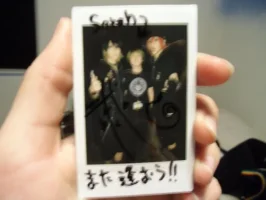
Please help! Thank you!
- 15 Mar 2002
- 16,758
- 2,298
Hi! I would like someone who can read Japanese to please translate what it says at the bottom of this picture. I'll be so grateful, I'm dying of curiousity as to what it says!! I know it says 'mata something ou' but I can't read that kanji. It looks familiar..
Please help! Thank you!
View attachment 11633
また逢おう (mata aou: let's meet again)
You'd probably recognize it if it had been また会おう instead
Elizabeth
先輩
- 22 Apr 2003
- 9,839
- 135
I think the set phrase "Douitashimashite" is fine to cover "I'm glad I could help you. You're welcome. You're most welcome. You're more than welcome. The pleasure is all mine. I thank you." etcI would like to know how to say the following sentence.
"I'm glad I could help."
My Japanese co-worker asked me for some English assistance. I helped him and he said "Thank you for helping me". I want to respond with "I'm glad I could help". Or something close to that.
Thank you ,
- 15 Mar 2002
- 16,758
- 2,298
I think the set phrase "Douitashimashite" is fine to cover "I'm glad I could help you. You're welcome. You're most welcome. You're more than welcome. The pleasure is all mine. I thank you." etc
"Yaku ni tatete ureshii desu" is also kinda-sorta a set phrase and means "I'm glad I could be useful", which is practically the same thing.
Similar threads


- Replies
- 11
- Views
- 115K